
In This Guide
- Why Washington Is a Solid Geothermal State
- Seattle vs. Spokane: Climate Demand Across the State
- Washington's Geology: What It Means for Your Loop Field
- Regional Cost Table: 5 Washington Markets
- Incentives: Federal Credit Status and the No-State-Income-Tax Reality
- Utility Rebates: PSE, Seattle City Light, Avista & PUDs
- Case Studies: Two Real Washington Scenarios
- Month-by-Month Energy Profile: What Geothermal Saves Seasonally
- Washington's Low Electricity Rates: The Hidden Advantage
- Open-Loop Assessment for Washington
- CETA and the Clean Energy Future
- Permits: What You Actually Need
- How to Apply for Your Utility Rebate (Step by Step)
- Financing Your System
- Finding a Qualified Installer in Washington
- Washington vs. Neighboring States
- Frequently Asked Questions
- The Bottom Line for Washington Homeowners
📊 Washington by the Numbers
Washington doesn't follow a neat script when it comes to geothermal energy. It's a state of two climates, wildly different geology on either side of the Cascades, and an energy landscape shaped by decades of cheap hydropower — at 13.11¢/kWh, Washington's residential rates run 27% below the national average of roughly 17.92¢. That background matters more than most people realize when you're evaluating whether a ground-source heat pump makes sense for your home.
Here's the honest short version: Washington is a genuinely good state for geothermal heat pumps, but the reasons depend entirely on what you're replacing. If you're on electric resistance baseboard heat or propane, geothermal can be an excellent investment. If you're on cheap natural gas with an efficient furnace, the pure financial math is weak — and we'll tell you exactly why rather than hand-wave it away.
This guide covers every Washington market: from Seattle urban lots to Kitsap Peninsula suburbs, Whidbey Island propane homes, Spokane gas customers, and Olympic Peninsula rural properties. We'll give you real numbers, honest payback estimates, and the specific steps to access utility rebates and find qualified installers.
If you're new to how ground-source systems work, take a few minutes with our complete guide to how geothermal heat pumps work before reading on.
Ready to Get Real Numbers for Your Home?
Get 3 quotes from IGSHPA-certified Washington installers and compare loop designs, equipment specs, and rebate-filing assistance. Takes about 10 minutes.
Get 3 Free Quotes →Why Washington Is a Solid Geothermal State
The case for geothermal in Washington comes down to four things working together:
- Real heating loads. Seattle's mild reputation is partly earned and partly myth. The city averages roughly 4,800 heating degree days per year — modest by national standards, but still a heating-dominated climate. Cross the Cascades to Spokane and you're at around 6,800 HDD — solidly cold-winter territory comparable to Boise or Missoula.
- Favorable geology in key population centers. The Puget Lowland's glacial soils are among the more cooperative in the country for ground loop installations, particularly horizontal systems on larger lots. Western Washington installers deal with these soils every day and have the local experience to price accurately.
- Active utility rebate programs. Washington's major utilities — PSE, Seattle City Light, and Avista — each run energy efficiency programs that can reduce your installed cost by $2,000–$3,500 or more. Dozens of local PUDs run similar programs.
- Among the lowest electricity rates in the country. Cheap electricity is Washington's defining energy characteristic. It narrows the annual savings gap vs. gas, but it makes geothermal one of the least expensive heating systems in the world to operate — a meaningful advantage over a 25-year equipment lifetime.
Washington also has an ambitious clean energy policy trajectory — the Clean Energy Transformation Act (CETA) mandates 100% clean electricity by 2045. As the grid decarbonizes, the emissions case for running an electric heat pump instead of a gas furnace only gets stronger over time.
Seattle vs. Spokane: Climate Demand Across the State
Washington is genuinely two states climatically. The Cascades split the weather in half, and what that means for your geothermal investment depends entirely on which side you're on.
Western Washington: Wet, Mild, Heating-Dominated
Seattle's climate is defined by its marine influence. Winters are gray and damp but rarely brutal — temperatures below 20°F are unusual. With roughly 4,800 heating degree days and only about 700 cooling degree days per year, western Washington is clearly heating-dominated, but not severely so. The ground at 8–10 feet depth stays around 48–54°F year-round west of the Cascades — always a comfortable heat source for your heat pump, even in January.
One trend that's reshaping the economics: increasingly hot summers. The 2021 heat dome brought temperatures over 110°F to the Pacific Northwest — a shock to a region where many homes lack central cooling. A geothermal system delivers both heating and cooling at high efficiency, which is a compelling offer in a market that's rapidly realizing it needs summer cooling capacity. An air-source heat pump gives you this too, but the geothermal version operates more efficiently across the temperature extremes that western WA now sees.
Eastern Washington: Colder Winters, Drier, More Like the Interior West
Spokane sits at around 6,800 heating degree days — closer to Boise or Missoula than to Seattle. Winters are genuinely cold, summers are hot and dry, and the payback math for geothermal looks more like the inland Northwest. If you're in Spokane, Yakima, the Tri-Cities, or Walla Walla, your heating bills are doing real work from November through March, and the efficiency advantage of a ground-source system is substantial — even if the dollar savings are modest because Avista's electricity rates are relatively low too.
Washington's Geology: What It Means for Your Loop Field
Where you live in Washington has a significant effect on loop system type, installed cost, and performance. The state's geological diversity is striking.
The Puget Lowland: Glacial Soils That Cooperate
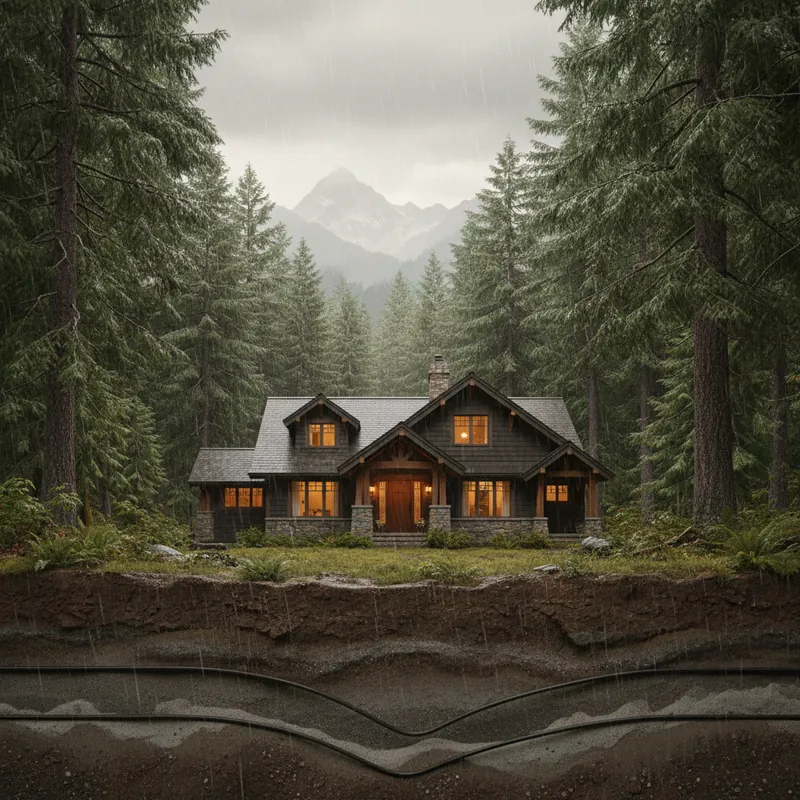
For most of Washington's population — the I-5 corridor from Bellingham through Seattle, Tacoma, and Olympia — the underlying geology is glacial. The last ice sheets left behind layers of sand, gravel, silt, and till. This is generally good news for geothermal:
- Soils are deep enough that you won't hit bedrock at 20 feet (usually)
- Thermal conductivity in saturated glacial soils is decent — 0.9–1.4 BTU/hr·ft·°F is typical, enough to support well-designed vertical or horizontal loops
- Horizontal trenching is practical on suburban lots of a third of an acre or more
- The water table is relatively shallow in much of the lowland, which helps maintain soil moisture and loop performance
One caveat: Puget Lowland glacial deposits sometimes contain large cobbles or boulders left by glaciers. An experienced local driller will know the neighborhood — a driller unfamiliar with your specific area is more likely to be surprised mid-bore, which increases cost.
The Cascade Foothills and Volcanic Terrain
Washington has more active volcanoes than any other state in the lower 48. The Cascade Range's volcanic history means elevated geothermal gradients in certain areas — the ground warms up faster as you drill deeper, which can be favorable for loop performance. But volcanic and igneous rock (basalt, andesite) is hard on drill bits and can make vertical drilling slower and more expensive. If you're in the Cascade foothills or on volcanic terrain, ask your driller specifically about local subsurface conditions before agreeing to a fixed-price quote.
Eastern Washington: Drier Conditions, Columbia Plateau Basalt
East of the Cascades, the Columbia Plateau's basalt underlies much of the region, overlain by loess (windblown silt) in farming country and alluvial deposits in river valleys. Drier soils mean lower thermal conductivity — dry silt doesn't transfer heat as efficiently as saturated glacial soils. This doesn't disqualify eastern Washington for geothermal, but it means loop designs need to account for the drier conditions. More bore footage or larger horizontal fields may be needed to achieve equivalent performance vs. western WA systems. River valley locations (Spokane Valley, Yakima Valley, Tri-Cities) tend to have more cooperative conditions than dry benchland.
Regional Cost Table: 5 Washington Markets
Washington isn't one market. Installation costs, rebate access, and payback timelines vary meaningfully by region. Here's what to expect across five distinct Washington markets — all figures represent 2,000–2,600 sq ft homes as of early 2026:
Note: Rebate amounts are marked [NV] = Needs Verification. Verify current amounts directly with your utility before budgeting. All rebate figures reflect historically documented program levels. Last verified against DSIRE and utility websites March 2026.
| Region | Loop Type | Installed Cost | Utility Rebate | Best Case Payback |
|---|---|---|---|---|
| Seattle Urban Seattle city, dense urban lots |
Vertical, 3–5 bores | $42,000–$58,000 | $2,000–$3,500 [NV] Seattle City Light |
16–24 yr (elec replace) | 45+ yr (gas) |
| Puget Sound Suburbs Bellevue, Kent, Olympia, Kitsap — ⅓+ acre lots |
Horizontal slinky/trench | $26,000–$40,000 | $2,000–$3,500 [NV] PSE or local PUD |
12–18 yr (elec replace) | 35+ yr (gas) |
| Island & Rural West Whidbey, Orcas, Olympic Peninsula, rural propane |
Horizontal preferred; vertical where needed | $28,000–$44,000 | $1,500–$3,000 [NV] PSE or PUD varies |
9–14 yr (propane) | 14–20 yr (elec) |
| Spokane Metro South Hill, Valley, Liberty Lake |
Vertical, 3–4 bores | $32,000–$46,000 | $800–$2,000 [NV] Avista |
12–20 yr (elec replace) | 50+ yr (gas) | 14–22 yr (propane) |
| Cascade Foothills / Mountain Snoqualmie, Leavenworth, Cle Elum, Bellingham area |
Vertical (rocky terrain) | $36,000–$54,000 | PSE or PUD varies [NV] | 10–16 yr (propane) | 18–28 yr (elec) | 40+ yr (gas) |
Incentives: Federal Credit Status and the No-State-Income-Tax Reality
No State Income Tax Credit — By Design
Washington has no state personal income tax. None. That's great for your paycheck, but it also means there's no mechanism for a state-level geothermal income tax credit — the kind of thing you see in Idaho (where a 20% state deduction is available) or in states like New York or Massachusetts. Don't go looking for a Washington state geothermal credit, because it doesn't exist and can't exist under the current tax structure. The good news: Washington's utility programs do a lot of the same work.
Federal Section 25D Credit: Expired After December 31, 2025
This is important for 2026 planning. The federal residential clean energy credit (Section 25D), which covered 30% of geothermal heat pump installation costs with no dollar cap, expired for expenditures made after December 31, 2025 under legislation associated with the "One Big Beautiful Bill."
⚠️ Verify Current Federal Credit Status
If you installed your system before the end of 2025, claim the 30% credit on your 2025 federal return using IRS Form 5695. For 2026 installations, treat 25D as expired unless IRS publishes updated guidance. Always verify at IRS.gov and DSIRE before making financial decisions. Tax law can change. Verified March 2026 against IRS OBBBA guidance page.
A 30% credit on a $35,000 installation was $10,500 — a genuinely transformative incentive. Its absence changes the economics of a 2026 installation significantly. That's not a reason to abandon the project, but it is a reason to sharpen your pencil on utility rebates, financing terms, and long-run operating savings.
Utility Rebates: PSE, Seattle City Light, Avista & PUDs
Washington's major utilities provide rebate programs that partially offset installation costs. Here's what's available and what you need to know about each — with verification notes on current amounts.
Puget Sound Energy (PSE)
Puget Sound Energy is the largest investor-owned utility in Washington by coverage area, serving most Puget Sound suburbs, the Eastside, South Sound (Kent, Auburn, Renton), and the Kitsap Peninsula. PSE runs the most robust residential energy efficiency rebate program of any Washington investor-owned utility.
PSE has historically offered ground-source heat pump rebates in the $2,000–$3,500 range depending on system capacity and current program rules. However, PSE rebate programs are funded: amounts change, eligibility requirements evolve, and funding occasionally runs out. [NEEDS VERIFICATION: Verify current PSE GSHP rebate at pse.com before budgeting this amount — PSE website was temporarily redirecting to outage notices during March 2026 windstorm event; rebate amounts confirmed historically via DSIRE but current 2026 program levels should be verified directly.]
Key things to know about PSE rebates:
- PSE typically requires contractor enrollment in their rebate program — ask your installer if they're enrolled before assuming they can submit rebate paperwork
- Pre-approval before installation may be required — contact PSE before work begins
- PSE has periodically offered on-bill financing options that can make cash-flow-neutral installations possible — ask about this specifically
- Fuel-switching programs (gas-to-electric) may have separate tracks and potentially higher rebates than straight electric efficiency upgrades
Seattle City Light
Seattle City Light is a municipally owned utility serving Seattle proper. SCL has historically supported energy efficiency programs aligned with Seattle's environmental goals, and has offered heat pump incentive programs in recent years. [NEEDS VERIFICATION: Check current SCL ground-source rebate directly at seattle.gov/city-light — program amounts may have changed after Q4 2025 budget cycle.]
Seattle-specific note: The city's urban density means most SCL customer geothermal installations will require vertical boreholes rather than horizontal loops, which pushes installed costs toward the $42,000–$58,000 range. The rebate helps, but Seattle urban installs are among the more expensive Washington scenarios. Run the full numbers before committing.
Avista Utilities
Avista serves eastern Washington — Spokane, the Palouse, and surrounding areas — as well as parts of northern Idaho. Avista has historically offered heat pump incentive programs; ground-source heat pumps have been categorized separately from air-source systems in past programs. [NEEDS VERIFICATION: Verify current Avista GSHP rebate at myavista.com — Avista historically offered $1,000–$2,000 for GSHP installations in some program years, but amounts and eligibility have varied.]
Avista customers should ask about the fuel-switching angle specifically. If you're heating with natural gas and considering conversion to electric geothermal, Avista may have dedicated program tracks for that transition — it's worth asking the energy efficiency line directly.
Public Utility Districts (PUDs)
Washington has dozens of public utility districts serving areas not covered by PSE, SCL, or Avista. Snohomish County PUD, Clark Public Utilities, Puget Sound Energy co-ops, and many others run their own efficiency programs. If you're served by a PUD, check directly with your utility. Many Washington PUDs participate in regional programs and have comparable incentive levels. The DSIRE database (filtered to Washington) is a good starting point, though always verify with your specific PUD before counting on a number.
Case Studies: Two Real Washington Scenarios
Numbers without context don't tell you much. Here are two detailed Washington scenarios — one where geothermal makes strong economic sense, and one where honesty requires a more nuanced answer.
Case Study 1: Whidbey Island — Propane to Geothermal (Strong Case)
Property: 2,400 sq ft ranch home, built 1994, Oak Harbor area, Whidbey Island (PSE service territory)
Current heat source: Propane forced-air furnace + propane water heater
Propane usage: 870 gallons/year for heat and water heating
Annual propane cost: ~$4,100 (island delivery premium at ~$4.70/gallon, March 2026 pricing)
Lot: 1.8 acres, open field — excellent for horizontal loop
Proposed system: 4-ton horizontal closed-loop GSHP (WaterFurnace Series 7), integrated desuperheater for water heating
Installed cost: $34,500 (horizontal loop in favorable glacial soil, includes ductwork modifications)
PSE rebate: ~$2,500 [NEEDS VERIFICATION at pse.com]
Net installed cost: ~$32,000
Annual operating cost after GSHP: ~$1,140
(Electricity: ~8,700 kWh/year × $0.138/kWh PSE rate = $1,200, offset ~$60 for water heating desuperheater savings)
Annual savings: $4,100 − $1,140 = $2,960/year
Simple payback: $32,000 ÷ $2,960 = 10.8 years
25-year lifetime savings (nominal, no escalation): ~$74,000
Carbon reduction: ~9.2 tonnes CO₂e/year eliminated
Bottom line: This is the best-case Washington geothermal scenario. Rural propane homes on the west side of the Cascades — Whidbey, the San Juan Islands, the Olympic Peninsula, Kitsap rural — often have paybacks in the 9–13 year range. The combination of high propane prices, good glacial soil for horizontal loops, and PSE rebate availability makes these properties genuinely compelling candidates.
Case Study 2: South Hill, Spokane — Natural Gas (Honest Assessment)
Property: 2,100 sq ft two-story, built 2001, South Hill neighborhood, Spokane (Avista service territory)
Current heat source: 96% AFUE natural gas furnace, 11 years old
Gas heating cost: ~$950/year (850 therms × ~$1.12/therm, Avista residential rate)
Lot: 8,500 sq ft suburban lot — too small for horizontal, vertical required
Proposed system: 3.5-ton vertical closed-loop GSHP (ClimateMaster Trilogy 45), 3 bores at 240 ft
Installed cost: $39,500 (vertical drilling in mixed basalt/loess)
Avista rebate: ~$1,200 [NEEDS VERIFICATION at myavista.com]
Net installed cost: ~$38,300
Annual operating cost after GSHP: ~$720
(Electricity: ~6,800 kWh/year × $0.106/kWh Avista WA rate = $721)
Annual savings: $950 − $720 = $230/year
Simple payback: $38,300 ÷ $230 = ~166 years (not financially viable on pure ROI)
Bottom line: This is the honest Washington gas story. Washington gas is cheap. Avista's electricity rates are also low. When you're replacing efficient gas heat, the efficiency advantage of geothermal translates to a modest absolute dollar saving per year — not enough to justify $38,000+ in upfront cost on financial merits alone.
When does this scenario make sense anyway? If you're adding cooling (Spokane needs AC — summers are hot), if you're replacing an aging furnace and AC system where the incremental cost over new conventional HVAC is the relevant comparison, or if you're motivated by long-run fuel price independence and grid emissions reduction. The incremental comparison (geothermal vs. new conventional gas furnace + AC) might show $10,000–$15,000 incremental cost with $400–$600/year in combined heating + cooling savings — an 18–35 year payback. Still long, but more honest than pretending geothermal magically pencils on pure economics.
Month-by-Month Energy Profile: What Geothermal Saves Seasonally
Washington's geothermal economics aren't spread evenly through the year. Here's how savings accumulate month by month for a typical Puget Sound suburban home replacing electric resistance baseboard heat (a 2,200 sq ft home in Thurston County, PSE service territory):
| Month | Electric Heat Cost (Before) | GSHP Cost (After) | Monthly Savings | Notes |
|---|---|---|---|---|
| January | $220 | $65 | $155 | Peak heating month, 3.4x efficiency COP |
| February | $195 | $58 | $137 | Cold, wet Pacific weather |
| March | $145 | $43 | $102 | Transitional heating |
| April | $80 | $24 | $56 | Light heating only |
| May | $40 | $12 | $28 | Minimal conditioning |
| June | $15 | $8 | $7 | Cooling mode begins; both systems minimal |
| July | $0 | $28 | −$28 | GSHP provides cooling (baseboard had none); new service value |
| August | $0 | $32 | −$32 | Peak cooling — but you now have AC for the first time |
| September | $0 | $10 | −$10 | Light cooling tail |
| October | $75 | $22 | $53 | Heating season begins |
| November | $155 | $46 | $109 | Wet, cold Pacific NW month |
| December | $200 | $59 | $141 | Holiday cold snap common |
| ANNUAL TOTAL | $1,125 (heat only) | $407 (heat + cooling) | $718 net savings | + You now have air conditioning |
Note: July–September costs represent new cooling service the homeowner didn't have before. A more complete comparison would price out what a separate mini-split or window AC installation would cost — typically $3,000–$8,000 for the home, annualized over its life. When that's factored in, geothermal's full-service value is meaningfully higher than these numbers suggest.
Washington's Low Electricity Rates: The Hidden Advantage
Here's something that surprises people when they start running geothermal numbers in Washington. The state's electricity rates — around 13.11¢/kWh average, compared to a national average in the high teens — seem like they'd make geothermal less attractive. If electricity is cheap, the efficiency premium of geothermal saves less money per year, right?
That's partially true. But it misses the bigger picture.
Low Rates Mean Low Operating Costs
A geothermal heat pump in Washington costs very little to run. That's not just about the efficiency multiplier — it's about the absolute dollar cost of the electricity you do use. A system pulling 3 kWh of input to deliver 10+ kWh of heat costs very little per unit of delivered warmth when electricity is at 13 cents — far less than the same system costs to run in California (at 30¢+) or Massachusetts (at 29¢+).
The practical benefit: your geothermal system is resilient to normal seasonal energy cost volatility. Even in a high-billing month, the absolute cost is low. This is part of why whole-system economics — heating and cooling from one efficient unit at one low electricity rate — look compelling over a 25-year horizon.
Rate Trajectory and Hydropower Risk
Washington's electricity rates are low largely because of the state's enormous hydroelectric infrastructure — the Columbia River system and its dams. That resource is finite. As the state adds electricity demand (EVs, heat pumps, data centers, AI computing facilities), and as climate variability affects reservoir levels (drier snowpack years reduce hydro output), there's legitimate reason to expect electricity prices to rise over the coming decades — though timing and magnitude are uncertain.
A geothermal system with a 25-year equipment life locks in high efficiency regardless of what electricity costs in 2040. If rates rise, your efficient system becomes proportionally more valuable.
Open-Loop Assessment for Washington
Open-loop geothermal systems — which pump groundwater through the heat pump and discharge it — can offer higher efficiency and lower installed cost than closed-loop systems in the right conditions. Washington has some areas where this is viable. Here's what you need to know.
Where Open-Loop Is Viable
Open-loop works best where you have:
- A reliable, high-yield aquifer (minimum 2–5 gallons per minute per ton of system capacity as a rough starting point)
- Good water quality (low mineral content, no significant iron or manganese that would foul heat exchangers)
- Space for a return well located downflow from the supply well
In Washington, promising open-loop areas include: river valleys on both sides of the Cascades (Yakima Valley, Walla Walla, Columbia River lowlands), parts of the Puget Lowland with productive sand-and-gravel aquifers, and some Whatcom County areas near Bellingham. Eastern Washington's basalt aquifer system is extensive and productive in many areas.
Permitting Requirements for Open-Loop in Washington
Open-loop is significantly more complex to permit than closed-loop. You'll need:
- Water right or water right exemption from the Washington Department of Ecology. Washington water rights law is serious — don't assume you can just pump groundwater without verification. Small-volume domestic wells have exemptions, but geothermal pumping volumes may exceed exemption thresholds.
- Well permits for both supply and return (injection) wells.
- Potentially a groundwater discharge permit if the return water's temperature or chemistry meets discharge thresholds — unlikely for standard residential systems but worth confirming.
The permitting process for open-loop can take 3–6 months or more, vs. a few weeks for closed-loop. Most residential Washington installations default to closed-loop for this reason. If you're on a larger property with good aquifer conditions and want to explore open-loop for its efficiency advantage, get an experienced hydrogeologist or well driller involved early — not after you've committed to the project.
CETA and the Clean Energy Future
Washington's Clean Energy Transformation Act (CETA), administered by the Washington State Department of Commerce, sets an unambiguous trajectory:
- 2025: Coal eliminated from the electricity mix ✓
- 2030: Grid must be greenhouse gas neutral
- 2045: 100% clean electricity
What does that mean for a geothermal heat pump owner? Three things. First, as the grid gets cleaner, the lifecycle carbon footprint of running an electric heat pump drops continuously — without any changes to your equipment. A system installed today that's already low-carbon will become near-zero-carbon over its 25-year life. Second, Washington utilities are under regulatory pressure to help customers electrify their heating, which is part of why rebate programs exist and tend to stay funded. Third, the policy direction creates downstream infrastructure benefits — a growing installer network, better training programs, more contractor experience in the field.
CETA doesn't write you a check, but it shapes the operating environment for your investment for the next 25 years. That matters when you're evaluating a long-duration capital expenditure like a ground-source system.
Permits: What You Actually Need
Washington has a defined regulatory structure for geothermal installations. Here's what's involved:
Well Completion Report: Department of Ecology
All boreholes in Washington — including closed-loop geothermal bores — require a well completion report filed with the Washington Department of Ecology by your licensed driller. This isn't a permit you apply for in advance; it's documentation your driller files after the bore is complete. It records depth, geology encountered, grouting, and completion method — all designed to protect groundwater quality.
Your driller must hold a Washington State water well contractor's license (issued by the Department of Ecology). Verify your driller's license before signing a contract — you can look up licensed contractors in the Ecology database. An unlicensed driller can create legal and liability issues you don't want, regardless of how good their work is.
Local Mechanical and Electrical Permits
The heat pump equipment, air handler, and electrical connections require standard city or county building permits. Requirements vary by jurisdiction:
- Seattle, Bellevue, Spokane, and other cities have established permit processes for HVAC installations
- Smaller counties are simpler but still require mechanical and electrical permits
- Ask your installer to confirm what permits are required in your specific jurisdiction before work begins
A reputable installer handles all permits as part of their job scope. Ask to see permit documentation before final payment — it protects you at resale and confirms the work was done to code. If an installer suggests skipping permits to save time or money, walk away immediately.
How to Apply for Your Utility Rebate (Step by Step)
Here's the process for claiming a ground-source heat pump rebate from a Washington utility. This applies to PSE, Seattle City Light, Avista, and most local PUDs — though specific steps vary. Always confirm with your utility before starting.
- Verify your utility and current program. Confirm your utility serves your address and that GSHP rebates are currently available. Don't rely on third-party websites or this guide for current amounts — call your utility or check their website directly.
- Contact your utility before work begins. Most Washington utilities require pre-approval before installation starts. Contacting your utility 4–6 weeks before your planned install date is a safe window. Work that starts before pre-approval may not be eligible.
- Select a utility-enrolled contractor. Ask prospective installers: "Are you enrolled in [utility] rebate programs and can you submit rebate paperwork on my behalf?" Contractor enrollment is often a program requirement, and it signals contractor experience with the rebate process.
- Submit pre-installation documentation. Your contractor or you submits the pre-approval application: project scope, equipment specs (make, model, rated COP/EER), contractor credentials, and permit application copy.
- Complete installation with all permits. All required permits must be pulled and completed. Keep copies of everything — mechanical permits, drilling reports, equipment invoices.
- Submit the rebate application with documentation. After installation: final invoice, equipment specs, permit numbers/copies, and any utility-required inspection confirmation.
- Receive your rebate. Typical processing: 6–10 weeks after a complete application. Follow up at 10 weeks if you haven't heard. Rebates are typically issued as checks or bill credits.
Financing Your System
With the 30% federal credit no longer available for 2026 installations, financing terms matter more than before. The difference between a 3% and an 9% loan on a $35,000 installation is over $8,000 in total interest cost.
Utility On-Bill Financing
PSE and some Washington utilities have offered on-bill financing programs that let you pay for efficiency improvements over time on your utility bill at subsidized rates. When available, these can be compelling: the payment fits within your energy bill, rates are often below market, and the application process is simpler than a bank loan. Check directly with your utility — program availability changes.
HELOC and Home Equity Loans
For homeowners with equity, a home equity line of credit (HELOC) or home equity loan is often the lowest-cost private financing option. Interest may be deductible depending on your situation — consult a tax advisor. Washington's rising home values over the past decade have given many homeowners substantial equity access.
USDA REAP (Rural Properties)
If your property qualifies as rural under USDA definitions — common on the Olympic Peninsula, eastern Washington farming areas, and smaller communities — the USDA Rural Energy for America Program (REAP) offers grants (up to 25%) and guaranteed loans for energy efficiency improvements including geothermal heat pumps. This is primarily for agricultural producers and rural small businesses, but worth exploring if your property fits. Contact your local USDA Rural Development office for current program details.
For a deeper look at all geothermal financing options, see our complete geothermal financing guide.
Finding a Qualified Installer in Washington
The quality of your installer matters more than almost any other single decision in a geothermal project. Washington has a growing geothermal contractor base — here's how to find and evaluate qualified professionals.
IGSHPA Certification: Your Starting Point
The International Ground Source Heat Pump Association (IGSHPA) is the industry's main credentialing body. Their certifications — Certified GeoExchange Designer (CGD) and Accredited Installer — represent trained professionals who've passed industry exams and have documented experience with ground-source systems specifically.
Use IGSHPA's member and business directory to filter for Washington State. Not every good installer has IGSHPA credentials — the certification program is voluntary — but it's a reliable signal of seriousness about the trade. Cross-reference IGSHPA results with contractors who've done documented ground-source work in Washington and Oregon; the Pacific Northwest regional market means many contractors serve both states.
Washington State Contractor Licensing Requirements
Washington requires HVAC contractors to hold a specialty contractor license. The driller doing your borehole work must hold a Washington State water well contractor's license (issued by Ecology). Verify both licenses before contracting. You can look up contractor licenses at the Washington State Department of Labor & Industries website and well contractor licenses through the Department of Ecology's well data system.
Utility Contractor Networks
PSE, Seattle City Light, and Avista may each have contractor enrollment requirements tied to rebate programs. A contractor enrolled in PSE's ground-source heat pump rebate program has at minimum done the paperwork and met PSE's baseline requirements — it's a practical screening signal. Ask any prospective installer: "Are you enrolled in [my utility's] rebate program and familiar with their pre-approval process?"
What to Look for Beyond Credentials
- Experience with Washington-specific drilling conditions — glacial cobbles on the west side, basalt on the east side. Ask how many residential boreholes they've drilled in your county or neighborhood specifically.
- In-house drilling or established drilling partnership — a driller they've worked with on multiple projects is better than someone they hired once. The quality of the loop field determines long-run system performance.
- References from completed Washington projects — ask for at least 2–3 references from installs in similar soil/drilling conditions to your property. Actually call them.
- Written load calculation before proposing equipment size — if an installer quotes you equipment size without doing a Manual J load calculation on your home, the sizing may be off. Oversized or undersized systems cost you money over 25 years.
Questions to Ask Before You Sign
- Do you hold IGSHPA Accredited Installer or Certified GeoExchange Designer certification?
- How many residential geothermal systems have you installed in Washington in the last three years?
- Do you have a Washington State water well contractor's license for your driller?
- Are you enrolled in [my utility's] rebate program and can you handle the rebate paperwork?
- Will you perform a Manual J load calculation to size the system?
- What warranty do you offer on the loop field? On the heat pump equipment?
- Will you pull all required permits (mechanical, electrical, and ensure well completion report is filed)?
Get at least three quotes. Geothermal pricing varies significantly between installers — partly because loop design genuinely differs, and partly because some contractors price aggressively to win bids. A quote substantially lower than others isn't necessarily a good deal; understand what's different before choosing on price alone. See our geothermal installation cost guide for a detailed breakdown of what drives pricing.
Washington vs. Neighboring States: How Does WA Compare?
If you're weighing a move, or just curious how Washington's geothermal economics stack up against neighboring states, here's a quick comparison:
| State | Elec Rate | State Credit | Best Payback Scenario | WA vs. This State |
|---|---|---|---|---|
| Washington | 13.11¢ | None (no income tax) | 9–14 yr (propane/island) | — |
| Oregon | ~12.8¢ | None state-specific | 10–15 yr (propane/rural) | Very similar economics to WA; Portland gas comparable to Seattle |
| Idaho | ~10.8¢ | Yes — 20% state deduction | 8–12 yr (propane/rural) | Idaho has a better state incentive. WA has lower electricity rates on average but no state credit. Very competitive states overall |
| Montana | ~11.2¢ | Historical credit repealed | 9–13 yr (propane) | WA has stronger utility rebate programs; MT has colder climate (larger heating savings) |
| California | ~30¢+ | None specific to geo | 7–12 yr (gas cooling-dominated) | CA's high electricity rates make geothermal save far more per year in absolute $. WA's low rates mean smaller annual savings but much lower operating costs |
The bottom line on comparisons: Washington and Oregon are very similar geothermal markets. Idaho is stronger on state incentives. Montana offers larger heating savings due to colder winters. California has higher dollar savings per year due to extreme electricity rates, but at the cost of a very expensive grid to operate on for everything else.
If you're considering a home in Washington specifically for geothermal viability, the Pacific Northwest as a whole is a solid region — just understand that the economics are driven primarily by utility rebates and what fuel you're replacing, not state tax incentives.
Frequently Asked Questions
Does Washington State have a geothermal heat pump tax credit?
No. Washington has no state personal income tax, which means there's no mechanism for a state geothermal tax credit. The primary incentives are utility rebate programs from PSE, Seattle City Light, Avista, and local public utility districts.
What happened to the federal 30% geothermal tax credit?
The federal Section 25D credit expired for expenditures made after December 31, 2025 under the "One Big Beautiful Bill" legislation. If you installed before end of 2025, claim the credit on your 2025 return (IRS Form 5695). For 2026 installations, verify current status at IRS.gov before assuming any credit is available.
How much does Puget Sound Energy rebate for geothermal?
PSE has historically offered $2,000–$3,500 for ground-source heat pump installations depending on system capacity and current program rules. Always verify directly at pse.com or by calling PSE's energy efficiency line before budgeting this amount — programs are funded and amounts change. Verified as historically available via DSIRE; current 2026 amounts require direct verification.
Is geothermal worth it in Seattle's mild climate?
Yes, in specific scenarios. The strongest case: replacing electric resistance baseboard heat (very common in western WA), or replacing propane on island/rural properties where delivered fuel costs are high. The weakest case: replacing an efficient modern gas furnace, where pure financial payback can stretch 40+ years. New construction is often a good case — the incremental cost over conventional HVAC is much smaller than a retrofit.
What type of loop system works best in western Washington?
Horizontal slinky or trenched loops work well in the Puget Lowland's glacial soils if you have adequate lot space (roughly a third of an acre of open area for a typical residential system). Seattle urban lots almost always require vertical boreholes. Horizontal systems typically cost $5,000–$10,000 less than vertical systems of equivalent capacity.
Can I install an open-loop geothermal system in Washington?
Open-loop is viable in some Washington areas with productive aquifers and good water quality — particularly river valleys and parts of the Puget Lowland. However, the permitting process is complex: water rights, well permits, and potentially discharge permits from the Department of Ecology. Most residential installations use closed-loop systems due to simpler permitting. Discuss with your installer and consult Ecology before pursuing open-loop.
How does Washington's low electricity rate affect geothermal ROI?
WA's ~13.11¢/kWh rate (27% below national average) means geothermal costs less to operate than in high-rate states — but also generates fewer annual savings dollars when replacing gas. The best economic cases are replacing electric resistance heat or propane. The gas-replacement case is weaker in WA than in high-rate states. See the case studies section for real numbers.
What permits do I need for geothermal in Washington?
For closed-loop systems: (1) a well completion report filed with the Department of Ecology by your licensed driller, (2) a mechanical permit from your local building department, and (3) an electrical permit. A reputable installer handles all of these. Open-loop systems require additional water rights and well permits — see the open-loop section above.
How long does geothermal installation take in Washington?
Loop field work (drilling or trenching): 3–7 days. Equipment installation and commissioning: 1–2 days. From contract to running system: 4–12 weeks, primarily due to utility rebate pre-approval timelines and permit processing. Plan 3–4 months from initial inquiry to completion for a comfortable schedule.
Get Quotes from Washington GSHP Installers
Compare designs and pricing from IGSHPA-certified contractors in the Puget Sound region, Spokane, and across Washington State. Free, no obligation.
Get 3 Free Quotes →The Bottom Line for Washington Homeowners
Washington's geothermal picture in 2026 is nuanced — and we've tried to give you the honest version rather than the easy sell.
The 30% federal credit has expired. There's no state income tax credit. Utility rebates from PSE, Seattle City Light, Avista, and local PUDs are real but variable — you need to verify current amounts directly, not rely on this guide or any third-party source for specific dollar figures.
But here's what's genuinely compelling about geothermal in Washington:
- If you're on electric resistance heat (baseboard, electric furnace) — this is among the strongest geothermal upgrade cases in the country. Washington's 57.7% electric heating rate means a huge share of homes have this exact scenario. A 3x–4x efficiency improvement at Washington's already-low electricity rates produces meaningful savings, and you get AC as part of the deal in a region that suddenly needs it.
- If you're on propane — especially on the west side islands, Olympic Peninsula, or Kitsap rural areas — the economics are often excellent. High delivered fuel costs, good glacial soil for horizontal loops, PSE rebates, and island/peninsula properties that plan to stay long-term make for 9–14 year payback scenarios.
- New construction in the Puget Sound suburbs — designing geothermal in from day one means the incremental cost is far smaller than a retrofit, and you lock in efficient, clean heating for the full life of the building.
- Spokane-area homes on electric or propane — colder winters mean bigger heating loads and more efficiency value. The honest caveat is that Avista's already-low electricity rates limit the dollar gap vs. gas, but the efficiency and long-run case is real.
The honest "maybe not yet" scenarios: anyone currently on cheap natural gas with a relatively new efficient furnace, renters, and homeowners planning to sell within 5 years.
Washington's electricity grid is on a mandated path to 100% clean energy by 2045. A geothermal system installed today will operate on an increasingly clean, hydropower-dominated grid for its entire 25-year life. The environmental case compounds continuously. The economic case requires matching system type and fuel replacement scenario carefully — which is why getting accurate quotes from qualified installers, not ballpark guesses from websites, is the essential next step.
Start by understanding how the technology works and what installation actually costs. Then use our payback calculator to run your specific scenario numbers. Then get three qualified Washington installers to assess your property and provide real design proposals. The ground doesn't lie — but it does require someone who knows how to read it.
Considering neighboring states? See our Oregon geothermal guide, Idaho geothermal guide, and Alaska geothermal guide for comparison. For the financial case vs. propane specifically, read our geothermal vs. propane deep dive.
Washington Geothermal: The Honest Bottom Line
Washington's ~13.11¢/kWh electricity rate is 27% below the national average, creating low operating costs but modest annual savings vs. gas. Best candidates: electric resistance homes (57.7% of WA housing), rural propane properties on PSE territory, and new construction. Utility rebates from PSE/SCL/Avista/PUDs partially offset the loss of the expired 30% federal credit. The state's CETA mandate makes Washington's grid cleaner every year — a long-run tailwind for geothermal.
Sources
- U.S. EIA — Electricity Monthly, State Retail Prices (Washington avg. 13.11¢/kWh, 2025)
- NOAA/NCEI — U.S. Climate Normals (Seattle ~4,800 HDD, Spokane ~6,800 HDD; WA ground temp est. 52.3°F)
- U.S. Census ACS 2023 — Washington State housing units (3,020,558), heating fuel (57.7% electric heat)
- IRS — "Instructions for Form 5695" (Residential Energy Credits, 2025)
- IRS — "One Big Beautiful Bill Provisions" (Section 25D credit expiration)
- DSIRE — Database of State Incentives for Renewables & Efficiency (WA programs; verified March 2026)
- Puget Sound Energy — Rebates and Energy Efficiency Programs [NEEDS VERIFICATION: current 2026 GSHP rebate amount; PSE website under windstorm outage response March 14, 2026]
- Seattle City Light — Rebates and Programs [NEEDS VERIFICATION: current GSHP rebate]
- Avista Utilities — Energy Efficiency Rebates [NEEDS VERIFICATION: current GSHP rebate amount]
- Washington State Legislature — Clean Energy Transformation Act (SB 5116, 2019)
- Washington State Department of Commerce — Energy Programs
- Washington State Department of Ecology — Water Resources, Well Permitting, and Groundwater
- U.S. DOE — "Geothermal Heat Pumps" (payback range, efficiency data)
- IGSHPA — Member Directory (Washington State certified professionals)
- USDA Rural Development — Rural Energy for America Program (REAP)
- Washington Department of Labor & Industries — Contractor License Verification (HVAC specialty contractor requirements)