
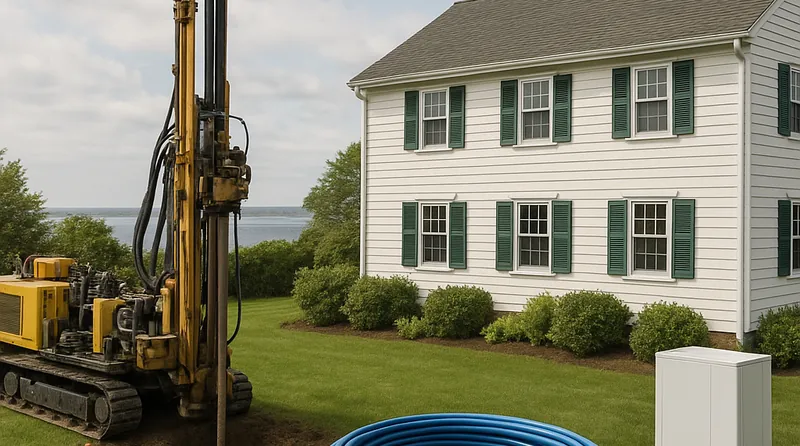
The Rhode Island Paradox
Rhode Island has a problem: residential electricity priced at roughly 29.06¢/kWh — among the highest in the country, tied with Connecticut. That number makes homeowners hesitate about electric heating of any kind.
But for the ~40% of Rhode Island households still on heating oil, the argument runs the other way. When a geothermal heat pump extracts 3.5–4 units of heat for every 1 unit of electricity consumed, 29¢/kWh electricity beating $4.00/gallon oil isn't a paradox. It's just arithmetic.
Rhode Island also has a geological advantage most people don't know about: ground temperatures average ~53°F year-round — warmer than Maine (45°F), New Hampshire (48°F), or Vermont (47°F). Every extra degree means better heat pump efficiency in heating mode. The ground is doing more of the work.
The paradox cuts both ways, though. Natural gas customers in Providence face a different calculus — at 29¢/kWh, geothermal operating costs are actually higher than cheap gas for heating alone. This guide will be direct about who should and shouldn't invest in Rhode Island.
Quick Verdict: Should You Go Geothermal in Rhode Island?
| Your Situation | Verdict | Estimated Payback | Notes |
|---|---|---|---|
| Oil heat — Providence/Cranston/Warwick | ✅ Strong yes | 7–9 years | Core RI market; 40% of homes |
| Oil heat + RI Energy rebate stacking | ✅ Strong yes | 6–8 years | Verify current rebate with rienergy.com |
| Electric resistance heat | ✅ Strongest savings | 4–5 years | 29¢ cuts deepest when you're already electric |
| Propane — South County, rural RI | ✅ Yes | 8–11 years | Sandy soils favor horizontal loops |
| New construction — anywhere in RI | ✅ Strong yes | 4–6 years incremental | Loop during site work is transformative |
| Vacation rental — Block Island, Narragansett | ✅ Yes | 6–9 years | Eco-premium + propane elimination |
| Aging heat pump / AC replacement | ⚠️ Evaluate at replacement | 9–14 years | Compare to standard heat pump cost |
| Natural gas — Providence metro | ❌ Not on payback | 20–30+ years | Honest: 29¢/kWh makes geo more expensive than gas |
IGSHPA-certified installers serving RI. CT and MA contractors regularly work in Rhode Island — cast a wide net.
Get Free Quotes → Free · No obligationRhode Island by the Numbers
| Area | HDD | CDD | Ground Temp (°F) | Primary Heating Fuel |
|---|---|---|---|---|
| Providence Metro | 5,800 | 550 | 52–54 | Oil / Natural gas |
| Warwick / Cranston | 5,700 | 550 | 52–54 | Oil / Gas |
| Newport / Aquidneck Island | 5,400 | 500 | 53–55 | Oil / Gas |
| South County (Narragansett, Westerly) | 5,500 | 500 | 53–55 | Oil / Propane |
| Woonsocket / Northern RI | 6,100 | 500 | 51–53 | Oil / Gas |
| Block Island | 5,200 | 400 | 53–55 | Oil / Propane / Electric |
Key stats: 29.06¢/kWh electricity (EIA 2024). ~38–42% of homes on heating oil. Grid CO₂: 541 lbs/MWh (rank 40 — cleaner than New England average thanks to offshore wind buildout). 100% clean electricity target by 2033. Primary utility: Rhode Island Energy (formerly National Grid).
Why 53°F ground temp matters: RI's southerly latitude and maritime climate — warmed by Narragansett Bay and the Atlantic — push ground temps 8°F warmer than northern Maine. Every degree warmer means better COP in heating mode. A geothermal system in Cranston consistently outperforms the same unit in Bangor.
Cost & ROI by Fuel Type
Regional Installation Costs
| Region | 3-Ton Vertical (Gross) | After 30% ITC | Horizontal Option | Contractor Access |
|---|---|---|---|---|
| Providence Metro / Cranston | $21,000–$30,000 | $14,700–$21,000 | Limited (small lots) | Good — MA/CT firms serve RI |
| Warwick / East Greenwich | $20,000–$28,000 | $14,000–$19,600 | $15,000–$22,000 (where land allows) | Good |
| Newport / Aquidneck Island | $22,000–$32,000 | $15,400–$22,400 | Very limited | Moderate — logistics |
| South County / Narragansett | $19,000–$27,000 | $13,300–$18,900 | $14,000–$21,000 (sandy soils) | Moderate |
| Block Island | $25,000–$38,000 | $17,500–$26,600 | $18,000–$28,000 | Limited — 15–25% island premium |
Scenario 1: Heating Oil (40% of RI Homes) — Core Market
Oil at $4.00/gal delivers heat at ~$33.22/MMBTU. Geothermal at 29.06¢/kWh and COP 3.6 delivers at ~$23.68/MMBTU. The per-unit cost of electricity is high; the per-unit cost of heat delivered through a ground-source heat pump is not.
- Annual oil cost (1,800 sq ft, ~65 MMBTU): ~$2,160/year
- Geothermal annual cost: ~$1,540/year
- Heating savings: ~$620/year + cooling savings $200–$400/year
- Total savings: ~$820–$1,020/year
- If oil rises to $4.50/gal: savings grow to ~$1,100–$1,300/year
- Payback (net ~$15,400): 7–9 years at $4.00 oil / 6–7 years at $4.50
Scenario 2: Propane (South County, Rural RI)
- Annual propane (650 gal × $3.40): ~$2,210/year
- Geothermal annual cost: ~$1,540/year
- Annual savings: ~$870–$1,070/year
- Payback (net ~$14,700): 8–11 years
Scenario 3: Electric Resistance — Strongest Per-kWh Savings
- Annual resistance cost: ~$4,200–$5,500/year (at 29¢/kWh — devastating)
- Geothermal annual cost: ~$1,200–$1,540/year (COP 3.6 cuts electricity 72%)
- Annual savings: ~$3,000–$3,960/year
- Payback (net ~$15,400): 4–5 years — fastest payback in New England
At 29¢/kWh, electric resistance is the most expensive heat possible. The COP multiplier from geothermal produces the largest savings gap of any fuel conversion in RI.
Scenario 4: Natural Gas (Providence Metro) — Honest Assessment
- Annual gas cost: ~$820/year
- Geothermal annual cost: ~$1,540/year (yes, MORE expensive for heating alone at 29¢)
- Cooling savings: ~$200–$400/year
- Net effect: marginal to negative on operating cost
- Payback: 20–30+ years. Be direct with yourself.
RI's 29¢/kWh rate makes geothermal operating costs higher than gas for heating. This is the one scenario where high electricity rates genuinely hurt. The case only works at system replacement time, new construction, or if you strongly value energy independence.
25-Year Total Cost of Ownership
| System | Net Install | 25-yr Operating | 25-yr Total |
|---|---|---|---|
| Geothermal (after ITC) | $14,000–$21,000 | $35,000–$38,500 | $49,000–$59,500 |
| Oil boiler + AC | $5,000–$8,000 | $62,000–$80,000 | $67,000–$88,000 |
| Propane furnace + AC | $4,500–$7,000 | $55,250–$67,500 | $59,750–$74,500 |
| Gas furnace + AC | $5,000–$8,000 | $25,000–$30,000 | $30,000–$38,000 |
Geothermal's 25-year advantage vs. oil: $18,000–$28,500 savings, plus insulation against oil price volatility. Gas customers have a lower 25-year total — the honest math.
Case Study 1: Cranston Oil-Heated Cape
The property: 1,900 sq ft cape cod in Cranston (Providence County). Built 1955. Oil boiler with hot-water baseboard radiators + window AC units. Glacial till over granite bedrock.
The challenge: Converting hot-water heat to forced air requires ductwork — significant cost. But the savings math still works for an oil home.
| Cost Item | Amount |
|---|---|
| 3-ton WaterFurnace unit + air handler | $8,500 |
| Ductwork installation (no existing ducts) | $10,000 |
| Vertical loop drilling (3 × 280 ft bores in glacial till) | $11,500 |
| Loop materials + connections | $3,500 |
| Permits + electrical upgrade | $1,500 |
| Total installed | $35,000 |
| Federal ITC (30%) | -$10,500 |
| RI Energy rebate [NV — verify current] | -$800 |
| Net cost | $23,700 |
| Vs. replacing oil boiler + adding central AC | -$11,500 baseline |
| Incremental cost | $12,200 |
Before: Oil heating $2,788/year + window AC $380/year = $3,168/year After geothermal: Heating + cooling $1,580/year Annual savings: $1,588/year
- Standalone payback: 14.9 years (full $23,700 net)
- Incremental payback: 7.7 years (vs. replacing boiler + adding AC)
The ductwork cost makes this a higher investment — but the long-term economics are sound. If the oil boiler was nearing end of life anyway, the incremental cost comparison is the right one.
Case Study 2: Narragansett Beach Rental
The property: 2,200 sq ft ranch in Narragansett (Washington County). Built 1978. Year-round rental. Propane furnace + central AC. Sandy soil. 0.65-acre lot — excellent for horizontal loop.
| Cost Item | Amount |
|---|---|
| 3-ton ClimateMaster unit | $7,500 |
| Horizontal slinky trenching (2 trenches × 200 ft, sandy soil) | $6,000 |
| Loop materials (HDPE slinky coils + fittings) | $3,500 |
| Installation + permits | $2,500 |
| Total installed | $19,500 |
| Federal ITC (30%) | -$5,850 |
| RI Energy rebate [NV] | -$800 |
| Net cost | $12,850 |
Before: Propane 720 gal × $3.45 = $2,484 + AC $520 = $3,004/year After geothermal: $1,480/year (heavy cooling load at coastal location) Annual savings: $1,524/year
- Standalone payback: 8.4 years
- Incremental payback: 7.1 years (vs. replacing propane furnace + AC)
Horizontal loop in sandy South County soil — no rock, fast trenching, lower cost. Year-round rentals earn faster ROI than seasonal properties. "Geothermal heated and cooled — net zero ambition" on VRBO listings earns measurable premium in RI's eco-conscious coastal market.
Case Study 3: East Greenwich New Construction + Solar
The property: 2,600 sq ft new construction in East Greenwich (Kent County). Planned development. 0.35-acre lot with room for horizontal loop installation during site work. Builder coordinating with HVAC contractor for loop-first approach. 8 kW rooftop solar included in plan.
Why new construction changes the math in RI: The horizontal loop goes in before the house — same excavation equipment, coordinated timing. The ductwork is designed from the start. No retrofitting penalty.
| Cost Comparison | Geothermal | Standard Gas Hybrid HP | Incremental Geo Cost |
|---|---|---|---|
| HVAC equipment + air handler | $9,500 | $7,000 | $2,500 |
| Ground loop (horizontal slinky during site work) | $7,000 | — | $7,000 |
| Ductwork (new build — same either way) | $8,000 | $8,000 | $0 |
| Installation labor | $3,500 | $3,500 | $0 |
| Total HVAC cost | $28,000 | $18,500 | $9,500 |
| Federal ITC (30% of geo total) | -$8,400 | — | -$8,400 |
| Net cost | $19,600 | $18,500 | $1,100 |
After ITC, the incremental cost of geothermal over a gas hybrid heat pump is only $1,100.
Annual operating costs (gas heat pump vs. geothermal):
- Gas hybrid heat pump: ~$1,480/year (gas heat + electric cooling)
- Geothermal: ~$1,620/year heating only (29¢ bites here vs. gas)
- Without solar: Geothermal slightly HIGHER — $140/year more than gas hybrid
With 8 kW solar ($28,000 → $19,600 net after ITC):
- Solar offsets ~85% of geothermal electricity
- Effective annual cost: ~$240/year (near-zero energy)
- Vs. gas hybrid: ~$1,480/year (solar barely helps gas heating)
- Annual savings with solar: ~$1,240/year
- Combined incremental payback (geo + solar vs. gas hybrid + solar): 16.3 years total investment / but geo alone pays back in 7.8 years on the operating cost gap once solar is credited
The real case for RI new construction geo: At $1,100 incremental net cost, you're buying a system that will outperform anything else once solar is on the roof. The combination locks in near-zero energy costs for 25+ years against a state with the highest electricity rates in New England. The ROI on the combined investment is compelling.
Note: Unlike propane or oil states where geo ROI is obvious, Rhode Island's high electricity rate means the business case is tighter. This is real. But new construction + solar is where the math unambiguously works.
Month-by-Month Energy Profile
Cranston oil-heated cape (1,900 sq ft) — before and after geothermal:
| Month | Old Oil + AC | Geothermal | Monthly Savings | Notes |
|---|---|---|---|---|
| January | $445 | $250 | $195 | Peak heating — COP 3.6 wins vs. $4.10 oil |
| February | $410 | $235 | $175 | Cold month; steady savings |
| March | $290 | $175 | $115 | Heating tails off late March |
| April | $120 | $80 | $40 | Shoulder season |
| May | $55 | $45 | $10 | Minimal load; desuperheater saves $10–$15 DHW |
| June | $95 | $70 | $25 | Cooling starts; COP 5.0 vs. window AC EER 8 |
| July | $130 | $85 | $45 | Peak cooling; humidity control advantage |
| August | $120 | $80 | $40 | Summer peak; desuperheater maxes out |
| September | $65 | $50 | $15 | Cooling fades; DHW desuperheater |
| October | $165 | $100 | $65 | Heating ramp-up; oil delivery month |
| November | $350 | $195 | $155 | Heavy heating; oil vs. stable geo cost |
| December | $420 | $240 | $180 | Near-peak; oil price volatility risk |
| Annual | $2,665 | $1,605 | $1,060 |
Key observations:
- Winter savings are real but moderate — 29¢/kWh makes geo operating costs higher than in cheap-electricity states. January geo costs $250 here vs. ~$110 in Iowa at 11¢. But $250 still beats $445 in oil.
- Summer savings are smaller — 545 CDD in Narragansett is real, but the cooling savings (geo vs. window AC) are genuinely valuable comfort and cost improvement.
- Desuperheater adds ~$80–$120/year in water heating savings not captured in the table.
- Oil price volatility is the hidden risk — if oil reaches $4.50+, geothermal payback shortens dramatically. Lock in operating cost with a long-term view.
Rhode Island's Geology & Drilling Conditions
| Region | Primary Rock/Soil Type | Thermal Conductivity (BTU/hr·ft·°F) | Typical Bore Depth | Drilling Difficulty | Cost Per Bore Foot | Special Considerations |
|---|---|---|---|---|---|---|
| Providence Metro / Cranston | Glacial till over granite/schist bedrock | 1.2–1.6 | 200–320 ft | Moderate | $20–$32 | Bedrock at 50–100ft; till is drill-friendly; urban utility conflicts add cost |
| Warwick / East Greenwich | Glacial outwash, sandy till, bedrock at depth | 1.1–1.5 | 200–300 ft | Easy-Moderate | $18–$28 | Good drilling conditions; larger lots in suburbs allow horizontal where preferred |
| Newport / Aquidneck Island | Shallow bedrock, schist/granite, thin till | 1.3–1.7 | 180–280 ft | Moderate-Hard | $22–$35 | Bedrock close to surface = expensive; high thermal conductivity partially offsets |
| South County / Narragansett | Sandy coastal plain, glacial outwash | 0.8–1.2 | 160–260 ft | Easy | $16–$25 | Best horizontal loop territory in RI; sandy = fast, cheap trenching |
| Westerly / Hopkinton | Granite bedrock, thin till, sandy lowlands | 1.3–1.8 | 180–280 ft | Moderate-Hard | $22–$35 | Granite is hardest drilling but highest thermal conductivity; lowland sandy areas viable for horizontal |
| Woonsocket / Northern RI | Glacial till, river valley sediments | 1.1–1.5 | 200–320 ft | Moderate | $20–$30 | Good conditions; historic Blackstone Valley industrial sites require water quality testing for open-loop |
| Block Island | Sandy glacial moraine, no deep bedrock | 0.8–1.1 | 120–200 ft (no bedrock) | Easy | $15–$22 | No bedrock = horizontal preferred; logistics premium 15–25%; sandy soil = fast installation once on island |
What thermal conductivity means for RI: Higher conductivity rock (Westerly granite at 1.8) means the ground loop exchanges heat with the earth faster — you need fewer bore feet per ton. Lower conductivity sand (South County at 0.9) means you need more linear feet, but sand trenches easily and cheaply. The effective cost per ton of installed capacity can be similar between rock and sand despite the difference in footage.
The granite question: Newport and Westerly homeowners sometimes assume granite is a problem. It's not — it's actually an advantage in thermal conductivity. The drilling is harder (more expensive per foot), but you need fewer feet. Get an accurate site assessment rather than assuming granite makes geothermal impossible.
Open-Loop System Assessment
| Area | Open-Loop Viability | DEM Requirements | Notes |
|---|---|---|---|
| South County / Narragansett | ✅ Often viable | DEM OWTS permit + flow test | Sandy coastal aquifer with good yields; cleanest water in RI; best open-loop territory |
| East Bay / Barrington | ✅ Site-specific | DEM review | Some coastal aquifer areas viable; saltwater intrusion risk near tidal zones |
| Providence Metro | ⚠️ Limited | Full DEM review | Urban contamination risk; small lots limit discharge options; closed-loop standard |
| Newport / Aquidneck | ⚠️ Site-specific | DEM + CRMC review | Small lots; saltwater at depth on coastal sides; closed-loop preferred |
| Northern RI / Blackstone Valley | ⚠️ Water quality testing required | DEM + water quality analysis | Industrial legacy sites; test before committing to open-loop |
| Block Island | ⚠️ Limited | DEM + careful siting | Saltwater lens at depth; freshwater lens thin; closed-loop or horizontal preferred |
Rhode Island DEM requires notification and permit for any water well — including closed-loop ground heat exchangers. Your licensed driller files this. Typical processing: 2–4 weeks. Open-loop requires additional review and potentially a CRMC assent if near tidal waters.
Loop Type Cost Comparison
| Loop Type | Typical RI Cost (3-ton) | Land Required | Best Suited For | RI Notes |
|---|---|---|---|---|
| Vertical closed-loop | $19,000–$30,000 | Small — 15×15 ft/bore | Providence metro, Newport, urban RI | Standard for RI; fits lots as small as 3,000 sq ft; 3 bores × 300 ft typical |
| Horizontal slinky | $14,000–$22,000 | ½–1 acre | South County, East Greenwich, rural RI | Sandy coastal soil = easy trenching where land available; 30–40% cheaper than vertical |
| Pond/lake loop | $15,000–$22,000 | ½+ acre pond (8 ft+ deep) | Farm ponds, reservoir-adjacent South County | Limited availability in RI; some South County farm ponds work |
| Open-loop | $16,000–$24,000 | Existing well + discharge location | South County sandy aquifers | DEM + potentially CRMC permit required; avoid coastal saltwater zones |
Loop type decision for RI:
- Urban Providence/Cranston: Vertical — fits any yard with 2,500+ sq ft
- Suburban Warwick/North Kingstown: Vertical or horizontal depending on lot size and soil
- South County properties with land: Horizontal slinky — fastest, cheapest, excellent in sandy soils
- Block Island: Horizontal — sandy moraine, no bedrock, ideal for horizontal
- Newport historic districts: Vertical — only practical option; check Newport Historic District Commission rules before drilling
Small Lots: Is Your Property Suitable?
Rhode Island's compact lots are the most common concern — and the most commonly overestimated barrier.
The reality of vertical loop footprint:
- 3 boreholes at 300 ft require only ~75 sq ft of surface area
- Boreholes can be spaced 15–20 ft apart
- A standard suburban backyard in Cranston or Warwick works
- The drill rig needs 25×40 ft staging temporarily — a standard driveway works
Lot size reality check:
| Lot Size | Verdict | Notes |
|---|---|---|
| 6,000+ sq ft | ✅ Easy | Nearly always feasible; horizontal an option on larger lots |
| 4,000–6,000 sq ft | ✅ Usually feasible | Vertical standard; clearances require planning |
| 2,500–4,000 sq ft | ✅ Often feasible | Creative layout needed; get pre-site assessment |
| Under 2,500 sq ft | ⚠️ Constrained | Genuine challenges; get honest site assessment; may require directional boring |
| Urban row house with zero side yard | ⚠️ Difficult | Some contractors offer directional boring under structures; specialized and expensive |
After installation: The only surface evidence is small wellhead covers flush with the ground. No landscaping impact. No permanent surface equipment.
Newport historic districts: The Newport Historic District Commission (HDC) may have specific requirements for drilling operations in historic districts. Consult before contracting — some streets have underground utility restrictions that complicate staging.
Incentives & Financing
| Incentive | Amount | Status | Where to Apply |
|---|---|---|---|
| Federal ITC (§25D) | 30% of total installed cost | ✅ Confirmed through 2032 | IRS Form 5695 with annual return |
| RI Energy Rebate | $300–$1,500 (varies by program year) | [NV — verify current amounts] | rienergy.com/rebates — must use qualified contractor |
| RI Property Tax Exemption | Value added by system exempt | [NV — verify by municipality] | Check with Providence, Cranston, Warwick etc. RPT offices |
| USDA REAP (agricultural) | 25–50% grant | ✅ Active | USDA Rural Development RI office |
| Section 48 ITC (rental/commercial) | 30% + MACRS 5-yr depreciation | ✅ Confirmed | Via tax return; consult tax advisor for rental properties |
| GreenSun RI (financing) | Low-interest financing | [NV] | Check with RI Infrastructure Bank |
Incentive stacking example (South County propane home):
| Incentive | Savings | Running Total |
|---|---|---|
| Installed cost (horizontal) | — | $19,500 |
| Federal §25D (30%) | -$5,850 | $13,650 |
| RI Energy rebate [NV — if $800] | -$800 | $12,850 |
| Best-case net cost | $12,850 |
What RI lacks vs. neighbors: Massachusetts has the Mass Save $13,500 rebate and 0% HEAT Loan. Connecticut has the Green Bank Smart-E Loan. Rhode Island's incentive landscape is weaker — but the federal 30% ITC still produces a compelling net cost. RI homeowners should strongly consider calling RI Energy directly to verify current GSHP rebate eligibility before budgeting.
Solar + Geothermal Stacking
Rhode Island's high electricity rate makes solar unusually valuable — every kWh offset saves 29¢, nearly double the national average. Combined with geothermal, this is where the most powerful RI energy strategy emerges.
Solar + geo for oil homes (the core RI case):
| Scenario | Annual Energy Cost |
|---|---|
| Oil + window AC (current) | $3,168/year |
| Geothermal alone (after ITC) | $1,580/year |
| Solar alone (8 kW, after ITC) | ~$800/year (offset most electricity) |
| Geothermal + solar combined | ~$180/year (near-zero heating/cooling) |
The NEM advantage: Rhode Island's Net Metering program credits excess solar generation at the full retail rate (29¢/kWh) — among the most generous in the country. Every kWh your solar array generates that offsets geothermal electricity is worth 29¢ avoided, not the 10–15¢ export credit available in states with weaker NEM programs.
Rhode Island Renewable Energy Growth (REG) program: RI has an active SREC-like program. Solar paired with geothermal maximizes your ability to use solar production efficiently — geothermal is the ideal self-consumption load.
Combined investment (oil home, 8 kW solar + geo):
- Solar net: ~$16,100 after ITC
- Geo net: ~$15,400 after ITC
- Total investment: ~$31,500
- Annual savings vs. oil + window AC: ~$2,980/year
- Combined payback: ~10.6 years — with near-zero energy costs for 20+ years after that
How to Claim the Federal Tax Credit
- Confirm eligibility Your geothermal heat pump must meet ENERGY STAR requirements and serve your primary or secondary residence. Vacation rentals used partly for personal use may qualify under §25D — consult a tax advisor for the personal-use percentage.
- Gather all documentation Itemized invoice with equipment and labor broken out, AHRI or ENERGY STAR certification number, RI Energy rebate documentation (if applicable — subtract grants from cost basis), proof of residence, and all payment records.
- Complete IRS Form 5695 Part I Enter total installed cost on Line 12a. If you received a utility rebate (RI Energy), you may need to reduce your cost basis by that amount — consult IRS guidance or a tax professional. For a $25,000 installation, the credit is $7,500.
- Calculate credit (30%, no cap) Multiply total eligible cost by 30%. No cap through 2032. If you also install solar in the same year, both credits go on the same Form 5695 — they stack.
- Transfer to Form 1040 Credit goes to Schedule 3, Line 5, then Form 1040, Line 21. If the credit exceeds your current-year tax liability, the excess carries forward to future tax years indefinitely until used — you don't lose it.
- File and retain records Attach Form 5695 to your federal return. Retain all installation documentation for at least 7 years — the IRS audit window is 3 years normally but longer for certain credits.
- Check RI Energy rebate timing RI Energy rebates (if active) are typically paid after installation verification. Confirm rebate payment before filing taxes — some rebates reduce your ITC-eligible cost basis if received before year-end.
Permits & Licensing
Contractor Licensing Requirements
| License/Certification | Issuing Agency | Requirement | Cost | Notes |
|---|---|---|---|---|
| Contractor Registration | RI Contractors' Registration & Licensing Board (CRLB) | Required for all HVAC/plumbing work | Application fee + $180–$360 surety bond | Verify at contractors.ri.gov — all contractors must be registered |
| Plumbing Contractor | RI Division of Professional Regulation | Required for ground loop piping | License fee + exam | Covers HDPE loop installation and connections |
| HVAC / Mechanical | RI Division of Professional Regulation | Required for heat pump unit installation | License fee + exam | Refrigerant handling requires EPA §608 certification |
| Well Driller | RI DEM — Office of Water Resources | Required for all vertical bore drilling | Registration + bond | Must be licensed RI well driller; file DEM well permit |
| IGSHPA Accredited Installer | IGSHPA | Recommended, not required | ~$1,000 training + exam | National geothermal certification; preferred for quality assurance |
| EPA Section 608 | EPA | Required for refrigerant handling | Exam fee ~$30 | Universal certification required for any technician handling refrigerant |
Critical note: Rhode Island requires contractors to be registered with the CRLB. Verify any contractor at contractors.ri.gov before signing. Unregistered work creates liability and may void insurance coverage.
Permit Requirements
| Permit | Issuing Agency | When Required | Typical Timeline | Cost |
|---|---|---|---|---|
| Well Construction Permit | RI DEM — Office of Water Resources | All vertical closed-loop bores | 2–4 weeks | $100–$250 per bore |
| Building Permit | Municipal Building Department | All GSHP installations | 2–4 weeks | $100–$400 based on project value |
| Mechanical / Plumbing Permit | Municipal Building Department | Heat pump unit + loop connections | Usually concurrent with building permit | $75–$150 additional |
| CRMC Assent | Coastal Resources Management Council | Properties within ~200 ft of tidal water | 3–8 weeks | Varies — minor vs. major assent |
| Freshwater Wetlands Permit | RI DEM | Properties with wetland features (50 ft setback) | 3–8 weeks | $150–$500 |
| Historic District Approval | Newport Historic District Commission (Newport only) | Properties in Newport historic districts | 2–4 weeks | No fee; approval required before permitting |
| HOA Approval | Your HOA (if applicable) | Planned communities, condos | 2–6 weeks | No fee typically |
Municipality-by-Municipality Notes
| Municipality | Key Considerations |
|---|---|
| Providence | Urban utility conflicts common; small lots may require detailed site plan; building department typically efficient |
| Cranston | Straightforward residential permitting; good contractor familiarity with typical suburban installations |
| Warwick | Larger lots make permitting simpler; some coastal areas near Greenwich Bay need DEM wetlands check |
| Newport | Historic District Commission review required in historic areas; small lots on Aquidneck Island common challenge |
| Narragansett / South Kingstown | DEM wetlands review for South County coastal properties; sandy soils make horizontal viable where permitted |
| Westerly / Charlestown | Close to CT border; some CT contractors familiar with RI requirements; DEM review for inland ponds and wetlands |
Project Timeline (Typical RI Installation)
| Phase | Duration | Notes |
|---|---|---|
| Site assessment & design | 1–2 weeks | Loop sizing, geology review, permit scope |
| HOA/HDC approval (if needed) | 2–6 weeks | Newport and planned communities; start early |
| DEM well permit | 2–4 weeks | File early — can run concurrent with building permit |
| CRMC review (coastal only) | 3–8 weeks | Only for tidal-adjacent properties; adds significant time |
| Municipal building permit | 2–4 weeks | Usually fastest permit |
| Equipment delivery | 1–2 weeks | Most equipment ships from Midwest; plan ahead |
| Installation | 1–2 weeks | Drilling + indoor unit + commissioning |
| Total (non-coastal) | 6–12 weeks | Plan 2–3 months from contract to operating |
| Total (coastal/CRMC) | 10–18 weeks | Plan 3–5 months for tidal-adjacent properties |
Finding a Qualified Installer
Rhode Island's small size is an advantage here: southern New England is one interconnected installer market, with Connecticut and Massachusetts contractors regularly serving RI.
Installer Availability
| Region | RI-Based Contractors | Regional Coverage | Notes |
|---|---|---|---|
| Providence Metro | 3–5 GSHP-experienced | CT + MA firms serve routinely | Best competition; most installer options |
| South County | 2–3 | CT + RI firms | Some CT installers prefer South County's sandy soils |
| Newport / Aquidneck | 1–2 | Providence-based | Limited; logistics add some cost |
| Block Island | 0 resident | Must mobilize from mainland | Ferry logistics; 15–25% premium; book well ahead |
| Northern RI / Woonsocket | 2–4 | MA firms close | Worcester MA area firms often serve northern RI |
Where to Find Installers
- IGSHPA Contractor Directory — igshpa.org/directory — search RI + CT + MA for comprehensive results
- WaterFurnace Dealer Locator — waterfurnace.com — search Providence area zip codes
- ClimateMaster Dealer Network — climatemaster.com
- Bosch Contractor Finder — bosch-thermotechnology.com
- GeoExchange Directory — geoexchange.org
- RI Energy Qualified Contractor List — rienergy.com — required if claiming RI Energy rebates
- CRLB License Verification — contractors.ri.gov — verify any contractor before signing
8-Point Installer Vetting Checklist for Rhode Island
- CRLB registration verified — check contractors.ri.gov; registration is required for all RI HVAC/plumbing work
- DEM-registered well driller — for vertical loops; the drilling subcontractor must be licensed with RI DEM Office of Water Resources
- IGSHPA certification — accredited installer or designer; critical for loop sizing accuracy
- RI installation references — ask specifically for RI jobs; New England experience is transferable but RI soil conditions and permitting are distinct
- DEM permit knowledge — can they explain the well permit process? Do they file it? A contractor unfamiliar with RI DEM process is a red flag
- Coastal experience (if applicable) — CRMC assent experience for any tidal-adjacent property; this is specialized and many contractors skip it
- Insurance and CRLB bond — verify active liability insurance ($1M+ recommended); RI requires surety bond through CRLB
- Ductwork experience (oil-home retrofits) — RI has a high proportion of hot-water baseboard homes; if you're converting from baseboard heat, verify the contractor has experience with full ductwork retrofit, not just loop installation
RI-specific red flags:
- No RI CRLB registration (illegal to work without it)
- Claims RI has no permitting requirements for ground loops (wrong — DEM well permit always required)
- No experience with hot-water baseboard conversion (common RI retrofit challenge)
- Unfamiliar with CRMC requirements (big problem for coastal properties)
- Can't provide RI-specific references
On Block Island: You'll likely need to bring a mainland contractor. Factor in mobilization costs ($500–$1,500) and ferry logistics. Some Providence-area contractors make Block Island trips regularly — ask. Book well ahead; summer scheduling on Block Island is tight.
Maintenance & System Longevity
Rhode Island's New England climate creates specific maintenance considerations — freeze/thaw cycles, coastal salt air near the Bay, and high humidity.
Maintenance Schedule
| Task | Frequency | Estimated Cost | RI-Specific Notes |
|---|---|---|---|
| Air filter replacement | Every 1–3 months | $15–$30 | Replace more frequently during high-use heating season (Dec–Feb) and cooling season (Jul–Aug); coastal properties may need monthly due to salt air |
| Condensate drain inspection | Twice yearly (spring/fall) | DIY or $75 service call | RI humidity makes algae growth in drain lines common; treat condensate pan with algae tablets |
| Coil cleaning | Annually | $150–$250 | Narragansett Bay area — salt air can deposit on indoor coil in coastal properties; inspect annually |
| Antifreeze (glycol) check | Every 2–3 years | $100–$200 | RI winters are cold; loop antifreeze is critical; test concentration and pH; replace if degraded |
| Loop pressure/flow verification | Annually | $150–$300 | Check circulating pump, verify pressure, inspect loop integrity; important after first winter |
| Refrigerant charge | Every 2–3 years | $200–$350 | EPA-certified tech required; check during annual service visit |
| Ductwork inspection | Every 3–5 years | $200–$400 | RI humidity can promote mold in duct insulation if not properly sealed; inspect after any major humidity events |
| Full system inspection | Annually | $300–$450 | Annual tune-up by GSHP-qualified technician; schedule before heating season (October) |
Antifreeze is non-negotiable in RI: Unlike Hawaii or Florida, Rhode Island ground freezes at shallow depths. Loop fluid must be properly antifreeze-protected to prevent catastrophic loop failure. Typical mix: 20–25% propylene glycol (food-grade) or methanol. Have this tested every 2–3 years — glycol degrades over time and loses freeze protection.
Component Lifespan
| Component | Expected Lifespan | RI Factors | Replacement Cost |
|---|---|---|---|
| Indoor heat pump unit | 20–25 years | Standard New England climate; proper glycol = no freeze damage; annual service important | $5,000–$9,000 installed |
| Compressor | 15–20 years | RI's 5,800 HDD means real heating load; compressor works hard Dec–Feb; well-maintained systems hit upper range | $1,500–$3,500 installed |
| Circulating pump | 10–15 years | Standard life; protected underground; failure shows up as efficiency drop | $400–$1,000 |
| Ground loop (HDPE) | 50+ years | RI soils (granite, glacial till, sand) all chemically inert to HDPE; proper glycol prevents freeze; designed to outlast the house | $12,000–$22,000 (rarely needed) |
| Desuperheater | 12–18 years | RI water quality generally good; scale less of an issue than hard-water states; minimal maintenance needed | $600–$1,200 |
| Air handler / blower | 15–20 years | Standard; filter maintenance is key predictor of longevity | $800–$1,500 |
| Thermostat / controls | 10–15 years | Smart thermostats excellent for RI variable weather; upgrade at replacement | $200–$500 |
| Ductwork | 25–35 years | If properly installed; RI humidity can damage poorly sealed insulation; inspect every 5 years | $4,000–$10,000 |
RI longevity advantages:
- Moderate climate (no extreme cold or desert heat) — compressors don't face the extremes of northern Minnesota or Arizona
- Clean water in most areas — desuperheater scaling is minimal
- 53°F ground temp — loop works efficiently without over-stressing the system
RI longevity challenges:
- Freeze protection is critical — glycol degradation is the #1 silent failure mode
- Coastal salt air at Narragansett Bay, Newport, and South County — inspect exposed metal connections annually
- High humidity — duct insulation mold risk if improperly sealed
Block Island: Special Considerations
Block Island is a unique case: glacial moraine with sandy soils, no drillable bedrock, extremely limited contractor access, and some of the highest energy costs in New England (propane + expensive electricity with island premium of 20–40% above mainland rates).
Block Island geothermal profile:
- Best loop type: Horizontal slinky — no bedrock to hit, sandy glacial soil trenches easily and cheaply
- Ground temp: 53–55°F (favorable, warmed by Atlantic)
- Installer access: No resident GSHP contractors; must mobilize from Providence or South County
- Cost premium: 15–25% above mainland for mobilization, ferry logistics, and limited labor availability
- Permitting: Same DEM well permit + Block Island town permits; Block Island Land Trust properties have additional review requirements
- ROI: Strong despite premium — island energy costs are extreme and geothermal's stable, predictable operating cost is particularly valuable when propane delivery can be disrupted by ferry schedules
When to pursue Block Island geothermal:
- Year-round residence (vacation properties have weaker economics unless rented heavily)
- High propane consumption (1,000+ gal/year)
- Large lot suitable for horizontal loops (½+ acre preferred)
- Willing to plan 6–12 months ahead for contractor booking and permit processing
Block Island vacation rental math: A 2,000 sq ft Block Island rental spending $3,500–$5,000/year on propane + electricity can achieve near-zero heating/cooling costs with geothermal + solar. "Off-grid capable, sustainably heated" is a premium marketing position in the Block Island vacation market, which attracts exactly the eco-conscious, affluent demographic willing to pay for it.
Vacation Rental Analysis
Rhode Island's coastal rental markets — Narragansett, Watch Hill, Block Island, Jamestown, and Newport — make geothermal particularly compelling.
| Market | Typical Property | Annual HVAC Cost | Geo Savings | Eco-Premium | Notes |
|---|---|---|---|---|---|
| Block Island | 2,000–3,000 sq ft | $4,000–$7,000+ | $2,500–$4,500 | 15–20% | Highest island energy costs; strong eco-tourism market; ferry logistics challenge |
| Narragansett / South Kingstown | 1,800–2,800 sq ft | $2,500–$4,000 | $1,500–$2,500 | 8–12% | Sandy soils favor horizontal; year-round rental growth |
| Watch Hill / Westerly | 2,000–3,500 sq ft | $2,800–$4,500 | $1,700–$2,800 | 10–15% | Luxury coastal market; eco-premium strongest here |
| Newport | 1,500–2,500 sq ft | $2,200–$3,500 | $1,300–$2,200 | 8–12% | Historic district logistics; small lots; strong year-round rental |
| Jamestown / Conanicut | 1,800–2,600 sq ft | $2,400–$3,800 | $1,400–$2,300 | 10–14% | Island character; ferry access; growing eco-conscious renter base |
Rental property tax strategy: Schedule E rental properties using geothermal may qualify for §48 commercial ITC + MACRS 5-year accelerated depreciation (if no personal use). On a $20,000 net-cost system, MACRS can provide $4,000–$6,000 in additional tax benefit over 5 years. Consult a tax advisor who understands rental property depreciation.
Year-round rental advantage: RI's coastal rental market has grown significantly year-round (not just summer), particularly for remote workers seeking RI coastal escapes in fall/winter. A geothermal-heated property that's comfortable and efficient year-round is more attractive to this market than a propane-dependent property with unpredictable operating costs.
Rhode Island vs. Neighboring States
| Factor | Rhode Island | Connecticut | Massachusetts | New York |
|---|---|---|---|---|
| Electricity rate | 29.06¢/kWh | 29.16¢/kWh | 25.31¢/kWh | 20.51¢/kWh |
| Grid CO₂ (lbs/MWh) | 541 (#40) | 541 (#39) | 536 (#41) | 537 (#43) |
| Ground temp (°F) | 52–55 | 50–53 | 48–52 | 46–52 |
| State incentive | RI Energy rebate [NV] | None | Mass Save $13,500 ✅ | IT-267 25% ($10K cap) ✅ |
| 0% financing available | No | CT Green Bank Smart-E | HEAT Loan (0%) | No |
| Oil home payback | 7–9 yr | 7–9 yr | 6–8 yr (w/ Mass Save) | 7–9 yr |
| Gas payback | 20–30+ yr (honest) | 20–30+ yr | 18–25 yr | 15–20 yr |
| Lot size challenge | Moderate | Less (larger suburban lots) | Similar (Cape Cod small lots) | Varies widely |
| Installer availability | Good (SE NE market) | Good | Excellent | Good (varies by region) |
| Permitting complexity | Moderate (DEM + CRMC coastal) | Similar | Similar | Moderate-High |
| Best scenario | Providence oil belt | Hartford/Fairfield oil homes | Western/Central MA oil homes | LI oil homes |
Where RI stands: Nearly identical electricity rate to Connecticut, but warmer ground temps (53°F vs. 50°F) give RI a slight efficiency edge in heating mode. The state incentive landscape is genuinely weaker than Massachusetts (Mass Save) or New York (IT-267) — RI homeowners pay more out of pocket for the same system. The federal 30% ITC is doing the heavy lifting here. RI's compact size means working with the entire southern New England installer market — a genuine advantage.
Frequently Asked Questions
At 29¢/kWh, how can geothermal possibly save money in Rhode Island?
Is my Providence or Cranston lot big enough for geothermal?
What about Block Island? Can I get geothermal there?
I'm on natural gas in Providence. Should I consider geothermal?
Does Rhode Island have a state tax credit for geothermal?
Why is Rhode Island's ground temperature warmer than Maine or New Hampshire?
Is solar + geothermal worth combining at 29¢/kWh?
My home has hot-water baseboard radiators from my oil boiler. Can I still use geothermal?
What's the permitting process for coastal Rhode Island properties?
Which Rhode Island contractor license types should I verify before hiring?
What's the best region of Rhode Island for geothermal ROI?
How does the antifreeze loop work in Rhode Island winters?
Get Started
If you're on heating oil in RI, the financial case is clear. Here's your action plan:
- Calculate your current annual oil cost — multiply gallons used by price per gallon; add your summer AC electricity if you have central AC
- Assess your lot — 6,000+ sq ft: easy; 3,000–6,000: usually fine; under 2,500: get professional assessment
- Check your heat distribution system — radiators or forced air? Know whether ductwork is needed
- Verify RI Energy rebate — call 1-800-RI-ENERGY or visit rienergy.com; rebates change; confirm before budgeting
- Get 3 quotes — search IGSHPA directory for RI + CT + MA; don't limit to RI-only contractors
- Verify contractor registration — contractors.ri.gov for CRLB registration; ask about DEM well driller subcontractor
- Confirm coastal/wetland status — if you're near Narragansett Bay, tidal water, or freshwater wetlands, ask installer about CRMC/DEM permit requirements before signing
Connect with IGSHPA-certified installers serving RI — include CT and MA firms for the best pricing and availability.
Get Free Quotes → Free · No obligationRelated Reading
- Complete Guide to Geothermal Energy for Homeowners — comprehensive starting point
- Geothermal vs. Heating Oil — deep dive on RI's core comparison
- Geothermal Financing Options — HEAT loan, PACE, and more
- Geothermal and Solar Panels — the 29¢/kWh combination strategy
- Geothermal Payback Period — complete payback methodology
- Connecticut Geothermal Guide — RI's twin on electricity rates
- Massachusetts Geothermal Guide — strong incentive comparison
- Federal Geothermal Tax Credit Guide — maximizing the 30% credit
Your property is unique — oil vs. gas, lot size, coastal status, and heat distribution all matter. A qualified installer will evaluate your specific situation for free.
Get Quotes → Free · No obligationSources
- U.S. Energy Information Administration — Rhode Island electricity rates (29.06¢/kWh, EIA-861 2024)
- EIA — Rhode Island grid carbon intensity, 541 lbs CO₂/MWh (eGRID 2024)
- NOAA — U.S. Climate Normals, Providence RI HDD/CDD (NOAA 1991–2020)
- IRS — Residential Clean Energy Credit, IRC §25D (IRS Form 5695 instructions)
- ENERGY STAR — Geothermal Heat Pump certification requirements
- IGSHPA — Geothermal installer certification and contractor directory (igshpa.org)
- Rhode Island Energy (formerly National Grid) — Rebates and Programs (rienergy.com)
- RI Contractors' Registration & Licensing Board — Contractor verification (contractors.ri.gov)
- RI Department of Environmental Management — Well permitting and water resources (dem.ri.gov)
- RI Coastal Resources Management Council — Coastal zone permitting (crmc.ri.gov)
- RI Office of Energy Resources — State energy programs and clean electricity target
- DSIRE — Rhode Island incentives and policies for renewable energy (programs.dsireusa.org)
- WaterFurnace International — Equipment specifications and dealer locator
- ClimateMaster — GSHP equipment specifications and dealer network
- Bosch Thermotechnology — Geothermal equipment, contractor finder
- GeoExchange — Industry association, contractor directory, best practices
- USDA Rural Development — REAP program guidelines, RI Rural Development office
- U.S. Census Bureau — Rhode Island QuickFacts (housing, heating fuel data)
- USGS — New England bedrock geology, glacial geology mapping
Last updated March 29, 2026. Electricity rates from EIA 2024 data (29.06¢/kWh). Federal tax credit confirmed through 2032 via IRC §25D. RI Energy rebates require current verification at rienergy.com. Contractor licensing verified via CRLB at contractors.ri.gov. DEM well permit requirements from RI DEM Office of Water Resources. CRMC requirements from Coastal Resources Management Council.