
In This Guide
- Pennsylvania's Energy Paradox
- Quick Verdict: Should You Go Geothermal?
- Does Geothermal Work in PA?
- Five Distinct Pennsylvania Markets
- Cost and ROI: The Three-Scenario Breakdown
- Real-World Case Studies
- Month-by-Month Energy Profile
- Open-Loop System Assessment
- Loop Type Cost Comparison
- Incentives and Financing
- Solar + Geothermal Stacking
- Vacation Rental & Second Home Analysis
- USDA REAP for Agricultural Properties
- How to Claim the Federal Tax Credit
- Permitting in Pennsylvania
- Finding a Qualified PA Installer
- Pennsylvania vs. Neighboring States
- Frequently Asked Questions
- Bottom Line
- Sources
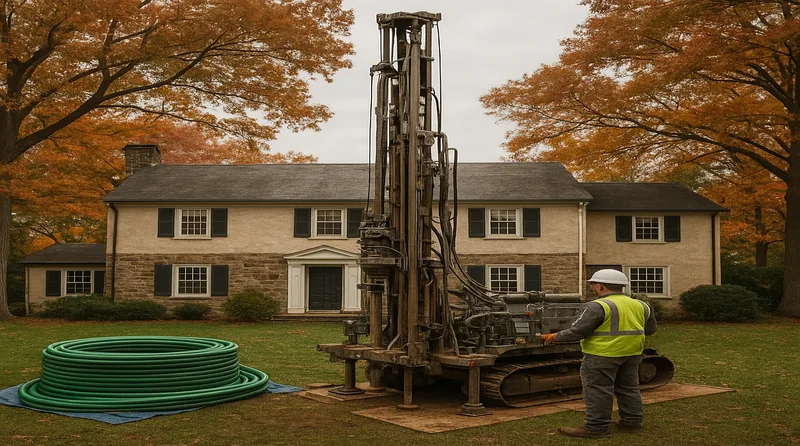
Pennsylvania's Energy Paradox
Pennsylvania sits atop the Marcellus Shale — the largest natural gas field in the United States, producing more gas than any state except Texas. You'd expect every PA home to be heating cheaply with natural gas. And in Pittsburgh and the western counties, that's mostly true.
But drive east to the Philadelphia suburbs — Delaware County, Chester County, Montgomery County — and you'll find neighborhood after neighborhood of pre-1960s colonial and split-level homes that were built before natural gas distribution reached suburban Philadelphia. Many still heat with oil. Some have never converted. And further north into the Pocono mountains and the rural counties stretching toward the New York border, natural gas infrastructure disappears almost entirely, replaced by propane tanks.
This geographic split creates two very different geothermal stories in Pennsylvania. For oil-heated southeastern PA suburbs and propane-dependent rural communities, geothermal is a compelling investment — payback periods of 6–9 years are realistic. For Pittsburgh-area homes on cheap Marcellus gas, the math is genuinely difficult, and we won't pretend otherwise.
Pennsylvania's electricity rate averages 12.51¢/kWh (EIA 2024, rank 19 nationally), and the state's grid emits approximately 893 lbs CO₂/MWh — reflecting a coal-heavy generation mix that makes efficiency gains from geothermal's 3.5–4.2 COP environmentally significant even beyond the financial case.
Quick Verdict: Should You Go Geothermal in Pennsylvania?
| Your Situation | Verdict | Typical Payback |
|---|---|---|
| Oil heat — Philadelphia suburbs (Chester, Delaware, Montgomery Co.) | ✅ Strong yes | 6–7 years |
| Propane heat — rural PA, Poconos, northern counties | ✅ Yes | 7–9 years |
| New construction — anywhere in PA | ✅ Strong yes | 3–5 years (incremental) |
| USDA REAP eligible farm/ag property | ✅ Excellent | 4–6 years |
| Vacation rental — Poconos, Lake Wallenpaupack | ✅ Yes — enhanced ROI | 5–8 years |
| Electric resistance heat — anywhere in PA | ✅ Yes | 8–12 years |
| Aging heat pump replacement (15+ years) | ⚠️ Compare costs at replacement | 10–14 years |
| Natural gas — Pittsburgh, western PA | ❌ Usually not on payback alone | 25–30+ years |
Get Your Pennsylvania Geothermal Quote
Connect with IGSHPA-certified installers serving your county. Compare up to 3 free quotes — no obligation.
Find PA Installers → Free · No obligation · IGSHPA certified onlyDoes Geothermal Work in Pennsylvania?
Ground Temperatures
Pennsylvania's ground temperature runs 50–54°F depending on location — slightly cooler than New Jersey or Maryland due to higher latitude. Southeastern PA (Philadelphia region) sits at the warmer end of that range, around 53–55°F. The Pocono plateau and northern counties run toward 50–52°F.
Those temperatures translate to a COP of roughly 3.5–4.2 in heating mode — slightly lower than what MD or NJ installations achieve, but still delivering 3.5–4+ units of heat for every unit of electricity consumed. A high-efficiency gas furnace at 96% efficiency delivers 0.96 units. The efficiency advantage is substantial even in Pennsylvania's cooler soils.
Climate: Wide Variation Across the State
| City | HDD | CDD | Ground Temp (°F) | Primary Heating Fuel |
|---|---|---|---|---|
| Philadelphia | 4,800 | 900 | 53–55 | Gas / Oil (older homes) |
| Harrisburg | 5,400 | 700 | 52–54 | Gas / Oil mix |
| Pittsburgh | 5,900 | 700 | 51–53 | Natural gas (Marcellus) |
| State College | 6,400 | 550 | 50–52 | Gas / Propane mix |
| Erie | 6,500 | 550 | 50–52 | Gas / Propane |
| Scranton/Poconos | 6,100 | 600 | 50–52 | Propane / Oil |
The higher heating degree days in central and northern PA actually improve geothermal ROI — more heating load means more hours of efficient operation, faster payback, and more annual savings. The complication is that most of those high-HDD areas are also where natural gas infrastructure thins out and propane becomes the alternative — which is, paradoxically, a better scenario for geo ROI.
Philadelphia's cooling season is real — roughly 900 cooling degree days. Geothermal in cooling mode runs at COP 5.0+, meaning real savings on summer air conditioning that add $150–$250/year to the ROI calculation regardless of heating fuel.
Five Distinct Pennsylvania Markets
Southeastern PA / Philadelphia Suburbs (Piedmont Province)
Chester, Delaware, and Montgomery counties — the "collar counties" around Philadelphia — are geothermal's sweet spot in Pennsylvania. The geology is favorable: crystalline basement rock (gneiss, schist) with relatively thin weathered overburden, thermal conductivity of 1.2–1.8 BTU/hr·ft·°F, and ground temps of 53–55°F. Active geothermal contractors operate throughout the region.
The market driver: these counties have one of the highest concentrations of oil-heated homes in the mid-Atlantic. Pre-1960s housing stock that was built before gas mains reached the suburbs. Many of these homes have been on oil delivery for 50+ years. When an oil boiler fails — and they do, eventually — geothermal is a serious option that competes directly with gas conversion.
Ridge-and-Valley Province (Central PA)
Lancaster, Lebanon, Dauphin, Cumberland, and Juniata counties sit in the folded limestone, shale, and sandstone of the Ridge-and-Valley province. Limestone has excellent thermal conductivity (1.4–2.2 BTU/hr·ft·°F), and where carbonate aquifers yield sufficient water, open-loop systems are potentially viable — though most installers default to closed-loop for regulatory simplicity.
Lancaster County deserves a specific mention: it's one of the more active rural geothermal markets in Pennsylvania, driven in part by the agricultural community's interest in energy-efficient heating for homes, barns, and outbuildings. Farms with propane heating and large lots are natural horizontal loop candidates.
Pittsburgh / Appalachian Plateau (Western PA)
Pittsburgh and the surrounding Allegheny, Westmoreland, Fayette, and Somerset counties sit on the Appalachian Plateau — flat-lying sandstones and shales with moderate thermal conductivity. The geology supports vertical loop installations well. The challenge isn't the ground; it's the economics. Western PA is deeply embedded in the natural gas infrastructure. Cheap Marcellus gas makes geothermal's ROI case very difficult for most Pittsburgh-area homes.
That said, Pittsburgh's HVAC market is sophisticated, and the handful of Pittsburgh-area homes on oil or propane — some older borough housing, some rural properties outside the gas distribution grid — do have a strong case for geothermal.
Pocono Plateau / Glaciated Northeast
Monroe, Pike, Wayne, and Susquehanna counties are Pennsylvania's recreational mountain region — the Poconos. The geology here is glacial till and outwash over sandstone bedrock, with variable soil thickness. Ground temps run toward 50–52°F. Heating dominates (ski season, cold winters). Propane is the standard fuel for homes outside the few town centers with gas distribution.
Vacation and second homes in the Poconos are an interesting geothermal opportunity: they often have larger wooded lots (enabling horizontal loops), they run propane at high cost for intermittent use, and they have substantial summer cooling loads if used as summer rentals. The combination of high heating load, propane economics, and generous lot sizes makes the Poconos worth a serious look.
Northern PA / Endless Mountains
Tioga, Potter, Cameron, Clinton, Sullivan, and Lycoming counties — the northern wilds of Pennsylvania — are almost entirely propane-dependent. Heating degree days exceed 6,000 in some locations. Lots are large. This is some of the most compelling geothermal territory in the state from a pure ROI standpoint, though thin contractor markets mean you may be working with an installer who travels from a larger metro. Get multiple quotes.
Cost and ROI: The Three-Scenario Breakdown
Regional Installation Costs
| Region | 3-Ton Vertical (Gross) | After 30% ITC | Horizontal (if land allows) | Contractor Availability |
|---|---|---|---|---|
| SE PA / Philly Suburbs | $24,000–$36,000 | $16,800–$25,200 | $18,000–$28,000 | Good — multiple IGSHPA firms |
| Ridge-and-Valley / Central PA | $20,000–$30,000 | $14,000–$21,000 | $15,000–$24,000 | Moderate |
| Pittsburgh / Western PA | $22,000–$34,000 | $15,400–$23,800 | $17,000–$27,000 | Good — but few geo specialists |
| Poconos / NE PA | $20,000–$30,000 | $14,000–$21,000 | $14,000–$22,000 | Limited — regional travel |
| Northern PA / Endless Mountains | $19,000–$28,000 | $13,300–$19,600 | $13,000–$20,000 | Thin — wider geographic net needed |
Scenario 1: Replacing Heating Oil (Philadelphia Suburbs)
This is where geothermal's case in Pennsylvania is genuinely strong.
- Annual oil heating cost: ~700 gallons × $3.80/gal = ~$2,660/year
- Geothermal operating cost: ~$480–$540/year electricity
- Heating savings: ~$2,120–$2,180/year
- Cooling savings vs. central AC: ~$150–$250/year
- Total annual savings: ~$2,270–$2,430/year
- Payback (net ~$16,800): ~6–7 years
A 6–7 year payback on a system with a 25-year lifespan is an excellent investment. After payback, you're banking $2,000+ annually. For a Delaware County or Chester County home currently paying $3,000+ per year for oil delivery, geothermal converts a perpetual operating expense into a fixed upfront cost with low operating costs for the next two decades.
Scenario 2: Replacing Propane (Rural PA, Poconos, Northern Counties)
- Annual propane cost: ~700 gallons × $3.20/gal = ~$2,240/year
- Geothermal operating cost: ~$480–$540/year electricity
- Total annual savings: ~$1,850–$2,000/year + cooling savings
- Payback (net ~$14,000): ~7–9 years
Rural PA propane users are strong geothermal candidates. They're typically off the gas grid permanently (natural gas distribution is not coming to Potter County), they have larger lots that enable cost-effective horizontal loops, and the higher heating degree days in northern PA mean more annual savings hours. The propane-to-geothermal switch also removes the vulnerability to propane price spikes that periodically hit rural markets in cold winters.
Scenario 3: Replacing Natural Gas (Pittsburgh and Western PA)
Here's the hard truth for Pittsburgh-area homeowners: Pennsylvania sits on top of the Marcellus Shale, and that proximity means residential gas prices that are among the lowest in the country — roughly $1.00–$1.20/therm for residential customers.
- Annual gas heating cost: ~600 therms × $1.10/therm = ~$660/year
- Geothermal operating cost: ~$430–$490/year electricity (at 12.51¢/kWh, COP 3.8)
- Heating savings: ~$170–$230/year
- Cooling savings vs. central AC: ~$150–$250/year
- Total annual savings: ~$320–$480/year
- Payback (net ~$15,500): ~25–30+ years
Twenty-five to thirty years is beyond the financial planning horizon for most homeowners. We're not going to dress this up: geothermal does not make financial sense for most western PA gas-heated homes on pure payback math. The honest exceptions are new construction (where the incremental cost comparison changes everything), homes replacing failing HVAC systems, or homeowners who prioritize energy independence and long-term price stability over short-term payback.
25-Year Total Cost of Ownership
| Heating System | Net Install Cost | 25-yr Operating | 25-yr Total |
|---|---|---|---|
| Geothermal (after 30% credit) | $14,000–$21,000 | $10,000–$13,500 | $24,000–$34,500 |
| High-eff. gas furnace + central AC | $5,500–$8,500 | $20,000–$25,000 | $25,500–$33,500 |
| Oil boiler/furnace + central AC | $5,000–$8,000 | $66,500–$77,000 | $71,500–$85,000 |
| Propane furnace + central AC | $4,500–$7,000 | $56,000–$65,000 | $60,500–$72,000 |
Operating costs assume current PA energy prices with 3% annual escalation for fossil fuels, 2% for electricity. Gas scenario shown at Pittsburgh Marcellus rates (~$1.10/therm). Individual results vary — use your actual utility bills.
See our geothermal payback period analysis for how Pennsylvania compares to neighboring states.
Real-World Pennsylvania Case Studies
Case Study 1: Chester County Oil-Heated Colonial — 6.3-Year Payback
- Location: Downingtown, Chester County (Piedmont geology)
- Home: 2,800 sq ft stone colonial, built 1958, oil-fired boiler + window AC units
- Prior fuel: Heating oil — 800 gallons/year at $3.85/gal = $3,080/year + $420 summer window AC
- System installed: 4-ton vertical closed-loop (3 × 250ft boreholes), WaterFurnace 7 Series
- Gross cost: $32,500 (includes ductwork modifications — former hot-water radiator system)
- Federal ITC (30%): −$9,750
- Net cost: $22,750
- Annual geo operating cost: ~$890/year electricity (heating + cooling + DHW via desuperheater)
- Annual savings: ($3,080 + $420) − $890 = $2,610/year
- Simple payback: $22,750 ÷ $2,610 = 8.7 years (full system) / 6.3 years (incremental vs. replacing oil boiler + adding central AC = ~$16,000 baseline)
The ductwork modification added ~$6,500 to the project — homes with existing forced-air systems avoid this cost entirely and see a faster payback. Desuperheater provides ~60% of domestic hot water May through October, saving an additional ~$180/year not included in the core calculation.
Case Study 2: Pocono Mountain Vacation Home — 7.4-Year Payback
- Location: Tobyhanna, Monroe County (Pocono Plateau, glacial till)
- Home: 2,200 sq ft A-frame cabin, year-round rental (Airbnb), propane furnace + central AC
- Prior fuel: Propane — 900 gallons/year at $3.35/gal = $3,015/year + $380 AC electricity
- System installed: 3-ton horizontal slinky loop (3 trenches × 200ft, 6ft depth — large wooded lot)
- Gross cost: $21,000 (horizontal loop = lower cost than vertical)
- Federal ITC (30%): −$6,300
- Net cost: $14,700
- Annual geo operating cost: ~$720/year electricity (heating + cooling)
- Annual savings: ($3,015 + $380) − $720 = $2,675/year
- Simple payback: $14,700 ÷ $2,675 = 5.5 years (standalone) / 7.4 years (incremental vs. propane furnace replacement at $7,500)
- Rental premium: "Eco-friendly geothermal heated" listing differentiation — estimated $15–$25/night premium during ski season
The horizontal slinky loop saved ~$6,000 vs. vertical drilling — possible because of the 1.5-acre wooded lot. Propane consumption included maintaining 55°F setpoint between guest stays; geothermal maintains this more efficiently. The rental income offset makes ROI even stronger than a primary residence.
Month-by-Month Energy Profile
Based on a 2,600 sq ft Chester County home replacing oil heat (Case Study 1 baseline):
| Month | Old Oil + AC Cost | Geothermal Cost | Monthly Savings | Notes |
|---|---|---|---|---|
| January | $485 | $125 | $360 | Peak heating — COP 3.6 at 51°F EWT |
| February | $440 | $115 | $325 | Cold month, heavy heating load |
| March | $320 | $90 | $230 | Shoulder — heating tails off |
| April | $140 | $45 | $95 | Light heating, some cooling starts |
| May | $65 | $35 | $30 | Minimal conditioning + DHW savings |
| June | $95 | $55 | $40 | Cooling ramp-up — COP 5.2 |
| July | $145 | $75 | $70 | Peak cooling — 900 CDD market |
| August | $130 | $70 | $60 | High cooling, desuperheater peak |
| September | $70 | $40 | $30 | Cooling tails off |
| October | $160 | $55 | $105 | Heating ramp-up |
| November | $340 | $95 | $245 | Heavy heating resumes |
| December | $460 | $120 | $340 | Near-peak heating |
| Annual Total | $2,850 | $920 | $1,930 |
Based on EIA Pennsylvania average of 12.51¢/kWh, oil at $3.80/gal, COP 3.6 heating / 5.2 cooling. Philadelphia-area 900 CDD provides meaningful summer savings that northern PA locations won't match.
Open-Loop System Assessment
Open-loop systems use groundwater directly, offering 10–15% higher efficiency than closed-loop — but they require adequate well yield, acceptable water chemistry, and a legal discharge path. Here's where they're viable in Pennsylvania:
| Region | Open-Loop Viability | Key Considerations |
|---|---|---|
| SE PA / Piedmont | ⚠️ Site-specific | Crystalline bedrock — well yields variable (2–20 gpm). Some sites excellent; others inadequate. Test well recommended. |
| Ridge-and-Valley / Lancaster | ✅ Generally viable | Carbonate aquifers can yield 15–50+ gpm. Excellent water quality. Best open-loop territory in PA. DEP permit required. |
| Pittsburgh / Plateau | ⚠️ Limited | Sandstone/shale yields often low (1–5 gpm). Coal mine drainage risk in some areas. Closed-loop strongly preferred. |
| Poconos / NE PA | ⚠️ Site-specific | Glacial outwash zones can yield well. Bedrock areas variable. Water quality generally good where available. |
| Northern PA / Endless Mtns | ⚠️ Site-specific | Sandstone yields moderate. Remote areas may lack disposal options. Verify with driller before committing. |
| Lake Erie Lowlands | ✅ Often viable | Glacial sand and gravel deposits can yield excellent water. Surface discharge to drainage ditches usually feasible. |
Pennsylvania DEP requires a Water Well Permit for open-loop systems, and discharge must comply with Clean Streams Law. Most PA installers default to closed-loop — it's simpler, it's universally applicable, and the efficiency penalty is modest. If you're in the Ridge-and-Valley or Lake Erie corridor with a known high-yield well, ask your installer specifically about open-loop — the savings over 25 years can offset the permitting complexity.
Loop Type Cost Comparison
| Loop Type | Typical PA Cost (3-ton) | Land Needed | Best For | PA Considerations |
|---|---|---|---|---|
| Vertical closed-loop | $20,000–$34,000 | Small — 15×15 ft per bore | Suburban lots, Philly collar counties | Standard for Piedmont rock; 250–300ft bores typical |
| Horizontal slinky | $14,000–$24,000 | ½–1 acre of trenchable ground | Rural PA, Lancaster farms, Poconos | 30–40% cheaper; needs 6ft depth below PA frost line |
| Horizontal straight | $13,000–$22,000 | 1–2 acres minimum | Northern PA large lots, farmland | Lowest cost per ton; ideal for Endless Mountains properties |
| Open-loop | $16,000–$26,000 | Existing well + discharge | Lancaster limestone aquifers, Erie lowlands | 10–15% more efficient; DEP Water Well Permit required |
| Pond/lake loop | $15,000–$24,000 | ½+ acre pond, 8ft+ depth | Farm ponds, Poconos lakefront | Cheapest closed-loop option; verify pond volume year-round |
Incentives and Financing
Incentive Stacking Summary
| Incentive | Amount | Status | How to Claim |
|---|---|---|---|
| Federal ITC (Section 25D) | 30% of total cost | ✅ Confirmed through 2032 | IRS Form 5695 with tax return |
| PECO Smart Ideas rebate | Varies by program year | [NEEDS VERIFICATION] | peco.com/savings |
| PPL EnergyWise rebate | Varies by program year | [NEEDS VERIFICATION] | pplelectric.com |
| FirstEnergy / West Penn Power | Varies | [NEEDS VERIFICATION] | firstenergycorp.com |
| Duquesne Light (Pittsburgh) | Varies | [NEEDS VERIFICATION] | duquesnelight.com |
| PA property tax exemption | Assessed value exempt | [NEEDS VERIFICATION] | County assessor — varies by county |
| USDA REAP (farms/rural biz) | 25–50% grant | ✅ Active program | See REAP section below |
Important: Pennsylvania utility rebate programs change annually based on PUC-approved budgets. Call your utility before signing a contract to confirm current rebate availability and any pre-approval requirements. Don't count on utility rebates in your ROI calculation unless you've verified them in writing.
PA's Deregulated Electricity Market: A Variable Worth Noting
Pennsylvania is a deregulated electricity market — residential customers can choose their retail electric supplier, and rates vary. The EIA average of 12.51¢/kWh is a statewide average; your actual rate may be higher or lower depending on your current supplier contract. Before doing your own ROI calculation, use your actual electric rate, not the state average. If you're on a high fixed-rate contract, switching suppliers when you install geothermal could improve your ROI further.
Financing Options
For southeastern PA homeowners with substantial home equity (Delaware and Chester counties have some of the highest median home values in the state), a HELOC is typically the most cost-effective financing vehicle. For rural PA homeowners with less equity, USDA Rural Energy for America Program (REAP) loans may be an option for agricultural properties. See our geothermal financing guide for a full breakdown of eight financing paths.
Solar + Geothermal Stacking Strategy
Pennsylvania's net metering laws (Act 129) allow residential solar up to 50 kW — plenty for a combined solar + geothermal system. The stacking math in PA is compelling for oil/propane homes:
- Geothermal alone: Reduces heating cost by 65–75% (oil/propane → electricity)
- Solar panels: A 6–8 kW system ($12,000–$18,000 after 30% ITC) offsets most or all of the geothermal electricity consumption
- Combined effect: Near-zero energy cost for heating and cooling — total energy independence from fossil fuel deliveries
- Combined payback: 8–11 years for both systems (vs. 7–9 for geo alone) — but you're eliminating ALL heating/cooling costs
For Philadelphia-area oil homes already spending $3,000+/year on heating, the combined solar + geo investment of $30,000–$40,000 (net after dual 30% ITC) replaces $3,400+/year in energy costs. That's a decade of payback followed by 15+ years of near-free conditioning.
Pennsylvania's SREC (Solar Renewable Energy Certificate) market — while less lucrative than neighboring New Jersey's — provides an additional $20–$40/SREC income stream. Factor this into your combined system ROI.
Vacation Rental & Second Home Analysis
The Poconos, Lake Wallenpaupack, and the Endless Mountains have a significant vacation rental market — and geothermal changes the economics in ways that make these properties more attractive.
Why Geothermal Favors PA Vacation Rentals
- Propane elimination: Vacation homes typically run propane at higher per-gallon rates (smaller deliveries, remote locations). Annual propane costs of $3,000–$4,000 are common for year-round Pocono rentals.
- Four-season earnings: Geothermal's efficient cooling enables comfortable summer rentals — Monroe County's Airbnb market peaks in both ski season AND summer.
- Eco-premium: "Geothermal heated and cooled" is a genuine listing differentiator in the eco-conscious Poconos market. Properties report $15–$25/night premium during peak season.
- Low maintenance during vacancy: Set to 50°F when empty; the ground loop maintains temperature efficiently regardless of occupancy. No propane delivery scheduling or tank monitoring.
- Horizontal loops on large lots: Most Pocono rental properties sit on 1+ acres of wooded land — perfect for cost-effective horizontal slinky loops that save $5,000–$8,000 over vertical drilling.
Tax Treatment
If the property generates rental income, you may be able to depreciate the geothermal system under MACRS (5-year accelerated schedule for energy property) in addition to the 30% residential ITC. Consult a tax professional — the IRS treatment of mixed-use vacation properties has specific rules about personal-use days vs. rental days that affect eligibility.
USDA REAP for Agricultural Properties
Pennsylvania's extensive agricultural sector — particularly Lancaster County, the northern tier, and the western dairy belt — makes USDA Rural Energy for America Program (REAP) grants relevant for many PA properties.
REAP Math: Lancaster County Farm Example
| Item | Amount |
|---|---|
| 5-ton horizontal loop system (farmhouse + barn office) | $32,000 |
| USDA REAP grant (25%) | −$8,000 |
| Federal ITC 30% (on $32,000 − REAP = $24,000) | −$7,200 |
| Net cost after stacking | $16,800 |
| Annual propane savings (farm + house) | $3,400/year |
| Payback | 4.9 years |
REAP grants range from 25% to 50% depending on the funding cycle and application competitiveness. The 25% figure is conservative. A 50% REAP grant on the same project drops net cost to $8,800 and payback to 2.6 years.
Applications go through the USDA Rural Development Pennsylvania State Office. Apply early — funds are competitive and awarded in quarterly cycles.
How to Claim the Federal Tax Credit (IRS Form 5695)
- Confirm system eligibility. Your ground-source heat pump must meet ENERGY STAR requirements. Check the manufacturer's certification — WaterFurnace, ClimateMaster, Bosch, and most major brands meet the standard. The system must be installed at your primary or secondary residence (rental-only properties do not qualify for Section 25D).
- Gather documentation. Collect: (a) final invoice from your installer showing total installed cost (equipment, labor, drilling, loop, all materials), (b) ENERGY STAR certification or AHRI certificate for the heat pump unit, (c) proof the property is your residence. Keep the installer's itemized invoice — the IRS may request it.
- Complete IRS Form 5695, Part I. Enter the total installed cost on Line 12a (Qualified geothermal heat pump property costs). The credit is 30% of this amount — there is no dollar cap through 2032.
- Calculate the credit. Multiply your Line 12a entry by 0.30. Enter the result on Line 14. This flows to Line 15 (total residential energy credits).
- Transfer to Form 1040. The credit from Form 5695 Line 15 flows to Schedule 3 (Form 1040), Line 5. This reduces your tax liability dollar-for-dollar.
- Handle carryforward if needed. If your tax liability for the year is less than the credit amount, the unused portion carries forward to subsequent tax years. On a $32,500 installation, the 30% credit is $9,750 — if your annual tax liability is $6,000, you claim $6,000 in Year 1 and $3,750 in Year 2.
- File and retain records. File Form 5695 with your federal tax return. Retain: installer invoice, ENERGY STAR certification, permit documentation, and any utility rebate correspondence (rebates reduce the eligible cost basis) for at least 7 years.
For a detailed walkthrough, see our complete federal tax credit guide.
Permitting in Pennsylvania
PA DEP Water Well Permits
Vertical closed-loop boreholes require a Water Well Permit from the Pennsylvania Department of Environmental Protection under the Water Resources Management Act. Standard procedure — your installer handles it. Pennsylvania's Act 32 specifies well construction standards, grouting requirements, and setback distances from property lines and water sources. Budget 2–4 weeks for permit issuance and $100–$200 in fees.
Local Permits
Mechanical and electrical permits are required from your municipality. Pennsylvania's fragmented local government structure (townships, boroughs, second-class cities) means permit processes vary more than in states with county-level administration. Most jurisdictions are familiar with heat pump installations; budget $300–$600 for local permits.
Simpler Than Some Neighbors
Compared to New Jersey's CAFRA zones or Maryland's Chesapeake Bay Critical Area, Pennsylvania has a relatively straightforward permitting landscape for most locations. There's no broad coastal overlay affecting large portions of the residential market. Properties near streams or wetlands have standard environmental setback requirements, but these are well-understood by experienced installers.
Finding a Qualified PA Installer
Start with the IGSHPA certified contractor directory. The Philadelphia metro area and southeastern PA have a reasonable number of IGSHPA-certified installers; western PA and rural areas are thinner. For rural northern PA, you may need to contact installers from Harrisburg, State College, or even from the New York Southern Tier who work across the border.
Questions to ask any PA installer:
- Do you handle the PA DEP water well permit, or is that my responsibility?
- What's your conductivity assumption for this soil type, and how did you arrive at that?
- Do you submit paperwork for PECO/PPL rebates, and who's responsible for pre-approval?
- What's the warranty on the ground loop itself? (Should be 50 years or lifetime on the HDPE pipe)
- Can you provide references from similar installations in my county?
Get at least three quotes. In the Philadelphia suburbs, price competition is real and quotes can vary $5,000+ for comparable systems. In rural areas with fewer contractors, cast a wider geographic net. See our installation cost guide for what fair pricing looks like in the mid-Atlantic market.
Pennsylvania vs. Neighboring States
| Factor | PA | NY | NJ | MD | OH | WV |
|---|---|---|---|---|---|---|
| Electricity rate | 12.51¢ | 20.51¢ | 16.29¢ | 15.04¢ | 11.29¢ | 11.78¢ |
| Grid CO₂ (lbs/MWh) | ~893 | 537 | 507 | 604 | 1,005 | 1,171 |
| State incentive | Utility [NV] | IT-267 25% ($10K cap) | NJCEP [NV] | EmPOWER [NV] | None | None |
| Oil home payback | 6–7 yr | 7–9 yr | 6–8 yr | 5–7 yr | 7–10 yr | 5–7 yr |
| Gas home payback | 25–30+ yr | 15–20 yr | 18–25 yr | 20–30 yr | 22–35 yr | 20–30 yr |
| Best scenario | Philly oil belt | LI oil homes | NW NJ oil | Eastern Shore oil | SE propane | E. baseboard |
PA's unique position: Pennsylvania has the cheapest natural gas of any Northeast state (Marcellus Shale proximity), which makes the gas-home ROI the worst in the region. But PA also has one of the largest oil-heated housing stocks in the country, concentrated in high-value Philadelphia suburbs — making oil-to-geo conversion one of the strongest ROI stories in any state. It's genuinely a tale of two markets.
Frequently Asked Questions
On pure payback, probably not for most Pittsburgh-area gas homes — we're talking 25–30+ year payback with Marcellus Shale gas prices. Where it might make sense: new construction (the incremental cost comparison changes everything — you're comparing geo to a furnace + AC, not to a working system), homes replacing failing HVAC equipment (same incremental math), or commercial/larger-scale installations where efficiency gains compound. We won't sell you a number that doesn't pencil.
A 6–7 year payback is realistic for most oil-heated homes in the collar counties. Get a site assessment from an IGSHPA-certified installer — your specific lot (size, access, soil conditions), home size, and actual oil usage will give you a more precise number than any guide can. The structural case is sound: you're converting a variable operating expense (oil price × usage) into a fixed capital cost with much lower operating costs. After year 7, you're netting $2,000+ annually.
Yes, with some caveats. Geothermal systems can be set to a lower setpoint when unoccupied — the loop field doesn't care whether the house is occupied. The key consideration for vacation homes is freeze protection: your antifreeze concentration needs to protect the loop down to the minimum expected temperature, and the building's domestic plumbing needs protection too. For a Pocono rental property with high summer occupancy and high winter heating costs, the ROI case is often better than a primary residence because the four-season rental income partially offsets the system cost.
Yes — and some of the most creative geothermal applications in Pennsylvania have been on farms. Large lots enable horizontal loop systems that cost 30–40% less than urban vertical installations. Year-round temperature control for poultry houses, dairy facilities, and farm offices creates a consistent heating and cooling load that maximizes system efficiency. Stack a USDA REAP grant (25–50%) with the 30% federal ITC and your net cost drops to $8,000–$17,000 for a 5-ton farm system. Talk to your county extension office or the USDA Rural Development PA office.
It can, in your favor. If you're currently on a high-rate retail electric supplier contract, switching to a lower-rate supplier when you install geothermal reduces your operating cost — improving your payback. If you're already on a favorable rate, the EIA average of 12.51¢/kWh is a reasonable planning number. Run your ROI calculation at your actual rate, not the state average. Pennsylvania's competitive market means you can actively manage this variable.
Pennsylvania's grid emits approximately 893 lbs CO₂/MWh — higher than the national average due to significant coal generation (about 16% of PA's mix). A geothermal system with COP 3.8 effectively produces ~235 lbs CO₂ per million BTU of heating delivered, compared to ~117 for natural gas direct combustion. On raw carbon math, a gas furnace in PA is actually lower-carbon than geothermal right now. But the grid is getting cleaner (PA's renewable portfolio standard requires 18% by 2026), and geothermal's carbon footprint improves automatically as the grid decarbonizes. For oil and propane homes, geothermal is cleaner today — oil produces ~161 lbs/MMBTU and propane ~139, but at COP 3.8 geothermal matches or beats both when you account for the full thermal efficiency.
Pennsylvania has four major geological zones that affect drilling. The Piedmont (Chester/Delaware/Montgomery counties) has hard crystalline rock — drilling is slower but thermal conductivity is excellent (fewer feet needed). The Ridge-and-Valley (Lancaster through Lewistown) has folded limestone that drills efficiently and conducts heat well. The Appalachian Plateau (western PA) has flat sandstones and shales — moderate drilling and moderate conductivity. The glaciated northeast (Poconos) has variable glacial till over bedrock — your driller needs to know the local overburden depth. All four zones support geothermal; drilling cost varies by $3–$5/foot depending on rock type.
Yes — and it's one of the strongest combined-system plays in the mid-Atlantic. Both qualify for the 30% federal ITC independently. A 7 kW solar array (~$10,500 net after ITC) can offset most or all of your geothermal electricity consumption, effectively zeroing out your heating and cooling costs. PA's net metering laws (Act 129) support this. For oil-heated Philly suburban homes, the combined investment of ~$25,000–$35,000 net replaces $3,400+/year in energy costs — a compelling 7–10 year combined payback followed by 15+ years of near-free energy.
Pennsylvania does not currently offer a state-level tax credit specifically for geothermal systems. The primary financial incentive is the federal 30% ITC (Section 25D), which alone is substantial. Some PA utilities offer efficiency rebates that may apply to ground-source heat pumps — check with PECO, PPL, West Penn Power, or Duquesne Light for current program availability. PA's property tax exemption for renewable energy systems may also apply — verify with your county assessor.
The strongest ROI in PA is in the oil-heated Philadelphia suburbs — Chester County, Delaware County, and parts of Montgomery and Bucks counties — where 6–7 year paybacks are typical. Second-best is the propane-dependent rural belt from Lancaster County through the Poconos to the northern tier (7–9 year paybacks). Worst ROI is the Pittsburgh metro and western PA counties where cheap Marcellus Shale gas makes the savings gap too small (25–30+ years). If you're anywhere with oil or propane, get quotes — the math almost certainly works.
Bottom Line: Who Should Seriously Consider Geothermal in Pennsylvania
Strong candidates:
- Oil-heated homes in Delaware, Chester, Montgomery, Bucks counties — 6–7 year payback, clear long-term financial win
- Propane-heated rural PA (Poconos, northern counties, Lancaster County rural) — 7–9 year payback
- New construction anywhere in PA — system designed in from the start avoids retrofit premium, 3–5 year incremental payback
- Agricultural properties with large lots and year-round conditioning needs — especially with USDA REAP stacking
- Pocono vacation/rental properties with high summer cooling load and propane heat — enhanced ROI from rental income
Think carefully:
- Natural gas homes in Pittsburgh and western PA — long payback; mainly makes sense at system replacement time or new construction
- Rural properties with very thin contractor markets — you may need to bring in an installer from 1–2 hours away; factor in the travel premium
Ready to Explore Geothermal for Your PA Home?
Compare quotes from certified installers in your area. Three quotes is the minimum — in the Philly suburbs, price competition can save you $5,000+.
Get Free Quotes → Free · No obligation · IGSHPA certified onlyFirst step: get a site assessment from an IGSHPA-certified installer. For comparison with neighboring states, see our New Jersey geothermal guide, Maryland guide, New York guide, and Ohio guide. For propane-specific analysis, see our geothermal vs. propane comparison.
🎬 Video: Geothermal in Pennsylvania
Coming soon — Chuck the Contractor will walk through a real PA installation, from Chester County's oil-heated colonials to Pocono vacation homes. Subscribe to know when it drops.
Sources
- EIA — Pennsylvania Electricity Profile (12.51¢/kWh average, 2024)
- EIA — State CO₂ Emissions from Electricity Generation
- NOAA — U.S. Climate Normals (Pennsylvania HDD/CDD by station)
- PA DEP — Water Resources Management (well permit program)
- PA Act 32 — Water Well Construction Standards
- IRS — Residential Clean Energy Credit (Section 25D)
- ENERGY STAR — Geothermal Heat Pump Federal Tax Credits
- IGSHPA — Find a Certified Geothermal Contractor
- PECO — Smart Ideas Energy Efficiency Programs
- PPL Electric — EnergyWise Rebate Programs
- USDA — Rural Energy for America Program (REAP)
- PA PUC — Act 129 Energy Efficiency and Conservation
- U.S. Census — Pennsylvania QuickFacts
- DSIRE — Pennsylvania Incentives and Policies for Renewables
- Penn State Extension — Energy Programs