
In This Guide
- Why Oklahoma Is Quietly Good for Geothermal
- Quick Verdict: Should You Go Geothermal?
- Does Geothermal Work in Oklahoma?
- Geology & Drilling Conditions by Region
- Oklahoma's Regulated Energy Market
- Regional Costs & ROI
- Real-World Case Studies
- Month-by-Month Energy Profile
- Open-Loop System Assessment
- Loop Type Cost Comparison
- Incentives: Federal ITC and the Honest Picture
- Incentive Stacking Table
- Oil Country Drilling Advantage
- Tornado Resilience: The Underground Advantage
- New Construction Economics
- How to Claim the Federal Tax Credit
- Permits & Licensing
- Finding & Vetting an Oklahoma Installer
- Maintenance & System Longevity
- Vacation Rental & Lake Property Economics
- Oklahoma vs. Neighboring States
- Frequently Asked Questions
- Bottom Line
- Sources
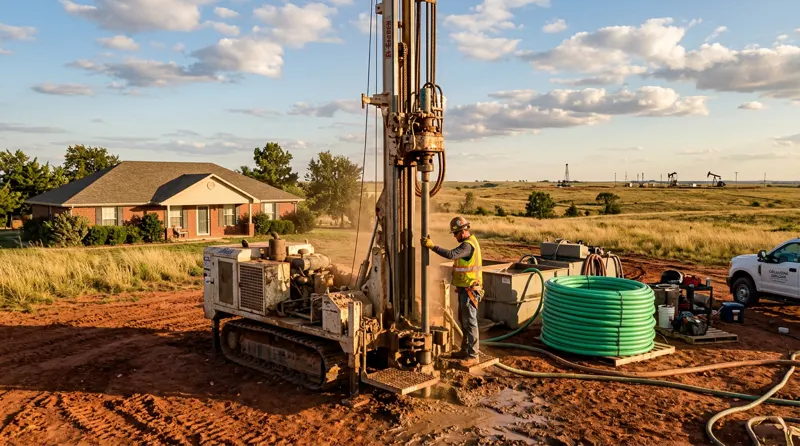
Why Oklahoma Is Quietly Good for Geothermal
Oklahoma doesn't show up on most "best states for geothermal" lists. It has no state tax credits, no utility rebate programs, and some of the cheapest electricity in the country at 9.09¢/kWh (EIA 2024, rank 48 nationally). On paper, that should kill the geothermal case before it starts.
But Oklahoma has something most states don't: an army of experienced drillers. The same oil and gas industry that made Oklahoma City and Tulsa energy capitals left behind a deep bench of drilling contractors, rig operators, and well technicians who can install vertical bore ground loops faster and cheaper than drillers in states without that infrastructure. When your neighbor's cousin runs a drilling company, vertical bore quotes come in 15–25% below national averages.
Three things define the Oklahoma geothermal conversation:
- Extreme climate swings. Oklahoma experiences genuine four-season extremes — 110°F summer highs and single-digit winter lows are both common. That means significant heating and cooling loads, which is exactly where geothermal delivers the most value. Heating degree days range from 3,200 (southeast) to 5,200 (Panhandle), and cooling degree days from 1,500 (Panhandle) to 2,400 (south-central). Both modes generate savings.
- Propane and electric resistance heating. Oklahoma has 3.9 million people spread across 69,899 square miles, with vast rural areas where natural gas service doesn't reach. Thousands of homes rely on propane at $2.50–$3.50/gallon or electric resistance heating. These are the homes where geothermal delivers 7–10 year payback even with cheap electricity.
- No state incentives — but also no obstacles. Oklahoma's minimal regulatory environment means no permitting nightmares, no special geothermal licensing beyond standard well-drilling permits, and fast project timelines. The federal 30% ITC (IRC §25D) is your only incentive, which means the economics are transparent and don't depend on legislative mood swings.
Let's be direct: if you heat with cheap natural gas in Oklahoma City or Tulsa and have a modern HVAC system, geothermal payback will likely exceed 18 years. But if you're on propane, building new, or replacing a dying system — the numbers are surprisingly competitive, especially with Oklahoma's drilling cost advantage.
Quick Verdict: Should You Go Geothermal in Oklahoma?
| Your Situation | Verdict | Typical Payback |
|---|---|---|
| Rural Oklahoma — propane or electric resistance heating | ✅ Best OK scenario | 7–10 years |
| New construction — anywhere in Oklahoma | ✅ Incremental cost is low | 6–9 years |
| Ranch/farm property — USDA REAP eligible | ✅ 55% coverage possible | 4–7 years |
| Large home (3,000+ sqft) — high heating & cooling loads | ✅ Economies of scale | 8–12 years |
| Replacing failed HVAC system — any fuel type | ⚠️ Good — compare incremental cost | 10–14 years |
| OKC/Tulsa suburbs — natural gas heating, modern HVAC | ❌ Hard to justify financially | 18–25+ years |
| Small home (<1,500 sqft) — low energy use | ❌ Fixed costs too high relative to savings | 20–30+ years |
Does Geothermal Work in Oklahoma?
Geothermal heat pumps work exceptionally well in Oklahoma. The state's ground temperatures are near-ideal for both heating and cooling, and the climate demands significant energy for both modes — maximizing the annual savings window.
Ground Temperatures by Region
| Region | Ground Temp (50ft) | HDD | CDD | Dominant Mode |
|---|---|---|---|---|
| Panhandle (Guymon/Boise City) | 57–60°F | 5,000–5,200 | 1,400–1,600 | Heating-dominant |
| Northwest (Woodward/Enid) | 59–62°F | 4,200–4,500 | 1,800–2,000 | Slightly heating-dominant |
| Oklahoma City Metro | 62–64°F | 3,600–3,800 | 2,100–2,300 | Balanced |
| Tulsa Metro | 62–64°F | 3,500–3,700 | 2,100–2,300 | Balanced |
| Southwest (Lawton/Altus) | 63–65°F | 3,200–3,500 | 2,300–2,500 | Slightly cooling-dominant |
| Southeast (McAlester/Durant) | 63–65°F | 3,000–3,300 | 2,200–2,400 | Balanced to cooling-dominant |
| Northeast (Miami/Vinita) | 60–63°F | 3,800–4,200 | 1,800–2,000 | Slightly heating-dominant |
Oklahoma's sweet spot is that ground temperatures cluster between 60–65°F statewide — warm enough for efficient heating (COP 3.8–4.5) and cool enough for efficient cooling (COP 4.5–5.5 when rejecting heat into 63°F earth vs. 100°F+ air). The balanced heating/cooling demand in the OKC and Tulsa corridors means both modes generate savings year-round, unlike cooling-only states like South Texas or heating-only states like Minnesota.
Geology & Drilling Conditions by Region
Oklahoma's geology varies dramatically across the state — from soft Permian red beds in the center to hard Ozark limestone in the northeast and sandy Ogallala formations in the Panhandle. The good news: decades of oil and gas exploration have mapped Oklahoma's subsurface more thoroughly than almost any state, and your installer can access existing well logs from the Oklahoma Geological Survey (OGS) database to reduce drilling uncertainty.
| Region | Primary Formation | Thermal Conductivity (BTU/hr·ft·°F) | Typical Bore Depth | Drill Cost/ft | Key Challenges |
|---|---|---|---|---|---|
| Central Red Bed Plains (OKC, Norman, Stillwater, Enid) | Permian red shale & clay (iconic "red dirt") | 0.8–1.1 | 200–275 ft | $10–$14/ft | Expansive clay — needs sand/bentonite backfill for horizontal; vertical bores drill easily through soft red beds |
| Ozark Plateau / NE (Tulsa, Miami, Tahlequah, Vinita) | Limestone, dolomite, chert (Boone Formation) | 1.0–1.5 | 175–250 ft | $13–$18/ft | Harder rock = higher drill cost but excellent thermal performance; fewer bore feet needed; karst voids possible in chert zones |
| Cross Timbers / East-Central (Shawnee, Muskogee, McAlester metro fringe) | Sandstone & shale with clay soils | 0.8–1.2 | 200–275 ft | $11–$15/ft | Alternating hard/soft layers; good all-around geology; clay overburden for horizontal |
| Ouachita Mountains / SE (McAlester, Poteau, Broken Bow) | Folded shale, sandstone, novaculite | 0.7–1.3 | 225–300 ft | $14–$20/ft | Highly variable — novaculite formations very hard; get site-specific geological assessment; valleys drill easier than ridges |
| Western Plains / Panhandle (Woodward, Guymon, Elk City) | Sandy soils over Ogallala aquifer | 0.6–1.0 | 225–300 ft | $9–$13/ft | Easy drilling, cheapest in state; lower conductivity offset by abundant land for horizontal; irrigation moisture improves performance |
| Arbuckle Mountains / South-Central (Ardmore, Sulphur, Davis) | Precambrian granite & Arbuckle Group limestone | 1.1–1.6 | 175–250 ft | $15–$22/ft | Oldest exposed rock in state — excellent conductivity but highest drilling costs; surrounding sedimentary plains much easier |
| Southwest (Lawton, Altus, Duncan) | Permian/Triassic red beds, gypsum, Wichita Mountains granite | 0.7–1.2 | 200–275 ft | $11–$16/ft | Gypsum dissolution risk in some areas (avoid open-loop near gypsum karst); granite in Wichita Mountains expensive to drill; surrounding plains are easy |
Pre-drill research tip: Oklahoma's oil and gas exploration has generated millions of well logs. The Oklahoma Geological Survey maintains a searchable database of subsurface data. Your installer (or you) can look up existing wells near your property to preview formation types and estimate drilling costs before getting quotes. This is a unique Oklahoma advantage — most states have far less subsurface data available.
Oklahoma Geology: Red Dirt and Drilling
The geology story in Oklahoma is simple: most of the state is easy and cheap to drill. The Permian red beds that cover central Oklahoma are soft, predictable, and drill quickly. The western plains are sandy and straightforward. Only the Ozark Plateau (harder limestone), Ouachita Mountains (folded formations), and Arbuckle Mountains (ancient granite) present meaningful drilling challenges — and even there, Oklahoma's drilling expertise keeps costs competitive.
For horizontal loops, Oklahoma's deep soils and abundant land in rural areas make it one of the best states in the country. A 3-ton horizontal slinky system that would cost $16,000–$22,000 in a tight-lot Northeast state can be installed for $10,000–$16,000 on Oklahoma acreage.
Oklahoma's Regulated Energy Market
Unlike Texas's deregulated ERCOT market, Oklahoma operates a traditional regulated utility model. You don't choose your electricity provider — it's determined by where you live. This creates predictable but generally low electricity rates.
Major Utilities
| Utility | Service Area | Avg. Residential Rate | Geothermal Programs |
|---|---|---|---|
| OG&E (Oklahoma Gas & Electric) | Central & western OK, OKC metro | ~9.5–10.5¢/kWh | None specific to GSHP |
| PSO (Public Service Co. of Oklahoma / AEP) | Eastern OK, Tulsa metro | ~10.0–11.5¢/kWh | None specific to GSHP |
| Rural electric cooperatives (various) | Rural areas statewide | ~10.0–13.0¢/kWh | Some co-ops offer rebates — check directly |
| Municipal utilities (various) | Smaller cities | Varies widely | Check individual municipal utility |
What the Regulated Market Means for Geothermal
| Factor | Impact on Geothermal Case |
|---|---|
| Average rate: 9.09¢/kWh (EIA 2024) | Low savings per kWh — but both heating AND cooling generate savings |
| Rate stability | Less price volatility than Texas/deregulated states — steady but predictable savings |
| No utility geo rebates | Federal ITC is your only incentive from the utility side |
| Rural co-op rates (10–13¢) | Higher co-op rates improve geothermal payback in rural areas |
| Natural gas: ~$1.00–$1.30/therm | Oklahoma gas is very cheap — the biggest headwind for geothermal in metro areas |
| Propane: $2.50–$3.50/gal | Rural propane users see the strongest geothermal case |
Oklahoma's statewide average of 9.09¢/kWh makes it one of the cheapest electricity states in the country. That's good for consumers but challenging for geothermal payback in natural gas homes. The saving grace: Oklahoma's natural gas is also cheap, which means many rural homes that lack gas service are paying premium prices for propane — and those are the homes where geothermal shines.
The state's grid CO2 intensity sits at 673 lbs/MWh (EIA 2024, rank 31) — cleaner than the national average thanks to Oklahoma's massive wind energy buildout. Oklahoma generates approximately 40% of its electricity from wind, one of the highest percentages in the nation. This means a geothermal heat pump in Oklahoma is running on increasingly clean electricity.
Regional Costs & ROI
Installed System Cost by Region
| Region | Typical Home Size | System Size | Installed Cost | After 30% ITC | Primary Loop Type |
|---|---|---|---|---|---|
| OKC Metro | 1,800–2,800 sqft | 3–4 ton | $18,000–$28,000 | $12,600–$19,600 | Vertical (typical suburban lot) |
| Tulsa Metro | 1,800–2,800 sqft | 3–4 ton | $19,000–$30,000 | $13,300–$21,000 | Vertical (limestone slightly higher) |
| Rural Central OK | 1,600–2,400 sqft | 2.5–3.5 ton | $17,000–$25,000 | $11,900–$17,500 | Horizontal (acreage available) |
| Northeast (Ozark region) | 1,600–2,400 sqft | 2.5–3.5 ton | $19,000–$28,000 | $13,300–$19,600 | Vertical (limestone bedrock) |
| Southeast (Ouachita region) | 1,600–2,200 sqft | 2.5–3 ton | $18,000–$26,000 | $12,600–$18,200 | Horizontal or vertical |
| Western Plains / Panhandle | 1,600–2,400 sqft | 3–4 ton | $17,000–$26,000 | $11,900–$18,200 | Horizontal (sandy soil, flat land) |
Why Oklahoma costs less than national averages: Three factors. First, the oil and gas drilling infrastructure means competitive vertical bore pricing — drillers here have equipment, experience, and competition that other states lack. Second, land costs and labor rates are below national averages. Third, Oklahoma homes tend to be smaller than the national median, keeping system sizes moderate. A 3-ton system in Norman costs less than a 5-ton system in Houston.
Annual Savings by Fuel Replaced
| Current Fuel | Annual Cost (Typical) | Geo Annual Cost | Annual Savings |
|---|---|---|---|
| Propane ($2.50–$3.50/gal) + old AC | $3,800–$5,500 | $1,400–$2,100 | $2,400–$3,400 |
| Electric resistance + old AC | $3,200–$4,800 | $1,200–$1,800 | $2,000–$3,000 |
| Standard gas furnace + aging AC (SEER 10–13) | $2,200–$3,200 | $1,100–$1,700 | $1,100–$1,500 |
| High-efficiency gas + new AC (SEER 16+) | $1,600–$2,400 | $1,000–$1,600 | $600–$800 |
Real-World Case Studies
Case Study 1: Rural Payne County — Propane Home on Acreage
- Home: 2,200 sqft ranch on 10 acres near Stillwater
- Previous system: Propane furnace + SEER 10 AC (18 years old)
- Propane cost: $2.80/gallon, ~850 gallons/year ($2,380 heating)
- AC cost: ~$1,400/year (6 months of cooling at co-op rate of 11¢/kWh)
- Total previous energy cost: $3,780/year
- New system: 3-ton ClimateMaster Tranquility 30, horizontal slinky loop (plenty of land)
- Installed cost: $21,000 (horizontal loop in red clay soil)
- After 30% ITC: $14,700 net cost
- Geothermal annual cost: $1,250 (electricity only, at 11¢/kWh co-op rate)
- Annual savings: $2,530
- Simple payback: 5.8 years
- 25-year savings: $48,550 (after system cost, before maintenance savings)
Key insight: This is the Oklahoma geothermal sweet spot — rural propane home with acreage for a cheap horizontal loop, served by a co-op with slightly higher rates. The old propane tank was removed, eliminating an ongoing maintenance and safety concern.
Case Study 2: Edmond Suburb — Natural Gas (Honest Assessment)
- Home: 2,600 sqft in Edmond (OKC metro), OG&E service territory
- Previous system: 92% AFUE gas furnace + SEER 14 AC (10 years old, still functional)
- Gas heating cost: $780/year (Oklahoma natural gas is cheap)
- AC cost: $1,200/year (6–7 months of cooling)
- Total previous energy cost: $1,980/year
- Proposed system: 4-ton closed-loop vertical, 3×250ft bores in Permian red beds
- Installed cost: $26,000
- After 30% ITC: $18,200 net cost
- Geothermal annual cost: $1,180 (electricity only)
- Annual savings: $800
- Simple payback: 22.8 years
Our honest take: This doesn't make financial sense. Oklahoma's cheap natural gas and cheap electricity create a double headwind. The existing system is still functional. The only scenarios where this changes: the gas furnace and AC both die simultaneously (incremental payback: ~11 years), the homeowner values tornado resilience and equipment longevity, or natural gas prices spike significantly above historical levels.
Case Study 3: New Construction — Moore (OKC South)
- Home: 2,400 sqft new build in Moore
- Conventional HVAC quote: $12,000 (96% AFUE gas furnace + SEER 16 AC)
- Geothermal quote: $24,000 (3.5-ton vertical closed-loop)
- Incremental cost: $12,000
- After 30% ITC on geo system: $24,000 × 30% = $7,200 credit → net geo cost $16,800
- Effective incremental cost: $4,800
- Annual savings vs. conventional: $900–$1,100
- Incremental payback: 4.4–5.3 years
Key insight: New construction is always the best time to go geothermal. The incremental cost (difference between geo and conventional) is what matters — not the full system price. In Moore, a community that was devastated by the 2013 EF5 tornado, the underground resilience angle carries real emotional and practical weight.
Month-by-Month Energy Profile
Based on a 2,200 sqft home in Oklahoma City replacing propane heat + SEER 12 AC with a 3-ton geothermal system:
| Month | Old System Cost | Geo Cost | Monthly Savings | Notes |
|---|---|---|---|---|
| January | $520 | $175 | $345 | Peak heating — propane vs. COP 4.0 in 62°F ground |
| February | $440 | $155 | $285 | Heavy heating, ice storms common |
| March | $280 | $115 | $165 | Transition — tornadic weather begins but heating still needed |
| April | $200 | $95 | $105 | Mild shoulder — minimal heating or cooling |
| May | $320 | $130 | $190 | AC starts in earnest — severe weather season peak |
| June | $440 | $165 | $275 | Heavy cooling — 95°F+ days, geo rejects into 62°F earth |
| July | $510 | $185 | $325 | Peak cooling — 100°F+ common, ground stays 62°F |
| August | $520 | $185 | $335 | Oklahoma's hottest month on average |
| September | $380 | $145 | $235 | Cooling tapers, still 90°F+ early month |
| October | $190 | $90 | $100 | Beautiful shoulder season — minimal HVAC |
| November | $310 | $120 | $190 | First cold fronts, heating ramps up |
| December | $450 | $160 | $290 | Deep cold arrives — blue northers drop temps 30°F in hours |
Annual total: Old system $4,560 → Geothermal $1,720 = $2,840 savings
Note: Unlike Texas (where summer drives the biggest savings) or Minnesota (where winter does), Oklahoma generates substantial savings in both seasons. January/February and July/August are nearly equal savings months — a sign that Oklahoma's balanced climate is ideal for geothermal.
Open-Loop System Assessment
Oklahoma sits atop several productive aquifer systems that can support open-loop geothermal installations. The Oklahoma Water Resources Board (OWRB) regulates all water wells in the state, and open-loop geothermal systems require specific permits.
| Aquifer / Region | Open-Loop Viability | Key Considerations |
|---|---|---|
| Ogallala Aquifer (Panhandle/NW) | ⚠️ Site-specific | Productive but declining water levels. OWRB groundwater permits required. Viable where well yields are adequate (25+ GPM for residential). Check current allocation status with OWRB. |
| Garber-Wellington (Central OK / OKC area) | ✅ Good potential | Serves OKC metro area. Good water quality and temperature (~62°F). Well yields often adequate for residential open-loop. OWRB permit required for any new well. |
| Roubidoux (Northeast / Ozark region) | ✅ Good potential | Limestone aquifer with consistent yields. Water temperature ~60–62°F. Good open-loop opportunity in Grand Lake, Miami, and Grove areas. |
| Arbuckle-Simpson (South-Central) | ⚠️ Heavily studied | Major aquifer feeding springs and streams. OWRB has conducted extensive studies. Open-loop may face additional scrutiny due to environmental sensitivity. |
| Rush Springs Sandstone (Southwest) | ✅ Generally viable | Good yields, clean water. Caddo County and surrounding area. Less regulatory pressure than eastern aquifers. |
| Alluvial aquifers (river valleys statewide) | ✅ Often excellent | Shallow, productive, easy to develop. Along the Canadian, Cimarron, Arkansas, and Red River valleys. Best open-loop opportunities in the state. |
OWRB Permitting for Open-Loop Systems
Oklahoma law requires a groundwater permit from the OWRB for any well that will produce more than domestic-use quantities. For open-loop geothermal:
- Domestic wells (under 5 acre-feet/year, roughly 4,400 GPD): No permit needed for household and domestic use — but open-loop systems that discharge water may trigger additional review.
- Return flow: Open-loop systems must have an approved discharge method. Options include: return well (reinjection), surface discharge to drainage (may require ODEQ permit), or irrigation use of discharge water.
- Well construction standards: All wells must be drilled by an OWRB-licensed well driller and meet the state's minimum well construction standards.
- Closed-loop systems do not require OWRB water permits since they don't produce or consume groundwater. A well permit is still needed for the borehole itself.
Contact the Oklahoma Water Resources Board early in your planning process if considering open-loop. Their staff is generally helpful and can advise on permit requirements for your specific location and aquifer.
Loop Type Cost Comparison
| Loop Type | Cost Range (3-ton) | Land Needed | Best Oklahoma Application |
|---|---|---|---|
| Horizontal (trenched) | $10,000–$16,000 | 1,500–2,500 sqft | Rural properties with acreage — most of Oklahoma |
| Slinky (coiled horizontal) | $11,000–$17,000 | 800–1,500 sqft | Moderate lots where straight horizontal won't fit |
| Vertical (bored) | $15,000–$24,000 | Minimal (drill pads) | OKC/Tulsa suburbs — limited yards, oil country pricing |
| Open-loop (well-based) | $12,000–$20,000 | Well pad + discharge | River valley alluvial aquifers, Garber-Wellington, Roubidoux |
| Pond/lake loop | $9,000–$14,000 | ½ acre+ pond | Farm ponds — Oklahoma has thousands of suitable stock ponds |
Oklahoma pond loop advantage: Oklahoma has over 200 reservoirs and lakes, plus countless farm ponds across cattle country. If your property has a pond of at least ½ acre and 6+ feet deep within a reasonable distance of the house (under 200 feet is ideal), a pond loop is almost always the cheapest and most efficient option. The pond's thermal mass acts as a natural heat exchanger, and Oklahoma's ponds generally maintain adequate temperatures year-round.
Incentives: Federal ITC and the Honest Picture
Oklahoma has no state tax credits, no state rebates, and no mandatory utility energy efficiency programs that specifically target ground-source heat pumps. The state does not have a renewable portfolio standard that includes geothermal heat pumps, and the Oklahoma Corporation Commission (which regulates utilities) has not mandated efficiency incentive programs for GSHP adoption.
Your sole incentive is the federal Residential Clean Energy Credit (IRC §25D):
- Credit amount: 30% of total installed cost (equipment + labor + drilling)
- No cap on credit amount
- Applies through 2032 (steps down to 26% in 2033, 22% in 2034)
- System requirements: Must meet ENERGY STAR criteria at time of installation
- Carryforward: If your tax liability is less than the credit, unused portion carries forward to future tax years
For a typical Oklahoma installation of $22,000, that's a $6,600 credit — reducing net cost to $15,400.
Important note about Oklahoma state income tax: Unlike Texas, Oklahoma does have a state income tax (0.25–4.75% graduated). While there is no state geothermal tax credit, having state income tax means you're likely to have sufficient federal tax liability to absorb the 30% ITC in 1–2 years — a practical advantage over Texas homeowners who sometimes face carryforward issues.
Incentive Stacking Table
| Incentive | Amount | Status | Notes |
|---|---|---|---|
| Federal ITC (IRC §25D) | 30% of cost | ✅ Confirmed | Through 2032. No income limit. |
| Oklahoma state credit | — | ❌ None | No state-level geothermal incentive exists |
| OG&E rebates | — | ❌ None | No GSHP-specific rebate program |
| PSO/AEP rebates | — | ❌ None | No GSHP-specific rebate program |
| Rural electric co-op rebates | Varies ($200–$1,500) | ⚠️ Check your co-op | Some Oklahoma co-ops offer HVAC efficiency rebates — call yours directly |
| USDA REAP (rural/ag) | Up to 25% grant + 25% loan | ✅ Available | Rural properties and ag operations — can stack with ITC |
| Property tax impact | — | ℹ️ No exemption | Oklahoma has no property tax exemption for GSHP. System likely won't increase assessment (indoor equipment). |
Rural Electric Cooperatives: The Hidden Incentive
Oklahoma has 27 electric distribution cooperatives serving rural areas. While the major investor-owned utilities (OG&E, PSO) don't offer geothermal rebates, some cooperatives do offer HVAC efficiency incentives. These vary by co-op and change over time, but are worth investigating:
- Contact your specific cooperative's member services department
- Ask about heat pump rebates, energy efficiency loans, or on-bill financing
- Some co-ops have offered $200–$1,500 for ENERGY STAR heat pump installations
- The Oklahoma Association of Electric Cooperatives (OAEC) may have current program information
USDA REAP: Oklahoma Farmers' and Ranchers' Advantage
Oklahoma's agricultural economy makes USDA REAP particularly relevant. If your property qualifies (rural location, agricultural operation, or small business), you can receive:
- Grant: Up to 25% of project cost
- Guaranteed loan: Up to 75% of project cost
- Combined with 30% ITC: Up to 55% of total cost covered
Example — Canadian County cattle ranch:
- 3-ton system for ranch house: $20,000 installed
- USDA REAP grant (25%): −$5,000
- Federal ITC (30% of $15,000 remaining): −$4,500
- Net cost: $10,500 (48% reduction)
- Annual savings (replacing propane): $2,400
- Payback: 4.4 years
Contact the USDA Oklahoma State Office for current application cycles and deadlines.
Oil Country Drilling Advantage
Oklahoma is the 5th-largest oil-producing and 3rd-largest natural gas-producing state in the nation. This legacy has created something invaluable for the geothermal heat pump industry: a deep pool of drilling expertise and equipment that other states simply don't have.
How Oil & Gas Infrastructure Benefits Geothermal
- Drilling equipment availability: Oklahoma has hundreds of drilling rigs and service companies. A geothermal vertical bore (150–300 feet) is trivial compared to oil wells (5,000–15,000+ feet). Many drilling companies offer geothermal boring as a side business, driving competitive pricing.
- Experienced operators: Oklahoma drillers understand subsurface geology, well completion, grouting, and casing — skills that directly transfer to geothermal loop installation. Less learning curve means fewer mistakes and faster installations.
- Competitive pricing: With more drilling companies per capita than almost any other state, Oklahoma benefits from market competition. Vertical bore costs in Oklahoma typically run $10–$16/ft vs. the national average of $15–$22/ft.
- Geological knowledge: Oil and gas exploration has thoroughly mapped Oklahoma's subsurface geology. Your installer can often access existing well logs and geological surveys for your area — reducing uncertainty in loop design and eliminating surprises during drilling.
The practical impact: A 3-bore vertical loop system that might cost $24,000 in a Northeastern state often comes in at $15,000–$20,000 in Oklahoma, purely because of drilling competition and expertise. This single factor can knock 2–4 years off your payback period.
Finding Drillers Who Do Geothermal
Many Oklahoma water well drillers and small oil field service companies will bore geothermal loops. However, the drilling is only part of the job — the loop design, heat pump selection, and system commissioning require HVAC and geothermal expertise. The ideal installer either has both skillsets in-house or works with a drilling subcontractor who follows their specifications exactly.
Tornado Resilience: The Underground Advantage
Oklahoma averages 56 tornadoes per year — among the highest in the nation. The state has experienced some of the most powerful tornadoes ever recorded, including the 1999 Bridge Creek-Moore EF5 (301 mph winds) and the 2013 Moore EF5 that killed 24 people and destroyed 1,150 homes.
Geothermal offers a unique resilience advantage in Tornado Alley:
What Survives a Tornado
| Component | Conventional HVAC | Geothermal |
|---|---|---|
| Outdoor condenser/compressor | ❌ Destroyed or damaged by debris, hail, wind | ✅ No outdoor unit — heat pump is indoors |
| Ground loop | N/A | ✅ Buried 4–300ft underground — tornado-proof |
| Ductwork (if house survives) | ⚠️ Same risk | ⚠️ Same risk |
| Indoor unit | ⚠️ May survive in basement | ✅ Indoor unit in basement/utility room |
| Post-storm replacement | Replace entire outdoor unit ($3,000–$8,000) | Reconnect indoor unit to intact loop ($500–$2,000) |
The real-world scenario: After a severe tornado damages your home but doesn't destroy it (the most common outcome for homes in the damage path but not direct hit), a conventional system likely needs a full outdoor condenser replacement — a $3,000–$8,000 expense during a time when HVAC contractors are overwhelmed with demand. A geothermal system's ground loop is completely unaffected, and the indoor unit is protected. Getting your HVAC back online after repairs is dramatically faster and cheaper.
For Oklahoma homeowners who've lived through tornado damage or near-misses, this resilience factor carries real weight — even if it's hard to quantify financially.
Hail Damage
Oklahoma also experiences significant hail events. Conventional outdoor AC condensers are vulnerable to hail damage — bent fins, punctured refrigerant lines, and damaged fan motors are common insurance claims. A geothermal system's indoor installation eliminates this exposure entirely. Over a 25-year system life, avoiding even one hail damage repair ($500–$3,000) helps the payback math.
New Construction Economics
If you're building new in Oklahoma, geothermal economics are dramatically better than retrofit. Here's why:
The Incremental Cost Advantage
Every new home needs an HVAC system. The question isn't "should I spend $24,000 on geothermal?" — it's "should I spend an extra $8,000–$12,000 for geothermal instead of conventional?"
| New Construction Comparison | Conventional HVAC | Geothermal | Difference |
|---|---|---|---|
| 2,000 sqft home (3-ton) | $10,000–$13,000 | $18,000–$24,000 | $8,000–$11,000 |
| 2,500 sqft home (3.5-ton) | $12,000–$15,000 | $21,000–$27,000 | $9,000–$12,000 |
| 3,000 sqft home (4-ton) | $14,000–$17,000 | $24,000–$30,000 | $10,000–$13,000 |
After the 30% ITC on the geothermal system, the incremental cost drops to $3,000–$6,000. With annual savings of $900–$1,500 over conventional (even with cheap Oklahoma gas), the incremental payback is typically 3–6 years.
Builder Advantages
- Trenching is already happening: During new construction, excavation equipment is already on site for foundation, plumbing, and electrical. Adding horizontal loop trenching is minimally incremental.
- No retrofit disruption: Landscaping, driveways, and finished yards don't exist yet. No restoration costs.
- Mortgage financing: The geothermal system cost rolls into the construction loan/mortgage at 6–7% interest rather than requiring a separate home improvement loan at 8–12%.
- Better load calculation: The builder's HVAC design is done from scratch, allowing optimal sizing. Retrofit systems often deal with existing ductwork limitations.
If you're building in tornado-prone areas like Moore, Norman, or Joplin-adjacent northeast Oklahoma, the underground resilience factor adds practical value to the financial case.
How to Claim the Federal Tax Credit
- Confirm system qualifies. Must be an ENERGY STAR-certified ground-source heat pump installed in a U.S. home you own. Both primary and secondary residences qualify. Rental-only properties do not.
- Keep all documentation. Save the installer contract, itemized invoice (equipment, labor, drilling separate), ENERGY STAR certification, and manufacturer spec sheets.
- Calculate your credit. Total installed cost × 30% = your credit amount. Include everything: equipment, ground loop materials, drilling, trenching, piping, manifolds, antifreeze, labor, permits, and commissioning.
- File IRS Form 5695. Complete Part I (Residential Clean Energy Credit). Enter total costs on Line 1. The 30% credit calculates on Line 6a.
- Transfer to Form 1040. The credit from Form 5695 carries to Schedule 3, Line 5, then to Form 1040, Line 20.
- If credit exceeds tax liability: Unused credit carries forward to the next tax year. Oklahoma's state income tax (up to 4.75%) means most homeowners have sufficient federal liability to absorb a $5,000–$9,000 credit within 1–2 years.
- Consider REAP stacking: If you received a USDA REAP grant, subtract the grant amount from your total cost before calculating the 30% ITC. The ITC applies to your out-of-pocket cost, not the full system price.
Permits & Licensing
Oklahoma's permitting process for geothermal is among the simplest in the country. No special "geothermal system permit" exists — the existing well drilling and HVAC frameworks cover everything. Here's what's required:
Contractor Licensing
| License Type | Issuing Agency | Requirement | Verification |
|---|---|---|---|
| Mechanical Contractor License | Construction Industries Board (CIB) | Required for heat pump installation — covers HVAC equipment, ductwork, refrigerant | CIB License Lookup online |
| Well Driller License | Oklahoma Water Resources Board (OWRB) | Required for ALL boreholes — closed-loop and open-loop. Must pass OWRB exam. | OWRB licensed driller list |
| Electrical License | CIB Electrical Division | Required for wiring, thermostat installation, electrical connections | CIB License Lookup |
| IGSHPA Certification | IGSHPA at Oklahoma State University | Not legally required but strongly recommended — the industry design standard. No excuse in OK: IGSHPA HQ is at OSU. | IGSHPA certified installer directory |
Permit Requirements by Type
| Permit | Required For | Issuing Authority | Typical Timeline | Typical Cost |
|---|---|---|---|---|
| OWRB Well/Bore Permit | All vertical boreholes (closed-loop and open-loop) | OWRB | 1–2 weeks | $50–$100 |
| OWRB Groundwater Permit | Open-loop systems exceeding domestic use | OWRB | 4–8 weeks | $200–$500 |
| Mechanical/HVAC Permit | All heat pump installations | City/county building dept | 3–7 days | $75–$200 |
| Trenching/Excavation Permit | Horizontal loops (some municipalities) | City building dept | 3–5 days | $50–$100 |
| Electrical Permit | New circuit/panel work | City/county building dept | 3–7 days | $50–$150 |
County-by-County Notes
| Jurisdiction | Permit Office | Special Notes |
|---|---|---|
| Oklahoma City (Oklahoma County) | OKC Development Services | Mechanical + electrical permits. Inspection required. No trenching permit for backyard horizontal loops. |
| Tulsa (Tulsa County) | Tulsa Permit Center | Mechanical permit required. Ozark limestone zone — vertical bores common. Storm shelter incentive sometimes stackable. |
| Norman (Cleveland County) | Norman Building Permits | University area setback rules may apply. Moore tornado zone — geothermal viewed favorably by inspectors. |
| Edmond (Oklahoma County) | Edmond Building Division | HOA review common in newer subdivisions but rarely an issue — no outdoor unit. |
| Stillwater (Payne County) | Stillwater Community Dev | IGSHPA at OSU provides informal technical support to local inspectors. |
| Rural counties | County commissioner's office | Many rural Oklahoma counties require ONLY the OWRB well permit. No municipal permits needed. |
Typical Project Timeline
| Phase | Duration | Notes |
|---|---|---|
| Permits filed | Day 1 | Installer files mechanical + OWRB well permit simultaneously |
| Permits approved | 1–2 weeks | Rural: often faster. OKC/Tulsa: standard 5–10 business days |
| Loop installation (vertical) | 1–3 days | Oil country drillers are fast — 250ft bores in 4–6 hours each |
| Loop installation (horizontal) | 1–2 days | Excavation + lay pipe + backfill. Red clay requires sand/bentonite mix |
| Equipment installation | 1–2 days | Indoor unit, ductwork connections, electrical, controls |
| Inspection | 1–3 days | Mechanical + electrical inspection. OWRB well completion report filed. |
| System commissioning | 1 day | Flow testing, antifreeze concentration, thermostat programming |
| Total (typical) | 3–5 weeks | Oklahoma is one of the fastest states for geothermal permitting |
Oklahoma's regulatory advantage: Compared to states like New York, California, or even neighboring Colorado, Oklahoma's permitting process is remarkably straightforward. No environmental impact assessments, no special geothermal permits, no coastal zone reviews, no historic preservation reviews. The existing well drilling and HVAC frameworks cover everything. Rural properties in unincorporated counties may need only the OWRB well permit — nothing else.
Finding & Vetting an Oklahoma Installer
Oklahoma's geothermal installer network is unique: the oil and gas drilling infrastructure provides a deep bench of experienced drillers, and IGSHPA's headquarters at Oklahoma State University means a high concentration of trained professionals. The challenge is finding contractors who combine drilling capability with proper geothermal design expertise.
Where to Find Installers
- IGSHPA Certified Installer Directory — the gold standard. IGSHPA HQ is at OSU, so Oklahoma has more certified professionals than most states.
- WaterFurnace Dealer Locator — authorized dealers with manufacturer training
- ClimateMaster Dealer Locator — ClimateMaster is headquartered in Oklahoma City, giving OK strong dealer representation
- Bosch Dealer Locator
- GeoExchange / Geothermal Exchange Organization
- CIB License Lookup — verify any contractor's mechanical license status
- Rural electric co-op referrals — many OK co-ops maintain lists of contractors who've installed geothermal in their service territory
Regional Installer Availability
| Region | Estimated Active Installers | Wait Time | Notes |
|---|---|---|---|
| OKC Metro | 8–12 | 2–4 weeks | Best selection in state. ClimateMaster HQ nearby. Multiple drilling companies. |
| Tulsa Metro | 6–10 | 2–4 weeks | Good selection. Ozark limestone experience important — ask specifically. |
| Stillwater / North-Central | 4–6 | 2–6 weeks | IGSHPA at OSU = high certification rates. OSU research connections. |
| SE Oklahoma (McAlester/Broken Bow) | 2–4 | 4–8 weeks | Limited — may need OKC or Tulsa installer. Ouachita geology experience critical. |
| Western Plains / Panhandle | 2–4 | 4–8 weeks | Few dedicated geo installers but abundant oil/gas drillers who subcontract. Mobilization fees for travel. |
| SW Oklahoma (Lawton) | 3–5 | 3–6 weeks | Fort Sill area has military housing geo experience. Wichita Mountains granite = specialized drilling. |
8-Point Vetting Checklist
- IGSHPA certification — In Oklahoma, there's no excuse for a geothermal contractor not to have it. IGSHPA HQ is at OSU in Stillwater.
- CIB mechanical contractor license — verify at ok.gov/cib. Active license, no disciplinary actions.
- OWRB well driller license — either held directly or a documented subcontractor relationship with a licensed driller.
- Minimum 10 residential systems installed — ask for a reference list. OK geology varies; an OKC installer may lack Ozark limestone experience.
- Design software — should use LoopLink RLC, GLD, or GLHEPro for loop sizing. "Rules of thumb" or "we always do 200 feet per ton" is a red flag.
- Written Manual J load calculation — refuse anyone who sizes by "square footage rule of thumb." Demand the calculation.
- Antifreeze specification — should specify food-grade propylene glycol concentration for OK's climate (typically 15–20% for central OK, 20–25% for Panhandle).
- Warranty terms in writing — separate warranties for equipment (5–10 yr), compressor (10 yr), and ground loop (25–50 yr). Understand registration requirements.
Red Flags
- No IGSHPA certification despite operating in Oklahoma (IGSHPA HQ state)
- Can't provide 5+ local references with verifiable contact info
- "One-size-fits-all" pricing without site visit or load calculation
- No familiarity with your specific region's geology
- Refuses to quote multiple loop types for comparison
- No ClimateMaster, WaterFurnace, or Bosch dealer authorization
- Driller has oil/gas experience but no geothermal-specific training (grout requirements differ)
The ClimateMaster advantage: ClimateMaster is headquartered in Oklahoma City, making Oklahoma one of the best-supported states for this major geothermal brand. ClimateMaster dealers in OK often have direct factory relationships, access to training, and faster warranty service than dealers in other states.
Get at least 3 quotes. Oklahoma's installation costs vary by region, geology, and whether the contractor has their own drilling equipment. A system quoted at $28,000 in Tulsa's limestone might come in at $20,000 in Enid from a driller who also does geothermal.
Maintenance & System Longevity
Geothermal systems have far fewer moving parts than conventional HVAC and no outdoor equipment exposed to Oklahoma's extreme weather — hail, ice storms, dust, tornadic winds. Here's the maintenance schedule and what to expect over the system's lifetime.
Recommended Maintenance Schedule
| Task | Frequency | DIY or Pro? | Oklahoma-Specific Notes |
|---|---|---|---|
| Air filter replacement | Every 1–3 months | DIY | Monthly during spring dust storms (March–May) and fall harvest (September–October). Red dirt particulates clog filters faster than national average. |
| Thermostat check / seasonal mode switch | Twice per year | DIY | Oklahoma's balanced climate means both heating and cooling modes get heavy use — verify switchover in spring and fall. |
| Condensate drain inspection | Monthly (cooling season) | DIY | Oklahoma's humidity + 6-month cooling season = significant condensate. Check drain line for algae/clogs April–October. |
| Loop pressure / flow check | Annually | Professional | Verify circulating pump is maintaining design flow rate. Red clay expansion/contraction can shift header connections over time. |
| Antifreeze concentration test | Annually (fall) | Professional | Critical for Panhandle installations where design temp reaches −10°F. Central OK: test before first freeze. pH should be 7.5–9.0. |
| Desuperheater check (if equipped) | Annually | Professional | Oklahoma's hard water (especially central and western regions) can cause mineral buildup in desuperheater heat exchanger. Flush annually. |
| Ductwork inspection | Every 2–3 years | Professional | Red dust infiltration can reduce airflow over time. Oklahoma homes with ductwork in unconditioned crawlspaces or attics should inspect for leaks. |
| Full system tune-up | Every 3–5 years | Professional | Refrigerant charge, electrical connections, compressor performance, loop temperature differential. $150–$300. |
Component Lifespan
| Component | Expected Lifespan | Replacement Cost | Notes |
|---|---|---|---|
| Ground loop (HDPE pipe) | 50–75+ years | $0 (outlasts the home) | No exposure to weather, UV, or mechanical stress. Buried in stable OK ground temps. |
| Compressor | 15–25 years | $2,000–$4,000 | Lower stress than air-source (stable source temps). Variable-speed units last longer. |
| Indoor heat pump unit | 20–25 years | $4,000–$8,000 | No outdoor components = no hail, tornado, or ice storm damage. Indoor location extends life. |
| Circulating pump | 10–15 years | $300–$800 | Most common replacement item. Stock a spare for rural/remote OK properties where service calls take time. |
| Thermostat / controls | 10–15 years | $200–$500 | Modern smart thermostats with geo-optimized scheduling. |
| Desuperheater | 15–20 years | $500–$1,200 | Hard water areas (central/western OK) reduce lifespan without annual flushing. |
| Ductwork | 25–40 years | $3,000–$8,000 | Shared with any forced-air system. Red dust buildup means OK ductwork needs more frequent cleaning. |
The Oklahoma longevity advantage: Geothermal's indoor-only equipment placement is a genuine advantage in Tornado Alley. No outdoor condenser to replace after hailstorms ($2,000–$5,000 per incident for conventional AC), no ice-storm damage to outdoor coils, no tornado debris. Over a 25-year ownership period, avoiding 2–3 hail damage events alone can save $4,000–$15,000 in repair/replacement costs that aren't captured in standard payback calculations.
Second-generation savings: When the indoor heat pump equipment eventually needs replacement (year 20–25), the ground loop is still there. Your second system costs only $6,000–$10,000 for equipment replacement — essentially a conventional HVAC replacement price — but you get geothermal efficiency for another 20+ years. This is the hidden long-term value of geothermal.
Vacation Rental & Lake Property Economics
Oklahoma's lake country and tourism destinations create a compelling geothermal case for vacation rental and investment properties — where energy costs are especially variable and marketing advantages matter.
Oklahoma Lake Country
Oklahoma has more man-made lakes than any other state — over 200 — and lakefront property is a major vacation rental market:
- Grand Lake O' the Cherokees (NE Oklahoma): Premium vacation rental market. Ozark limestone geology = excellent ground loop performance. Cabins renting $200–$500/night can market "geothermal heated and cooled" as a premium amenity. Propane-heated lakefront properties see 6–9 year payback.
- Lake Texoma (South-Central): Shared with Texas. Red bed geology, easy drilling. High summer cooling demand. Properties with both heating and cooling needs see balanced year-round savings. Typical rental: $150–$350/night.
- Broken Bow Lake / Beavers Bend (SE Oklahoma): Fastest-growing vacation rental market in Oklahoma. Luxury cabins $250–$600/night. Ouachita Mountain geology — get site-specific assessment. Hot tub desuperheater integration is a selling point. Many cabins on propane — the replacement case is strong.
- Lake Eufaula (East-Central): Cross Timbers geology, easy drilling. Moderate rental market. Properties often on propane or electric resistance — strong geothermal case.
- Turner Falls / Arbuckle area: Smaller market but growing. Limestone geology, good loop performance. Day-trip tourism is evolving into overnight rental market.
Vacation Rental Math
Vacation rentals benefit from geothermal in ways that primary residences don't always capture:
- Unoccupied efficiency: Geothermal maintains set-back temperatures more efficiently than propane or electric resistance during vacant periods. A cabin that's unoccupied 60% of the year still saves on maintaining 55°F in winter.
- Marketing premium: "Eco-friendly, geothermally heated and cooled" is a genuine differentiator on Airbnb/VRBO in Oklahoma's competitive lake cabin market. Early data suggests $15–$40/night premium for eco-marketed properties.
- Propane elimination: No propane delivery logistics for remote cabins. No tank rental. No price volatility. One electric bill.
- Hot tub efficiency: Desuperheater provides essentially free hot water during cooling season — significant for cabins with hot tubs that are a major energy draw.
- Tax treatment: Rental properties qualify for the 30% ITC under §25D (if you use the property 14+ days/year) or the §48 commercial credit. MACRS 5-year accelerated depreciation may also apply. Consult your tax advisor.
Oklahoma vs. Neighboring States
| Factor | OK | TX | KS | AR | MO | CO | NM |
|---|---|---|---|---|---|---|---|
| Avg. electricity rate | 9.09¢ | 9.79¢ | 11.83¢ | 10.92¢ | 11.25¢ | 13.93¢ | 13.16¢ |
| CO2 (lbs/MWh) | 673 | 823 | 702 | 975 | 1,340 | 762 | 714 |
| State incentive | None | None | None | None | None | None | 10% state credit |
| Typical cost (3-ton vertical) | $18K–$28K | $24K–$40K | $20K–$30K | $20K–$30K | $22K–$32K | $24K–$35K | $22K–$34K |
| Drilling cost advantage | ✅ Strong (oil/gas) | ✅ Strong (oil/gas) | Moderate | Moderate | Moderate | Moderate | Moderate |
| Climate balance (H+C) | ✅ Excellent | Cooling-heavy | Good | Good | Good | Heating-heavy | Heating-dominant |
| IGSHPA presence | ✅ HQ at OSU | Moderate | Good | Low | Moderate | Moderate | Low |
| Open-loop potential | Good | Regional | Good | Good | Good | Limited | Limited |
| Permitting complexity | ✅ Low | Low–Med | Low | Low | Medium | Medium | Medium |
| Installer density | Moderate | Moderate | Good (Midwest) | Low | Good | Good | Low |
Oklahoma's position among its neighbors is interesting: it has the cheapest electricity (bad for geothermal payback), but also the lowest installation costs (good for payback), the most balanced climate (both heating and cooling savings), and IGSHPA headquarters in its backyard. None of the neighboring states offer state-level geothermal incentives either, so Oklahoma isn't at a policy disadvantage.
The biggest difference: Colorado's higher electricity rates (13.93¢/kWh) make geothermal payback faster despite higher installation costs. Kansas is the closest comparison to Oklahoma in terms of climate, geology, and economics. Missouri and Arkansas have more moderate climates with less heating demand, which somewhat reduces the geothermal value proposition.
Frequently Asked Questions
Yes — Oklahoma's red clay (Permian red beds) is one of the most common soils for geothermal installation in the state. Red clay has moderate thermal conductivity (0.8–1.1 BTU/hr·ft·°F) and maintains good contact with loop piping. The main consideration is that Oklahoma's expansive clays swell when wet and shrink when dry, so horizontal loop trenches need proper backfill (typically a sand/bentonite mix) to maintain consistent thermal contact. Vertical bores drill easily through the soft red beds. Most OKC-area installations are in red clay with excellent results.
No. As of 2026, Oklahoma has no state tax credit, rebate, or incentive program for geothermal heat pumps. The federal 30% Residential Clean Energy Credit (IRC §25D) is your only tax incentive. Some rural electric cooperatives may offer modest HVAC rebates ($200–$1,500) — check with your specific co-op. Rural properties may also qualify for USDA REAP grants (up to 25% of project cost).
For a typical 3–4 ton residential system: $18,000–$30,000 installed, depending on region and loop type. After the 30% federal tax credit, net costs range from $12,600–$21,000. Oklahoma's installation costs run below national averages thanks to the oil and gas industry's drilling infrastructure. Horizontal loops in rural areas are cheapest ($17,000–$25,000); vertical bores in Tulsa's limestone run highest ($19,000–$30,000). Always get at least 3 quotes.
The ground loop — your most expensive component — is buried 4–300 feet underground and is completely tornado-proof. The indoor heat pump unit is protected inside your home (typically in a basement or utility closet). A conventional system's outdoor condenser, by contrast, is fully exposed to wind, debris, and hail damage. After a tornado that damages but doesn't destroy your home, a geothermal system is much cheaper and faster to restore — you're reconnecting to an intact loop, not replacing a destroyed outdoor unit during a contractor shortage.
For most existing homes with modern gas furnaces — no, not purely on financial terms. Oklahoma's cheap gas (~$1.00–$1.30/therm) and cheap electricity (9.09¢/kWh average) create a double headwind. Annual savings are often only $600–$800, yielding 18–25+ year payback on a retrofit. The exceptions that change the math: new construction (incremental payback 3–6 years), replacing a dead HVAC system (incremental payback 8–12 years), or if tornado/hail resilience and equipment longevity matter to you.
Oklahoma's oil and gas industry has created a deep pool of drilling contractors, equipment, and expertise. A geothermal bore (150–300 feet) is trivial for companies accustomed to drilling oil wells at 5,000+ feet. More drillers = more competition = lower prices. Oklahoma vertical bore costs typically run $10–$16/ft vs. the national average of $15–$22/ft. This single factor can reduce your total system cost by $3,000–$6,000 compared to states without this infrastructure.
Yes — any borehole drilled in Oklahoma must be done by an OWRB-licensed driller and meet state well construction standards. However, closed-loop systems don't consume groundwater, so you don't need a groundwater allocation permit. The OWRB well permit process for closed-loop geothermal boreholes is straightforward and typically takes 1–2 weeks. Open-loop systems that pump and discharge groundwater face additional permitting requirements.
It depends on your property. Rural homes with acreage: horizontal loop in Oklahoma's deep soils is cheapest ($10,000–$16,000 for 3-ton). Suburban lots in OKC/Tulsa: vertical bores are standard and competitively priced thanks to drilling expertise ($15,000–$24,000). Properties with farm ponds: pond loop is cheapest of all ($9,000–$14,000). Alluvial aquifer areas (river valleys): open-loop can be efficient but requires OWRB permitting. Ask your installer to quote multiple loop types.
Yes, practically speaking. The International Ground Source Heat Pump Association is headquartered at Oklahoma State University in Stillwater. This means Oklahoma has one of the highest concentrations of IGSHPA-certified professionals in the country. When interviewing installers, ask for their IGSHPA certification — in Oklahoma, there's no excuse for a geothermal contractor not to have it. OSU also conducts ongoing geothermal research, and some of the most current performance data for Oklahoma's geology comes from their programs.
This is the single strongest case for geothermal in Oklahoma. Propane at $2.50–$3.50/gallon is 3–4× more expensive than natural gas for heating. A rural home spending $2,000–$3,500/year on propane heating can typically cut that to $800–$1,200 with geothermal — savings of $1,200–$2,300 on heating alone, plus cooling savings. With a horizontal loop (cheap installation on rural acreage) and the 30% ITC, payback is typically 6–8 years. Add USDA REAP eligibility and it drops to 4–6 years. If your propane furnace is aging, this is a no-brainer.
Oklahoma geothermal installations require two key licenses: a CIB (Construction Industries Board) mechanical contractor license for the heat pump/HVAC work, and an OWRB (Oklahoma Water Resources Board) well driller license for any boreholes. The installer either holds both or subcontracts drilling to a licensed well driller. IGSHPA certification (International Ground Source Heat Pump Association) is not legally required but strongly recommended — and since IGSHPA is headquartered at Oklahoma State University in Stillwater, there's no excuse for an OK contractor not to have it. Verify all licenses at ok.gov/cib and owrb.ok.gov.
Less than conventional HVAC. The main DIY task is air filter replacement every 1–3 months (monthly during Oklahoma's spring dust storms and fall harvest season — red dirt clogs filters faster than average). Condensate drain checks during the 6-month cooling season, and a thermostat check twice per year. Professional maintenance includes an annual loop pressure check, antifreeze concentration test before winter (especially important in the Panhandle), and a full system tune-up every 3–5 years ($150–$300). No outdoor unit means no hail damage repairs, no ice-storm coil cleaning, and no tornado debris concerns — a significant advantage in Oklahoma.
Bottom Line
Oklahoma is a geothermal state that doesn't know it yet. The raw economics face headwinds from cheap gas and cheap electricity — but Oklahoma has structural advantages that offset those headwinds in the right situations:
- Rural propane homes: 6–10 year payback, with USDA REAP potentially cutting that to 4–6 years. This is Oklahoma's geothermal sweet spot.
- New construction: 3–6 year incremental payback. If you're building anyway, geothermal should be on every bid.
- Farm and ranch properties: Pond loops (cheapest installation), REAP eligibility, and propane replacement = the best geothermal economics in Oklahoma.
- Oil country drilling advantage: Lower-than-average drilling costs thanks to the oil and gas workforce. This knocks 2–4 years off payback compared to states without drilling infrastructure.
- Tornado resilience: Your most expensive HVAC component is underground and tornado-proof. In Moore, Norman, and Tornado Alley, that matters.
- IGSHPA headquarters: Oklahoma State University's IGSHPA program gives the state a uniquely strong pool of trained geothermal professionals.
- Balanced climate: Significant heating AND cooling loads mean savings in both seasons — unlike states that only benefit in one mode.
Where it doesn't make sense: existing homes in OKC or Tulsa with modern gas furnaces and working AC systems. The $600–$800/year savings on a $18,000–$26,000 net investment (after ITC) means 22+ year payback. Wait until your system dies, then compare geothermal quotes against conventional replacement — the incremental math is much better.
Get three quotes minimum. Verify IGSHPA certification (there's no excuse in Oklahoma). Ask about loop type options for your specific geology. And if you're on propane with a farm pond, stop reading and start calling installers.
Last verified: March 2026. EIA rate data: 2024 annual average. Federal tax credit status: confirmed through 2032 per IRC §25D. OWRB regulations current as of publication.
Sources
- U.S. Energy Information Administration — Oklahoma Electricity Profile 2024
- U.S. Energy Information Administration — Oklahoma Natural Gas Prices
- ENERGY STAR — Geothermal Heat Pumps Tax Credit
- IRS — Form 5695: Residential Energy Credits
- Oklahoma Water Resources Board — Well Drilling and Groundwater Permitting
- Oklahoma Construction Industries Board — Mechanical Contractor Licensing
- USDA Rural Development — Rural Energy for America Program (REAP)
- IGSHPA at Oklahoma State University — International Ground Source Heat Pump Association
- NOAA — Climate Data: Norman, OK Weather Forecast Office
- Oklahoma Geological Survey — Subsurface Geology Resources
- U.S. DOE — Geothermal Heat Pumps Technical Reference
- DSIRE (Database of State Incentives for Renewables & Efficiency) — Oklahoma Incentive Programs
- WaterFurnace — Dealer Locator and Product Specifications
- ClimateMaster (Oklahoma City HQ) — Residential Dealer Locator
- Bosch Thermotechnology — Geothermal Heat Pump Dealer Locator
- GeoExchange (Geothermal Exchange Organization) — Industry Resources and Installer Directory
- NREL (National Renewable Energy Laboratory) — Solar and Energy Resource Maps for Oklahoma
- Oklahoma Corporation Commission — Utility Rate Filings and Service Territories
- NOAA National Weather Service — Tulsa Weather Forecast Office — Oklahoma Climate Data