
Table of Contents
- The Honest Verdict
- Why New Mexico Is Complicated for Geothermal
- The Propane Opportunity
- New Mexico's Five Geothermal Regions
- New Mexico Geology & Drilling Conditions by Region
- Regional Cost Breakdown
- Loop Type Comparison
- Open-Loop Reality: Water Rights Kill It
- 12-Month Energy Profile
- Case Study 1: Taos Propane Adobe Home
- Case Study 2: Albuquerque Gas Home (The Honest Math)
- Case Study 3: Santa Fe New Construction + Solar
- Incentives & Rebates
- How to Claim the Federal Tax Credit (IRS Form 5695)
- Permits & Licensing in New Mexico
- Finding & Vetting a Qualified Installer
- Maintenance & System Longevity
- New Mexico vs. Neighboring States
- Swamp Coolers vs. Geothermal: The Elephant in the Room
- Solar + Geothermal Stacking
- USDA REAP: The Rural Game-Changer
- Vacation Rentals & Adobe Conversions
- Frequently Asked Questions
- Sources
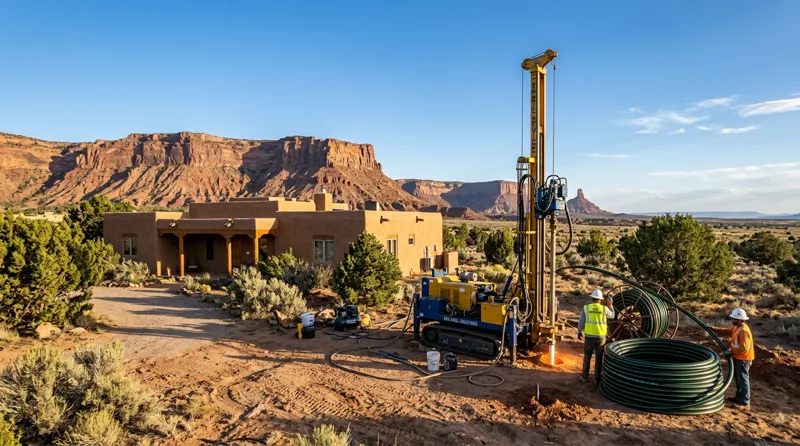
New Mexico is the Land of Enchantment — and for geothermal heat pump economics, it's also the land of brutal honesty. With the 5th cheapest electricity in the nation at 9.18¢/kWh and affordable natural gas, most New Mexican homeowners connected to a gas line will not see a reasonable payback on a geothermal system. That's the truth, and we're going to lead with it. But here's where it gets interesting: if you're one of the thousands of households burning propane in the mountains north of Santa Fe, on the eastern plains, or in rural communities beyond the gas grid, geothermal can cut your heating costs by 60–70% with paybacks under 10 years. This guide covers both realities — because you deserve the real numbers, not a sales pitch.
🔥 Heating with Propane? Get 3 Free Geothermal Quotes
Propane homes in New Mexico have the strongest case for geothermal. Compare prices from certified installers in your area — no obligation, no cost.
Get 3 Free Quotes →The Honest Verdict: Is Geothermal Worth It in New Mexico?
We evaluate every state across eight factors. New Mexico's profile is unusual — strong on some dimensions, weak on others. Your fuel source matters more here than in almost any other state.
| Factor | Rating | Details |
|---|---|---|
| Climate Suitability | ⭐⭐⭐⭐ | Large heating/cooling swings at altitude make heat pumps efficient. 5,000–7,000+ HDD in the north. |
| Electricity Cost | ⭐⭐ (low = harder ROI) | 9.18¢/kWh — 5th cheapest in the U.S. Great for running a GSHP, but also means cheap resistance heat and swamp coolers. |
| Current Heating Cost | ⭐⭐⭐⭐⭐ (propane) / ⭐⭐ (gas) | Propane at $2.50–$3.50/gal = high cost to displace. Natural gas at $0.80–$1.10/therm = very hard to beat. |
| State Incentives | ⭐ | No state-specific geothermal incentives. Zero rebates, zero state tax credits. Federal 30% credit is it. |
| Ground Conditions | ⭐⭐⭐ | Varies wildly — sandy soil in the Rio Grande Valley (good), caliche and hard rock in the mountains (expensive drilling). |
| Water Rights / Open-Loop | ⭐ | Strict prior appropriation doctrine. Open-loop systems require water rights permits and face severe restrictions. Essentially dead for residential. |
| Installer Availability | ⭐⭐ | Limited. Fewer than 15 certified GSHP installers statewide. Most concentrated in ABQ and Santa Fe corridors. |
| Overall ROI Potential | ⭐⭐⭐ (propane) / ⭐ (gas) | Propane homes: 7–10 year payback. Gas homes: 40–50 years. The split is enormous. |
Bottom line: If you heat with propane, geothermal is one of the best investments you can make in New Mexico. If you heat with natural gas and cool with a swamp cooler, it's one of the worst. Know which camp you're in before you spend another minute researching.
Why New Mexico Is Complicated for Geothermal
Most geothermal guides will tell you that ground-source heat pumps work everywhere. That's technically true — the ground temperature 6 feet below your yard is a stable 55–62°F across New Mexico, and a geothermal heat pump can extract or reject heat into that reservoir year-round. The physics work. The economics often don't.
Here's why New Mexico creates a perfect storm of challenging economics for the average homeowner:
1. Electricity Is Absurdly Cheap
At 9.18¢/kWh, New Mexico has the 5th cheapest electricity in the nation (EIA 2024 data). That's great if you're running a geothermal system — your operating costs will be low. But it also means your conventional alternatives (gas furnace + swamp cooler) are already cheap to run. The savings gap narrows to almost nothing.
2. Natural Gas Is Also Cheap
New Mexico is a major natural gas producing state. Residents connected to gas lines enjoy some of the lowest gas rates in the country, typically $0.80–$1.10 per therm. A 95% efficient gas furnace heating a 2,000 sq ft home in Albuquerque costs roughly $500–$700 per year. A geothermal system heating the same home costs maybe $250–$400 per year in electricity. That $200–$400 annual savings on a $26,000+ investment makes the math brutal.
3. Swamp Coolers Actually Work Here
This is the factor that out-of-state geothermal salespeople consistently underestimate. In New Mexico's arid climate — Albuquerque averages just 9 inches of rain annually — evaporative coolers (swamp coolers) provide effective, efficient cooling for $50–$150 per summer. A rooftop swamp cooler costs $1,500–$3,000 installed. A geothermal system that also provides cooling costs $24,000–$32,000. When your existing cooling solution costs 1/10th as much and works 90% as well, the cooling benefit of geothermal essentially disappears from the ROI calculation.
4. No State Incentives Exist
Unlike Colorado with its utility rebates or states with dedicated renewable heating programs, New Mexico offers zero state-level incentives for geothermal heat pumps. No state tax credit, no rebate program, no low-interest loan fund. The 30% federal tax credit (through 2032) is your only incentive — unless you qualify for USDA REAP (more on that below).
5. Water Rights Make Open-Loop Nearly Impossible
New Mexico follows the prior appropriation doctrine — "first in time, first in right" — and every drop of water is legally allocated. Open-loop geothermal systems that pump groundwater need permits from the New Mexico Office of the State Engineer (OSE), and in most basins, new appropriations are either restricted or subject to lengthy adjudication. For practical purposes, open-loop is dead for residential applications in New Mexico.
The Propane Opportunity: Where Geothermal Actually Makes Sense
Now let's talk about where the economics flip entirely. Thousands of New Mexico households — concentrated in the northern mountains, eastern plains, and scattered rural communities — heat with propane because natural gas pipelines don't reach them. And propane in New Mexico is expensive.
At $2.50–$3.50 per gallon (2024–2025 prices), propane heating a 2,000 sq ft home in the mountains near Taos or Angel Fire can easily cost $3,000–$5,000 per winter. Some larger or older homes spend $6,000+. Replace that with a geothermal system running on 9.18¢/kWh electricity, and annual heating costs drop to $600–$1,000. The savings are real, immediate, and substantial.
The best candidates for geothermal in New Mexico are:
- Propane-heated homes — savings of $2,000–$4,000/year make paybacks of 7–10 years achievable
- New construction — installing during the build avoids retrofit costs and can be rolled into the mortgage
- Rural agricultural properties — eligible for USDA REAP grants covering up to 50% of costs
- Homes replacing aging propane furnaces — if you need a new furnace anyway, the incremental cost of geothermal shrinks
- Off-grid or hybrid solar homes — New Mexico's excellent solar resource (#4 in the nation) pairs perfectly with geothermal
New Mexico's Five Geothermal Regions
New Mexico spans from 2,800 ft elevation at the southern border to over 13,000 ft in the Sangre de Cristos. Climate, ground conditions, fuel availability, and economics vary dramatically by region.
Region 1: Northern New Mexico — Santa Fe, Taos, Los Alamos
Climate: Heating-dominant. 6,000–7,500 HDD at 6,800–7,200 ft elevation. Cold winters (lows in the teens), mild summers. Many homes don't have conventional AC at all — they open windows in summer.
Fuel mix: Mix of natural gas (Santa Fe, Los Alamos) and propane (rural Taos County, mountain communities). This is the heart of New Mexico's propane belt.
Ground conditions: Rocky soils and decomposed granite in the mountains. Drilling costs run 15–25% above state average. Horizontal loops are often impractical due to rocky terrain and small lots in historic districts.
Geothermal potential: ⭐⭐⭐⭐ for propane homes, ⭐⭐ for gas homes. The high heating demand and expensive propane create strong savings. Hot springs throughout the Jemez Mountains (Ojo Caliente, Jemez Springs) hint at the geothermal energy literally underfoot — though residential GSHP systems tap shallow ground heat, not deep hydrothermal resources.
Cultural note: Northern New Mexico's iconic adobe homes have thick thermal mass walls that naturally moderate temperature swings — making them ideal partners for geothermal's steady, low-temperature output. A heat pump providing 95°F water works beautifully with radiant floor heating in an adobe home that holds heat for hours.
Region 2: Central New Mexico — Albuquerque Metro, Rio Rancho, Valencia County
Climate: Balanced. 4,200–4,800 HDD at 5,000–5,300 ft. Cold enough to need heat (November–March), warm enough to want cooling (June–September). Classic four-season climate.
Fuel mix: Nearly universal natural gas via PNM and New Mexico Gas Company. Very few propane homes in the metro area.
Ground conditions: Rio Grande Valley alluvial soils — sandy, easy to drill, good thermal conductivity. The best drilling conditions in the state. However, caliche layers (hardened calcium carbonate) can appear at various depths and slow drilling.
Geothermal potential: ⭐⭐ overall. Despite excellent ground conditions, the cheap gas + cheap electricity + effective swamp coolers combination makes ROI difficult. The Meta data center in Los Lunas demonstrates that large-scale ground-source cooling works in this region — but commercial economics don't translate to residential.
Region 3: Southern New Mexico — Las Cruces, Deming, Alamogordo
Climate: Cooling-dominant. 2,800–3,500 HDD but 1,800–2,400 CDD at 3,800–4,300 ft. Long, hot summers reaching 100°F+. Mild winters with occasional freezes.
Fuel mix: El Paso Electric territory for electricity. Natural gas available in cities. Some propane in rural Doña Ana and Luna counties.
Ground conditions: Desert soils, generally sandy with low moisture content. Ground temperatures around 62–65°F. Adequate for closed-loop but low soil moisture reduces thermal conductivity.
Geothermal potential: ⭐⭐. The cooling-dominant climate means you're comparing geothermal to conventional AC (not just swamp coolers), which improves the cooling side of the equation. But cheap electricity still limits savings. Best opportunities are in new construction where geothermal can be the sole HVAC system.
Region 4: Eastern Plains — Clovis, Portales, Tucumcari, Roswell
Climate: Continental. 4,000–5,000 HDD with significant temperature swings. Hot summers, cold winters, persistent wind.
Fuel mix: Mix of natural gas (larger towns on pipelines) and propane (rural farms and ranches). Xcel Energy/Southwestern Public Service provides electricity.
Ground conditions: Generally good — flat terrain with deep soil profiles. The Ogallala Aquifer underlies portions of the eastern plains, but water rights restrictions prevent open-loop use.
Geothermal potential: ⭐⭐⭐ for propane farms/ranches, ⭐⭐ for gas homes. The big opportunity here is USDA REAP — Rural Energy for America Program grants can cover 25–50% of geothermal system costs for agricultural producers and rural small businesses. Combined with the 30% federal tax credit, a rancher could install a $30,000 system for under $10,000 out of pocket.
Region 5: Mountain and Ski Country — Ruidoso, Angel Fire, Red River, Cloudcroft
Climate: Heavily heating-dominant. 5,500–8,000+ HDD at 6,800–9,000 ft. Some of the coldest temperatures in the state. Short, cool summers.
Fuel mix: Predominantly propane. These mountain communities are generally beyond gas pipeline reach.
Ground conditions: Challenging. Rocky mountain terrain with shallow bedrock in many areas. Drilling costs are the highest in the state — expect to pay 25–40% above average for vertical bore installation.
Geothermal potential: ⭐⭐⭐⭐ despite drilling costs. The combination of extreme propane costs ($4,000–$7,000/year for many homes), high heating demand, and minimal cooling needs creates strong savings. Even with elevated installation costs, paybacks of 8–12 years are common. Many ski-area vacation homes are also good candidates, especially those with radiant floor heating already installed.
New Mexico Geology & Drilling Conditions by Region
New Mexico's geology is among the most varied in the western U.S. — from ancient Precambrian granite in the Sangre de Cristos to young alluvial sediments in the Rio Grande Rift. Understanding your local geology is critical because drilling costs can double between the easiest and hardest formations. This table summarizes what to expect by region, based on data from the New Mexico Bureau of Geology and Mineral Resources (NMBGMR) and contractor experience.
| Region | Dominant Geology | Thermal Conductivity (BTU/hr·ft·°F) | Drilling Cost/ft | Typical Bore Depth | Key Challenge |
|---|---|---|---|---|---|
| Rio Grande Valley (ABQ/Socorro) | Quaternary alluvium, sand/gravel, Rio Grande Rift fill | 0.8–1.2 | $12–$16/ft | 200–275 ft | Caliche layers at 5–30 ft can slow drilling; generally easy below caliche |
| Santa Fe Basin | Tesuque Formation sediments, decomposed granite, volcanic tuff | 0.7–1.0 | $16–$22/ft | 225–300 ft | Mixed formations — can transition from soft sediment to hard rock mid-bore |
| Taos/Sangre de Cristo Mountains | Precambrian granite, gneiss, schist, thin soil over bedrock | 1.2–1.6 | $20–$28/ft | 250–325 ft | Hard rock = expensive drilling but excellent conductivity; limited horizontal loop sites |
| Jemez Mountains / Los Alamos | Bandelier Tuff, volcanic deposits, Valles Caldera ignimbrite | 0.6–0.9 | $15–$22/ft | 225–300 ft | Highly variable — tuff is soft but low conductivity; proximity to hot springs can elevate ground temps |
| Eastern Plains (Clovis/Roswell) | Ogallala Formation, caliche cap, deep alluvial fill | 0.7–1.0 | $11–$15/ft | 200–250 ft | Thick caliche cap (2–10 ft) requires hammer drilling; soft below. Flattest terrain = horizontal loop viable. |
| Southern NM (Las Cruces/Deming) | Bolson fill, desert alluvium, Mesilla Basin sediments | 0.6–0.9 | $13–$17/ft | 200–275 ft | Low soil moisture reduces conductivity; ground temps higher (62–65°F) — less heating benefit |
| Mountain/Ski Country (Ruidoso/Angel Fire) | Permian limestone, sandstone, mountain granite, shallow bedrock | 1.0–1.5 | $22–$32/ft | 250–350 ft | Most expensive drilling in NM; bedrock at 3–15 ft in many locations; mobilization costs for remote sites |
Key takeaway: If you're in the Rio Grande Valley or eastern plains, drilling is straightforward and affordable. In mountain areas, expect to pay 50–100% more per foot due to hard rock. Always get a site-specific assessment — New Mexico's geology can change dramatically within a few miles, especially near fault zones in the Rio Grande Rift.
Caliche — New Mexico's drilling wildcard: Caliche (also called "calcrete" or "hardpan") is a layer of calcium carbonate–ceite soil found across much of New Mexico at depths of 1–30 feet. It ranges from a few inches thick in the Rio Grande Valley to several feet on the eastern plains. Standard rotary drilling slows dramatically in caliche — many NM drillers switch to air hammer or percussion methods. Ask your contractor specifically about caliche strategy during the bidding process. A driller who hasn't worked in your specific area may significantly underestimate this challenge.
NMBGMR well log database: Before committing to a geothermal installation, check the New Mexico Bureau of Geology well log database for nearby water well records. These logs reveal the exact geology at depth near your property — formation types, water table depth, and rock hardness. An experienced driller will pull these logs during the quoting process, but it's worth checking yourself to verify their assessment.
Regional Cost Breakdown
Installation costs in New Mexico vary significantly by region due to ground conditions, installer availability, and system requirements. All costs shown are for a typical 4-ton system serving a 2,000–2,500 sq ft home with vertical closed-loop installation.
| Region | Avg. System Cost | After 30% Federal Credit | Drilling Premium | Primary Fuel Displaced | Typical Payback |
|---|---|---|---|---|---|
| Northern NM (Taos, Santa Fe) | $27,000–$32,000 | $18,900–$22,400 | +15–25% | Propane / Gas | 8–10 yr (propane) / 40+ yr (gas) |
| Central NM (ABQ Metro) | $24,000–$28,000 | $16,800–$19,600 | Baseline | Natural Gas | 40–50 yr |
| Southern NM (Las Cruces) | $25,000–$29,000 | $17,500–$20,300 | +5–10% | Natural Gas / Electric | 30–45 yr |
| Eastern Plains (Clovis, Roswell) | $24,000–$28,000 | $16,800–$19,600 | Baseline | Propane / Gas | 7–9 yr (propane) / 35+ yr (gas) |
| Mountain / Ski Country | $29,000–$35,000 | $20,300–$24,500 | +25–40% | Propane | 8–12 yr |
Why the wide ranges? Ground conditions are the biggest variable. Drilling through caliche or hard rock in the mountains can add $3,000–$8,000 to a project versus sandy Rio Grande Valley soils. Installer travel costs also matter — if the nearest certified GSHP installer is 2 hours away (common outside ABQ/Santa Fe), mobilization charges add up.
Loop Type Comparison for New Mexico
The choice of loop configuration is more constrained in New Mexico than in most states. Here's how each option stacks up:
| Loop Type | Installed Cost (4-ton) | Best For | NM Viability | Notes |
|---|---|---|---|---|
| Vertical Closed-Loop | $24,000–$35,000 | Most NM properties | ✅ Primary option | 2–4 boreholes, 200–300 ft each. Works in all soil types. Higher cost in rock. |
| Horizontal Closed-Loop | $18,000–$25,000 | Rural properties with acreage | ✅ Where land allows | Needs 1,500–2,500 sq ft of trench area. Great for ranches/farms. Rocky soil limits options. |
| Slinky / Spiral Loop | $17,000–$23,000 | Properties with moderate land | ✅ Good option | Compact horizontal variant. Needs less land than straight horizontal. |
| Open-Loop (Groundwater) | $15,000–$22,000 | Properties with water rights | ❌ Effectively dead | Requires OSE water rights permit. Most basins are fully appropriated. Don't count on this. |
| Pond/Lake Loop | $16,000–$24,000 | Properties with ponds | ⚠️ Rare | Few permanent water bodies in NM. Stock ponds on ranches are seasonal. Very limited applicability. |
For most New Mexico installations, vertical closed-loop is the default. Land constraints in Santa Fe's historic districts and Albuquerque's established neighborhoods typically rule out horizontal loops. Rural properties and ranches on the eastern plains are the exception — if you have the acreage, horizontal loops save $5,000–$10,000 over vertical.
Open-Loop Reality: Water Rights Kill It
In many eastern and midwestern states, open-loop geothermal systems offer the lowest installation cost and highest efficiency. In New Mexico, they're a regulatory dead end. Here's the detailed assessment:
| Factor | Status in New Mexico | Impact |
|---|---|---|
| Water Rights Doctrine | Prior appropriation ("first in time, first in right") | All water is legally allocated. New appropriations require proving no impairment to existing rights. |
| Permitting Authority | NM Office of the State Engineer (OSE) | Permits required for any groundwater withdrawal, including geothermal return-flow systems. |
| Basin Status | Most basins fully or over-appropriated | New permits in the Rio Grande, Pecos, and San Juan basins are extremely difficult to obtain. |
| Return Flow Credit | Possible but not guaranteed | Even with 100% return to aquifer, OSE may require full consumptive-use permit. |
| Typical Timeline | 6–24 months for permit review | Project delays make open-loop impractical for most homeowners. |
| Legal Costs | $3,000–$10,000 for water rights attorney | Adds substantial cost to an already expensive proposition. |
| Standing Injection Well (Class V UIC) | EPA permit also required for return wells | Additional regulatory layer beyond state water rights. |
| Practical Recommendation | Do not pursue open-loop in NM | Closed-loop avoids all water rights issues. Period. |
If an installer suggests open-loop in New Mexico without mentioning water rights permits, that's a red flag. Any reputable installer in the state will default to closed-loop systems.
12-Month Energy Profile: ABQ Metro (2,000 sq ft Home)
This table shows estimated monthly energy use and costs for a typical 2,000 sq ft home in the Albuquerque metro area, comparing a conventional gas furnace + swamp cooler setup against a geothermal heat pump system. Both assume 9.18¢/kWh electricity and $0.90/therm gas.
| Month | Conventional: Gas + Swamp | Geothermal System | Monthly Savings | Notes |
|---|---|---|---|---|
| January | $105 (gas $85, elec $20) | $55 | $50 | Peak heating month. GSHP COP ~3.8 |
| February | $90 (gas $70, elec $20) | $48 | $42 | Cold but shorter month |
| March | $65 (gas $45, elec $20) | $38 | $27 | Shoulder season — heating tapering off |
| April | $30 (gas $10, elec $20) | $22 | $8 | Minimal heating/cooling. Windows open. |
| May | $25 (elec only) | $20 | $5 | No heating. Swamp cooler starts. |
| June | $45 (elec $35, water $10) | $42 | $3 | Swamp cooler vs. GSHP cooling — nearly equal cost |
| July | $65 (elec $45, water $20) | $55 | $10 | Monsoon humidity reduces swamp cooler effectiveness |
| August | $60 (elec $40, water $20) | $50 | $10 | Monsoon continues. GSHP advantage in humidity. |
| September | $35 (elec $25, water $10) | $28 | $7 | Cooling demand dropping |
| October | $40 (gas $20, elec $20) | $25 | $15 | First heating. Furnace fires up. |
| November | $75 (gas $55, elec $20) | $42 | $33 | Heating season ramps up |
| December | $100 (gas $80, elec $20) | $52 | $48 | Near-peak heating |
| Annual Total | $735 | $477 | $258 | Savings don't justify $26K investment |
The uncomfortable truth: A $258 annual savings on an $18,200 net investment (after 30% tax credit) yields a simple payback of 70+ years for this specific scenario. Even accounting for propane price escalation, maintenance savings, and equipment longevity benefits, the payback period for a gas-heated, swamp-cooled home in ABQ hovers around 40–50 years. That's not an investment — that's a donation.
Now compare the same table for a propane-heated home in Taos (6,900 ft elevation, ~6,500 HDD) and the annual savings jump to $2,000–$3,000. Same technology, completely different economics.
Case Study 1: Taos Propane Adobe Home — The Win
Property Profile
- Location: Taos, NM (elevation 6,969 ft)
- Home: 2,200 sq ft adobe with addition, built 1985
- Previous heating: Propane forced-air furnace (82% AFUE) + wood stove supplement
- Previous cooling: Evaporative cooler (rarely needed at altitude)
- Annual propane use: ~900 gallons at $2.85/gal = $2,565/year
- Annual wood cost: ~2 cords at $250/cord = $500/year
- Total annual heating cost: $3,065
Geothermal Installation
- System: 4-ton WaterFurnace 7 Series, variable-speed, desuperheater for domestic hot water
- Loop: Vertical closed-loop, 3 boreholes × 250 ft (rocky terrain required extra depth)
- Distribution: Retained existing ductwork + added radiant floor heating in main living area
- Total installed cost: $28,000
- 30% federal tax credit: –$8,400
- Net cost: $19,600
Results (First Full Year)
- Annual electricity for GSHP: $665 (7,240 kWh at 9.18¢/kWh)
- Previous annual cost: $3,065
- Annual savings: $2,400
- Simple payback: 8.2 years (on net cost)
- Bonus: Desuperheater provides ~60% of domestic hot water, saving an additional $180/year on the electric water heater
Homeowner Notes
"The adobe walls hold heat so well that the geothermal system barely runs during the shoulder seasons. In January, it runs more, but we've never seen a monthly electric bill over $120 for the whole system. Compared to watching that propane gauge drop and writing $800 checks to the propane company every six weeks in winter, this is life-changing. The house has never been more comfortable — radiant floor heat in an adobe is how these houses were meant to be heated."
Verdict: Excellent investment. The $19,600 net cost will be fully recovered in under 9 years, and the system has a 25+ year expected lifespan. Every year after payback is pure savings of $2,400+.
Case Study 2: Albuquerque Gas Home — The Honest Math
Property Profile
- Location: Albuquerque NE Heights (elevation 5,350 ft)
- Home: 2,400 sq ft stucco, built 2003, well-insulated
- Previous heating: 95% AFUE natural gas furnace
- Previous cooling: Mastercool evaporative cooler (rooftop unit)
- Annual gas heating cost: $580 (645 therms at $0.90/therm)
- Annual swamp cooler cost: ~$120 electricity + $80 water = $200
- Total annual HVAC cost: $780
Geothermal Installation (Quoted)
- System: 4-ton Bosch Greensource IHP, dual-stage
- Loop: Vertical closed-loop, 2 boreholes × 275 ft
- Total quoted cost: $26,000
- 30% federal tax credit: –$7,800
- Net cost: $18,200
Projected Results
- Estimated annual GSHP electricity: $380 (4,140 kWh at 9.18¢/kWh)
- Previous annual cost: $780
- Annual savings: $400
- Simple payback: 45.5 years
Our Honest Assessment
This installation does not make financial sense. A 45.5-year simple payback far exceeds the 25-year equipment lifespan. Even with optimistic assumptions — gas price increases of 3% annually, the homeowner would still be looking at a 25–30 year payback. The system provides superior comfort (true air conditioning versus evaporative cooling), which has value during Albuquerque's July monsoon season when humidity spikes render swamp coolers less effective. But that comfort premium costs $18,200 — you could install a mini-split AC system for monsoon season for $3,000–$5,000 and keep your gas furnace for decades.
Verdict: Not recommended. The homeowner wisely decided not to proceed. If this home heated with propane instead of gas, the same system would have a 7–8 year payback. Fuel source changes everything.
Case Study 3: Santa Fe New Construction + Solar — The All-Electric Dream
Property Profile
- Location: Santa Fe, NM (elevation 7,199 ft) — new construction in a master-planned community south of town
- Home: 2,800 sq ft contemporary adobe-style, passive solar design, radiant floor heating, R-30 walls, R-49 roof
- Builder HVAC quote (conventional): 96% AFUE gas furnace + evaporative cooler = $8,500 installed
- Climate: 6,200 HDD, heating-dominant. Summer highs reach low 90s but low humidity makes open windows workable most days.
Geothermal + Solar Installation
- Geothermal: 5-ton WaterFurnace 7 Series with desuperheater, vertical closed-loop (3 bores × 275 ft in Santa Fe Basin sediments)
- Solar: 8 kW rooftop array (20 × 400W panels, south-facing, 6.4 peak sun hours)
- Solar production: ~14,600 kWh/year (8 kW × 6.4 hrs × 365 × 0.78 derating)
- Geothermal system cost: $32,000
- Solar system cost: $22,400 ($2.80/watt)
- Combined gross cost: $54,400
- 30% federal credit on both: –$16,320
- NM solar tax credit (10%, up to $6,000): –$2,240
- Net combined cost: $35,840
- Incremental vs. builder HVAC + no solar: $35,840 – $8,500 = $27,340 net incremental
Annual Energy Economics
- Total home electricity consumption (including GSHP): ~12,500 kWh/year
- Solar production: ~14,600 kWh/year (net exporter)
- Net annual electricity cost: ~$0 (PNM net metering credits offset winter usage with summer overproduction)
- Conventional alternative annual cost: Gas heating $850/yr + swamp cooler $150/yr + household electric $920/yr = $1,920/year
- Annual savings vs. conventional: $1,920/year
- Simple payback on incremental cost: $27,340 ÷ $1,920 = 14.2 years
- Mortgage impact: $27,340 added to a 30-year mortgage at 6.5% = $173/month additional payment. Energy savings = $160/month. Near cash-flow neutral from day one.
Why This Works
New construction changes the equation fundamentally. You're not comparing "$32,000 geothermal vs. keep my existing furnace" — you're comparing "$32,000 geothermal vs. $8,500 conventional HVAC that needs replacement in 15–20 years." The incremental cost is smaller, it's rolled into the mortgage (no upfront cash), and the combined solar + geothermal system eliminates utility bills entirely. In New Mexico's 300+ days of sunshine, the solar array produces more than the geothermal system consumes. The passive solar adobe design — thermal mass walls, south-facing windows, tile floors — reduces heating load so the GSHP barely cycles during shoulder seasons.
Verdict: Strong investment for new construction. Near cash-flow neutral when financed, eliminates all utility costs, and the home is a genuine net-zero energy producer. The system adds significant resale value in Santa Fe's eco-conscious luxury market where buyers actively seek net-zero homes. At $2.85/gal propane (the alternative in many Santa Fe-area homes), the savings would be even larger.
Incentives & Rebates: What's Actually Available
Let's be direct: New Mexico's incentive landscape for geothermal heat pumps is thin. There are no state-specific programs. Here's what you can stack:
| Incentive | Value | Eligibility | Stackable? | Notes |
|---|---|---|---|---|
| Federal Residential Clean Energy Credit (25D) | 30% of total installed cost | All homeowners with federal tax liability | Yes — with all others | No cap. Includes equipment, labor, drilling, ductwork modifications. Expires end of 2032 (steps down to 26% in 2033). |
| USDA REAP Grant | 25–50% of project cost (up to $500,000) | Rural small businesses and agricultural producers | Yes — with federal tax credit | Competitive grant program. Rural NM ranches and farms are excellent candidates. Application rounds typically April and October. |
| USDA REAP Loan Guarantee | Up to 75% loan guarantee | Same as REAP Grant | Yes — can combine grant + loan guarantee | Reduces lender risk, improving loan terms for rural borrowers. |
| Utility Rebates | $0 | N/A | N/A | No NM utility currently offers GSHP rebates. PNM, El Paso Electric, Xcel/SPS, Kit Carson — none have programs. |
| NM State Tax Credit | $0 | N/A | N/A | New Mexico has solar and wind tax credits but NO geothermal heat pump tax credit. |
| NM Sustainable Building Tax Credit | Up to $10,600 for new homes | New construction meeting LEED Silver or Build Green NM | Yes — with federal credit | Not geothermal-specific, but a GSHP can help qualify the home for green building certification. |
| Property Tax Exemption | Partial — value added by renewable energy systems excluded from assessment | Systems meeting statutory definition | Yes | NM NMSA §7-36-21.3 — geothermal systems may qualify. Consult county assessor. |
Best-Case Incentive Stack: REAP-Eligible Rural Ranch
For a rancher on the eastern plains installing a $28,000 geothermal system:
- USDA REAP Grant (40%): –$11,200
- Remaining cost: $16,800
- Federal 30% tax credit on remaining: –$5,040
- Final net cost: $11,760
- With $2,500/year propane savings: 4.7-year payback
That's the best geothermal deal available anywhere in New Mexico. If you're a rural agricultural producer heating with propane, REAP should be your first phone call.
How to Claim the Federal Tax Credit (IRS Form 5695)
The 30% Residential Clean Energy Credit is the single most important incentive for New Mexico homeowners. Here's exactly how to claim it:
Step 1: Confirm Your System Qualifies
Your geothermal heat pump must meet ENERGY STAR requirements at the time of installation. All major brands (WaterFurnace, ClimateMaster, Bosch, Carrier) sold in 2024–2026 meet this standard. Keep the ENERGY STAR certification documentation from your installer.
Step 2: Gather Your Documentation
Collect all invoices and receipts for: equipment purchase, ground loop installation (drilling/trenching), indoor unit installation, ductwork modifications, desuperheater installation, and any directly related electrical work. All of these costs qualify for the 30% credit.
Step 3: Calculate Your Total Qualified Expenditure
Add up all qualifying costs. There is no dollar cap on the credit — 30% of the total is your credit amount. For a $28,000 installation, your credit is $8,400.
Step 4: Complete IRS Form 5695, Part I
Download Form 5695 (Residential Energy Credits) from irs.gov. Enter your qualified geothermal heat pump property costs on Line 3. The form walks you through calculating 30% on Line 13.
Step 5: Transfer to Form 1040
The credit amount from Form 5695 transfers to Schedule 3 (Form 1040), Line 5. This directly reduces your federal tax liability dollar-for-dollar — it's a credit, not a deduction.
Step 6: Handle Excess Credit (If Needed)
If your tax credit exceeds your federal tax liability for the year, you can carry the unused portion forward to future tax years. For example, if your credit is $8,400 but your tax liability is only $5,000, you claim $5,000 this year and carry $3,400 forward.
Step 7: Keep Records for 3+ Years
Retain all invoices, the ENERGY STAR certification, Form 5695, and your contractor's documentation for at least 3 years after filing (the IRS standard audit window). If you carry forward credits, keep records until 3 years after claiming the final portion.
Permits & Licensing in New Mexico
New Mexico's permitting landscape for geothermal heat pumps involves multiple agencies. Understanding these requirements upfront prevents costly delays — especially for the drilling component, which is more regulated in NM than in many states.
Contractor Licensing: NM Construction Industries Division (CID)
All HVAC and mechanical work in New Mexico is regulated by the Construction Industries Division (CID) under the Regulation and Licensing Department (RLD). Your geothermal installer must hold appropriate CID licensing:
| License Type | Required For | How to Verify |
|---|---|---|
| MM98 — Mechanical | All mechanical system installation including HVAC, heat pumps, ductwork, piping | rld.nm.gov/construction-industries/ → License Lookup |
| GB98 — General Building | General contractors who subcontract mechanical work; must use licensed MM98 sub for HVAC | Same RLD lookup |
| EE98 — Electrical | Electrical connections, panel upgrades, dedicated circuits for heat pump unit | Same RLD lookup — separate license from mechanical |
Important: New Mexico does NOT have a specific "geothermal contractor" license class. GSHP installations are performed under the general mechanical (MM98) license. This means your contractor's IGSHPA certification is even more important as a measure of geothermal-specific competence — the state license alone doesn't distinguish between someone who installs furnaces and someone who designs ground loop fields.
Well Driller Licensing: Office of the State Engineer (OSE)
Vertical borehole drilling for closed-loop geothermal systems in New Mexico falls under the jurisdiction of the Office of the State Engineer (OSE) per NMAC 19.27.4 (Well Driller Licensing). Key requirements:
- Licensed well driller required: Per NMSA §72-12-12, it is unlawful to drill any well for underground water without an OSE well driller's license. Geothermal boreholes that penetrate the water table require a licensed driller.
- Drill rig supervisor registration: Each drill rig must have a registered supervisor on-site per NMAC 19.27.4.
- Closed-loop exception: Closed-loop boreholes that are grouted and sealed and do not produce or consume water may qualify for simplified permitting. However, because most NM vertical bores pass through water-bearing formations, the safe practice is to use an OSE-licensed driller regardless.
- Well completion report: Required within 20 days of completing any borehole, documenting depth, formations encountered, grouting method, and water levels encountered.
County Building Permits
Building permit requirements vary by county. Here's what to expect in the major jurisdictions:
| Jurisdiction | Permit Required? | Approximate Cost | Timeline | Notes |
|---|---|---|---|---|
| City of Albuquerque | Yes — mechanical permit | $150–$350 | 1–3 weeks | Standard HVAC mechanical permit. Inspection required before backfill of loop trenches. |
| Santa Fe County | Yes — mechanical + possibly land use | $200–$500 | 2–4 weeks | Historic districts may require additional review for ground disturbance. Adobe structural considerations. |
| Bernalillo County | Yes — mechanical permit | $150–$300 | 1–3 weeks | Follows City of ABQ code in most areas. |
| Taos County | Yes — mechanical permit | $100–$250 | 1–2 weeks | Less backlog than urban counties. Well driller may need to file with county as well as OSE. |
| Doña Ana County (Las Cruces) | Yes — mechanical permit | $150–$300 | 1–3 weeks | El Paso Electric service territory — electrical permit separate. |
| Rural/unincorporated counties | Varies — some have no building department | $0–$200 | 0–2 weeks | Many rural NM counties have minimal permitting. Still need OSE well driller compliance. |
Special Considerations
- Historic districts: Santa Fe's historic eastside, the Taos Pueblo Buffer Zone, and other historic areas may restrict ground disturbance. Drilling equipment access can be challenging in narrow streets with adobe walls. Discuss site access with your installer before signing a contract.
- Acequia easements: Many northern NM properties have acequia (irrigation ditch) easements. Loop fields and boreholes must not obstruct acequia access or damage ditch infrastructure. Coordinate with your local acequia commission.
- HOA restrictions: Some newer developments in Rio Rancho, ABQ, and Santa Fe may have HOA restrictions on ground disturbance or exterior equipment placement. Review CC&Rs before committing. New Mexico does not have a statewide HOA override law for renewable energy equipment the way some states do.
- Septic setbacks: Properties on septic systems must maintain setback distances between boreholes and the septic field (typically 50–100 ft). On smaller lots, this can constrain loop field placement.
Permit Timeline Summary
| Step | Typical Timeline | Who Handles It |
|---|---|---|
| CID license verification | Same day | Homeowner (online lookup at rld.nm.gov) |
| County mechanical permit application | 1–4 weeks for approval | Installer files on your behalf |
| OSE well driller compliance verification | Same day (license check) | Homeowner verifies; driller provides license number |
| Drilling + loop installation | 2–5 days on-site | Licensed driller + installer crew |
| Mechanical inspection | 1–3 days after completion | County inspector |
| Well completion report filing | Within 20 days of drilling | Licensed driller files with OSE |
| Total typical project timeline | 4–8 weeks |
Finding & Vetting a Qualified Installer in New Mexico
New Mexico's limited installer pool is both a challenge and a reason to be extremely selective. With fewer than 15 IGSHPA-certified installers statewide, you may need to look beyond your immediate area — but that limited competition also means vetting is critical.
Where to Find Installers
| Resource | URL | What You'll Find |
|---|---|---|
| IGSHPA Installer Directory | igshpa.org | IGSHPA-certified designers and installers searchable by state. The gold standard. |
| WaterFurnace Dealer Locator | waterfurnace.com | Factory-trained WaterFurnace dealers in NM. Typically 3–5 active. |
| ClimateMaster Dealer Locator | climatemaster.com | ClimateMaster-certified dealers. |
| Bosch Contractor Locator | bosch-thermotechnology.us | Bosch Greensource certified contractors. |
| NM RLD License Lookup | rld.nm.gov | Verify any contractor's CID license status, classification, and disciplinary history. |
| GeoExchange Directory | geoexchange.org | Industry association directory of geothermal professionals. |
Regional Installer Availability
| Region | Estimated Active GSHP Contractors | Typical Wait Time | Notes |
|---|---|---|---|
| Albuquerque Metro | 5–8 | 4–8 weeks | Best selection in the state. Some also serve Santa Fe. |
| Santa Fe / Los Alamos | 3–5 | 6–10 weeks | Mix of local + ABQ-based contractors willing to travel. Higher mobilization costs. |
| Taos / Northern Mountains | 1–3 | 8–14 weeks | Very limited. Some contractors travel from Santa Fe or ABQ (add $500–$1,500 mobilization). |
| Las Cruces / Southern NM | 2–4 | 6–10 weeks | Some El Paso TX-based contractors serve southern NM. Verify NM CID license. |
| Eastern Plains | 1–2 | 10–16 weeks | Most underserved region. May need to bring in ABQ or Lubbock TX-area contractors. |
| Mountain / Ski Country | 1–2 | 10–16 weeks | Remote access adds cost. Limited drillers experienced in hard rock at altitude. |
The 8-Point Vetting Checklist
Before signing a contract with any geothermal installer in New Mexico, verify all eight:
- ✅ NM CID license (MM98 or GB98 with MM98 sub) — Verify at rld.nm.gov. Check for any disciplinary actions or complaints. Do not accept an out-of-state license.
- ✅ IGSHPA certification — Current Accredited Installer or Certified GeoExchange Designer credential. Ask for the certificate number and verify at igshpa.org.
- ✅ OSE-licensed well driller — If the installer subcontracts drilling (most do), verify the driller holds a current NM OSE well driller's license per NMSA §72-12-12. Ask for the license number.
- ✅ Manual J load calculation — The installer must perform a room-by-room Manual J heat loss/gain calculation before sizing the system. A "rule of thumb" sizing approach is a disqualifying red flag — oversized or undersized systems waste money.
- ✅ Manufacturer dealer status — Authorized dealer for the specific equipment brand (WaterFurnace, ClimateMaster, Bosch). This ensures factory training and warranty support.
- ✅ Insurance and bonding — General liability ($1M minimum) and workers' compensation. Drilling is inherently risky work — verify coverage before anyone puts a rig on your property.
- ✅ Local installation references — At least 3 completed GSHP installations within 100 miles of your property, completed within the last 3 years. Call the homeowners. Ask about system performance after the first winter.
- ✅ Detailed written proposal — Must include: Manual J calculations, loop field design with bore depths, equipment specifications, total cost broken into line items (equipment, drilling, labor, materials), warranty terms, and projected annual operating cost. Any proposal that's a single lump-sum number without this detail should be rejected.
Red flags to watch for:
- Installer has never worked in New Mexico (doesn't understand caliche, water rights, or CID requirements)
- Quotes a system without visiting the property
- Claims open-loop is viable without mentioning OSE water rights permits
- Cannot provide Manual J calculations
- Lacks IGSHPA certification ("I've been doing HVAC for 30 years" is not a substitute)
- Significant price outlier (more than 25% below other quotes usually means cutting corners on bore depth or grouting)
Key Utilities to Contact
- PNM (Public Service Company of New Mexico) — Largest electric utility, serves ABQ metro and northern NM. No current GSHP rebates but may have rate structures favorable to heat pumps.
- El Paso Electric — Serves Las Cruces and southern NM.
- Xcel Energy / Southwestern Public Service — Serves eastern NM plains.
- Kit Carson Electric Cooperative — Serves Taos County. Progressive co-op that has shown interest in renewable heating.
- Jemez Mountains Electric Cooperative, Continental Divide Electric, and other rural co-ops — May have specific programs or at least can advise on rate impacts.
Ready to Compare Prices? Get 3 Free Quotes
Connect with certified geothermal installers serving your area of New Mexico. Compare system designs, costs, and warranties — completely free, no obligation.
Get 3 Free Quotes →Maintenance & System Longevity
One of geothermal's strongest arguments — especially in New Mexico's harsh environment — is the longevity and low maintenance requirement compared to conventional HVAC systems that must endure extreme UV exposure, temperature swings, and dust storms.
Annual Maintenance Schedule
| Task | Frequency | DIY or Pro? | NM-Specific Notes |
|---|---|---|---|
| Air filter replacement | Every 1–3 months | DIY | Monthly during spring wind season (March–May). NM's notorious dust storms load filters fast. Check bi-weekly in April. |
| Thermostat calibration check | Annually (fall) | DIY | Altitude affects thermostat readings in older units. Verify against a separate thermometer. |
| Loop pressure check | Annually | Professional | Verify loop pressure holds within manufacturer spec. Pressure drops indicate a leak — critical to catch early in NM's dry climate where soil shifts can stress fittings. |
| Antifreeze concentration test | Every 2–3 years | Professional | Methanol or propylene glycol concentration must stay within spec. NM's altitude means ground temps can dip lower than expected in mountain installations — proper freeze protection is essential. |
| Desuperheater flush | Every 2–3 years | Professional | Critical in NM. Hard water (common in ABQ, eastern plains, and Las Cruces) causes mineral buildup in desuperheater heat exchangers. Annual flushing recommended in hard-water areas. |
| Condensate drain cleaning | Annually (before monsoon) | DIY | Dust buildup in condensate lines during dry months. Clean in June before July monsoon humidity arrives. |
| Ductwork inspection | Every 3–5 years | Professional | NM homes often have ductwork in unconditioned crawlspaces or attics where temperatures hit 140°F+. Check for separation, seal integrity, and insulation degradation. |
| Full system tune-up | Annually (fall) | Professional | Refrigerant charge, electrical connections, compressor amps, entering/leaving water temperatures. Schedule for September before heating season. |
Component Lifespan
| Component | Expected Lifespan | Replacement Cost | NM-Specific Factors |
|---|---|---|---|
| Ground loop (HDPE pipe) | 50+ years | N/A (effectively permanent) | NM's dry, non-corrosive soils are ideal for HDPE longevity. No freeze-thaw soil heaving at depth. |
| Compressor | 15–25 years | $2,500–$4,500 | Altitude reduces air density — not a factor for GSHP compressors (sealed system), but worth noting vs. air-source alternatives that lose efficiency at altitude. |
| Circulating pump | 10–15 years | $400–$800 | Hard water areas may reduce pump life. Annual flush helps. |
| Reversing valve | 15–20 years | $800–$1,500 | Standard lifespan. No NM-specific concerns. |
| Desuperheater | 15–20 years | $600–$1,200 | Hard water scaling is the #1 threat in NM. Flush every 1–2 years in hard-water areas (ABQ, Las Cruces, eastern plains). |
| Air handler / fan coil | 20–25 years | $1,500–$3,000 | Indoor installation protects from NM's extreme UV and dust. Major advantage over outdoor condensing units. |
| Thermostat / controls | 10–15 years | $200–$500 | Smart thermostats can optimize for PNM's time-of-use rates when available. |
The NM longevity advantage: Geothermal's indoor equipment placement is a significant benefit in New Mexico. Conventional AC condensing units sit outside, exposed to 300+ days of intense UV radiation, dust storms, monsoon hail, and temperature swings from -10°F to 110°F. Geothermal heat pumps are installed indoors (basement, mechanical closet, or utility room), protected from all of this. The ground loop is buried and effectively maintenance-free. This is why geothermal systems consistently outlast conventional HVAC in desert climates — the most punishing environmental factors simply don't touch the equipment.
New Mexico vs. Neighboring States
How does New Mexico compare to its neighbors for geothermal viability? The contrast is instructive:
| Factor | New Mexico | Colorado | Arizona | Texas | Utah | Oklahoma |
|---|---|---|---|---|---|---|
| Avg. Electricity Rate | 9.18¢/kWh | 13.96¢/kWh | 12.45¢/kWh | 12.19¢/kWh | 10.13¢/kWh | 10.67¢/kWh |
| Grid CO₂ (lbs/MWh) | 743 | 809 | 733 | 805 | 878 | 659 |
| Primary Heating Fuel | Natural gas / Propane | Natural gas | Electric / Gas | Electric / Gas | Natural gas | Natural gas / Electric |
| State GSHP Incentives | None | Utility rebates (Xcel, Holy Cross) | None | Limited utility rebates | Rocky Mountain Power rebate | None |
| Open-Loop Viability | ❌ Severely restricted | ⚠️ Restricted | ⚠️ Restricted | ✅ Generally available | ⚠️ Varies by district | ✅ Generally available |
| Ground Conditions | Variable (sand to hard rock) | Variable (plains to mountains) | Desert soils, caliche | Generally good (clay, sand) | Variable (valley to mountain) | Generally good (red clay, limestone) |
| Climate Advantage | High altitude = large ΔT | Cold winters = high demand | Extreme cooling demand | High cooling demand | Cold winters at altitude | High cooling + cold winters |
| Installer Density | Low (~15 statewide) | Moderate (40+ Front Range) | Low (~20 statewide) | Growing (100+ statewide) | Low (~20 statewide) | Moderate (30+ statewide) |
| Permitting Complexity | Moderate (CID + OSE) | Moderate (varies by county) | Moderate (ROC + ADWR) | Low–Moderate (TDLR) | Low–Moderate | Low |
| Overall Viability | ⭐⭐ (⭐⭐⭐⭐ for propane) | ⭐⭐⭐ | ⭐⭐ | ⭐⭐⭐ | ⭐⭐⭐ | ⭐⭐⭐ |
New Mexico's cheap electricity is a double-edged sword: it makes geothermal systems cheap to operate but also makes conventional systems cheap to operate. Colorado's higher electricity rates (13.96¢/kWh) actually create better geothermal economics because the baseline energy costs are higher, giving geothermal more room to generate savings. Texas benefits from high cooling loads that keep geothermal systems running year-round, improving utilization. Oklahoma's cheap electricity and cheap gas create similar challenges to NM, but higher cooling demand improves the equation slightly.
The NM paradox: New Mexico has some of the best geological conditions for geothermal in the West (stable ground temps, geothermal hot spots, large temperature differentials at altitude) but some of the worst economic conditions (cheap gas, cheap electricity, effective swamp coolers, no state incentives). The physics are excellent; the checkbook math is brutal — unless you're burning propane.
Swamp Coolers vs. Geothermal: The Elephant in the Room
No honest New Mexico geothermal guide can ignore evaporative cooling. In a state where relative humidity regularly drops below 15%, swamp coolers are devastatingly effective and cheap.
The comparison:
- Mastercool evaporative cooler: $1,800–$3,000 installed, $100–$200/season to run
- Geothermal system (cooling component of total cost): ~$10,000–$15,000 of the system cost is attributable to cooling capacity
- Performance gap: Swamp coolers deliver 65–72°F air in low humidity. Geothermal delivers 55–60°F dehumidified air.
When swamp coolers fall short: July and August monsoon season. When humidity climbs above 30–40%, swamp cooler effectiveness drops sharply. During monsoon weeks, indoor temperatures can climb to 80°F+ even with the swamp cooler running full blast. This is when homeowners with geothermal systems love their investment — the GSHP provides true dehumidified cooling regardless of outdoor humidity.
But is monsoon discomfort worth $18,000+? For most people, no. A ductless mini-split AC unit ($3,000–$5,000 installed) can supplement a swamp cooler during monsoon season for a fraction of the cost. This is why we don't recommend geothermal solely for cooling improvement in arid New Mexico.
Solar + Geothermal Stacking: New Mexico's Hidden Advantage
New Mexico ranks #4 in the nation for solar energy potential, and solar panel costs have dropped to $2.50–$3.00/watt installed. This creates an interesting opportunity for homeowners who want to go all-electric:
The solar-geothermal combo:
- A 6 kW solar array in Albuquerque produces ~10,000 kWh/year — enough to power a 4-ton geothermal system AND offset most household electricity
- Cost: ~$16,000 for solar + $26,000 for geothermal = $42,000 total
- After 30% federal credit on both: $29,400 net
- NM solar tax credit (10%, up to $6,000): potentially –$1,600 additional on solar portion
- Net utility bill: near zero for HVAC
This combination is most compelling for new construction where both systems can be designed together, and for propane homes where the geothermal savings are large enough to justify the investment even without solar. For existing gas homes, adding $42,000 in equipment to save $780/year in utility costs is still not viable.
The philosophical case: If your goal is energy independence rather than pure ROI — perhaps you're building a passive solar adobe home in the Jemez Mountains — the solar + geothermal combination makes your home essentially net-zero energy. New Mexico's 300+ days of sunshine and stable ground temperatures make this more achievable here than in most states. Just go in with eyes open about the financial return.
USDA REAP: The Rural Game-Changer
For rural New Mexico agricultural producers, the USDA Rural Energy for America Program (REAP) transforms geothermal economics from marginal to excellent. Here's a detailed breakdown:
REAP Farm Example: Curry County Cattle Ranch
A rancher near Clovis on the eastern plains heating a 2,400 sq ft ranch house and 800 sq ft office building with propane:
| Item | Amount |
|---|---|
| Geothermal system (5-ton, horizontal loop — flat terrain) | $26,000 |
| USDA REAP Grant (40%) | –$10,400 |
| Remaining cost | $15,600 |
| Federal 30% tax credit on remainder | –$4,680 |
| Final out-of-pocket cost | $10,920 |
| Annual propane savings | $3,100 |
| Simple payback | 3.5 years |
That 3.5-year payback makes geothermal a better investment than most farm equipment. The system pays for itself before the first major maintenance interval.
How to Apply for USDA REAP in New Mexico
Step 1: Confirm Eligibility
You must be an agricultural producer (50%+ of gross income from agriculture in the prior year) or a rural small business in a community under 50,000 population. Most of New Mexico outside ABQ qualifies geographically. Contact the NM USDA Rural Development State Office in Albuquerque: (505) 761-4950.
Step 2: Get an Energy Audit or Assessment
REAP applications for systems under $80,000 may use a simplified energy assessment instead of a full audit. Your geothermal installer can often provide this, but verify with USDA whether the assessment meets their requirements.
Step 3: Obtain Competitive Bids
USDA requires evidence of fair market pricing. Get at least 2–3 quotes from qualified installers. This may require casting a wide net in NM given limited installer availability.
Step 4: Prepare the Application
Complete USDA RD Form 4280-3A (for grants under $80,000) or RD Form 4280-3 (for larger projects). Include: energy assessment, bid documentation, financial statements, proof of agricultural income, and a project narrative explaining energy savings.
Step 5: Submit by the Deadline
REAP has competitive funding rounds, typically with deadlines in March 31 and October 31. Earlier submission within a round is better — applications are scored and ranked. Budget permitting, awards are announced 60–90 days after the deadline.
Step 6: Do Not Begin Work Until Approved
Critical: Work started before USDA approval makes your project ineligible. Do not sign a construction contract with a "start date" before your REAP approval letter. You can sign a contingent contract.
Step 7: Complete Installation and Claim Reimbursement
After approval, complete the installation per your approved scope. Submit invoices, inspection documentation, and completion photos to USDA. Grant funds are typically disbursed within 30–60 days of documentation acceptance.
Vacation Rentals & Adobe Conversions
New Mexico's vacation rental market — particularly in Santa Fe, Taos, Ruidoso, and the ski resorts — offers a unique angle for geothermal investment:
The Vacation Rental Multiplier
- Santa Fe luxury market: High-end vacation rentals in Santa Fe's historic eastside command $300–$600/night. Guests expect climate-controlled comfort — not a swamp cooler that stops working during monsoon week. Geothermal provides year-round comfort that justifies premium nightly rates. The "net-zero adobe" marketing angle resonates strongly with Santa Fe's eco-conscious visitor demographic.
- Taos ski area: Angel Fire and Taos Ski Valley rentals operate primarily in winter when heating costs peak. A propane-heated rental spending $3,000–$5,000/winter on fuel can redirect those savings to the bottom line. Geothermal's quiet operation is also a selling point — no outdoor compressor humming at a mountain retreat.
- Ruidoso/Cloudcroft: Lincoln County's vacation rental market is growing rapidly. Propane-heated cabins with geothermal conversions can market as "all-electric, low-impact" — appealing to the growing segment of environmentally conscious travelers.
- Artisan adobe conversions: Northern NM has a thriving market for renovated historic adobes converted to luxury rentals. Geothermal + radiant floor heating in a restored adobe is the gold standard of comfort — thick thermal mass walls keeping the interior at 72°F while it's 5°F outside, powered by the earth 200 feet below. That's a story that sells bookings.
Tax note: Vacation rental properties qualify for the 30% federal tax credit on geothermal installations. If the property is also an agricultural operation (common in rural NM), REAP eligibility may apply on top of the ITC. Consult a tax professional for your specific situation.
Frequently Asked Questions
Is geothermal worth it in New Mexico?
It depends entirely on your heating fuel. If you heat with propane (common in northern mountains, eastern plains, and rural areas), geothermal can save $2,000–$4,000 per year with paybacks of 7–10 years — an excellent investment. If you heat with natural gas and cool with a swamp cooler (typical in Albuquerque and other cities), payback periods stretch to 40–50 years, making it financially impractical for most homeowners.
How much does a geothermal system cost in New Mexico?
A typical 4-ton residential system costs $24,000–$35,000 before incentives, depending on your region and ground conditions. Mountain areas with hard rock cost 25–40% more for drilling. After the 30% federal tax credit, net costs range from $16,800 to $24,500. Rural agricultural properties may qualify for USDA REAP grants that can reduce costs by an additional 25–50%.
Does New Mexico offer any state incentives for geothermal heat pumps?
No. As of 2026, New Mexico has no state tax credit, rebate, or incentive program specifically for geothermal heat pumps. The state has solar and wind credits but has not extended them to ground-source heat pumps. The 30% federal Residential Clean Energy Credit is the primary incentive. The NM Sustainable Building Tax Credit may indirectly help if a geothermal system contributes to qualifying for green building certification in new construction.
Can I install an open-loop geothermal system in New Mexico?
Technically possible but practically very difficult. New Mexico's strict prior appropriation water rights doctrine means all groundwater is legally allocated. You'd need a permit from the Office of the State Engineer, which can take 6–24 months and cost $3,000–$10,000 in legal fees — with no guarantee of approval. Most basins are fully appropriated. We strongly recommend closed-loop systems in New Mexico to avoid water rights complications entirely.
How does altitude affect geothermal performance in New Mexico?
New Mexico's high altitude (5,000–9,000+ ft for most populated areas) actually benefits geothermal heat pumps in an important way: ground temperatures remain stable at 55–62°F while air temperatures swing dramatically — from below zero to 90°F+. This large temperature differential between air and ground is exactly what makes geothermal efficient. Air-source heat pumps lose efficiency as air temperatures drop; geothermal systems don't have this problem because ground temperature is constant regardless of altitude.
What is USDA REAP, and can I use it for geothermal in New Mexico?
The USDA Rural Energy for America Program (REAP) provides grants of 25–50% of project costs for renewable energy systems installed by agricultural producers and rural small businesses. If you operate a ranch, farm, or qualifying rural business in New Mexico, REAP can dramatically improve geothermal economics. Combined with the 30% federal tax credit, a rancher could install a $28,000 system for under $12,000. Application rounds are typically in April and October. Contact the NM USDA Rural Development State Office in Albuquerque: (505) 761-4950.
Does geothermal work with adobe homes?
Adobe and geothermal are actually an excellent pairing. Adobe's thick thermal mass walls naturally moderate temperature swings, storing heat during the day and releasing it at night. Geothermal heat pumps provide low-temperature, steady heating output (typically 90–100°F supply water) that's ideal for radiant floor systems in adobe homes. This combination — adobe thermal mass + radiant floor heating powered by geothermal — creates exceptionally stable, comfortable indoor temperatures with minimal energy input.
Is a swamp cooler better than geothermal for cooling in New Mexico?
For pure cooling economics in arid areas, swamp coolers win decisively. A Mastercool evaporative cooler costs $1,800–$3,000 installed and runs for $100–$200 per season. The cooling component of a geothermal system costs $10,000–$15,000 more. Swamp coolers do fall short during July–August monsoon season when humidity rises above 30–40%. If monsoon humidity bothers you, a $3,000–$5,000 ductless mini-split is a more cost-effective supplement than a full geothermal system.
How do New Mexico's hot springs relate to geothermal heat pumps?
New Mexico's famous hot springs (Jemez Springs, Ojo Caliente, Truth or Consequences) demonstrate the state's deep geothermal resources — volcanic heat rising from depth. However, residential geothermal heat pumps are a completely different technology. Ground-source heat pumps use the shallow ground (top 300 feet) as a heat battery, exchanging heat at stable 55–62°F temperatures. They don't tap into deep hydrothermal resources. That said, areas near hot springs may have slightly warmer shallow ground temperatures, which can modestly improve GSHP heating efficiency.
What's the best region in New Mexico for geothermal heat pumps?
Northern New Mexico (Taos, Angel Fire, Red River) and the eastern plains (propane-heated farms and ranches) offer the best ROI because of high propane costs and significant heating demand. The Albuquerque metro area has the best ground conditions for drilling (sandy Rio Grande Valley soils) but the worst economics (cheap gas + effective swamp coolers). Mountain and ski country has high potential savings but also the highest installation costs due to rocky terrain. Propane displacement is the key factor — wherever propane is the primary fuel, geothermal makes financial sense.
What contractor license do I need for geothermal installation in New Mexico?
Your installer must hold an MM98 (Mechanical) license from the New Mexico Construction Industries Division (CID), which is part of the Regulation and Licensing Department (RLD). You can verify any contractor's license at rld.nm.gov. The drilling contractor must also hold a well driller's license from the Office of the State Engineer per NMSA §72-12-12. New Mexico does not have a separate "geothermal contractor" license class — GSHP work falls under general mechanical licensing, which makes IGSHPA certification especially important as proof of geothermal-specific training.
How often does a geothermal system need maintenance in New Mexico?
Plan for an annual professional tune-up (September is ideal, before heating season) and monthly air filter checks during the spring dust storm season (March–May). NM's hard water in many areas also requires desuperheater flushing every 1–2 years. The ground loop requires no maintenance. Total annual maintenance cost is typically $150–$300 — significantly less than maintaining a gas furnace + swamp cooler combination, which requires seasonal startup/winterization for the evaporative cooler plus annual furnace service.
Sources
- U.S. Energy Information Administration — New Mexico Electricity Profile, 2024. Average retail price 9.18¢/kWh. eia.gov
- U.S. Energy Information Administration — New Mexico Natural Gas Prices, 2024. eia.gov
- New Mexico Office of the State Engineer — Water Rights Administration and Permitting. ose.nm.gov
- NM Office of the State Engineer — Well Driller Licensing: NMAC 19.27.4 (Construction, Repair and Plugging of Wells). Well driller license required per NMSA §72-12-12. srca.nm.gov
- NM Regulation and Licensing Department — Construction Industries Division, Contractor Licensing (MM98 Mechanical, GB98 General Building). rld.nm.gov
- Internal Revenue Service — Form 5695: Residential Energy Credits Instructions, 2025 Tax Year. irs.gov
- USDA Rural Development — Rural Energy for America Program (REAP). Application rounds March/October. NM State Office: (505) 761-4950. rd.usda.gov
- Database of State Incentives for Renewables & Efficiency (DSIRE) — New Mexico Programs. dsireusa.org
- International Ground Source Heat Pump Association (IGSHPA) — Certified Installer Directory. igshpa.org
- New Mexico Bureau of Geology and Mineral Resources (NMBGMR) — Well Log Database and Geologic Maps. geoinfo.nmt.edu
- ENERGY STAR — Geothermal Heat Pump Specifications. energystar.gov
- U.S. EPA — eGRID Data, 2022. New Mexico CO₂ emissions rate: 743 lbs/MWh. epa.gov
- WaterFurnace International — Dealer Locator and Product Specifications. waterfurnace.com
- ClimateMaster — Residential Dealer Locator. climatemaster.com
- Bosch Thermotechnology — Greensource Contractor Locator. bosch-thermotechnology.us
- GeoExchange — Geothermal Heat Pump Consortium Professional Directory. geoexchange.org
- NOAA National Centers for Environmental Information — Climate Normals, New Mexico stations. Ground temperature and HDD/CDD data. ncei.noaa.gov
- New Mexico Energy, Minerals and Natural Resources Department — Sustainable Building Tax Credit (NMSA §7-2-18.19.1). emnrd.nm.gov
- New Mexico Statutes Annotated — §7-36-21.3 (Property Tax Exemption for Renewable Energy Systems) and §72-12-12 (Well Driller Licensing). nmonesource.com