
In This Guide
- Maine's Oil Problem — and the Alternative
- Quick Verdict: Should You Go Geothermal?
- Maine by the Numbers
- Cost & ROI by Fuel Type
- Real-World Case Studies
- Month-by-Month Energy Profile
- Open-Loop System Assessment
- Loop Type Cost Comparison
- Incentives & Financing
- Solar + Geothermal Stacking
- Maine's Geology by Region
- Vacation Rental & Camp Conversion Analysis
- How to Claim the Efficiency Maine Rebate
- Permitting in Maine
- Finding a Qualified Installer
- Maine vs. Neighboring States
- Frequently Asked Questions
- Bottom Line
- Video: Geothermal in Maine
- Sources
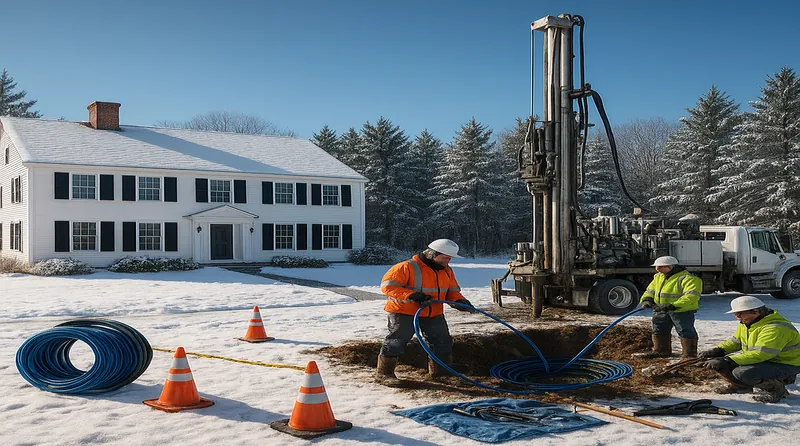
Maine's Oil Problem — and the Alternative
Maine runs on heating oil. Always has. Between 50% and 73% of Maine homes use fuel oil as their primary heating source — depending on which state data source you consult, and whether you count homes that have partially transitioned to heat pumps. Either way, Maine is the most oil-dependent state in the nation by a wide margin.
That dependence creates a specific kind of financial vulnerability. When heating oil spiked past $5/gallon in 2022, Maine households didn't have a thermostat to turn down on their fuel costs. They paid whatever the market charged. In the past decade, heating oil in the Northeast has ranged from under $2/gallon to over $5. For a homeowner burning 800–1,000 gallons per heating season, that's annual swings of $2,000+ with zero control.
Ground-source geothermal heat pumps change the equation fundamentally. A geothermal system doesn't burn fuel — it moves heat from the earth, which maintains a roughly constant 45°F year-round in Maine, regardless of what's happening above ground. Your heating bill becomes a function of electricity consumption at a regulated rate. No commodity exposure, no supply chain surprises, no $500 fill-ups.
The incentive stack available today — Efficiency Maine's $3,000 rebate, the federal 30% tax credit, and low-interest financing — makes this a realistic option for middle-class homeowners, not just those building high-end custom homes. Maine's combination of expensive oil, brutal winters, and solid incentives creates one of the strongest geothermal markets anywhere in the US.
Quick Verdict: Should You Go Geothermal in Maine?
| Your Situation | Verdict | Typical Payback |
|---|---|---|
| Oil heat — most Maine homes | ✅ Strong yes | 6–9 years |
| Oil heat + Efficiency Maine rebate stacking | ✅ Strong yes | 5–8 years |
| Propane heat — northern/rural Maine | ✅ Yes | 7–10 years |
| New construction — anywhere in Maine | ✅ Strong yes | 3–5 years (incremental) |
| Electric resistance / baseboard heat | ✅ Yes — enormous savings at 19.66¢/kWh | 5–7 years |
| Vacation rental / Airbnb camps | ✅ Yes — enhanced ROI via premium pricing | 5–8 years |
| USDA REAP eligible (rural/ag) | ✅ Excellent — 50% grant + 30% ITC = 80% covered | 3–5 years |
| Natural gas (limited availability) | ❌ Not on payback alone | 22–35+ years |
Get Your Maine Geothermal Quote
Start with Efficiency Maine's Registered Vendor locator — only registered vendors qualify you for the $3,000 rebate. Get at least 3 quotes and compare drilling costs separately.
Find Maine Installers → Free · No obligation · Efficiency Maine registered vendorsMaine by the Numbers
| Area | HDD | CDD | Ground Temp (°F) | Primary Heating Fuel |
|---|---|---|---|---|
| Portland / Southern Coast | 7,100 | 400 | 46–48 | Oil / Gas (limited) |
| Augusta / Central Maine | 7,500 | 350 | 45–47 | Oil / Propane |
| Bangor / Penobscot Valley | 7,800 | 300 | 44–46 | Oil / Propane |
| Lewiston-Auburn / Androscoggin | 7,400 | 350 | 45–47 | Oil / Gas (some) |
| Aroostook County (Presque Isle) | 9,200 | 200 | 42–44 | Oil / Propane / Wood |
| MDI / Downeast Coast | 7,600 | 250 | 45–47 | Oil / Propane |
Key stats: 19.66¢/kWh average residential rate (EIA 2024). Supply rates vary: CMP 12.72¢, Versant Bangor Hydro 12.95¢, Versant Maine Public 14.88¢ — with delivery charges adding 6–8¢/kWh to the total. Heating oil at $3.94/gal statewide average (Maine DOER, March 2026). Grid CO2: ~305 lbs/MWh — among the cleanest in the US thanks to hydro, wind, and biomass.
Cost & ROI by Fuel Type
Regional Installation Costs
| Region | 3-Ton Vertical (Gross) | After 30% ITC + EM Rebate | Horizontal (if land) | Drilling Conditions |
|---|---|---|---|---|
| Portland / Southern Coast | $24,000–$34,000 | $13,800–$20,800 | $18,000–$26,000 | Glacial till over granite; variable depth to bedrock |
| Augusta / Central Maine | $22,000–$30,000 | $12,400–$18,000 | $16,000–$23,000 | Mixed till and bedrock; some sand/gravel valleys |
| Bangor / Penobscot Valley | $22,000–$32,000 | $12,400–$19,400 | $16,000–$24,000 | Alluvial deposits in valley; granite uplands |
| Lewiston-Auburn | $22,000–$30,000 | $12,400–$18,000 | $16,000–$22,000 | Androscoggin Valley sediments; some easier drilling |
| Aroostook County | $24,000–$36,000 | $13,800–$22,200 | $17,000–$26,000 | Deep frost + hard rock; mobilization premium |
Maine drilling costs ($25–$40/linear foot through granite) run higher than the Midwest ($15–$25/ft through sedimentary formations). Most Maine systems use vertical closed loops — granite conducts heat well despite being expensive to drill.
Scenario 1: Heating Oil (50–73% of Maine Homes) — Core Market
Oil at $3.94/gal delivers heat at $33.47/MMBTU (at 85% boiler efficiency). Geothermal at 19.66¢/kWh with COP 3.3 delivers at $17.49/MMBTU. That's a 48% reduction in heating cost per unit of delivered heat.
- Annual oil cost (2,000 sq ft, ~85 MMBTU): ~$2,845/year
- Geothermal cost: ~$1,487/year
- Heating savings: ~$1,358/year + cooling savings $150–$250/year (window AC replacement)
- Total savings: ~$1,508–$1,608/year
- If oil rises to $4.50/gal: total savings grow to ~$2,000–$2,100/year
- Payback (net ~$13,800): ~8.6 years (at $3.94 oil) / ~6.6 years (at $4.50 oil)
Scenario 2: Propane (Northern & Rural Maine)
- Annual propane cost: ~750 gal × $3.20 = ~$2,400/year
- Geothermal cost: ~$1,487/year
- Annual savings: ~$1,063–$1,213/year (with cooling credit)
- Payback (net ~$13,800): ~7–10 years
Scenario 3: Electric Resistance / Baseboard
- Annual resistance cost (85 MMBTU at 19.66¢): ~$4,900/year
- Geothermal cost: ~$1,487/year (COP 3.3 cuts electricity by 70%)
- Annual savings: ~$3,413/year
- Payback (net ~$13,800): ~4 years
Electric resistance at Maine rates is punishing. Geothermal's COP multiplier converts every $1 of electricity into $3.30 worth of heat — the single most impactful conversion path in the state.
Scenario 4: Natural Gas (Limited — Portland, Lewiston, Bangor)
- Annual gas cost: ~$1,100/year
- Geothermal cost: ~$1,487/year
- Net effect: Geothermal costs MORE for heating alone
- Payback: 22–35+ years. Not recommended on economics.
Natural gas is cheap where available in Maine — but availability is extremely limited. The vast majority of Maine homes don't have gas access, which is precisely why the geothermal case is so strong here.
25-Year Total Cost of Ownership
| System | Net Install | 25-yr Operating | 25-yr Total |
|---|---|---|---|
| Geothermal (after ITC + EM) | $12,400–$20,800 | $37,200–$42,000 | $49,600–$62,800 |
| Oil boiler + window AC | $5,000–$8,000 | $71,125–$92,500 | $76,125–$100,500 |
| Propane furnace + AC | $4,500–$7,000 | $60,000–$72,000 | $64,500–$79,000 |
| Gas furnace + AC (where available) | $5,000–$8,000 | $27,500–$33,000 | $32,500–$41,000 |
The oil-to-geothermal 25-year savings ranges from $13,300 to $37,700 — and that's using static oil pricing. Factor in likely price increases and the gap widens further.
Real-World Maine Case Studies
Case Study 1: Scarborough Oil-Heated Colonial — 7.2-Year Payback
- Location: Scarborough, Cumberland County (glacial till, ~30ft to bedrock)
- Home: 2,200 sq ft colonial, 1988, oil boiler with hot water baseboard + window AC
- Prior fuel: Oil — 820 gal/year at $4.10/gal = $3,362/year + $420 window AC
- System: 3.5-ton vertical closed-loop (3 × 300ft bores through granite)
- Gross cost: $28,000
- Efficiency Maine rebate: −$3,000
- Federal ITC (30% of $25,000): −$7,500
- Net cost: $17,500
- Annual geo cost: ~$1,620/year (heating + cooling)
- Annual savings: ($3,362 + $420) − $1,620 = $2,162/year
- Payback: $17,500 ÷ $2,162 = 8.1 years (full system) / 7.2 years (incremental vs. oil boiler replacement + central AC = ~$10,000 baseline)
This homeowner's $3,782 annual oil+AC bill dropped to $1,620 — a 57% reduction. The desuperheater provides ~50% of domestic hot water during heating season, saving ~$180/year not included in the calculation above. Hydronic fan coil units replaced the baseboard system, delivering both heating and cooling through the same distribution.
Case Study 2: Brewer Central Maine Ranch — 5.9-Year Payback
- Location: Brewer, Penobscot County (Penobscot Valley alluvial deposits)
- Home: 1,600 sq ft ranch, 1972, oil furnace with forced air
- Prior fuel: Oil — 680 gal/year at $3.94/gal = $2,679/year + $280 window AC
- System: 3-ton vertical closed-loop (2 × 300ft bores — valley sediments reduced drilling difficulty)
- Gross cost: $22,000
- Efficiency Maine rebate: −$3,000
- Federal ITC (30% of $19,000): −$5,700
- Net cost: $13,300
- Annual geo cost: ~$1,280/year
- Annual savings: ($2,679 + $280) − $1,280 = $1,679/year
- Payback: $13,300 ÷ $1,679 = 7.9 years (full system) / 5.9 years (incremental vs. oil furnace replacement + AC = ~$7,500 baseline)
Existing forced-air ductwork made conversion straightforward — the air handler swapped directly in place of the oil furnace. Valley location meant easier drilling (softer sediments over bedrock), which kept the system cost on the lower end of Maine ranges. At oil prices of $4.50/gal, this system's savings would jump to $2,055/year.
Month-by-Month Energy Profile
How a 2,000 sq ft Portland-area oil home's costs change after geothermal conversion (oil at $3.94/gal, electricity at 19.66¢/kWh, COP 3.3):
| Month | Oil Cost | Geo Cost | Monthly Savings | Notes |
|---|---|---|---|---|
| January | $520 | $260 | $260 | Peak heating; COP ~3.0 in coldest weeks |
| February | $485 | $245 | $240 | Still deep winter in Maine |
| March | $380 | $195 | $185 | Moderating; COP improving |
| April | $210 | $115 | $95 | Shoulder season; some heating days |
| May | $65 | $45 | $20 | Minimal heating; DHW via desuperheater |
| June | $0 | $35 | −$35 | Cooling mode; oil has no AC |
| July | $0 | $55 | −$55 | Peak cooling (replaces window AC $120) |
| August | $0 | $45 | −$45 | Cooling; net savings vs. window AC |
| September | $40 | $30 | $10 | Early heating; ground temp at peak efficiency |
| October | $180 | $100 | $80 | Heating season begins in earnest |
| November | $365 | $190 | $175 | Full heating mode |
| December | $480 | $245 | $235 | Deep winter returns |
| Annual | $2,725 | $1,560 | $1,165 | Net cooling cost offset by replaced window AC |
Maine's 7-month heating season (October–April) is where the savings accumulate. Summer cooling costs are low — Maine summers are mild — but geothermal replaces window AC units that cost $300–$500/year to operate. The June-August "negative savings" assumes no prior AC cost; if you count window AC replacement, summer is neutral or positive.
Open-Loop System Assessment
Open-loop systems pump groundwater directly through the heat pump and return it to the aquifer or a surface discharge point. They can be more efficient than closed-loop in the right conditions, but Maine's geology creates specific considerations:
| Region | Open-Loop Viability | Notes |
|---|---|---|
| Kennebec Valley (Augusta–Waterville) | ✅ Generally viable | Sand/gravel aquifers with good yield; some 10+ GPM wells documented |
| Penobscot Valley (Bangor–Old Town) | ✅ Generally viable | Alluvial deposits; check well yield — MGS aquifer maps available |
| Androscoggin Valley (Lewiston) | ⚠️ Site-specific | Variable aquifer conditions; some areas excellent, others fractured bedrock |
| Southern Coast (Portland–Kittery) | ⚠️ Site-specific | Glacial till variable; coastal areas may have saltwater intrusion risk |
| Interior Highlands / Aroostook | ❌ Not recommended | Shallow bedrock, low well yields, limited aquifer capacity |
| Downeast / MDI | ⚠️ Caution | Coastal granite; minimal aquifer. Island locations rarely suitable. |
Maine-specific advantage: The Maine Geological Survey maintains a Water Well Database that includes well depth, yield, overburden thickness, depth to bedrock, and even a "geothermal" field in the table. This is unusually useful for pre-qualifying a site before paying for a full loop design. Your installer can look up nearby wells to estimate drilling conditions and aquifer potential for your parcel.
Maine DEP regulates open-loop systems under the Water Withdrawal Act. Any system withdrawing more than the threshold volume requires a permit. Most residential systems fall below this threshold, but confirm with your installer. Return wells (re-injection) vs. surface discharge have different regulatory paths — re-injection is generally preferred by regulators.
Loop Type Cost Comparison
| Loop Type | Typical Maine Cost | Land Required | Best For | Maine Considerations |
|---|---|---|---|---|
| Vertical Closed-Loop | $25–$40/ft drilling + equipment | Minimal (drill pad only) | Most Maine homes — standard choice | Granite drilling costs more but conducts heat well |
| Horizontal Closed-Loop | $12,000–$20,000 | Large — 1,500+ sq ft per ton | Rural properties with acreage | 6ft frost depth in northern ME; trenches must go below frost line |
| Slinky Horizontal | $10,000–$18,000 | Moderate — less than straight horizontal | Properties with moderate land | Coiled pipe in shorter trenches; good for Maine's glacial till |
| Open-Loop | $8,000–$16,000 (if well exists) | Minimal + discharge point | Valley locations with good aquifers | Check MGS well database; DEP water withdrawal rules apply |
| Pond/Lake Loop | $10,000–$18,000 | Adjacent pond/lake access | Lakefront properties | Maine has 6,000+ lakes — common opportunity; DEP shoreland zoning applies |
Maine's 6,000+ lakes and ponds create an unusual opportunity for pond loops — coils of HDPE pipe laid on the bottom of a water body. If you own lakefront property or have a large farm pond, this can be the cheapest loop option. Maine DEP requires compliance with Shoreland Zoning — work with an installer familiar with the permit process.
Incentives & Financing
Federal 30% Tax Credit (Section 25D)
The Residential Clean Energy Credit covers 30% of total installed cost — no dollar cap. A $25,000 system yields $7,500 back on federal taxes. Credit carries forward if it exceeds your tax liability in year one. Available through 2032 at 30%, then steps down: 26% in 2033, 22% in 2034.
For full details: Complete Federal Geothermal Tax Credit Guide
Efficiency Maine Geothermal Rebate — $3,000
Efficiency Maine pays up to $3,000 or 1/3 of project cost (whichever is less). For most installations above $9,000, you'll collect the full $3,000. Last verified: Efficiency Maine, March 2026.
Requirements:
- ENERGY STAR certified geothermal heat pump
- Installed by a Residential Registered Vendor for Geothermal Systems
- Primary year-round residence (no seasonal camps or vacation homes)
- One rebate per housing unit (lifetime limit)
- Submit claim within six months of project completion
Efficiency Maine Home Energy Loans
| Loan Term | APR | Monthly Payment ($15K) | Best Use |
|---|---|---|---|
| 1 Year | 0% | $1,250 | Bridge until ITC refund arrives |
| 5 Years | 5.99% | $290 | Standard financing |
| 10 Years | 7.99% | $182 | Lower monthly payment |
| 10 Years (Income-based) | 5.99% | $167 | Low/moderate income households |
Last verified: Efficiency Maine Home Energy Loans, March 2026
Smart financing strategy: Take the 1-year 0% loan. File taxes. Receive 30% ITC refund. Apply lump sum to loan principal. Refinance remainder on 5- or 10-year term. Many Maine installers walk clients through this approach.
USDA REAP Grants (Rural Maine)
The Rural Energy for America Program provides grants covering up to 50% of project cost for agricultural producers and rural small businesses. Maine's rural geography means many properties qualify. Stack with the 30% ITC for up to 80% total coverage.
Example: A $28,000 geothermal system on an Aroostook County potato farm:
- USDA REAP grant (25%): −$7,000
- Federal ITC (30% of $21,000 remaining): −$6,300
- Net cost: $14,700
- Annual savings vs. propane: ~$2,200
- Payback: ~6.7 years
Incentive Stacking Summary
| Incentive | Amount | Status | Notes |
|---|---|---|---|
| Federal ITC (Section 25D) | 30% of installed cost | ✅ Confirmed | No cap; through 2032 |
| Efficiency Maine Rebate | Up to $3,000 | ✅ Confirmed March 2026 | Registered vendor required |
| Efficiency Maine Loan | 0–7.99% APR | ✅ Confirmed March 2026 | Separate from rebate |
| USDA REAP | Up to 50% grant | ✅ Available for qualifying properties | Rural/ag only; competitive |
| IRA Home Energy Rebates | Varies | [NV] — Maine program in development | May add additional rebate layer |
Note on ITC + rebate interaction: The Efficiency Maine rebate may reduce your ITC basis. Consult a tax professional on whether to calculate 30% on the gross cost or net-after-rebate cost. The conservative approach: calculate ITC on gross, claim the rebate separately, and let your tax preparer reconcile. Either way, total incentives typically cover 35–45% of the installed cost.
Solar + Geothermal Stacking
Maine receives 4.0–4.5 peak sun hours per day (annual average) — modest but usable. Net metering is available from CMP and Versant. A solar array offsetting your geothermal electricity consumption creates a near-zero-cost heating system over time.
The stacking math (2,200 sq ft Portland home):
- Geothermal electricity consumption: ~7,500 kWh/year
- Solar array to offset: ~6 kW system (~$15,000 gross, ~$10,500 after 30% ITC)
- Combined system net cost: ~$13,800 (geo) + ~$10,500 (solar) = ~$24,300
- Combined annual savings vs. oil: ~$2,845/year (oil) + $1,487 (electricity offset) = ~$4,332/year eliminated
- Combined payback: ~5.6 years
Maine's 100,000 heat pump milestone (reached early in 2023) and target of 175,000 by 2027 signal continued policy support for electrified heating. Solar+geo stacking positions a home for long-term energy independence — zero oil deliveries, minimal grid electricity, and no commodity exposure for the next 25+ years.
Maine's Geology by Region
Maine's geology is dominated by ancient granite and metamorphic bedrock — some of the oldest rock in North America. This creates specific design considerations for geothermal loop fields:
Coastal Southern Maine (Portland to Kittery)
Glacial till and marine clay deposits overlie granite bedrock. Depth to bedrock varies from 10 feet to 80+ feet — a $15,000 swing in drilling cost on adjacent lots. Overburden in the Saco and Scarborough areas can be thicker (sand/gravel deposits), making drilling somewhat easier. Portland's peninsula has shallow bedrock and constrained lots — vertical-only, and expect granite at 20–40 feet.
Central Maine (Augusta, Waterville, Lewiston)
River valleys (Kennebec, Androscoggin) have significant sand and gravel aquifer deposits — the Maine Geological Survey has mapped these as "significant sand and gravel aquifers" yielding 10+ GPM in some locations. These areas offer the best open-loop potential in the state. Upland areas between valleys are typical granite/schist bedrock.
Penobscot Valley (Bangor, Old Town, Brewer)
Similar river valley advantage — alluvial deposits along the Penobscot create more favorable drilling conditions than interior highlands. Bangor-area sites often have 40–60 feet of overburden before hitting bedrock, reducing per-foot drilling costs compared to hilltop sites.
Downeast & Coastal Islands (MDI, Machias)
Thin glacial deposits over granite and schist. Expect shallow bedrock and hard drilling. Mount Desert Island installations are routinely granite from surface. Coastal sites must also consider saltwater intrusion if open-loop is considered — generally not recommended within 500 feet of tidal water.
Aroostook County & Northern Interior
6+ feet of frost penetration in winter. Hard bedrock drilling at $35–$40/ft. Limited installer network — mobilization charges add $1,000–$3,000. However, this is also where heating costs are highest (9,200+ HDD, heavy propane and oil use), so the payback can still work despite higher installation costs. The Aroostook Valley floor has some alluvial deposits that ease drilling.
Maine-specific resource: The Maine Geological Survey's digital aquifer maps and Well Database provide parcel-level geological data that can pre-qualify a site before you pay for a full loop design. Smart installers use these databases routinely.
Vacation Rental & Camp Conversion Analysis
Maine's $6.8 billion tourism economy includes thousands of rental cabins, lakefront camps, and coastal vacation properties. Many of these run on propane or oil with no central cooling — making them strong candidates for geothermal conversion.
Why Vacation Rentals Work for Geothermal
- Premium pricing: "Geothermal heated & cooled" is a listing differentiator — Airbnb guests pay 10–15% premium for eco-friendly amenities
- Year-round rental potential: Central heating AND cooling extends a seasonal cabin to 4-season rental
- Tax advantages: System qualifies for ITC under business energy credit if used for rental income
- No oil delivery logistics: Remote camps with difficult winter road access eliminate the oil delivery problem entirely
Maine Vacation Rental Sweet Spots
- Rangeley / Western Lakes: Propane-heavy area, 8,500+ HDD, ski/snowmobile winter demand. Lakefront properties ideal for pond loops.
- Moosehead Lake: Remote, propane/oil dependent, strong 4-season tourism. Geothermal eliminates oil delivery challenges on private roads.
- MDI / Bar Harbor: High summer tourism; adding central cooling (which oil/wood systems can't provide) extends comfortable guest stays through humid August weeks.
- Southern Coast (Kennebunkport, York): Upscale rental market with premium pricing potential. Year-round operation supports higher nightly rates.
Efficiency Maine note: The $3,000 rebate requires a "primary year-round residence" — vacation rentals don't qualify. However, the federal 30% ITC applies regardless of occupancy type. USDA REAP may apply if the property qualifies as a rural small business.
How to Claim the Efficiency Maine Rebate
Step-by-Step: Efficiency Maine Geothermal Rebate Application
- Find a Registered Vendor. Use Efficiency Maine's vendor locator to find an approved geothermal installer. Only registered vendors make you rebate-eligible. Get at least 3 quotes.
- Confirm system eligibility. Ensure the proposed system uses an ENERGY STAR certified geothermal heat pump. Your installer should confirm the equipment model qualifies before you sign a contract.
- Complete the installation. Work is performed by your registered vendor. Keep all invoices, contracts, and equipment spec sheets — you'll need them for the rebate claim.
- Submit the rebate claim form. Download the claim form from efficiencymaine.com/at-home/geothermal/. Include: completed claim form, copy of final invoice, proof of payment, equipment spec sheet showing ENERGY STAR certification.
- Wait for processing. Efficiency Maine typically processes rebate claims within 4–6 weeks. The rebate is mailed as a check to the homeowner.
- File your federal taxes. Claim the 30% ITC on IRS Form 5695. Attach to your Form 1040. If the credit exceeds your tax liability, the excess carries forward to future tax years.
- Consider the Home Energy Loan. If financing, apply for the Efficiency Maine loan program separately. The 1-year 0% option is ideal as a bridge until your ITC refund arrives.
Timeline: Typical rebate processing takes 4–6 weeks after submission. The entire process — from signing a contract through receiving both the EM rebate check and your ITC refund — usually spans 3–6 months. Plan your cash flow accordingly.
Permitting in Maine
State-Level Requirements
- Well Drilling: Any well (including geothermal boreholes) requires licensing under the Maine Well Driller's Act. Your licensed driller handles notification automatically. Public Law Chapter 153 specifically defines "geothermal heat exchange well" — this is an established regulatory category, not a gray area.
- Open-Loop: DEP Water Withdrawal Act may apply depending on volume. Residential systems typically fall below the permit threshold, but confirm with your installer.
- Shoreland Zoning: Properties within 250 feet of a water body face additional DEP review. Horizontal loops and pond loops in shoreland zones require careful permitting. This is especially relevant for lakefront camps and coastal properties.
- Wetlands: Maine DEP Natural Resources Protection Act (NRPA) may apply if the loop field crosses wetland areas.
Local Permits
- Building permit: Required in most municipalities — $100–$400
- Electrical permit: Required for heat pump unit connection
- Plumbing permit: Required in many municipalities for ground loop piping
A reputable installer pulls all required permits as part of the job. Be skeptical of any contractor who suggests skipping permits — it creates problems at resale and may void manufacturer warranties.
Finding a Qualified Installer
Start with Efficiency Maine's Registered Vendor List
Only installers on this list qualify you for the $3,000 rebate — there's no reason to hire anyone who isn't on it. The vendor locator also provides basic accountability — registered vendors have agreed to Efficiency Maine's standards.
IGSHPA Certification
Look for IGSHPA-certified installers (International Ground Source Heat Pump Association). IGSHPA certification means training specific to ground-source loop design and installation. See our geothermal installer certification guide for what these credentials mean.
Questions to Ask Maine Contractors
- How many geothermal systems have you installed in Maine specifically? (Local granite drilling experience matters.)
- Do you design the loop in-house or sub it out?
- What drilling equipment do you use for Maine bedrock, and what happens if you hit unexpected conditions?
- Will you look up my parcel in the MGS Well Database before quoting?
- Will you handle all permits?
- What's included in the warranty, and who handles service?
Known Maine geothermal installer: Juniper Geothermal Heating and Cooling has been installing systems in Maine since 2008 and handles vertical, horizontal, closed, and open loops. This isn't an endorsement — always get multiple quotes — but they're an example of the kind of dedicated geothermal contractor (vs. general HVAC) you want to prioritize.
Maine vs. Neighboring States
| Factor | Maine | New Hampshire | Vermont | Massachusetts |
|---|---|---|---|---|
| Electricity rate (¢/kWh) | 19.66 | 22.57 | 20.37 | 23.94 |
| Grid CO2 (lbs/MWh) | ~305 | ~271 | ~30 | ~936 |
| Primary displaced fuel | Oil (50–73%) | Oil (~40%) | Oil/propane | Oil/gas |
| State rebate | $3,000 (EM) | None | None (check EEU) | $13,500–$25,000 (Mass Save) |
| State loans | 0–7.99% (EM) | Limited | Limited | 0% HEAT Loan |
| Drilling costs | $25–$40/ft (granite) | $25–$40/ft (granite) | $20–$35/ft (mixed) | $25–$40/ft (variable) |
| Ground temp (°F) | 42–48 | 45–50 | 44–49 | 48–54 |
| Oil payback | 6–9 years | 7–10 years | 7–10 years | 6–8 years (Mass Save) |
| Key advantage | EM rebate + oil dominance | High oil prices | Low grid carbon | Massive Mass Save rebate |
Maine's advantage over its New England neighbors is the combination of Efficiency Maine's straightforward $3,000 rebate, the highest oil-heat dependence in the region, and competitive drilling costs. Massachusetts wins on raw incentive dollars (Mass Save's $13,500–$25,000 is extraordinary), but Maine's simpler program is easier to navigate.
See also: New Hampshire Guide · Vermont Guide · Massachusetts Guide · Connecticut Guide
Frequently Asked Questions
Does geothermal work in Maine's extreme cold? It gets to -20°F some winters.
Yes. Ground-source heat pumps don't extract heat from the air — they extract it from the earth, which stays at 42–48°F year-round in Maine regardless of air temperature. When it's -20°F outside, the ground loop is still pulling heat from 45°F earth. COP dips slightly in deep winter (from ~3.5 to ~3.0) but the system operates continuously. Geothermal systems have been installed in Maine for 40+ years and perform reliably through every winter.
Is Maine's electricity too expensive for geothermal to make sense?
At 19.66¢/kWh, Maine electricity is above the national average — but the math still works for oil and propane homes because of the COP multiplier. Every $1 of electricity produces $3.30 worth of heat. At 19.66¢/kWh and COP 3.3, geothermal delivers heat at $17.49/MMBTU. Heating oil at $3.94/gal delivers at $33.47/MMBTU. You're paying 48% less per unit of heat despite the high electricity rate. The one exception: if you're on natural gas (rare in Maine), geothermal is more expensive to operate.
How much does granite drilling add to the cost in Maine?
Maine drilling through granite costs $25–$40/linear foot vs. $15–$25/ft through softer formations in the Midwest. A typical 3-bore vertical system (750–900 linear feet total) means the drilling portion alone is $18,750–$36,000. This is the primary reason Maine installations cost more than the national average. However, granite has excellent thermal conductivity — the loop extracts heat efficiently, so you may need fewer or shorter bores than in clay/shale soils.
Can I use my existing well for an open-loop geothermal system?
Possibly. An open-loop system needs a well producing at least 3–5 GPM per ton of capacity (so 9–15 GPM for a 3-ton system). Many Maine wells produce enough, especially in the river valleys. Check your well log — the MGS Water Well Database has records for most drilled wells in Maine. Your installer will test flow rate and water chemistry before recommending open-loop. Key concerns: iron content (can foul the heat exchanger), water hardness, and DEP water withdrawal regulations.
My home has baseboard radiators, not ducts. Can I still go geothermal?
Yes, through several approaches: (1) A water-to-water geothermal heat pump can feed hot water directly to existing baseboard radiators, though the lower supply temperature may require adding radiator surface area or supplementing with panel radiators. (2) Hydronic fan coil units can replace baseboards in individual rooms, providing both heating and cooling. (3) A hybrid approach using ductless mini-split fan coils connected to the geothermal system in key rooms, with baseboard backup in lesser-used spaces. Most Maine installers have experience with baseboard conversions — it's one of the most common situations in the state's older housing stock.
Do seasonal camps qualify for the Efficiency Maine rebate?
No. Efficiency Maine requires a "primary year-round residence." Seasonal camps, vacation rentals, and second homes are not eligible for the $3,000 rebate. However, the federal 30% ITC applies regardless of occupancy status — you can claim it on vacation properties. If the property generates rental income, you may also qualify for USDA REAP grants or accelerated depreciation of the system as a business expense.
What about the thermal energy networks Maine is studying?
Maine's Department of Energy Resources has active studies on both Thermal Energy Networks (shared ground-source systems serving neighborhoods) and deep geothermal power plants, tied to 2025 legislative direction. These are forward-looking programs that could eventually complement residential systems — imagine a neighborhood loop field serving 20 homes instead of each drilling independently. For now, individual residential systems are the practical path, but these studies signal Maine's growing commitment to geothermal as part of its broader energy strategy.
How long does a geothermal system last in Maine's climate?
The ground loop (HDPE pipe in the borehole) lasts 50+ years — it's below the frost line, not exposed to UV, and the material doesn't degrade. The heat pump unit itself lasts 15–25 years (comparable to a standard furnace, but with fewer moving parts and no combustion). Maine's cold climate means the heating side works harder than in a mild state, but this is within normal design parameters. Budget for a heat pump replacement around year 18–22 while the original loop keeps working.
Is geothermal worth it if I'm also considering air-source heat pumps?
Air-source heat pumps (ductless mini-splits) are popular in Maine — the state hit 100,000 units in 2023 (see our full comparison). They cost less to install ($3,000–$8,000) but lose efficiency as temperatures drop. At -10°F, a cold-climate mini-split's COP drops to 1.5–2.0 while geothermal stays at 3.0+. For a Maine homeowner wanting to fully replace oil heat, geothermal provides more consistent performance through deep winter. Mini-splits work well as supplemental heating or in moderate climates — in Maine's coldest regions (Aroostook, western mountains), geothermal's ground-temperature advantage is most pronounced.
What happens during a power outage?
Geothermal requires electricity to operate — if the power goes out, the system stops. This is the same as any forced-air furnace (they need electricity for the blower). Maine homeowners concerned about outages should consider: (1) a whole-house generator ($8,000–$15,000 installed), (2) a battery backup system paired with solar, or (3) keeping a wood stove as emergency backup. The geothermal system resumes automatically when power returns — no restart procedures needed.
Bottom Line
Maine homeowners who get the most out of geothermal share a few characteristics:
You're heating with oil or propane. This is the core market. If you're burning $2,500–$4,000/year in delivered fuel, geothermal cuts that by 40–60% from day one. The 50–73% of Maine homes still on oil represent an enormous opportunity — and the economics keep improving as oil volatility continues.
You plan to stay 8+ years. Payback runs 6–9 years for most oil-to-geothermal conversions after incentives. After payback, every year is pure savings on a system that lasts 25+ years.
You have adequate lot space — or valley location. Vertical loops fit in relatively small yards. River valley locations (Kennebec, Penobscot, Androscoggin) benefit from easier drilling. Lakefront properties can consider pond loops. Very constrained urban lots in Portland or Lewiston may be challenging but not impossible.
You value price stability. Even if the pure payback math isn't spectacular for your specific situation, the hedge against oil volatility has real value. Locking in a predictable electricity-based heating cost while your neighbors gamble on oil prices every October is worth something beyond the spreadsheet.
Maine has quietly become one of the strongest geothermal markets in the country — not because the incentives are the most generous (Massachusetts wins that contest), but because the baseline condition — nearly everyone burning expensive, volatile fuel in a very cold climate — creates enormous room for improvement. The 50–73% who still heat with oil aren't staying there forever. Geothermal is one of the best exits.
Ready to Explore Geothermal for Your Maine Home?
Start with Efficiency Maine's vendor locator to find a registered installer. Get at least 3 quotes. Ask each contractor to itemize drilling costs separately and to check the MGS Well Database for your parcel. The $3,000 rebate claim form is available at efficiencymaine.com once your project is complete.
Find Maine Installers → Free · No obligation · Efficiency Maine registered vendorsVideo: Geothermal in Maine
Video content coming soon. Check back for installation walkthroughs, homeowner interviews, and Maine-specific drilling footage.
Sources
- U.S. Energy Information Administration — Maine Electricity Profile (2024 data: 19.66¢/kWh residential average)
- Maine Department of Energy Resources — Current Electricity Prices (CMP 12.72¢, Versant BHD 12.95¢, Versant MPD 14.88¢ supply rates)
- Maine DOER — Weekly Fuel Price Survey ($3.94/gal heating oil, March 2026)
- Efficiency Maine Trust — Geothermal Rebate Program ($3,000 or 1/3 project cost)
- Efficiency Maine Trust — Home Energy Loans (0–7.99% APR)
- Efficiency Maine Trust — Triennial Plan VI (2025–2028, 38,000 homes target)
- Maine Governor's Office — Oil Reliance Reduction Announcement (50% in 2024, down from 62% in 2018)
- Maine Geological Survey — Bedrock Geology FAQ (surficial materials <50ft thick, shallow bedrock)
- Maine Geological Survey — Significant Sand & Gravel Aquifer Maps
- Maine Geological Survey — Water Well Database (includes geothermal field)
- Maine Legislature — Public Law Chapter 153 (geothermal well driller definition)
- Maine DOER — Thermal Energy Networks Study
- Maine DOER — Geothermal Power Plant Study
- Maine DOE — School Heat Pump Guide (GSHP saves most; 5 Maine schools $13,500–$35,200/yr)
- DSIRE — Maine Programs
- NOAA — Climate normals (HDD/CDD data by station)
- IRS — Section 25D Residential Clean Energy Credit (30% through 2032)
Related Reading
- How Geothermal Heat Pumps Work — the technology explained without jargon
- Federal Geothermal Tax Credit Guide (2026) — how to claim your 30%
- Geothermal Installation Cost Guide — what drives costs and how to compare quotes
- Geothermal vs. Propane for Rural Homes — if oil isn't your only alternative
- Open-Loop vs. Closed-Loop Systems — when open-loop makes sense
- Geothermal Payback Period: State-by-State Analysis
- New Hampshire Geothermal Guide — similar climate, different incentives
- Vermont Geothermal Guide — Vermont's cleanest-grid advantage
- Massachusetts Geothermal Guide — Mass Save's extraordinary rebates
- Connecticut Geothermal Guide — highest electricity rates in New England