
In This Guide
- Why Kansas Is Horizontal Loop Paradise
- Quick Verdict: Should You Go Geothermal?
- Climate & Geology: Five Regions, Five Stories
- Geology & Drilling Conditions by Region
- Regional Costs & ROI
- Case Study: Riley County Propane Farmhouse
- Case Study: Olathe New Construction
- Case Study: Reno County Ranch — Pond Loop + REAP
- Month-by-Month Energy Profile
- Open-Loop System Assessment by Region
- Loop Type Cost Comparison
- Incentive Stacking: Federal ITC & USDA REAP
- Solar + Geothermal: The Prairie Combo
- Tornado Resilience: The Underground Advantage
- The Honest Gas Assessment
- Permits & Licensing Requirements
- Finding & Vetting a Qualified Installer
- Maintenance & System Longevity
- Vacation Rental & Rural Tourism Economics
- How to Claim the Federal Tax Credit (IRS Form 5695)
- Kansas vs. Neighboring States
- Frequently Asked Questions
- Bottom Line
- Sources
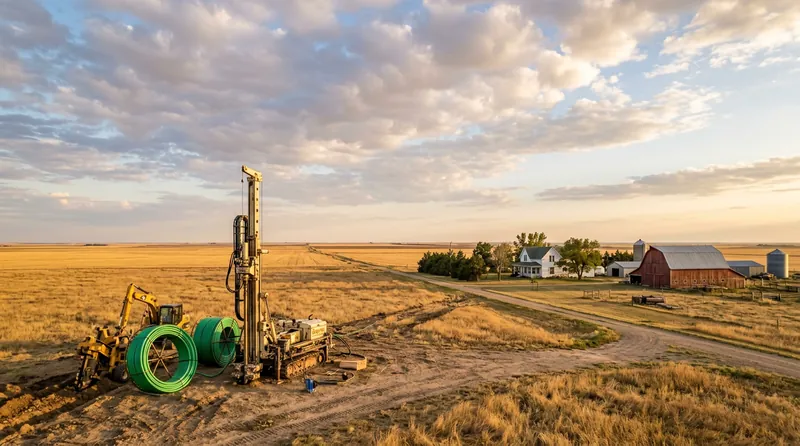
Why Kansas Is Horizontal Loop Paradise
Kansas gets more of its electricity from wind than from any other source. That single fact changes the entire geothermal calculation.
In most states, the environmental argument for geothermal runs headfirst into a coal-heavy grid — your heat pump is only as clean as the electrons powering it. But Kansas? At 680 lbs of CO2 per MWh (rank 30 nationally, trending cleaner every year), a geothermal heat pump here actually delivers on the carbon reduction promise. When the wind blows across the Flint Hills and through those 7,500+ turbines scattered across western Kansas, your ground-source system is running on some of the cleanest power in the Great Plains.
The other thing Kansas has going for it: flat, deep soil in every direction. This is horizontal loop paradise. If you've got a quarter-acre lot or bigger — and most Kansans outside Wichita and KC do — you're looking at installation costs that would make a Connecticut homeowner weep. A horizontal slinky system for a 2,000 sq ft home runs $18,000–$24,000 in central Kansas — well below the national average. Land is cheap, lots are big, and excavation through prairie soil is straightforward.
Then there's the dual-season advantage that separates Kansas from states farther north. Wichita averages 1,700 cooling degree days — more than Atlanta. Kansas isn't just a heating state; it's a state that needs genuine cooling capacity for 100°F+ July days. That means your geothermal system works year-round, keeping the ground loop thermally balanced and maximizing your equipment utilization. You're not paying for a system that sits idle five months a year.
The catch? Natural gas. Kansas sits atop the Hugoton gas field, one of the largest in North America. Gas rates are cheap. That makes the payback math for gas-heated homes brutally honest — and we'll be honest about it in this guide.
But for the estimated 70,000+ Kansas homes heating with propane, and for every new construction project where you can dodge the gas line hookup, and especially for the 58,500 farms and ranches covering 88% of the state's land that qualify for USDA REAP grants covering up to 50% of system costs — Kansas is one of the best geothermal markets in the Plains states.
Quick Verdict: Should You Go Geothermal in Kansas?
| Your Situation | Verdict | Estimated Payback |
|---|---|---|
| Rural propane home | 🟢 Strong yes | 6–10 years |
| Electric resistance heating | 🟢 Yes | 5–8 years |
| Farm/ranch (USDA REAP eligible) | 🟢 Excellent | 3–6 years |
| New construction (any fuel) | 🟢 Best opportunity | 4–7 years (incremental) |
| Western KS propane + high wind | 🟢 Yes | 6–11 years |
| Aging heat pump replacement | 🟢 Good upgrade | 5–9 years |
| Natural gas home (Wichita/KC metro) | 🔴 Probably not | 30–50+ years |
| Natural gas home (outstate) | 🟡 Long payback | 25–40 years |
If you heat with natural gas in the Kansas City suburbs or Wichita — roughly half the state's population — geothermal doesn't pencil out. Kansas natural gas rates are among the cheapest in the nation, thanks to proximity to production and pipeline infrastructure. But for propane homes, electric resistance homes, new construction, and especially REAP-eligible farms and ranches, geothermal is a strong play.
Climate & Geology: Five Regions, Five Stories
Eastern Kansas (KC Metro to Pittsburg)
Glacial till and loess over limestone characterize the eastern Kansas landscape. The top 15–50 feet is unconsolidated glacial deposits — ideal for trenching. Below that, Pennsylvanian-age limestone provides stable thermal mass. Ground temperatures run 55–57°F at 50-foot depth. Climate is four-season with 5,200 HDD (Kansas City) and a genuine cooling season — 1,500 CDD makes summer AC essential, not optional. This is the most populated region (Johnson County alone has 600,000+ residents) and has the best contractor availability.
Flint Hills (Council Grove to Emporia to Cassoday)
The iconic Flint Hills — the last remaining expanse of tallgrass prairie in North America — have thinner soil than the rest of eastern Kansas. Sometimes only 3–8 feet before hitting chert-bearing limestone. Horizontal loops may need wider, shallower trenches, or you might shift to vertical. The limestone itself has good thermal conductivity (1.2–1.6 BTU/hr·ft·°F) but drilling through chert (flint) dulls bits faster, adding 10–15% to vertical drilling costs.
Central Kansas (Salina to Great Bend to Hays)
The Arkansas River valley and Smoky Hill River corridor have 50–200+ feet of unconsolidated alluvial and loess deposits. This is the easiest digging in the state — horizontal loops go in fast and cheap. The Great Bend Prairie has some of the most installer-friendly soil conditions in the entire Midwest. Ground temperatures run 54–56°F. Climate is balanced at roughly 5,500 HDD / 1,400 CDD. Fewer installers than the KC/Wichita metros — expect some travel surcharge.
Western Kansas (Dodge City to Garden City to Goodland)
High Plains underlain by the Ogallala Aquifer. Sand, gravel, and silt deposits with drier conditions than eastern Kansas. Soil thermal conductivity is lower (0.7–1.0 BTU/hr·ft·°F) due to the arid climate, so horizontal loops need to be slightly oversized. But the aquifer creates open-loop potential in areas with adequate well yield and Groundwater Management District (GMD) permitting. Ground temperatures: 52–54°F. Propane dependency is highest here — many homes are well beyond gas pipeline infrastructure — making western Kansas some of the state's best geothermal payback territory despite the remote location.
Southeast Kansas (Pittsburg to Independence to Coffeyville)
Former coal-mining region with variable depth to bedrock. Strip-mined areas may have disturbed soil profiles. Undisturbed areas have decent horizontal loop conditions with glacial/alluvial deposits over coal measures. Site-specific assessment is essential — but the region's lower property values and prevalence of propane heating create favorable economics. Ground temperatures: 56–58°F — the warmest in the state.
Geology & Drilling Conditions by Region
Kansas's geology — overwhelmingly flat with deep unconsolidated soils — makes it one of the easiest and cheapest states for geothermal loop installation in the entire country. But conditions do vary by region, and understanding what your contractor will encounter determines your loop type, cost, and design.
| Region | Dominant Geology | Thermal Conductivity (BTU/hr·ft·°F) | Typical Bore/Trench Depth | Drilling Cost/ft | Key Challenges |
|---|---|---|---|---|---|
| KC Metro (Johnson / Wyandotte) | Glacial till (silt/clay/gravel) over Pennsylvanian limestone at 30–60 ft | 1.0–1.4 | Vertical: 150–200 ft; Horizontal: 6–8 ft | Vertical: $12–$16/ft; Horizontal trench: $3–$5/ft | Suburban lot sizes may require vertical. Glacial till drills easily. Some cobble layers near rivers slow drilling slightly. |
| Wichita Metro (Sedgwick) | Arkansas River alluvium (sand/gravel/clay), 50–150 ft deep, over Permian shale/limestone | 1.0–1.3 | Vertical: 150–200 ft; Horizontal: 6–7 ft | Vertical: $11–$15/ft; Horizontal trench: $2.50–$4.50/ft | Alluvial plains are excellent for both horizontal and vertical. Equus Beds aquifer area has shallow water table — monitor during excavation. |
| Northeast KS (Topeka / Manhattan / Lawrence) | Glacial deposits (10–50 ft) over alternating Pennsylvanian limestone and shale | 1.0–1.5 | Vertical: 150–225 ft; Horizontal: 6–8 ft | Vertical: $11–$15/ft; Horizontal trench: $3–$5/ft | Kansas and Missouri River corridors have excellent alluvium. Upland areas hit limestone sooner. Manhattan's Riley County has good glacial fill. |
| Flint Hills (Emporia / Council Grove) | Thin soil (3–8 ft) over chert-bearing Permian limestone bedrock | 1.2–1.6 (limestone) | Vertical: 175–250 ft; Horizontal: limited | Vertical: $14–$18/ft | Chert dulls drill bits (+10–15% cost). Shallow bedrock limits horizontal options. Vertical closed-loop is the standard. Good thermal conductivity in limestone compensates. |
| Central KS (Salina / Great Bend / Hays) | Deep loess and alluvium (50–200+ ft) over Cretaceous chalk and Permian evaporite | 0.9–1.2 | Vertical: 150–200 ft; Horizontal: 6–7 ft | Vertical: $10–$14/ft; Horizontal trench: $2–$4/ft | Easiest drilling in the state. Deep unconsolidated sediment means fast horizontal installation. Lower conductivity in dry loess — oversized loops recommended in drought conditions. |
| Western KS (Dodge City / Garden City / Goodland) | Ogallala Formation (sand/gravel/caliche) over Pierre Shale | 0.7–1.0 (dry) / 1.0–1.3 (saturated) | Vertical: 175–250 ft; Horizontal: 7–8 ft | Vertical: $12–$16/ft; Horizontal trench: $3–$5/ft | Dry conditions reduce thermal conductivity — oversized loops essential. Caliche layers possible. Where Ogallala is saturated, open-loop may be viable but GMD permits required. Remote location = installer travel surcharge ($1,500–$3,000). |
| Southeast KS (Pittsburg / Coffeyville) | Disturbed coal measures, alluvial deposits, Pennsylvanian sandstone/shale | 0.8–1.3 | Vertical: 150–225 ft; Horizontal: 6–8 ft | Vertical: $11–$15/ft; Horizontal trench: $3–$5/ft | Strip-mined areas have unpredictable fill — site assessment essential before horizontal. Undisturbed areas drill fine. Some acid mine drainage zones affect open-loop water quality. |
Reading Kansas Soil Before You Dig
Before committing to a loop design, check the Kansas Geological Survey (KGS) well log database at kgs.ku.edu. The KGS maintains records from thousands of water wells across the state, revealing formation types, water-bearing zones, and drilling rates at various depths. For Kansas in particular, the NRCS Web Soil Survey (websoilsurvey.nrcs.usda.gov) is also invaluable — it shows soil types, depth to bedrock, and permeability for any parcel in the state, which directly determines whether horizontal loops are feasible and how deep they should go.
For horizontal installations across the Great Plains portion of Kansas, the key question is moisture content. Dry soil has dramatically lower thermal conductivity than moist soil. In western Kansas during drought years, loop performance can drop 15–20%. A well-designed system accounts for this by adding 10–15% extra loop length. Your installer should be using a loop design program that accounts for Kansas soil moisture patterns, not just national averages.
Regional Costs & ROI
| Region | Avg. System Cost (3–4 ton) | Best Loop Type | Typical Annual Savings | Payback (Before Incentives) | Payback (After 30% ITC) |
|---|---|---|---|---|---|
| KC Metro (Johnson/Wyandotte) | $24,000–$44,000 | Vertical (smaller lots) | $700–$1,200 (vs. gas); $1,800–$2,500 (vs. propane) | 35–60 yr (gas); 10–17 yr (propane) | 25–42 yr (gas); 7–12 yr (propane) |
| Wichita Metro (Sedgwick) | $20,000–$38,000 | Horizontal or vertical | $600–$1,000 (vs. gas); $1,600–$2,200 (vs. propane) | 33–63 yr (gas); 9–17 yr (propane) | 23–44 yr (gas); 6–12 yr (propane) |
| NE Kansas (Topeka/Manhattan) | $19,000–$36,000 | Horizontal or vertical | $600–$1,100 (vs. gas); $1,500–$2,100 (vs. propane) | 31–60 yr (gas); 9–17 yr (propane) | 22–42 yr (gas); 6–12 yr (propane) |
| Central KS (Salina/Great Bend) | $18,000–$34,000 | Horizontal (deep soil) | $1,400–$2,000 (vs. propane) | 9–17 yr (propane) | 6–12 yr (propane) |
| Western KS (Dodge City/Garden City) | $20,000–$38,000 | Horizontal or open-loop | $1,600–$2,400 (vs. propane) | 8–16 yr (propane) | 6–11 yr (propane) |
| SE Kansas (Pittsburg/Coffeyville) | $19,000–$35,000 | Horizontal (undisturbed areas) | $1,300–$1,900 (vs. propane) | 10–18 yr (propane) | 7–13 yr (propane) |
Why Kansas trends affordable: Flat terrain plus deep, unconsolidated soil across most of the state means horizontal loops are viable nearly everywhere outside dense urban cores. A horizontal slinky system for a 2,000 sq ft home runs $18,000–$24,000 in central Kansas — well below the national average. And for farms and ranches with REAP grants, the economics get even better (see Incentives section below).
Case Study: Riley County Propane Farmhouse
The Setup
A 2,400 sq ft ranch home on 10 acres near Manhattan, KS. Built 1978. Heating with a 1,000-gallon propane tank and an aging 80% AFUE furnace. Central AC at 8 SEER — struggling through Kansas summers. Elevation: 1,100 ft.
The Old System Costs
- Annual propane: 900 gallons × $2.70/gallon = $2,430/year heating
- Annual cooling: $520/year (inefficient AC, 100°F+ summer peaks)
- Total HVAC: $2,950/year
The Geothermal System
- Equipment: 4-ton WaterFurnace 7 Series, variable speed + desuperheater
- Loop: Horizontal slinky — 10 acres means unlimited room, trenched at 7 ft depth in glacial fill
- Installed cost: $25,500
- Federal ITC (30%): −$7,650
- Net cost: $17,850
The New Operating Costs
- Annual geothermal electricity: ~$1,010/year (at 11.21¢/kWh, COP 3.8 heating / EER 20 cooling)
- Annual savings: $2,950 − $1,010 = $1,940/year
- Simple payback (after ITC): $17,850 ÷ $1,940 = 9.2 years
- At $3.10/gallon propane (winter spike pricing): payback drops to 7.8 years
- With USDA REAP grant (25%): net cost drops to $11,475 → payback 5.9 years
- 20-year net savings (after ITC, no REAP): ($1,940 × 20) − $17,850 = $20,950
Verdict: Solid payback even without REAP. With the grant, it's a no-brainer for a family planning to stay on the property 10+ years. The homeowner also eliminated the propane tank rental fee ($240/year) and gained proper AC for the first time — the old 8 SEER system couldn't keep up with Kansas July. The 7 Series variable-speed unit maintains 72°F evenly when it's 104°F outside.
Case Study: Olathe New Construction
The Setup
A 3,000 sq ft two-story in a Johnson County subdivision near Olathe. Builder spec'd a 96% AFUE gas furnace + 16 SEER AC as standard. The buyers chose to upgrade to geothermal during the design phase. Lot: 0.3 acres — not enough for horizontal, so vertical closed-loop was the design.
Conventional HVAC Quote
- 96% gas furnace + 16 SEER AC + ductwork: $15,500 installed (builder bid)
- Estimated annual gas + electric (conventional): $2,280/year
The Geothermal System
- Equipment: 4-ton ClimateMaster Tranquility 30, two-stage + desuperheater
- Loop: Vertical — 3 bores × 200 ft in glacial till, drilled during foundation work
- Total installed cost: $34,000
- Incremental over conventional: $34,000 − $15,500 = $18,500
- Federal ITC (30% of $34,000): −$10,200
- Net incremental cost: $23,800 − $15,500 = $8,300
The Math
- Annual geothermal electricity: ~$1,180/year
- Annual savings vs. conventional: $2,280 − $1,180 = $1,100/year
- Incremental payback: $8,300 ÷ $1,100 = 7.5 years
- Eliminate gas line connection fee ($2,500–$4,000 for new construction): payback drops to 5.0–5.3 years
- 20-year net savings on incremental: ($1,100 × 20) − $8,300 = $13,700
Verdict: Even in natural-gas-served Johnson County, new construction flips the math. The incremental cost is modest, the gas line hookup fee is avoided, and the family starts saving $90+/month immediately. The builder reported that geothermal was a selling differentiator in a competitive suburban market — buyers specifically chose this lot because the option was available.
Case Study: Reno County Ranch — Pond Loop + REAP Grant
The Setup
A cattle and wheat operation south of Hutchinson in Reno County. The 2,000 sq ft farmhouse, built in 1965, heats with propane (aging 78% AFUE furnace, 500-gallon tank) and cools with a 30-year-old window AC in the living room and bedrooms. No central air. The ranch has a 1-acre stock pond, 9 feet deep, located 150 feet from the house. The family earns 85% of gross income from agricultural operations — solidly REAP-eligible.
The Old System Costs
- Annual propane (heating + DHW): 750 gallons × $2.85/gallon = $2,138/year
- Window AC electricity (4 units): ~$480/year (EER 8, Kansas summers are brutal)
- Total HVAC: $2,618/year
The Geothermal System
- Equipment: 3-ton WaterFurnace 5 Series, two-stage + desuperheater
- Loop: Pond loop — 6 slinky coils sunk to the bottom of the stock pond, 150 ft of header pipe to the house
- New ductwork: First central air system for this home — full duct installation required
- Pond loop installation: $4,200 (coils fabricated off-site, sunk with a small boat, header trenched to house)
- Equipment + installation + ductwork: $16,800
- Total system cost: $21,000
REAP + ITC Stack
| Line Item | Amount |
|---|---|
| Total geothermal system cost | $21,000 |
| USDA REAP grant (40% — competitive round, strong agricultural score) | −$8,400 |
| Remaining eligible for ITC | $12,600 |
| Federal ITC (30%) | −$3,780 |
| Net out-of-pocket | $8,820 |
| Annual savings (vs. propane + window AC) | $1,878 |
| Simple payback | 4.7 years |
The Math
- Annual geothermal electricity (heating + central AC + partial DHW): ~$740/year (6,600 kWh at 11.21¢)
- Annual savings: $2,618 − $740 = $1,878/year
- 20-year net savings: ($1,878 × 20) − $8,820 = $28,740
Verdict: This is Kansas geothermal's home run scenario. The family had a stock pond they were using for cattle water — free infrastructure already in place. Pond loops are the cheapest loop type by a wide margin (no drilling, no deep trenching), and the 40% REAP grant brought the net cost below $9,000 for a complete HVAC system including their first-ever central air. They now have even heating in every room, genuine AC for the first time in 60 years of the house's existence, and are saving nearly $1,900/year.
The REAP application took 4 months from submission to award notification. The family worked with the local Reno County agricultural extension office and a REAP-experienced installer who helped prepare the energy audit and technical feasibility report. The installer's familiarity with the REAP process was worth more than any pricing difference between contractors.
Month-by-Month Energy Profile
This profile models the Riley County propane farmhouse (2,400 sq ft, 4-ton system) after the geothermal conversion, compared to old propane + AC costs.
| Month | Old Propane Cost | Old Electric (AC) | Geo Electric Cost | Monthly Savings |
|---|---|---|---|---|
| January | $510 | $0 | $145 | $365 |
| February | $430 | $0 | $125 | $305 |
| March | $290 | $0 | $90 | $200 |
| April | $110 | $15 | $50 | $75 |
| May | $0 | $55 | $45 | $10 |
| June | $0 | $105 | $75 | $30 |
| July | $0 | $140 | $100 | $40 |
| August | $0 | $130 | $95 | $35 |
| September | $0 | $75 | $55 | $20 |
| October | $80 | $0 | $40 | $40 |
| November | $300 | $0 | $85 | $215 |
| December | $480 | $0 | $130 | $350 |
| Annual Total | $2,200 | $520 | $1,035 | $1,685 |
Propane at $2.70/gallon. Electric at 11.21¢/kWh (EIA 2024 Kansas average). Kansas has significant cooling demand — July averages 80–90°F with spikes above 100°F.
The biggest savings come in winter (January: $365 saved), but notice that summer savings are positive too — the geothermal system cools for less than the old 8 SEER AC. Kansas's balanced heating/cooling demand means the system delivers value 10+ months of the year, with only the mild shoulder months showing minimal delta.
Open-Loop System Assessment by Region
| Region | Open-Loop Viability | Key Considerations |
|---|---|---|
| KC Metro | 🔴 Not recommended | Municipal water protection; lot sizes; urban restrictions. |
| Wichita Metro | 🟡 Site-specific | Equus Beds Aquifer underlying; city wells may conflict; suburban lots may work. |
| Northeast KS | 🟡 Limited | Kansas/Missouri River alluvium may support; KDA-DWR permit required. |
| Central KS (Great Bend Prairie) | 🟢 Generally viable | Shallow groundwater; high-yield wells; agricultural well infrastructure already exists. |
| Western KS (Ogallala) | 🟡 Possible, complex | Aquifer declining in SW Kansas; GMDs may restrict new appropriations; viable in NW where levels stable. |
| Southeast KS | 🟡 Limited | Shallow bedrock; variable water quality from former mining; acid mine drainage risk in some areas. |
Kansas Division of Water Resources (KDA-DWR) regulates all groundwater use. Open-loop systems require a water appropriation right. The five Groundwater Management Districts (GMDs) in western Kansas add another layer of regulation — some have closed areas to new appropriations where the Ogallala is declining. Contact your local GMD or KDA-DWR before planning an open-loop system.
Loop Type Cost Comparison
| Loop Type | Typical Cost (3-ton) | Best For | Kansas Notes |
|---|---|---|---|
| Horizontal slinky | $12,000–$18,000 | Rural lots, small towns | The Kansas default. Deep prairie soil is perfect. Cheapest option on lots with ¼+ acre. |
| Horizontal straight | $14,000–$20,000 | Farms, large properties | 400–600 ft trench per ton. Easy excavation in most Kansas soil. |
| Vertical closed-loop | $20,000–$30,000 | KC/Wichita subdivisions, Flint Hills | 150–200 ft per bore. Required where lots are small or bedrock is shallow. |
| Open-loop | $10,000–$16,000 | Central KS with well access | KDA-DWR permit required. Cheapest per ton where viable. Existing ag wells may work. |
| Pond/stock tank loop | $8,000–$14,000 | Ranches with ponds | Kansas has thousands of farm ponds. Min ½ acre, 8 ft deep. The cheapest option in the state. |
A note on pond loops: Kansas has an estimated 180,000+ farm ponds, most built for livestock water and erosion control. If your pond is at least ½ acre in surface area and 8 feet deep, it's a strong candidate for a pond loop. The coils sit on the bottom, weight-anchored, and the pond continues to function for livestock, fishing, and recreation. Installation is fast — often completed in a single day for the pond portion. If your property has a qualifying pond within 200 feet of the house, this should be your first option explored, hands down.
Incentive Stacking: Federal ITC & USDA REAP
Kansas has no state-level geothermal tax credit or rebate. The federal credit does the heavy lifting, and USDA REAP is the game-changer for the state's 58,500 farms and ranches.
Federal Investment Tax Credit (ITC) — 30%
The federal residential clean energy credit under IRC Section 25D provides 30% back on the total installed cost of your geothermal system — equipment, loops, drilling, trenching, ductwork, desuperheater, and all labor. No cap. Available through 2032, stepping down to 26% in 2033 and 22% in 2034. Carries forward to future tax years if you can't use the full credit in year one.
USDA REAP — Kansas's Best-Kept Secret
Kansas has 58,500 farms and ranches covering 45.7 million acres — 88% of the state's land. If you operate one, USDA REAP is your most powerful incentive for geothermal. Grants cover up to 50% of project costs, and loan guarantees cover up to 75%.
Why Kansas is a REAP sweet spot:
- Nearly all of Kansas qualifies geographically. Every community under 50,000 population — which is everything except the KC metro and Wichita metro cores.
- Agricultural producers qualify on income basis. If your farm or ranch earns at least 50% of gross income from agricultural operations, you're eligible regardless of location.
- Kansas farms average 779 acres. That means almost every qualifying property has room for horizontal loops at the cheapest per-foot rates in the state.
- Many farms already have stock ponds and water wells — existing infrastructure that reduces geothermal installation costs before any incentives.
REAP + ITC Stack: McPherson County Wheat Farm
| Line Item | Amount |
|---|---|
| 3-ton horizontal slinky system (installed) | $22,000 |
| USDA REAP grant (25%) | −$5,500 |
| Remaining eligible for ITC | $16,500 |
| Federal ITC (30%) | −$4,950 |
| Net cost | $11,550 |
| Annual propane savings | $2,100 |
| Payback | 5.5 years |
At 50% REAP (competitive round, strong application): net cost drops to $5,500 → payback 2.6 years. That's a 75% cost reduction and a return on investment that makes any financial advisor's head spin.
REAP applications are submitted to the USDA Kansas State Office. Application deadlines are typically March 31 and October 31. The process requires an energy audit or assessment (your geothermal installer can often provide this), a technical feasibility report, and financial documentation showing agricultural income. Plan 3–6 months from application to award. The Kansas Extension Service offices in your county can assist with application preparation.
Utility Programs
| Utility | Geothermal Rebate | Status | Notes |
|---|---|---|---|
| Evergy (formerly Westar/KCP&L) | No current GSHP rebate | [NEEDS VERIFICATION] | Has offered HVAC efficiency rebates. Check annually — programs change. |
| Midwest Energy (central/western KS) | Varies | [NEEDS VERIFICATION] | Cooperative serving central and western Kansas. Has historically offered efficiency incentives. |
| Kansas rural electric cooperatives (30+) | Varies by co-op | [NEEDS VERIFICATION] | Some co-ops offer heat pump incentives. Call your local co-op's energy efficiency coordinator. |
Solar + Geothermal: The Prairie Combo
Kansas gets 5.0–5.8 peak sun hours per day — excellent solar resource, especially in western Kansas. Combined with the wind-powered grid, a solar + geothermal combination can create a near-net-zero home.
Kansas has net metering for systems up to 200 kW — one of the more generous limits nationally. Evergy customers can bank excess solar production against geothermal consumption, which is particularly effective in spring and fall when solar peaks and heating/cooling demand is moderate.
| Component | Cost | After 30% ITC |
|---|---|---|
| 3-ton geothermal (horizontal slinky) | $24,000 | $16,800 |
| 7 kW solar array | $19,000 | $13,300 |
| Total | $43,000 | $30,100 |
| Annual energy savings (vs. propane + grid) | ~$2,600/year | |
| Combined payback | ~11.6 years | |
For REAP-eligible agricultural properties, stacking REAP + ITC on both the geothermal AND the solar system can bring the combined payback under 7 years. After payback, your home has near-zero energy costs — and on Kansas's wind-powered grid, the environmental impact is genuinely minimal.
Tornado Resilience: The Underground Advantage
Kansas averages 96 tornadoes per year — second only to Texas. While no one installs geothermal specifically for tornado protection, the resilience angle is real:
Your ground loop is underground and indestructible. A tornado can rip the roof off your house, scatter your outdoor AC condenser across a field, and destroy a propane tank. Your ground loop, buried 6–200 feet below the surface, is untouched. After rebuilding, you reconnect to the existing loop — saving $12,000–$28,000 on HVAC replacement that would otherwise be needed if you were replacing a conventional system from scratch.
No outdoor condenser to damage. Traditional AC and air-source heat pumps have outdoor units vulnerable to hail (Kansas averages $750M+ in annual hail damage), debris, and straight-line winds. Geothermal's entire mechanical system is indoors — in a basement, utility room, or mechanical closet.
Propane tank vulnerability. Propane tanks can be displaced, damaged, or create fire/explosion hazards during severe storms. Geothermal eliminates this risk entirely.
FEMA and insurance implications. While there's no specific geothermal insurance discount currently, systems with fewer exterior-exposed components generally sustain less storm damage. Some Kansas homeowners have reported lower HVAC replacement claims after switching to geothermal. If you're in a mobile/manufactured home park or other high-tornado-risk setting, the indoor-equipment-only advantage of geothermal is particularly meaningful.
The Honest Gas Assessment
Kansas produces natural gas. The Hugoton field in southwestern Kansas was once the largest gas field in North America. Pipeline infrastructure is dense. Gas is cheap. Let's be honest about what that means for geothermal economics.
The Math for a Wichita Gas Home
- Average Kansas gas heating cost: ~$750–$1,100/year for a 2,000 sq ft home
- Geothermal operating cost: ~$650–$950/year
- Annual savings: $100–$300
- Net system cost after credit: $14,000–$21,000
- Payback: 50–150+ years
This is not a pitch where we pretend the numbers don't exist. If you have a working gas furnace in Wichita or Johnson County, keep it until it dies. When it dies, then compare replacement costs — the incremental difference between a new furnace ($5,000–$8,000) and geothermal ($24,000–$34,000 minus credit) is the real comparison, and it's still a 15–25 year payback on operating cost savings alone.
When Gas Homes SHOULD Consider Geothermal
- New construction — avoid the $2,500–$4,000 gas line hookup, and the incremental cost is much lower. See the Olathe case study.
- Adding central AC — if your home doesn't have central air and you're installing it anyway, the incremental jump to geothermal is modest.
- Major renovation — gut rehab where ductwork is being replaced regardless.
- Environmental priority — Kansas's wind-powered grid (680 lbs CO2/MWh, trending down) makes geothermal a genuine green choice here, unlike coal-heavy Nebraska (1,082) or Missouri (1,305).
- Furnace failure — compare incremental cost to new furnace + AC, not full system-vs-zero cost.
Permits & Licensing Requirements
Kansas has a relatively straightforward permitting environment for geothermal installations, but there are key regulatory layers depending on your loop type and location.
Mechanical / Building Permit (All Installations)
Every geothermal installation requires a mechanical permit from your local building department. This covers the heat pump equipment, ductwork, refrigerant connections, and electrical work.
- Johnson County / KC Metro: City or county building department. Permit fee typically $75–$200. Turnaround 5–10 business days. Most suburban cities (Olathe, Overland Park, Lenexa) have electronic permit applications.
- Wichita / Sedgwick County: City of Wichita Metropolitan Area Building and Code Department, (316) 268-4441. Standard mechanical permit. Similar fees and timelines.
- Topeka / Shawnee County: City Building Services Division. Standard HVAC permit process.
- Rural / unincorporated areas: County-level jurisdiction. Many rural Kansas counties have minimal permitting requirements for residential HVAC work — some require only a contractor registration, not a formal permit. Confirm with your county clerk's office.
Water Well Permit — KDA Division of Water Resources
- Closed-loop systems: Closed-loop geothermal boreholes do not appropriate groundwater and generally do not require a KDA-DWR water right. However, some counties require notification or a "monitoring well" permit for vertical bores. Your driller should know the local requirements. Bore grouting must meet Kansas well construction standards to prevent aquifer contamination.
- Open-loop systems: Require a full water appropriation right from KDA-DWR. Processing time: 2–6 months. You must demonstrate adequate water availability and that your appropriation won't impair existing rights. In the five Groundwater Management Districts (GMDs) in western Kansas, additional GMD approval may be required — and some areas are closed to new appropriations due to Ogallala depletion.
- Existing agricultural wells: If you want to use an existing irrigation or stock well for geothermal, you'll need a change application with KDA-DWR. This modifies the purpose of use on your existing water right. Generally faster (4–8 weeks) and less contested than a new appropriation.
Contractor Licensing
Kansas contractor licensing varies by municipality:
- Cities with licensing requirements: Wichita, Kansas City KS, Topeka, Lawrence, Overland Park, and most Johnson County cities require HVAC contractors to hold a local mechanical contractor license. Verify with the city's licensing division before hiring.
- Unincorporated areas: Kansas does not have a statewide HVAC contractor license requirement. In rural areas, verify that your installer carries adequate liability insurance ($1M+ general liability), workers' compensation coverage, and manufacturer training credentials.
- Well driller licensing: Kansas requires all water well drillers to be licensed by KDA-DWR. This applies to both water wells (open-loop) and geothermal boreholes (closed-loop vertical). Verify your driller at the KDA-DWR Licensed Drillers page.
- Electrical work: Kansas requires licensed electricians for electrical connections. The HVAC contractor typically handles this or subcontracts to a licensed electrician.
HOA and Subdivision Restrictions
Kansas does not have a statewide solar/geothermal access law that overrides HOA restrictions (unlike some states). If you live in a Johnson County or Wichita subdivision with an HOA, review your CC&Rs for restrictions on ground disturbance, equipment, or temporary construction access. Most geothermal installations are invisible once complete — the loop is underground and the heat pump is indoors — but the drilling/trenching phase requires equipment access that may need HOA board notification.
Typical Permit Timeline
| Step | Timeframe | Notes |
|---|---|---|
| Mechanical permit application | 5–10 business days | Metro areas; rural may be faster or unnecessary |
| KDA-DWR notification (closed-loop) | 1–5 business days | Not always required — check county |
| KDA-DWR water right (open-loop) | 2–6 months | Start immediately. GMD areas may add time. |
| Trenching/drilling | 1–3 days | Horizontal in Kansas prairie soil: often 1 day |
| Equipment installation | 2–4 days | Includes piping, ductwork (if new), controls |
| Final inspection | 1–3 business days | Schedule proactively |
| Total (closed-loop) | 2–5 weeks | From permit to operational system |
| Total (open-loop) | 3–7 months | KDA-DWR water right is the bottleneck |
Finding & Vetting a Qualified Installer
Kansas has a moderate installer base concentrated in the KC metro and Wichita, with coverage thinning significantly as you move west. The state benefits from proximity to IGSHPA headquarters (in Stillwater, Oklahoma — just across the border), which means the region has strong installer representation in national directories.
Where to Find Installers
- IGSHPA Accredited Installer Directory: igshpa.org/accredited-installer — the gold standard. Search Kansas AND neighboring states.
- WaterFurnace Dealer Locator: waterfurnace.com/dealer-locator
- ClimateMaster Dealer Network: climatemaster.com/residential/find-a-dealer
- Bosch Geothermal: bosch-thermotechnology.us
- GeoExchange Directory: geoexchange.org
- Kansas rural electric cooperatives: Many co-ops maintain referral lists of energy-efficient HVAC contractors. Call your co-op's member services department.
- K-State Extension offices: Kansas State University agricultural extension offices sometimes have contractor referrals for REAP-eligible energy projects.
Regional Installer Availability
| Region | Estimated Qualified Installers | Wait Time (Typical) | Notes |
|---|---|---|---|
| KC Metro (Johnson/Wyandotte/Douglas) | 8–12 | 4–8 weeks | Best availability in the state. Multiple firms with 10+ years experience. Some also serve NE Kansas. |
| Wichita Metro (Sedgwick/Butler) | 5–8 | 4–8 weeks | Good availability. Several firms serve central Kansas from Wichita base. |
| NE Kansas (Topeka/Manhattan/Lawrence) | 3–5 | 6–10 weeks | Some KC firms serve this area. K-State proximity helps with technical resources. |
| Central Kansas (Salina/Great Bend/Hays) | 2–4 | 6–12 weeks | Limited local options. Wichita-based firms travel here regularly. Some from Denver serve far western areas. |
| Western Kansas (Dodge City/Garden City) | 1–3 | 8–14 weeks | Very limited. Wichita, Denver, or Oklahoma City contractors. Mobilization surcharge ($1,500–$3,000) common. |
| SE Kansas (Pittsburg/Coffeyville) | 2–4 | 6–10 weeks | Some Oklahoma/Missouri contractors serve this area. Joplin MO-based firms are often closest. |
8-Point Vetting Checklist
- IGSHPA accreditation or manufacturer certification — proves geothermal-specific training beyond general HVAC.
- Local HVAC license (metro areas) — verify with city licensing division. Required in KC, Wichita, Topeka, Lawrence, most Johnson County cities.
- KDA-DWR licensed well driller on staff or under contract — required for all bore drilling in Kansas. Verify at agriculture.ks.gov.
- At least 5 completed Kansas geothermal installations — ask for a reference list. Kansas soil conditions and climate are specific enough that out-of-state-only experience isn't sufficient.
- Manual J load calculation in the proposal — any contractor who sizes equipment without a load calculation is guessing. Kansas's dual heating/cooling demand requires careful sizing.
- Soil moisture/conductivity addressed in loop design — Kansas's western half has dry soils that require loop oversizing. If the installer uses a one-size-fits-all loop length regardless of your county, they're not designing for Kansas conditions.
- Written warranty covering equipment, labor, and loop — equipment: 10 years minimum from manufacturer; labor: 1–2 years from installer; HDPE loop: 25–50 years from pipe manufacturer.
- Itemized bid with trenching/drilling, equipment, labor, and permits separated — bundled bids hide markup. You should see each component clearly.
Red Flags
- No familiarity with USDA REAP application process (a knowledgeable installer can help with documentation and energy audits)
- Same loop design proposed for Johnson County clay and Finney County dry sand — conditions differ dramatically
- Quoting a system without visiting the property
- No mention of NRCS soil survey data or KGS well logs in their design process
- Unable to explain the difference between horizontal slinky, straight horizontal, and vertical — in Kansas, this matters because it determines your cost bracket
Maintenance & System Longevity
Kansas's climate creates a maintenance environment that's actually favorable for geothermal longevity. The balanced heating/cooling demand keeps the ground loop thermally stable, the indoor unit is protected from Kansas's severe weather, and the dry air reduces corrosion risk.
Maintenance Schedule
| Task | Frequency | DIY or Pro? | Kansas-Specific Notes |
|---|---|---|---|
| Check/replace air filter | Every 1–3 months | DIY | Monthly during summer dust season and winter heating season. Kansas's agricultural dust (harvest, field work) loads filters faster than urban areas. |
| Inspect condensate drain | Twice yearly (spring/fall) | DIY | Kansas's summer humidity (higher than people expect for a Plains state) produces significant condensate during cooling season. Check before summer starts. |
| Check loop pressure/antifreeze | Annually (fall) | Pro | Kansas design temps (-10°F to -15°F in NW) require adequate freeze protection. Less extreme than Wyoming, but still essential. Propylene glycol at 20–25% concentration is standard. |
| Desuperheater inspection | Annually | Pro | Central and western Kansas water is moderately hard (150–300 ppm). Annual inspection; descale if buildup exceeds ¼ inch. |
| Compressor and electrical check | Every 2–3 years | Pro | Kansas's year-round usage (balanced heating/cooling) means more compressor hours than heating-only states. Still well within design parameters. |
| Clean outdoor equipment pad (if applicable) | Annually (spring) | DIY | If your manifold or flow center is in a shed or garage near ground level, check for mud dauber wasp nests and field mice — common Kansas pests that can obstruct piping or wiring. |
| Ductwork inspection/sealing | Every 5–7 years | Pro | Kansas temperature swings (from -5°F to 105°F annually) stress duct seals. Leaky ducts waste capacity in both heating and cooling seasons. |
| Full system commissioning check | Every 5 years | Pro | Flow rates, entering/leaving water temps, COP verification. The "geothermal physical." |
System Lifespan
| Component | Expected Lifespan | Replacement Cost | Notes |
|---|---|---|---|
| Heat pump unit (indoor) | 20–25 years | $5,000–$9,000 | Protected from tornadoes, hail, and UV. No outdoor weather exposure. Balanced year-round usage reduces thermal shock cycling. |
| Ground loop (HDPE pipe) | 50–75+ years | $0 (doesn't need replacing) | Buried underground, protected from everything Kansas weather throws at the surface. HDPE is rated for 75–100 years. Tornado-proof. |
| Circulating pump | 10–15 years | $500–$1,200 | Variable-speed pumps last longer. Kansas's year-round usage means more hours but at lower stress (variable speed). |
| Compressor | 15–20 years | $2,000–$4,000 | Scroll compressors in modern units are very reliable. Kansas's moderate ground temps (54–57°F) keep compressor operating conditions comfortable. |
| Antifreeze solution | 10–15 years | $250–$500 | Kansas doesn't require the extreme concentrations of Wyoming or Montana. Test annually; replace when pH drops below specification. |
| Thermostat/controls | 10–15 years | $200–$500 | Smart thermostats (Ecobee, Honeywell) integrate well. Consider remote monitoring for farm properties where the house may be unoccupied during field work. |
Kansas-Specific Longevity Advantages
- Tornado-proof loop: Your ground loop survives any tornado. After a rebuild, you reconnect to existing loops — saving $12,000–$28,000. The indoor heat pump survives as well as anything else inside the home (and better than anything mounted outside).
- Balanced thermal cycling: Kansas's near-equal heating and cooling loads keep the ground around your loop at a stable temperature year-round. States that are heavily heating-dominant (Minnesota) or cooling-dominant (Arizona) can develop temperature drift over decades. Kansas's balance prevents this naturally.
- No outdoor unit: Conventional AC condensers in Kansas endure 96+ annual tornadoes, frequent hail storms, 100°F+ summers, ice storms, and Kansas's legendary wind. Your geothermal equipment sits indoors where it never sees any of this.
Vacation Rental & Rural Tourism Economics
Kansas tourism is modest compared to coastal or mountain states, but specific niches align with geothermal economics:
Flint Hills Tallgrass Prairie
The last remaining expanse of tallgrass prairie in North America draws eco-tourists, ranching heritage visitors, birdwatchers, and Kansas State gameday guests. Ranch-stay properties and B&Bs in the Flint Hills are almost universally propane-heated and are prime REAP-eligible geothermal candidates. The "heated by the earth beneath the prairie" story aligns perfectly with the eco-tourism brand these properties are selling.
Kansas Lake Properties
Milford Lake, Council Grove Lake, Cheney Reservoir — northeast and central Kansas lake properties draw fishing, boating, and weekend getaway guests. Propane-heated lake cabins benefit from both the fuel savings and the "eco-lodge" booking premium that increasingly drives Airbnb/VRBO search algorithms. If the cabin has a qualifying pond nearby, the pond loop option makes installation remarkably affordable.
Western Kansas Hunting Lodges
Pheasant and deer hunting is big business in western Kansas. Lodges are almost universally propane-heated with remote delivery surcharges. Seasonal occupancy (primarily October–January for pheasant, September–December for deer) means the highest energy usage coincides with heating season — perfect for geothermal's strengths. A geothermal conversion with REAP stacking can pay back in 4–6 years while improving guest comfort and eliminating propane delivery logistics during busy hunting season.
Vacation Rental Tax Treatment
For business-use properties, geothermal qualifies for the Section 48 commercial ITC (same 30%) and can be depreciated using MACRS 5-year schedule. Rental property owners can potentially recover 60–70% of the system cost through credits and depreciation in the first 5 years. Consult a tax professional familiar with Kansas rental property and energy improvements.
How to Claim the Federal Tax Credit (IRS Form 5695)
- Confirm system eligibility. ENERGY STAR certified geothermal heat pump at your primary or secondary residence. All major brands qualify.
- Keep all documentation. Itemized invoices, ENERGY STAR certification, proof of payment, REAP award letter if applicable.
- Complete IRS Form 5695, Part I. Enter total installed cost on Line 4. If you received a REAP grant, subtract it first.
- Calculate credit. 30% of eligible cost, no cap. Carries forward to future years if unused.
- Transfer to Form 1040. Schedule 3, Line 5 → Form 1040, Line 21. Dollar-for-dollar reduction in federal tax liability.
- If stacking with REAP: Subtract REAP grant from installed cost before calculating the 30% credit. Example: $22,000 − $5,500 REAP = $16,500 × 30% = $4,950 credit.
- File and retain records. Attach Form 5695 to your return. Keep documentation for 7 years.
Kansas vs. Neighboring States
| Factor | Kansas | Nebraska | Oklahoma | Missouri | Colorado | Iowa |
|---|---|---|---|---|---|---|
| Avg. Electricity Rate | 11.21¢ | 9.07¢ | 9.09¢ | 11.98¢ | 14.30¢ | 13.28¢ |
| Grid CO2 (lbs/MWh) | 680 (wind) | 1,082 (coal) | 670 (gas/wind) | 1,305 (coal) | 752 (gas) | 685 (wind) |
| State Incentive | None | Utility [NV] | None | None | Xcel rebate [NV] | Utility varies |
| Propane Payback | 6–10 yr | 6–10 yr | 5–10 yr | 6–10 yr | 7–12 yr | 6–10 yr |
| Gas Payback | 30–50+ yr | 25–45 yr | 20–45 yr | 18–26 yr | 15–25 yr | 20–35 yr |
| Horizontal Loop Potential | Excellent | Excellent | Good | Good | Good (rural) | Excellent |
| Installer Density | Low-Moderate | Low-Moderate | Moderate | Moderate | Moderate | Moderate |
| REAP Eligibility | Nearly statewide | Nearly statewide | Most areas | Most areas | Rural only | Nearly statewide |
| Permitting Complexity | Low | Low | Low | Low-Moderate | Moderate | Low |
| Unique Advantage | Wind-powered grid + 180K farm ponds | Cheapest electricity | IGSHPA HQ (Stillwater) | Highest gas savings | Mountain propane market | Strong wind grid + REAP |
Kansas's wind-powered grid gives it a cleaner carbon profile than Nebraska (1,082) or Missouri (1,305), making the environmental argument stronger here than in most Plains states. But Colorado's higher electricity rates (14.30¢ vs. 11.21¢) actually create a wider savings gap against gas, which helps Colorado's geothermal payback. Oklahoma benefits from having IGSHPA headquarters in Stillwater, which means higher installer density just across the border — Kansas installers in the southeastern part of the state often work both sides of the line.
Frequently Asked Questions
How much does geothermal cost in Kansas?
A typical system costs $18,000–$44,000 before incentives. After the 30% federal tax credit, expect $12,600–$30,800. Rural homes with large lots can install horizontal slinky loops for $18,000–$24,000 — well below the national average. Pond loops on qualifying ranches can run as low as $14,000–$18,000 total.
Does Kansas offer any geothermal rebates?
No state-level credit or rebate. The federal 30% ITC is the primary incentive. For farms and ranches, USDA REAP grants can cover up to 50% of costs — making it the most powerful incentive in Kansas. Check with your utility (Evergy, Midwest Energy, or local co-op) for any efficiency programs.
Is Kansas's flat terrain good for geothermal?
Excellent. Deep, unconsolidated prairie soil across most of the state makes horizontal loops cheap and easy. The Flint Hills (shallow limestone) are the main exception. Kansas is one of the best horizontal loop states in the entire country.
Can geothermal handle Kansas summers and winters?
Yes, and the dual-season demand is an advantage. Ground stays 52–57°F year-round. Wichita gets more cooling degree days than Atlanta (1,700 CDD). The system works year-round, keeping ground thermally balanced.
How does Kansas's wind-powered grid help?
Kansas grid: 680 lbs CO2/MWh — cleaner than Nebraska (1,082) or Missouri (1,305). A geothermal heat pump on Kansas's wind-powered grid genuinely delivers on carbon reduction. The environmental case is real here.
Can I use the Ogallala Aquifer for open-loop?
Potentially, in areas where the aquifer is accessible and not in a restricted Groundwater Management District zone. You need a KDA-DWR water appropriation right. Some SW Kansas areas are closed to new appropriations. Contact KDA-DWR first.
Is geothermal worth it for a Kansas farm?
Farms and ranches are Kansas's best geothermal candidates. Large lots (cheap loops), stock ponds (cheapest loops), propane heating (highest savings), and USDA REAP eligibility (up to 50% grants). REAP + ITC can cover 47–75% of costs, creating 3–6 year paybacks.
Will geothermal survive a Kansas tornado?
The underground loop is tornado-proof. No outdoor condenser to destroy. After a rebuild, reconnect to existing loops and save $12K–$28K on HVAC replacement. The indoor heat pump is as protected as anything else inside the home.
How do I find a geothermal installer?
IGSHPA directory (igshpa.org) — headquartered in Stillwater, OK just across the border. KC metro: 8–12 firms. Wichita: 5–8 firms. Western KS: may need travel from Wichita, Denver, or OKC ($1,500–$3,000 mobilization surcharge). Get at least 3 quotes.
How long does a system last?
Indoor unit: 20–25 years. Ground loop: 50–75+ years. Kansas's balanced climate keeps the loop thermally stable. When you replace the indoor unit at year 20–25, the loop is still perfectly functional — second-generation cost is equipment only.
What permits are needed?
Mechanical permit (metro areas). Closed-loop bores generally don't require KDA-DWR water right. Open-loop requires full water appropriation right (2–6 months). Western Kansas GMDs may add restrictions. Rural areas may have minimal requirements.
Can I use my farm pond for a loop?
Yes, if it's ½+ acre and 8+ feet deep. Kansas has 180,000+ farm ponds. Pond loops are the cheapest option ($8K–$14K for the loop). Coils sit on the bottom; pond still works for cattle, fishing, and recreation. If you have a qualifying pond, explore this first.
Bottom Line
Kansas is a state of two geothermal stories. If you heat with natural gas — roughly half the state's households — the economics are tough and we've been honest about that. Keep your gas furnace until it dies, then consider geothermal as a replacement option, especially in new construction where the incremental cost is much smaller.
But if you're among Kansas's 70,000+ propane-heated households, or if you're building new, or especially if you operate one of the state's 58,500 farms and ranches — Kansas is quietly one of the best geothermal markets in the Great Plains. Here's why:
- Cheapest horizontal loops in the country. Deep prairie soil, flat terrain, and big lots mean installation costs that would make a New England homeowner weep. $18,000–$24,000 for a complete system in rural central Kansas.
- 180,000+ farm ponds. Pond loops at $8,000–$14,000 are the cheapest geothermal option anywhere. If you've got a qualifying pond, you've got a built-in advantage most states can't match.
- REAP covers nearly the whole state. USDA REAP grants up to 50% for agricultural producers, stackable with the 30% federal ITC, can bring your out-of-pocket cost below $6,000 for a complete system. That's a sub-3-year payback on propane savings.
- Wind-powered grid. Kansas's 680 lbs CO2/MWh grid means your heat pump actually delivers on the environmental promise — unlike coal-heavy Missouri or Nebraska next door.
- Balanced climate works for you. 5,000+ HDD and 1,400+ CDD means your system works year-round, stays thermally balanced, and maximizes equipment utilization.
- Tornado-proof infrastructure. In a state that averages 96 tornadoes per year, having your entire HVAC system underground and indoors isn't just a comfort feature — it's a resilience strategy.
Kansas may not have the geothermal awareness of Colorado's mountain homes or Idaho's volcanic geology. But for the state's agricultural community, Kansas's combination of cheap horizontal loops, REAP eligibility, farm pond infrastructure, and propane displacement creates one of the strongest geothermal cases in the entire Midwest. The math works. The soil cooperates. The wind powers it clean. And the loop lasts longer than you will.
Sources
- U.S. Energy Information Administration — Kansas Electricity Profile 2024. Average residential rate: 11.21¢/kWh.
- U.S. Energy Information Administration — Kansas Natural Gas Prices. Residential natural gas pricing data.
- Internal Revenue Service — Form 5695: Residential Energy Credits. 30% credit for geothermal systems through 2032.
- USDA Rural Development — Rural Energy for America Program (REAP).
- USDA National Agricultural Statistics Service — Kansas Agricultural Statistics. 58,500 farms, 45.7 million acres, average farm size 779 acres.
- Kansas Division of Water Resources (KDA-DWR) — Water Appropriation and Well Permitting.
- Kansas Geological Survey — Water Well Log Database. Formation types and drilling records.
- NRCS Web Soil Survey — Kansas Soil Types and Properties.
- U.S. Department of Energy — Geothermal Heat Pumps Overview.
- Database of State Incentives for Renewables & Efficiency (DSIRE) — Kansas Incentives.
- International Ground Source Heat Pump Association (IGSHPA) — Accredited Installer Directory.
- WaterFurnace International — Dealer Locator.
- GeoExchange — Geothermal Heat Pump Industry Directory.
- Evergy (formerly Westar Energy / KCP&L) — Kansas Rate Information and Energy Efficiency Programs.
- Kansas Extension Service (K-State Research and Extension) — Agricultural Energy Resources.
- National Weather Service — Kansas Climate Data. Heating and cooling degree day calculations, tornado statistics.
- EPA eGRID — Emissions & Generation Resource Integrated Database. Kansas grid emissions: 680 lbs CO2/MWh.
- National Renewable Energy Laboratory — Solar Resource Maps. Kansas: 5.0–5.8 peak sun hours/day.
- KDA-DWR — Licensed Well Drillers Directory.