
In This Guide
- Indiana's Geothermal Landscape
- Who Should (and Shouldn't) Go Geothermal
- Costs by Region
- Incentives and Tax Credits
- Real-World Case Studies
- Month-by-Month Energy Profile
- Northern Indiana: The Propane Belt
- Indiana's Flat Terrain Advantage
- Indianapolis and Urban Markets
- The Coal Grid Carbon Paradox
- Open-Loop System Assessment
- Farm Operations and USDA REAP
- Solar + Geothermal Stacking
- Vacation Rental and Tourism Properties
- Geology and Ground Conditions
- Permitting in Indiana
- How to Claim the Federal Tax Credit
- Indiana vs. Neighboring States
- Video Resources
- Frequently Asked Questions
- Sources
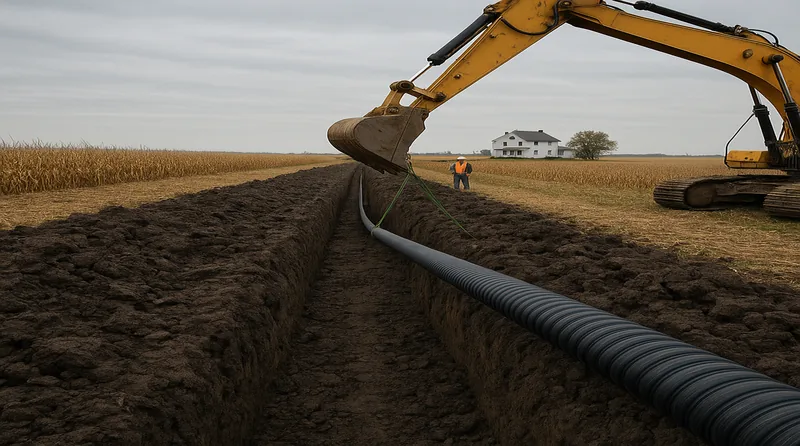
Indiana doesn't usually lead geothermal conversations. Flat, agricultural, historically coal-powered — it sounds like a state you'd skip. But that description contains two of the most compelling geothermal arguments in the Midwest.
That flatness? It means horizontal ground loop systems — significantly cheaper than vertical boreholes — work across virtually the entire state. And that coal grid? At 1,393 lbs of CO₂ per megawatt-hour, Indiana has the seventh-dirtiest electricity in America. A geothermal heat pump running at COP 3.5 on Indiana's grid still delivers heat at lower effective carbon intensity than a natural gas furnace — a counterintuitive finding that creates one of the strongest carbon arguments for geothermal anywhere in the country.
Then there's the northern propane belt. From Elkhart to Fort Wayne, tens of thousands of rural homes — including the largest Amish settlement in the world — heat with delivered propane at $2.50–$3.50 per gallon. Replace that with geothermal at Indiana's 11.38¢/kWh electricity rate, and you're looking at payback periods under 8 years with horizontal loops.
This guide maps Indiana's five distinct geothermal markets with real payback math, honest gas-city analysis, verified incentive data, and the specific angles — flat-terrain cost advantage, coal-grid carbon paradox, Amish community adoption, and farm REAP grants — that make Indiana's geothermal story more interesting than its reputation suggests.
Who Should (and Shouldn't) Go Geothermal in Indiana
| Situation | Typical Payback | Verdict |
|---|---|---|
| Northern IN propane + horizontal loop | 6–8 years | ✅ Strong — best economics in the state |
| Rural electric resistance heat | 7–10 years | ✅ Strong — 60–65% energy reduction |
| New construction (any fuel area) | 4–6 years (incremental) | ✅ Excellent — specify at build time |
| Farm/rural business + REAP grant | 4–7 years | ✅ Excellent — 55% combined incentives |
| Vacation rental (Brown County, Dunes) | 5–9 years | ✅ Good — 12-month revenue, premium positioning |
| Aging heat pump replacement | 8–12 years | ⚠️ Moderate — compare incremental cost |
| Indianapolis/Fort Wayne gas (existing) | 22–35 years | ❌ Not recommended on cost alone |
| Evansville gas (existing, low HDD) | 28–40 years | ❌ Low heating demand undermines case |
Installation Costs by Region
Indiana's flat terrain creates a cost advantage that most neighboring states can't match. Horizontal loops are practical across 90%+ of the state, and they cost 30–40% less than vertical boreholes. Regional cost variations reflect geology, lot conditions, local contractor availability, and whether you're in a metro area or rural county.
| Region | Horizontal (3-ton) | Vertical (3-ton) | After 30% ITC (horizontal) | Key Factor |
|---|---|---|---|---|
| Northern IN (Elkhart, Fort Wayne, South Bend) | $18,000–$24,000 | $28,000–$38,000 | $12,600–$16,800 | Deepest glacial till, best horizontal conditions |
| Indianapolis Metro (Marion, Hamilton, Hendricks) | $22,000–$30,000 | $32,000–$44,000 | $15,400–$21,000 | Higher labor costs, suburban lot constraints |
| Central IN Rural (Tippecanoe, Delaware, Grant) | $17,000–$23,000 | $26,000–$36,000 | $11,900–$16,100 | Flat farmland, lower labor/access costs |
| Southwest IN (Evansville, Terre Haute) | $19,000–$26,000 | $29,000–$40,000 | $13,300–$18,200 | Thinner till in Wabash lowland, fewer contractors |
| Southeast IN Karst (Crawford, Harrison, Washington) | N/A — terrain too hilly | $30,000–$42,000 | N/A | Vertical only; karst-experienced drillers required |
Costs include equipment, labor, loop installation, and ductwork modifications. Costs are for retrofit installations; new construction adds $8,000–$12,000 incremental over standard HVAC ($5,600–$8,400 after ITC). Prices as of March 2026.
Incentives and Tax Credits
Federal 30% Section 25D Credit — Confirmed
The federal residential clean energy credit applies to all Indiana geothermal installations at 30% through 2032 (26% in 2033, 22% in 2034). It covers the full installed cost — equipment, labor, drilling, and trenching. On a $24,000 horizontal installation, that's $7,200 back against your federal tax liability. The credit carries forward if your liability in year one doesn't absorb it. Verified March 2026 against IRS Publication 5695.
No Indiana State Geothermal Credit
Indiana has no state income tax credit for residential geothermal heat pumps as of March 2026. The state's CHOICE (Comprehensive Hoosier Option to Incentivize Cleaner Energy) program targets utility-scale generation rather than homeowner incentives. Indiana's renewable policy framework has historically been utility-oriented; residential incentives beyond the federal credit are not available. Verified March 2026 against DSIRE Indiana database.
Utility Rebates — Unconfirmed for Ground-Source
Duke Energy Indiana offers rebates for heat pump water heaters ($800) and some HVAC equipment, but no confirmed ground-source heat pump rebate appears in their published residential programs. Indiana Michigan Power (AEP), NIPSCO, and CenterPoint Energy Indiana similarly lack published geothermal-specific rebates. [NEEDS VERIFICATION — contact your utility directly; programs change annually and some "high-efficiency heat pump" categories may include ground-source systems.]
USDA REAP — For Agricultural and Rural Businesses
Indiana's large agricultural sector makes USDA REAP particularly relevant. Grants cover up to 25% of installation costs (maximum $500,000) for agricultural businesses and rural small businesses. Combined with the 30% federal ITC, Indiana farm operations can recover up to 55% of installation costs before energy savings. Contact USDA Rural Development Indiana at the Indianapolis state office for current grant cycles. See Farm Operations section for detailed math.
Incentive Stacking Summary
| Incentive | Amount | Status | Applies To |
|---|---|---|---|
| Federal 30% ITC (§25D) | 30% of total cost | ✅ Confirmed | All residential installations |
| Indiana state credit | None | ✅ Confirmed (no program) | — |
| Utility rebates (Duke, NIPSCO, AEP) | Unknown | ⚠️ Needs Verification | Contact utility directly |
| USDA REAP grant | Up to 25% | ✅ Confirmed | Farms and rural businesses only |
| Property tax exemption | None confirmed | ⚠️ Needs Verification | Check county assessor |
Real-World Case Studies
Case Study 1: LaGrange County Propane Farmhouse — 6.4-Year Payback
Home: 2,400 sq ft two-story farmhouse near Shipshewana, LaGrange County. Built 1985. Moderately insulated. 6,200 HDD. Propane forced-air furnace (85% AFUE) + central AC (12 SEER).
Existing heating cost: 1,200 gallons propane × $2.85/gallon = $3,420/year heating. Plus ~$480/year cooling electricity. Total HVAC: ~$3,900/year.
Geothermal system: 3.5-ton WaterFurnace 7 Series, horizontal slinky loop (ample yard on 5-acre lot). Desuperheater for supplemental hot water.
| Gross installed cost | $22,500 |
| Federal 30% ITC | −$6,750 |
| Net cost | $15,750 |
| Annual geothermal operating cost | $1,440 (heating + cooling + DHW boost) |
| Annual savings | $2,460 |
| Simple payback | 6.4 years |
| 25-year net savings | $45,750 |
At propane $3.25/gallon (common in winter surge pricing), savings rise to $2,880/year and payback drops to 5.5 years. If propane prices average $2.50/gallon, payback extends to about 8.2 years. The math works at any realistic propane price.
Case Study 2: Carmel New Construction — 3.8-Year Incremental Payback
Home: 2,800 sq ft new construction in Carmel (Hamilton County, north Indianapolis suburb). Natural gas available. 5,600 HDD. Builder's standard spec: 96% AFUE gas furnace + 16 SEER central AC.
Standard HVAC cost (builder spec): $14,500 installed.
Geothermal option: 4-ton ClimateMaster Tranquility 30 (TT), vertical closed loop (suburban 0.4-acre lot — horizontal not practical).
| Gross geothermal cost | $36,000 |
| Minus standard HVAC (already in budget) | −$14,500 |
| Incremental cost | $21,500 |
| Federal 30% ITC (on full $36K) | −$10,800 |
| Net incremental cost | $10,700 |
| Annual gas HVAC cost (projected) | $2,100 (gas heating + electric cooling) |
| Annual geothermal cost | $1,280 (all-electric, COP 4.0+) |
| Annual savings over gas baseline | $820 + $2,000 desuperheater hot water savings = $2,820 |
| Incremental payback | 3.8 years |
Note: The $2,820 annual savings includes the desuperheater offset (estimated $65/month average in hot water savings). Without the desuperheater contribution, annual HVAC savings alone are approximately $820, extending incremental payback to ~13 years. However, new construction in Carmel and Fishers increasingly specifies geothermal as a premium feature — buyers in the $450K–$800K market see it as both an operating cost advantage and a home value differentiator.
Month-by-Month Energy Profile
What geothermal savings actually look like across an Indiana year, using a 2,400 sq ft home in LaGrange County replacing propane with a horizontal ground-source system.
| Month | Mode | Old Cost (Propane + AC) | Geo Cost | Monthly Savings |
|---|---|---|---|---|
| January | Heating | $580 | $215 | $365 |
| February | Heating | $510 | $190 | $320 |
| March | Heating | $380 | $145 | $235 |
| April | Swing | $140 | $65 | $75 |
| May | Cooling | $85 | $50 | $35 |
| June | Cooling | $145 | $80 | $65 |
| July | Cooling | $185 | $105 | $80 |
| August | Cooling | $170 | $95 | $75 |
| September | Swing | $95 | $55 | $40 |
| October | Heating | $200 | $80 | $120 |
| November | Heating | $380 | $145 | $235 |
| December | Heating | $530 | $195 | $335 |
| Annual Total | $3,400 | $1,420 | $1,980 |
Based on 6,200 HDD, 1,100 CDD. Propane at $2.85/gallon, electricity at 11.38¢/kWh. Geothermal COP 3.5 heating, EER 17 cooling. Desuperheater savings (~$45/month average) included in geo cost offset but not broken out separately.
Northern Indiana: The Propane Belt
Northern Indiana — roughly the counties from Fort Wayne and Elkhart westward through LaGrange, Kosciusko, Steuben, Noble, and DeKalb — is home to the largest Amish settlement in the world. Tens of thousands of rural homes in this corridor heat with propane, delivered by tanker truck on routes that extend deep into unmarked township roads.
The Amish community's practical, long-term approach to property stewardship has made them a significant geothermal market. The economics align with their values — geothermal has low operating costs, high durability (25+ year lifespan), and zero combustion to maintain. Several IGSHPA-certified contractors in northern Indiana and nearby Ohio have noted growing geothermal adoption in the Elkhart/LaGrange/Noble County communities over the past decade.
The propane-to-geothermal economics in this region are among the strongest in the Midwest:
- Annual propane cost: 1,100–1,400 gallons × $2.50–$3.25/gallon = $2,750–$4,550/year
- Annual geothermal cost: $650–$950/year at 11.38¢/kWh (heating + cooling combined)
- Annual savings: $1,800–$3,600
- Horizontal loop net cost: $12,600–$16,800 (after 30% ITC)
- Payback: 4–9 years depending on propane price and system size
Northern Indiana's proximity to the Chicago and Michigan markets means there's a reasonable contractor base serving this corridor from multiple directions. NIPSCO's service territory in northwest Indiana extends into the South Bend metro, where a mix of urban gas-heated homes and rural propane properties creates a bifurcated market — propane properties with compelling economics, gas properties with marginal ones.
Indiana's Flat Terrain Advantage
This bears emphasis because it's genuinely significant: Indiana is one of the flattest states in the country. Almost the entire state was glaciated during the last ice age, leaving behind uniformly flat terrain covered by deep deposits of glacial till — clay and silt with embedded gravel and stones, consistent from surface to depth.
For geothermal installation, this means horizontal trench systems are practical virtually everywhere in Indiana outside the small unglaciated karst corner in the southeast. The cost difference is substantial:
| Loop Type | Cost per Ton | 3-Ton System | After 30% ITC |
|---|---|---|---|
| Horizontal trench | $5,000–$8,000 | $15,000–$24,000 | $10,500–$16,800 |
| Horizontal slinky | $5,500–$8,500 | $16,500–$25,500 | $11,550–$17,850 |
| Vertical borehole | $7,000–$12,000 | $21,000–$36,000 | $14,700–$25,200 |
| Pond/lake loop | $3,000–$5,000 | $9,000–$15,000 | $6,300–$10,500 |
On a 3-ton residential system, choosing horizontal over vertical saves $6,000–$12,000 before the federal credit — a meaningful difference that can shift payback by 3–5 years.
The glacial till also has reliable thermal conductivity (~1.3–1.6 W/m·K), consistent soil temperatures at loop depth, and predictable excavation conditions. No surprise ledge rock, no inconsistent soil layers, no need to reroute a trench mid-dig.
Horizontal loops require sufficient yard area — roughly 400–600 square feet per ton with straight trenches, or less with slinky configurations. Urban and close-in suburban lots in Indianapolis, Fort Wayne, or Evansville may not have the space. Rural properties, farm acreage, and suburban homes with larger lots (0.5+ acres) are prime horizontal candidates. When space is limited, vertical boreholes remain the reliable alternative.
Indianapolis and Urban Markets
Most of Indianapolis runs on natural gas — CenterPoint Energy Indiana (formerly Vectren) and Citizens Energy Group serve the metro. Gas prices in Indiana have historically been moderate to low, partly supported by proximity to Appalachian production and Midwest pipeline infrastructure.
For existing gas-heated homes in Indianapolis, Fort Wayne, and South Bend, the energy-cost case for switching to geothermal is honest but not dramatic:
| City | Annual HDD | Gas Heating Cost (est.) | Geo Heating Cost (est.) | Total Annual Savings |
|---|---|---|---|---|
| South Bend / Fort Wayne | ~6,100–6,300 | ~$750–$1,050/yr | ~$550–$750/yr | ~$500–$900/yr |
| Indianapolis | ~5,600 | ~$650–$900/yr | ~$450–$650/yr | ~$400–$800/yr |
| Evansville | ~4,500 | ~$550–$750/yr | ~$400–$550/yr | ~$350–$700/yr |
Total annual savings for most urban Indiana gas homes: $400–$900/year. Against a net installation cost of $21,000–$31,500 (vertical, typical for suburban lots), payback runs 23–35 years. That's a long time, and we won't pretend otherwise.
The situations where urban Indiana geothermal makes strong financial sense:
- New construction: Specifying geothermal at build time adds $8,000–$12,000 gross over standard HVAC, or $5,600–$8,400 after the credit. Incremental payback: 4–6 years. Indianapolis suburbs like Carmel, Fishers, Zionsville, and Noblesville are high-growth markets where geothermal makes strong sense as a builder specification. See Case Study 2 for detailed math.
- System replacement at end of life: When a 20-year-old furnace and AC die simultaneously, you're choosing between standard replacement ($8,000–$15,000) and geothermal ($28,000–$42,000 gross). The incremental $14,000–$19,000 net may justify itself over a 25-year system life, especially in northern Indiana.
- Environmental motivation: Indiana's coal grid argument (see carbon section) creates a compelling case independent of energy cost payback. Geothermal installed today gets cleaner as coal plants retire.
The Coal Grid Carbon Paradox
Indiana is one of the few states where the carbon argument for geothermal is actually stronger than the energy-cost argument.
Indiana's grid produces approximately 1,393 lbs of CO₂ per megawatt-hour — the seventh-highest carbon intensity in the U.S. (EIA 2024). That's primarily coal-fired generation. When you run an electric appliance in Indiana, the electrons behind it are mostly coal electrons.
A geothermal heat pump at COP 3.5 uses 1 kWh of electricity to deliver 3.5 kWh of heating. The carbon cost of that 1 kWh at Indiana's grid intensity: ~0.63 lbs of CO₂. But you got 3.5 kWh of heat, so the effective carbon intensity of geothermal heating is 0.63 ÷ 3.5 = roughly 0.18 lbs CO₂ per kWh of delivered heat.
A high-efficiency natural gas furnace (98% AFUE) produces about 0.116 lbs of CO₂ per kWh of delivered heat from direct combustion. So geothermal on Indiana's coal grid delivers heat at roughly 50% more carbon intensity than a gas furnace in heating mode alone.
But here's where the paradox resolves:
- Cooling matters. Geothermal replaces coal-fired central AC with dramatically more efficient ground-source cooling (EER 17–25 vs. SEER 14–16 for standard AC). In Indiana's humid summers (1,000–1,200 CDD), cooling efficiency improvements cut carbon significantly.
- The grid is changing. Indiana's major utilities have announced significant coal plant retirements through 2035. Every coal plant that retires improves the carbon math for every geothermal system already in the ground. A system installed in 2026 that runs on 40–60% cleaner electricity by 2035 will have dramatically better lifetime carbon performance than its install-year number suggests.
- Infrastructure lock-in. Installing a gas furnace in 2026 locks in a fossil fuel appliance for 20+ years. Installing geothermal locks in electric-efficiency infrastructure that improves with the grid. The investment thesis is about trajectory, not snapshot.
For homeowners focused on long-term carbon impact, Indiana's coal transition makes geothermal a high-value investment — you're locking in equipment that improves with the grid, rather than locking in equipment that doesn't.
Open-Loop System Assessment
Open-loop systems use groundwater directly as the heat exchange medium — typically more efficient than closed-loop when water quality and quantity are adequate. Indiana's open-loop viability varies significantly by region.
| Region | Viability | Key Considerations |
|---|---|---|
| Northwest IN (Lake/Porter/LaPorte) | ⚠️ Site-specific | Shallow water table near Lake Michigan drainage. High iron content common. IDEM discharge permits. Check well capacity and water chemistry. |
| North-Central IN (Elkhart/Kosciusko/Wabash) | ✅ Generally viable | Productive glacial aquifers. Good well yields (10–25 GPM common). Low dissolved minerals in many areas. IDNR well permit required. |
| Northeast IN (Fort Wayne/DeKalb/Steuben) | ✅ Generally viable | Glacial outwash aquifers. Good water quality and quantity. Fort Wayne metro has established open-loop installations. |
| Central IN (Indianapolis metro) | ⚠️ Site-specific | Variable aquifer productivity. Urban lot constraints limit discharge options. Suburban areas with wells may work — test before committing. |
| Wabash Valley (Terre Haute/Vincennes) | ⚠️ Site-specific | Alluvial aquifers along Wabash River can be productive. Mineral content varies. Suitable sites exist but test water quality. |
| Southeast IN Karst (Crawford/Harrison/Washington) | ❌ Not recommended | Limestone fracture connectivity means groundwater moves unpredictably. Sinkhole risk. Closed-loop strongly preferred in all karst terrain. |
Open-loop permitting: Indiana Department of Natural Resources (IDNR) well construction permit required. Indiana Department of Environmental Management (IDEM) may require discharge permits depending on volume and receiving body. Re-injection wells require separate IDNR permits. Typical flow requirement: 3 GPM per ton for pump-and-dump, 1.5 GPM per ton with re-injection.
Farm Operations and USDA REAP
Indiana's corn and soybean production ranks it among the top five agricultural states in the country. The USDA REAP program's 25% grant is relevant across a large share of Indiana's geography — most of the state outside the Indianapolis metro qualifies as "rural" under USDA definitions.
For an Indiana farm installing geothermal in a barn, grain facility, hog operation, or the main farmhouse as part of a qualifying agricultural business:
| Line Item | Amount |
|---|---|
| Gross installation cost | $28,000 |
| USDA REAP grant (25%) | −$7,000 |
| Federal 30% ITC (on $28,000) | −$8,400 |
| Net cost after incentives | $12,600 (55% covered) |
| Annual savings (propane replacement) | $2,200 |
| Payback | 5.7 years |
Indiana's abundant farm ponds add another dimension. A closed pond loop — coiled HDPE sunk to the bottom of an existing farm pond — costs $3,000–$5,000 per ton installed, significantly below either horizontal or vertical costs. Farm operations with ponds deep enough for loop placement (8+ feet at maximum depth, year-round) can combine REAP grants, federal credit, and pond loop savings for some of the best total geothermal economics available in the Midwest.
REAP application tips for Indiana farmers:
- Contact USDA Rural Development Indiana (Indianapolis state office: 317-290-3100) for current funding cycle dates
- Applications require an energy audit or assessment — budget $500–$1,500 for this
- Competitive grants favor projects with shorter payback periods — propane replacement scores well
- You can apply for REAP in addition to claiming the federal ITC — they stack
- Farm operations replacing propane with horizontal or pond loops have the strongest applications
Solar + Geothermal Stacking Strategy
Indiana's solar resource is moderate — 4.2–4.6 peak sun hours per day — but the combination of solar panels with geothermal creates a multiplier effect that's worth understanding.
A geothermal heat pump converts your home's entire energy load (heating, cooling, and partial hot water) to electricity. Solar panels then offset that electricity cost. The combination produces near-zero energy bills year-round:
- Geothermal operating cost (2,400 sq ft home): ~$1,200–$1,600/year in electricity
- Solar to offset geothermal: ~6–8 kW system ($14,000–$20,000 gross, $9,800–$14,000 after 30% ITC)
- Combined net energy cost: Near zero (net metering varies by utility — check your provider)
Indiana's net metering policies have been controversial. As of 2022, new customers receive 1:1 credit through 2032, after which the rate may shift to a lower avoided-cost rate. This affects the solar-only calculation but less so for solar-plus-geo owners, where most generation is consumed on-site by the heat pump rather than exported to the grid.
The combined 30% ITC applies to both systems independently — one Form 5695 covers both installations. If you're building new or making a major energy overhaul, designing both systems simultaneously lets the contractor optimize sizing and placement.
Vacation Rental and Tourism Properties
Indiana's tourism market creates a specific geothermal opportunity that standard residential math doesn't capture.
Brown County: Nashville, Indiana and surrounding Brown County draw 3+ million visitors annually. Cabin rentals in the Brown County hills command $150–$300/night, often with year-round occupancy during leaf season (October), holiday weekends, and summer. These cabins typically heat with propane — standard for rural Brown County. A geothermal system eliminates the propane delivery coordination headache for a rental property while cutting operating costs.
Indiana Dunes: Michigan City, Porter, and Chesterton vacation rentals near Indiana Dunes National Park see strong summer demand and growing winter weekend traffic. Properties converting from propane or electric heat to geothermal can market the sustainability angle — increasingly valued by the Chicago-area renters who dominate this market.
The rental multiplier: A vacation rental running 200–280 nights per year (typical for popular Indiana properties) uses more heating and cooling energy than an owner-occupied home. More energy use = larger savings from geothermal's efficiency. The payback calculation improves proportionally.
Marketing advantage: "Heated and cooled by geothermal — no fossil fuels" is a premium listing feature on Airbnb, VRBO, and Hipcamp. Properties in Brown County and Indiana Dunes can charge $10–$25/night more with a sustainability positioning that geothermal supports credibly.
Geology and Ground Conditions
Central and Northern Indiana — Glacial Till
The dominant geology across ~90% of Indiana. Deep clay-silt glacial till from the Wisconsin ice sheet. Consistent thermal conductivity (~1.3–1.6 W/m·K). Horizontal loops practical and cost-effective. Vertical boreholes also straightforward — no significant hard rock until deeper depths. Water table varies but is generally 15–40 feet below grade. Ground temperature: 53–55°F at loop depth.
Northwest Indiana — Lake Plain
The Gary/Hammond/Michigan City corridor sits on lacustrine (lake bed) deposits — fine silt and sand from ancient glacial Lake Chicago. Thermal conductivity slightly lower than glacial till (~1.1–1.4 W/m·K). Horizontal loops work but may need slightly larger loop fields. Shallow water table near Lake Michigan can complicate horizontal excavation — closed-loop vertical may be preferred in some locations.
Southwest Indiana — Wabash Lowland
The Terre Haute to Evansville corridor sits on thinner glacial deposits over sedimentary bedrock. Thermal conductivity adequate but less predictable than the deep till of central Indiana. Horizontal loops work in most locations but verify depth to bedrock. Coal seams present at depth in some areas — consult your driller about site conditions.
Southeast Indiana — Karst Corner
Crawford, Harrison, Washington, and parts of Jackson, Lawrence, and Orange counties sit on unglaciated limestone bedrock with karst features — sinkholes, underground streams, caves. This is geologically similar to south-central Kentucky and parts of Tennessee. In this area: closed-loop systems only. Open-loop not advised due to unpredictable fracture connectivity. Vertical boreholes work but require karst-experienced drillers who can navigate void spaces and grout properly. Ask your contractor about karst risk assessment before finalizing design.
Ground Temperatures
Indiana: 52–55°F statewide at loop depth, warmer in the south. Fully within the operational range for geothermal heat pumps. COP of 3.2–4.0 in heating mode at these entering water temperatures, depending on the unit and loop design.
Permitting in Indiana
Horizontal closed-loop: Standard local mechanical and building permits. No state water well permit required for closed horizontal trench systems. County zoning rules may apply for agricultural land disturbance — verify with your township before excavating.
Vertical closed-loop: Indiana Department of Natural Resources (IDNR) oversees water well construction under 312 IAC 13. A licensed well driller is required for vertical boreholes. Grouting requirements apply — your contractor should be familiar with Indiana's well construction standards. Borehole log filed with IDNR after completion.
Open-loop systems: IDNR well permit required for groundwater withdrawal. Minimum flow rates: 3 GPM per ton (pump-and-dump) or 1.5 GPM per ton (re-injection). Discharge permits from IDEM (Indiana Department of Environmental Management) may apply depending on volume and receiving body. Re-injection wells require separate IDNR construction permits.
Southeast Indiana karst: Additional scrutiny for any drilling or water withdrawal in karst areas. Consult with IDEM and your contractor about site-specific requirements in Crawford, Harrison, Washington, and Orange counties.
Finding a contractor: Search the IGSHPA contractor finder for Indiana. The state has a growing base of certified geothermal contractors, concentrated in the Indianapolis metro and northern Indiana near the Ohio/Michigan markets. For northern Indiana, also check contractors licensed in Ohio (many serve both states across the border). For southeast Indiana karst, look for drillers with Kentucky/Tennessee karst experience.
How to Claim the Federal 30% Tax Credit
Since Indiana has no state geothermal incentive, the federal Section 25D credit is your primary (and likely only) incentive. Here's the step-by-step process:
- Step 1: Install a qualifying system. Ground-source heat pumps meeting Energy Star requirements qualify. Your installer should confirm the equipment meets Section 25D criteria. Keep all invoices, contracts, and the Manufacturer's Certification Statement.
- Step 2: Gather documentation. You'll need: (a) Total installed cost including equipment, labor, drilling/trenching, and ductwork modifications; (b) Installer's invoice with line-item breakdown; (c) Manufacturer's Certification Statement (Form 8908-E equivalent — request from your installer); (d) Proof of placement in service (completion date).
- Step 3: Complete IRS Form 5695. Download Form 5695 (Residential Energy Credits) from irs.gov. Enter total qualified costs in Part I, Line 14a (Geothermal heat pump property). Calculate 30% credit on Line 14b.
- Step 4: Transfer to Form 1040. The credit from Form 5695 flows to Schedule 3, Line 5, then to Form 1040, Line 20. This reduces your tax liability dollar-for-dollar.
- Step 5: Handle carryforward if needed. If your federal tax liability is less than the credit amount, the excess carries forward to future tax years. There's no expiration on the carryforward — claim the remainder on next year's Form 5695.
- Step 6: Keep records. Retain all documentation for at least 3 years after claiming the credit (IRS standard audit window). Store invoices, the Manufacturer's Certification, Form 5695, and photos of the installation.
- Step 7: File with your return. Attach Form 5695 to your federal return. The credit is nonrefundable — it reduces what you owe but won't generate a refund below zero. If you use a tax preparer, bring your documentation to the appointment.
Tip: If you're also installing solar panels, both systems are claimed on the same Form 5695. Each gets 30% independently — there's no combined cap.
Indiana vs. Neighboring States
| Factor | Indiana | Ohio | Michigan | Illinois | Kentucky |
|---|---|---|---|---|---|
| Electricity rate | 11.38¢ | 11.29¢ | 14.11¢ | 12.27¢ | 10.56¢ |
| Grid CO₂ (lbs/MWh) | 1,393 | 1,005 | 759 | 510 | 1,504 |
| State geo credit | None | None | None | None | None |
| Utility rebates | [NV] | [NV] | [NV] | [NV] | TVA $1,500 |
| Best case payback | 4–6 yr (new const.) | 6–8 yr (SE propane) | 5–8 yr (UP propane) | 6–10 yr (N propane) | 7–9 yr (E propane) |
| Horizontal loop terrain | ✅ 90%+ of state | ✅ NW Ohio only | ⚠️ Variable | ✅ Most of state | ❌ Appalachian hills |
| Unique advantage | Flattest terrain, lowest horizontal loop cost | Holmes Co Amish, NW flat terrain | UP extreme cold = high savings | Nuclear grid (low carbon) | TVA rebate coverage |
Indiana's flat-terrain advantage is real. Horizontal loop installation costs in Indiana are among the lowest in the Midwest simply because the terrain cooperates everywhere. Ohio shares this advantage in the northwest but has Appalachian hills in the southeast. Illinois is similarly flat but has higher electricity rates. Michigan has more variable terrain and higher electricity costs. Kentucky is mostly hilly, requiring more expensive vertical installations statewide.
Video Resources
🎬 Video content coming soon. We're producing video guides covering Indiana geothermal installations, including horizontal loop trenching in glacial till, Amish community adoption in northern Indiana, and urban vs. rural cost comparison. Subscribe to our YouTube channel for updates.
Frequently Asked Questions
Does Indiana have a state geothermal tax credit?
No. Indiana has no state-specific geothermal credit as of March 2026. The federal 30% Section 25D credit is the primary incentive. USDA REAP is available for qualifying agricultural and rural business operations, covering up to 25% of costs and stacking with the federal credit for up to 55% total coverage.
Does Duke Energy Indiana offer geothermal rebates?
No confirmed ground-source rebate appears in Duke Energy Indiana's published residential programs. They offer heat pump water heater rebates ($800). Contact Duke Energy Indiana, NIPSCO, Indiana Michigan Power, or CenterPoint Energy directly — programs change annually and some "high-efficiency heat pump" categories may include ground-source systems. [NEEDS VERIFICATION]
Why is Indiana's coal grid relevant to geothermal?
Indiana's grid produces ~1,393 lbs CO₂/MWh — 7th highest in the U.S. Geothermal at COP 3.5 still delivers effective carbon benefits, especially in cooling mode. More importantly, Indiana is retiring coal plants through 2035. A geothermal system installed today runs on progressively cleaner electricity, while a gas furnace installed today locks in fossil fuel combustion for 20+ years. The carbon argument is about trajectory, not the snapshot.
What are the best geothermal opportunities in Indiana?
Northern Indiana propane homes with horizontal loops (6–8 year payback — among the best in the Midwest), new construction anywhere in Indiana (4–6 year incremental payback), and farm operations combining REAP + ITC (4–7 year payback with 55% incentive coverage). Pond loop on farm properties with existing ponds offers the lowest per-ton installation cost.
Why is Indiana terrain good for horizontal loops?
Indiana is one of the flattest states in the U.S. Glacial till covers 90%+ of the state — deep, consistent clay-silt deposits with predictable thermal conductivity (1.3–1.6 W/m·K). No surprise ledge rock, no boulders. Horizontal systems cost $5,000–$8,000/ton vs. $7,000–$12,000 for vertical, saving $6,000–$12,000 on a residential system. Only the small karst corner in the southeast requires vertical installation.
Is geothermal worth it in Indianapolis with natural gas?
For existing gas homes: 22–35 year payback on energy savings alone — not compelling purely on cost. Better cases: new construction (4–6 years incremental), system replacement at HVAC end of life (compare incremental cost over 25-year system life), and carbon motivation (coal grid transition makes geo increasingly valuable). If you're building new in Carmel, Fishers, or Zionsville, the incremental math is strong.
How much does geothermal cost in Indiana?
Horizontal loop: $17,000–$30,000 gross ($11,900–$21,000 after 30% ITC) for a 3-ton system. Vertical: $26,000–$44,000 gross ($18,200–$30,800 after ITC). Indiana's flat terrain means most homes outside metro centers can use horizontal loops — the more affordable option. Get three quotes from IGSHPA-certified contractors for accurate local pricing.
Can I use a pond or lake for my geothermal loop in Indiana?
Yes, if the pond is deep enough (8+ feet at maximum depth year-round) and large enough for your system size. Pond loops cost $3,000–$5,000/ton — the cheapest loop option. Indiana has thousands of farm ponds suited for this. Coiled HDPE pipe is weighted and sunk to the bottom. No drilling, minimal excavation, and often faster installation than any other loop type. Check with your contractor about minimum pond size for your tonnage requirement.
What about the Amish community and geothermal in northern Indiana?
Northern Indiana's Amish settlement — the largest in the world — has seen growing geothermal adoption. The economics align well: low operating costs, 25+ year system life, zero combustion, minimal maintenance. Several IGSHPA-certified contractors in the Elkhart/LaGrange/Noble County area specialize in serving this market. Propane replacement with horizontal loops produces 6–9 year payback in this corridor.
Is open-loop geothermal viable in Indiana?
In parts of the state, yes. North-central and northeast Indiana have productive glacial aquifers with good water quality — open-loop works well there. Northwest Indiana (near Lake Michigan) and central Indiana are site-specific. Southeast Indiana karst is not recommended for open-loop due to unpredictable underground water movement. Open-loop requires IDNR well permits and potentially IDEM discharge permits. Test water quality and flow before committing.
Sources
- EIA Indiana Electricity Profile 2024 — U.S. Energy Information Administration · Verified March 2026
- DSIRE Indiana Incentive Programs — Database of State Incentives for Renewables & Efficiency · Verified March 2026
- IRS Section 25D Home Energy Tax Credits — Internal Revenue Service · Verified March 2026
- USDA REAP Program — Rural Development · Verified March 2026
- Duke Energy Indiana Home Energy Improvement Programs
- IGSHPA Certified Geothermal Contractor Finder
- IDNR Water Well Drillers and Pump Installers — Indiana Department of Natural Resources
- Indiana Department of Environmental Management — Water Quality Permits
- EIA Indiana Natural Gas Prices — U.S. Energy Information Administration
- NOAA Ground Temperature Data — National Oceanic and Atmospheric Administration
- ACS Housing Fuel Type Data — U.S. Census Bureau
- Ohio Geothermal Guide — Geothermal Insider
- Illinois Geothermal Guide — Geothermal Insider
- Michigan Geothermal Guide — Geothermal Insider
- Kentucky Geothermal Guide — Geothermal Insider
- Geothermal Installation Cost Guide — Geothermal Insider
- Geothermal Payback Period Calculator — Geothermal Insider
- Geothermal vs. Propane Heating — Geothermal Insider
- Federal Geothermal Tax Credit Guide — Geothermal Insider