
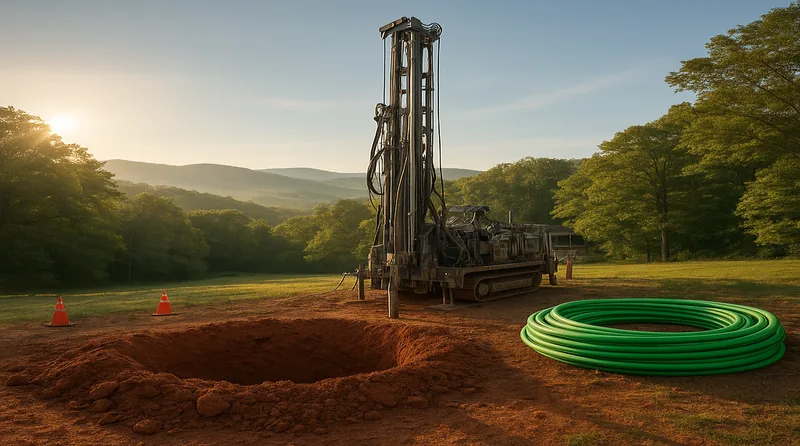
Georgia's geothermal story breaks into three distinct chapters — and the ending is different depending on which one you're in. A propane-heated cabin in Blue Ridge? Geothermal is one of the best financial decisions you can make, with payback under 10 years. A gas-heated home in Buckhead? The numbers probably don't work unless you're building new or replacing aging equipment anyway. A historic row house in Savannah? Geothermal might be the only practical upgrade option that satisfies preservation guidelines.
This guide covers all three chapters with real payback math, honest scenarios where geothermal doesn't make sense, and the specific angles that make Georgia unique — from Plant Vogtle's nuclear grid impact to the Floridan Aquifer's open-loop potential in south Georgia.
The Quick Verdict: Is Geothermal Worth It in Georgia?
| Your Situation | Verdict | Typical Payback | Notes |
|---|---|---|---|
| Blue Ridge / Ellijay propane home | ✅ Strong Yes | 7–11 years | Best economics in the state; cabin rentals even faster |
| North GA propane vacation rental | ✅ Excellent | 5–8 years | Operating expense reduction + eco-premium pricing |
| Electric resistance (any region) | ✅ Yes | 9–14 years | 65–70% electricity reduction; compelling at 11.40¢/kWh |
| USDA REAP farm/rural business | ✅ Excellent | 4–7 years | 25% grant + 30% ITC stacking |
| Atlanta new construction | ✅ Yes | 4–7 years | Incremental cost only; builder coordination key |
| Savannah historic district | ⚠️ Situational | 14–22 years | No outdoor condenser = preservation compliance |
| Aging heat pump replacement | ⚠️ Consider | 10–15 years | At replacement time, incremental cost drops significantly |
| Atlanta natural gas home | ❌ Probably Not | 22–35+ years | Gas is cheap; payback exceeds equipment life |
Georgia's Geothermal Landscape
Georgia's electricity rate sits at 11.40¢/kWh (EIA 2024, rank 31 nationally) — slightly below the national average of 12.64¢/kWh. That's a moderately favorable number for geothermal economics, but not the automatic win you'd see in New England states paying 24–30¢/kWh. Georgia's grid carbon intensity is 822 lbs CO₂/MWh (EIA 2024) — above the national average, but declining as Plant Vogtle's nuclear output ramps up.
What makes Georgia interesting is its diversity. The state spans four distinct geological and climatic zones: the Blue Ridge mountains in the north, the Piedmont plateau where Atlanta sits, the Fall Line transitional zone, and the Coastal Plain stretching to the Florida border. Each zone has different geology, different heating/cooling loads, and a different economic case for geothermal.
Climate snapshot: Atlanta sees roughly 3,000 heating degree days and 2,400 cooling degree days annually — meaningful on both sides, which is why a dual-function geothermal system makes more financial sense here than in a purely heating- or cooling-dominated climate. Savannah tips strongly toward cooling: ~2,000 HDD and 2,800 CDD. The Blue Ridge foothills are the most heating-dominant part of the state.
Utility Landscape
Georgia's primary utility, Georgia Power (a Southern Company subsidiary), serves approximately 2.7 million customers across the state including the Atlanta metro, north Georgia, coastal Georgia, and the Savannah area. Outside Georgia Power's footprint, 41 electric membership corporations (Georgia EMC) serve rural areas — they're cooperatives with their own rebate structures, which vary considerably by co-op.
Plant Vogtle Units 3 and 4 in Waynesboro came online in 2023 and 2024 — the first new nuclear reactors built in the United States in roughly 30 years. As they reach full output, Georgia's grid carbon intensity will decrease meaningfully over the next decade. A geothermal system you install today will operate on a progressively cleaner grid over its 25-year lifespan — roughly 3× more carbon-efficient than gas on today's grid, and improving through 2035.
Georgia's Seven-Region Geology & Drilling Conditions
Understanding Georgia's geology is critical for estimating drilling costs, selecting the right loop type, and setting realistic budget expectations. The state's subsurface conditions vary dramatically from the crystalline Blue Ridge mountains to the sandy Coastal Plain — and that directly affects what your geothermal installation will cost.
| Region | Geology | Thermal Conductivity (W/m·K) | Drilling Difficulty | Typical Depth (ft/ton) | Drilling Cost ($/ft) | Notes |
|---|---|---|---|---|---|---|
| Blue Ridge Crystalline Ellijay, Blue Ridge, Dahlonega, Blairsville |
Granite, gneiss, mica schist; fractured crystalline Appalachian bedrock | 2.5–3.5 | 🔴 Hard | 150–200 | $22–$30 | Hard rock = slow drilling, higher per-foot cost. Excellent thermal conductivity partially offsets with shorter bore depths. Steep terrain may limit rig access. Fractured zones can yield groundwater for open-loop (variable). |
| North GA Piedmont Roswell, Alpharetta, Marietta, Lawrenceville, Gainesville |
Granite, gneiss, amphibolite beneath 10–40 ft saprolite (weathered clay) overburden | 2.2–3.2 | 🟡 Moderate–Hard | 150–185 | $18–$28 | Most metro-north installations. Saprolite layer drills easy, then hits competent rock. Good thermal transfer. Vertical preferred on suburban lots under 0.5 acres. |
| Atlanta Basin (Saprolite/Weathered) Atlanta ITP, Decatur, East Point, College Park |
Deep weathered saprolite (red clay) over metamorphic bedrock; 30–80 ft clay/decomposed rock | 1.4–2.2 | 🟢 Easy–Moderate | 170–210 | $16–$24 | Thick saprolite means easy drilling through the upper zone but lower thermal conductivity. May need slightly deeper bores. Horizontal slinky feasible on larger intown lots (0.3+ acres). |
| Fall Line Transition Macon, Columbus, Augusta, Milledgeville |
Mixed: crystalline Piedmont rock gives way to Coastal Plain sediments. Sand, gravel, clay layers over bedrock. | 1.6–2.8 | 🟢 Easy–Moderate | 160–200 | $15–$22 | Transitional geology — site-specific variability. Both vertical and horizontal loops feasible. Good balance of cost and conductivity. Some gravel layers can cause lost circulation during drilling. |
| Upper Coastal Plain (Kaolin Belt) Sandersville, Wrens, Gordon, Dry Branch |
Kaolin clay deposits, sandy clay, and chalky limestone; Georgia's "White Gold" mining region | 1.0–1.8 | 🟢 Easy | 185–220 | $12–$18 | Very soft drilling — fast bore times, low per-foot cost. Kaolin clay has low thermal conductivity, so deeper bores or more loops needed. Large rural lots make horizontal loops very cost-effective. Active kaolin mines — verify no mining easements on property. |
| Lower Coastal Plain (Floridan Aquifer) Valdosta, Tifton, Waycross, Douglas, Vidalia |
Unconsolidated sand, sandy clay over Ocala Limestone; Floridan Aquifer system at 100–400 ft depth | 1.2–2.0 | 🟢 Easy | 175–210 | $10–$16 | Easiest and cheapest drilling in the state. Open-loop systems highly viable where Floridan Aquifer is accessible (50+ GPM common). Horizontal loops on large agricultural lots are extremely affordable. EPD permit required for open-loop. |
| Coastal & Barrier Islands Savannah, Tybee Island, St. Simons, Jekyll Island, Brunswick |
Marine sand, silt, marsh sediment; shallow water table; saltwater intrusion zone | 1.0–1.6 | 🟡 Moderate (logistically) | 190–230 | $14–$22 | Closed-loop ONLY — saltwater intrusion prohibits open-loop. Sandy sediments drill easily but low conductivity means more bore footage. High water table can complicate horizontal trenching. Island lots are often small, requiring vertical. Corrosion-resistant materials essential. |
Thermal conductivity data based on ASHRAE Handbook fundamentals and Georgia Geological Survey reports. Actual site conditions vary — a thermal conductivity test (in-situ test) costs $1,500–$3,000 and is recommended for systems over 5 tons or commercial projects. For residential systems under 5 tons, regional averages are typically adequate for loop design.
Installation Costs by Region
Geothermal installation costs in Georgia vary significantly by geology and location. Here's what to expect by region:
| Region | Typical Home | System Size | Gross Cost | After 30% ITC | Ground Temp |
|---|---|---|---|---|---|
| Blue Ridge / Ellijay | 2,200–2,800 sq ft | 3–4 ton | $24,000–$35,000 | $16,800–$24,500 | 57–60°F |
| Atlanta Metro | 2,400–3,200 sq ft | 3–5 ton | $25,000–$42,000 | $17,500–$29,400 | 60–63°F |
| Piedmont / Macon | 2,000–2,600 sq ft | 3–4 ton | $22,000–$32,000 | $15,400–$22,400 | 61–64°F |
| South GA / Valdosta | 1,800–2,400 sq ft | 3–4 ton | $20,000–$30,000 | $14,000–$21,000 | 63–66°F |
| Coastal / Savannah | 2,200–3,000 sq ft | 3–5 ton | $24,000–$38,000 | $16,800–$26,600 | 64–67°F |
Costs reflect 2025–2026 pricing for complete installations including equipment, drilling/trenching, ductwork connections, and commissioning. Actual costs vary by lot conditions, loop type, and contractor. Get at least three quotes.
Why the range? Blue Ridge installations use vertical boreholes in hard crystalline rock ($20–$30/ft drilling), while south Georgia's soft sediments allow less expensive horizontal trenching. Atlanta metro costs run higher due to contractor demand, smaller lots requiring vertical systems, and higher labor rates.
Case Study 1: Ellijay Propane Mountain Home
Profile: 2,400 sq ft home in Gilmer County, built 2004, propane forced-air furnace + central AC, 2 adults + 2 kids.
| Item | Details |
|---|---|
| Previous heating fuel | Propane (~780 gallons/year at $3.15/gal = $2,457/year) |
| Previous cooling cost | Central AC (~$680/year electricity) |
| Previous total HVAC | $3,137/year |
| System installed | 3.5-ton WaterFurnace 7 Series, vertical closed-loop (3 boreholes × 200 ft) |
| Gross cost | $28,500 |
| Federal ITC (30%) | −$8,550 |
| Net cost | $19,950 |
| New annual HVAC cost | $1,085/year (heating + cooling + hot water via desuperheater) |
| Annual savings | $2,052/year |
| Simple payback | 9.7 years (at $3.15 propane) |
| Payback at $3.50 propane | 8.3 years |
| 25-year net savings | $31,350 (at $3.15, 3% fuel escalation) |
The family also eliminated their propane tank rental ($85/year) and annual furnace service ($150/year), compressing effective payback further. The desuperheater provides roughly 60% of annual hot water needs at no additional electricity cost during heating and cooling seasons.
Case Study 2: College Park Electric Resistance Home
Profile: 2,000 sq ft ranch in Clayton County, built 1972, electric baseboard heaters + window AC units (upgraded to central AC 2015), 1 adult.
| Item | Details |
|---|---|
| Previous heating cost | Electric baseboard (~12,500 kWh/year × $0.1140 = $1,425/year) |
| Previous cooling cost | Central AC (~$785/year electricity) |
| Previous total HVAC | $2,210/year |
| System installed | 3-ton ClimateMaster Tranquility 30, horizontal slinky loop (4 trenches × 150 ft) |
| Gross cost | $23,000 |
| Federal ITC (30%) | −$6,900 |
| Net cost | $16,100 |
| New annual HVAC cost | $780/year (heating + cooling) |
| Annual savings | $1,430/year |
| Simple payback | 11.3 years |
| Payback (incremental vs. replacing baseboard + AC) | 7.8 years (counting $4,500 avoided conventional HVAC replacement) |
| 25-year net savings | $19,650 |
The horizontal slinky loop was possible because the 0.6-acre lot in College Park had sufficient yard space and soft Piedmont saprolite soil. Electric resistance to geothermal is one of the strongest retrofit cases in the Southeast — the COP improvement from 1.0 to 3.5–4.0 cuts heating electricity by 70%+.
Case Study 3: Cherokee County New Construction + Solar
Profile: 2,800 sq ft new construction in Canton (Cherokee County), 4-bedroom, 2-story, builder spec home in a growing subdivision. Young family of 4. Builder offered geothermal as an upgrade over standard 16-SEER heat pump. Combined with an 8 kW rooftop solar array.
Builder Spec vs. Geothermal Upgrade — Incremental Cost Analysis
| Item | Builder Spec (Standard HVAC) | Geothermal Upgrade |
|---|---|---|
| HVAC system | 4-ton, 16-SEER heat pump + gas furnace backup | 4-ton WaterFurnace 5 Series, vertical closed-loop (3 bores × 175 ft) |
| Builder HVAC allowance | $12,500 (included in home price) | — |
| Gross geothermal cost | — | $34,000 |
| Incremental cost (geo − allowance) | — | $21,500 |
| Federal ITC (30% of $34,000) | — | −$10,200 |
| Net incremental cost | — | $11,300 |
| Annual HVAC cost (no solar) | $2,280/year (gas + electric) | $1,040/year (electric only) |
| Annual HVAC savings | — | $1,240/year |
| Simple payback (geo only) | — | 9.1 years on incremental cost |
Adding the 8 kW Solar Array
| Item | Details |
|---|---|
| Solar array size | 8 kW (22 panels, south-facing roof) |
| Gross solar cost | $22,400 |
| Federal ITC (30%) | −$6,720 |
| Net solar cost | $15,680 |
| Annual solar production | ~11,200 kWh (based on 4.8 peak sun hours, Canton GA) |
| Annual electricity offset | ~85% of total home electricity (including geothermal) |
| Annual electricity bill (with solar + geo) | ~$185/year (net after solar credits) |
| Annual electricity bill (spec home, no solar) | ~$2,280/year |
| Combined annual savings | $2,095/year |
Combined Payback: Geothermal + Solar
| Metric | Value |
|---|---|
| Total net investment (geo + solar) | $26,980 ($11,300 + $15,680) |
| Combined annual savings | $2,095/year |
| Combined payback | 12.9 years |
| 25-year net savings | $25,395 (at 3% utility escalation) |
| Monthly mortgage increase | ~$158/month (30-yr at 6.5%, $26,980 rolled into mortgage) |
| Monthly energy savings | ~$175/month |
| Day-one cash flow | +$17/month positive from day one |
The day-one cash flow story is the key selling point for new construction. When the incremental cost is rolled into a 30-year mortgage, the monthly payment increase is less than the monthly energy savings — meaning the homeowner is cash-flow positive from the first mortgage payment. This is the single strongest financial argument for geothermal in new construction.
Why Cherokee County? Canton, Woodstock, and Holly Springs are among Georgia's fastest-growing communities — Cherokee County added over 25,000 residents between 2020 and 2025. New construction volume is high, lot sizes (typically 0.3–0.75 acres) accommodate vertical loops, and the Piedmont geology offers moderate drilling costs ($18–$25/ft). Builders differentiating with geothermal + solar capture the growing segment of buyers who want net-zero-ready homes.
Monthly Energy Profile: Ellijay Propane Home
This table shows the monthly energy cost comparison for the Case Study 1 Ellijay home — propane + AC baseline versus geothermal:
| Month | Propane + AC Cost | Geothermal Cost | Monthly Savings |
|---|---|---|---|
| January | $485 | $145 | $340 |
| February | $420 | $128 | $292 |
| March | $295 | $95 | $200 |
| April | $125 | $62 | $63 |
| May | $85 | $58 | $27 |
| June | $145 | $82 | $63 |
| July | $185 | $98 | $87 |
| August | $175 | $95 | $80 |
| September | $120 | $72 | $48 |
| October | $110 | $55 | $55 |
| November | $295 | $92 | $203 |
| December | $450 | $138 | $312 |
| Annual Total | $2,890 | $1,020 | $1,870 |
Based on Ellijay climate data (4,100 HDD / 1,200 CDD), propane at $3.15/gal, electricity at 11.40¢/kWh, COP 3.8 heating / EER 20 cooling. Desuperheater hot water savings (~$165/year) shown in annual but not distributed monthly. Actual monthly costs vary by weather, thermostat settings, and home envelope.
Georgia Geology and Loop Types
Georgia's four geological provinces determine installation options and cost:
Blue Ridge Province (North Georgia)
Hard crystalline Appalachian rock — granite, gneiss, schist. High thermal conductivity (2.5–3.5 W/m·K). Vertical loops required; horizontal trenching impractical on mountain lots. Drilling cost: $20–$30/ft. Typical residential system: 450–750 feet of borehole total (3–4 tons, 150–200 ft/ton). Ground temps: 57–60°F.
Piedmont (Atlanta Metro through Macon)
Crystalline metamorphic rock with a weathered saprolite surface layer (the famous red Georgia clay). The saprolite can be excavated for shallow horizontal loops on larger lots, but most urban/suburban installations use vertical boreholes. Drilling cost: $18–$28/ft. Ground temps: 60–63°F.
Fall Line Zone (Macon, Columbus, Augusta)
Transition between Piedmont crystalline rock and Coastal Plain sediments. Mixed installation options — both vertical and horizontal feasible depending on specific site. The boundary runs roughly from Columbus through Macon to Augusta. Ground temps: 62–65°F.
Coastal Plain (South Georgia to the Coast)
Unconsolidated sandy sediments, clays, and limestone. Easy drilling. Both horizontal trenches and vertical boreholes are feasible. Horizontal loop systems are practical on larger rural lots with soft soil. Ground temps: 63–67°F. The Floridan Aquifer underlies much of south Georgia and offers excellent open-loop potential in areas away from saltwater intrusion.
Loop Type Cost Comparison
| Loop Type | Best For | Typical Cost (3-ton) | Georgia Notes |
|---|---|---|---|
| Vertical closed-loop | Small lots, Blue Ridge, Atlanta | $22,000–$35,000 | Standard for north GA and metro; crystalline rock drilling |
| Horizontal closed-loop | Large lots, south GA, rural Piedmont | $18,000–$26,000 | Soft Coastal Plain soil; needs 0.5+ acre |
| Horizontal slinky | Budget-conscious, adequate land | $16,000–$24,000 | More pipe per trench; saves 20–30% on trenching |
| Open-loop | South GA with good aquifer access | $15,000–$22,000 | Floridan Aquifer zones; NOT coastal/saltwater zones |
| Pond/lake loop | Properties with 0.5+ acre pond | $14,000–$20,000 | Farm ponds; Lake Lanier/Hartwell/Oconee properties |
Open-Loop System Viability by Region
Open-loop systems use groundwater directly, pumping it through the heat exchanger and returning it to the aquifer. They're the most efficient loop type but require adequate water quality and quantity. Here's where they work in Georgia:
| Region | Aquifer | Open-Loop Viability | Notes |
|---|---|---|---|
| Blue Ridge | Fractured rock | ⚠️ Site-specific | Variable well yields; water quality varies; test first |
| Atlanta Metro | Piedmont crystalline | ❌ Not recommended | Low yields, municipal water restrictions, high iron |
| Fall Line | Transitional | ⚠️ Site-specific | Variable geology; test well yield and chemistry |
| South GA Interior | Floridan Aquifer | ✅ Generally viable | Excellent yields, good quality; EPD permit required |
| Coastal (inland) | Upper Floridan | ⚠️ Site-specific | Test for saltwater intrusion; EPD review required |
| Barrier Islands / Tidal | Saltwater zone | ❌ Not viable | Saltwater corrosion; closed-loop only |
Key rule: Any open-loop system in Georgia requires a Georgia EPD water withdrawal permit. The Floridan Aquifer in south Georgia often has excellent flow rates (50+ GPM from properly constructed wells), making open-loop systems both feasible and highly efficient. But coastal properties within the saltwater intrusion zone must use closed-loop systems — period. Contact Georgia EPD's Watershed Protection Branch for permit guidance.
Incentives and Tax Credits
Federal 30% Tax Credit (Section 25D) — ✅ Confirmed
The federal residential clean energy credit covers 30% of total installed geothermal system costs through 2032, then steps down to 26% in 2033 and 22% in 2034. This is a dollar-for-dollar credit against your federal income tax liability — not a deduction.
The credit covers equipment, labor, drilling costs, and the ground loop. It carries forward to future tax years if you can't use it all in year one. On a $25,000 installation, that's $7,500 back.
Georgia State Incentives — Limited
There is no confirmed state-level geothermal tax credit or rebate program in Georgia as of March 2026. Georgia's renewable portfolio standard is essentially voluntary (2% target, not mandatory), and the state has not passed geothermal-specific legislation comparable to New York, Massachusetts, or Maryland.
Property tax exemption (OCGA § 48-5-44): Georgia does have a renewable energy equipment property tax exemption. Geothermal systems may qualify, which would prevent your home's assessed value from increasing due to the installation. Worth verifying with your county tax assessor — interpretation varies. [NEEDS VERIFICATION]
Georgia Power rebates: Georgia Power's residential programs have historically focused on conventional heat pumps meeting specific SEER/HSPF ratings. No confirmed geothermal-specific rebate is available as of this writing. Check georgiapower.com/residential/save-money-energy for current programs or call 1-888-655-5888. [NEEDS VERIFICATION]
Georgia EMC co-ops: Individual co-ops vary. Some offer heat pump rebates; a few have experimented with geothermal-specific programs. Contact your specific co-op — the Georgia EMC association lists member co-ops at georgiaemc.com.
USDA REAP (Rural Energy for America Program): Available for agricultural businesses and rural small businesses in Georgia — not residential. Grants up to 25% + loans up to 75% of project costs. Combined with the 30% federal ITC, eligible farms can cover 55% of costs. Georgia has significant agricultural operations (poultry, pecans, row crops) where REAP makes geothermal compelling.
Incentive Stacking Summary
| Incentive | Amount | Status | Who Qualifies |
|---|---|---|---|
| Federal ITC (25D) | 30% of total cost | ✅ Confirmed through 2032 | All residential installations |
| GA Property Tax Exemption | Varies by county | ⚠️ Needs Verification | Renewable energy equipment; verify with assessor |
| Georgia Power Rebate | Unknown | ⚠️ Needs Verification | Check current program availability |
| Georgia EMC Co-op Rebate | Varies by co-op | ⚠️ Varies | Contact your specific EMC |
| USDA REAP Grant | Up to 25% | ✅ Available | Rural farms and small businesses only |
Comprehensive Incentive Stacking: Best-Case Scenarios
For eligible properties, stacking federal, state, and USDA incentives can dramatically reduce net costs. Here's what the best-case numbers look like for different property types:
| Scenario | Gross Cost | Federal ITC (30%) | USDA REAP (25%) | GA Property Tax Exempt | Utility Rebate | Net Cost | % Covered |
|---|---|---|---|---|---|---|---|
| Residential — Propane Home Blue Ridge, 3-ton vertical |
$28,500 | −$8,550 | N/A | ~$200–$400/yr saved | $0–$500 | $19,450–$19,950 | 30% |
| Residential — New Construction Cherokee County, 4-ton vertical |
$34,000 (incremental: $21,500) |
−$10,200 | N/A | ~$300–$500/yr saved | $0–$500 | $11,300 (incremental) | 47% of incremental |
| Farm — Poultry Operation Putnam County, 5-ton vertical |
$32,000 | −$9,600 | −$8,000 | ~$400–$600/yr saved | N/A | $14,400 | 55% |
| Farm — Pecan/Onion Operation Vidalia area, 7-ton horizontal |
$42,000 | −$12,600 | −$10,500 | ~$500–$800/yr saved | N/A | $18,900 | 55% |
| Commercial — Small Rural Business Middle GA, 10-ton system |
$65,000 | −$19,500 (48E ITC) | −$16,250 | Exempt | N/A | $29,250 | 55% |
| Commercial — MACRS + ITC + REAP (Maximum stacking) |
$65,000 | −$19,500 (48E ITC) | −$16,250 | Exempt | +MACRS 5-yr depr: ~$9,100 tax value | ~$20,150 (effective) | 69% (effective) |
MACRS (Modified Accelerated Cost Recovery System) allows commercial geothermal systems to be depreciated over 5 years, creating additional tax benefits. The ITC basis must be reduced by 50% of the REAP grant before calculating the credit. Consult a tax professional for your specific situation — incentive interactions are complex.
Bottom line: The federal credit does the heavy lifting in Georgia. Don't budget for state incentives — if they materialize, consider them a bonus. For farms and rural businesses, the REAP + ITC stack is a game-changer that cuts net costs by more than half.
North Georgia Mountains: The Strong Case
The Blue Ridge mountains — Blue Ridge, Ellijay, Dahlonega, Blairsville, Dawsonville, Helen, Hiawassee — present the most compelling geothermal economics in the state. The reason is straightforward: propane dependence.
Gas mains don't extend into much of the mountain zone. Rural homeowners heat with propane, and at $3.00–$3.25 per gallon delivered (2025 pricing), a 2,500-square-foot mountain home burns roughly 700–800 gallons per season. That's $2,100–$2,600 per year just for heating.
Geothermal running on Georgia's 11.40¢/kWh electricity heats the same home for approximately $500–$650 per year. Combined with cooling savings, total annual savings run $1,500–$2,100 — enough to produce a 7–11 year payback on a $16,800–$24,500 net investment.
The Cabin Rental Multiplier
North Georgia has a substantial vacation rental economy. Blue Ridge, Ellijay, and the surrounding counties are roughly 90 minutes from downtown Atlanta — close enough for frequent weekend trips from the metro. Properties on Airbnb and VRBO in this corridor often see 150–200 rental nights per year.
For a rental property, the economics improve considerably:
- Propane costs are a direct operating expense reducing net rental income
- A geothermal system saving $1,800/year in propane adds $1,800 to annual profit
- Payback timelines for well-occupied rentals compress to 5–8 years
- "Geothermal heated" and "eco-friendly" listings attract premium-pricing guests
- No propane deliveries to coordinate during peak rental season
- Consistent, quiet heating/cooling improves guest reviews
Lake cabin conversions — properties on Lake Blue Ridge, Lake Nottely, or Carters Lake — often combine the propane savings angle with a pond/lake loop opportunity if the property has suitable water access. Lake loops are typically the least expensive installation type.
Atlanta Metro and Suburbs
Atlanta is a complex market. The metro (6 million+ people, 29 counties) splits sharply on economics depending on current heating fuel.
The Gas-Home Reality (Honest Assessment)
Most established Atlanta suburbs — Buckhead, Sandy Springs, Marietta, Alpharetta, Decatur, Dunwoody, Roswell — are served by natural gas. The honest answer for gas-heated Atlanta homes:
- Annual natural gas heating cost (typical 2,800 sq ft home, ~550 therms): ~$600–$750
- Annual geothermal heating cost: ~$480–$620
- Annual heating savings: roughly $80–$200
- Cooling savings (geothermal vs. conventional AC): ~$300–$500/year
- Total annual savings: ~$400–$700
- Net installation cost (after 30% credit): ~$17,500–$29,400
- Payback: 25–42+ years
That exceeds the system's 25-year lifespan. Natural gas in Georgia is cheap, and Atlanta's heating load is moderate. We don't recommend geothermal as a fuel-cost play for gas-heated Atlanta homes.
When It Does Make Sense in Atlanta
Three scenarios where the Atlanta math works:
-
New construction — The incremental cost of adding geothermal over standard HVAC is often $5,000–$10,000 rather than the full $25,000–$42,000. Upper-tier suburbs like Milton, Alpharetta, and Johns Creek, where $800K–$2M+ custom homes are common, routinely incorporate geothermal as a premium builder specification. Payback on incremental cost: 4–7 years.
-
Electric resistance replacement — Older Atlanta homes without gas service heating with electric baseboard or strip heat (COP 1.0 at 11.40¢/kWh). Geothermal at COP 3.5–4.0 cuts that bill by 65–70%, producing 9–14 year payback timelines.
-
Full system replacement timing — If your 15-year-old gas furnace and AC need simultaneous replacement ($8,000–$12,000 for conventional), the incremental cost to go geothermal drops significantly. This is the only scenario where a gas-home conversion approaches reasonable payback.
Outer Suburbs and Growth Corridors
Cherokee, Forsyth, Paulding, Barrow, and Coweta counties are Georgia's fastest-growing areas. New construction volume is high, lot sizes are larger than established suburbs, and many properties have space for horizontal loop fields — the most cost-effective installation type. Builders marketing geothermal as a standard feature in this corridor can differentiate from competitors and capture the growing eco-conscious buyer segment.
Coastal Georgia and Savannah
The Savannah Historic District Advantage
Savannah's National Historic Landmark District is one of the largest in the United States. Its squares, Federal and Regency row houses, and antebellum architecture are irreplaceable — and increasingly difficult to maintain with modern HVAC equipment.
The problem with conventional air conditioning in a historic preservation zone: condensers. A standard central air system requires an exterior condenser unit — a noisy, visually intrusive box outside the house. In Savannah's historic district, exterior equipment placement is strictly regulated by the Metropolitan Planning Commission (MPC) and the Historic Savannah Foundation. Visible mechanical equipment on contributing structures is effectively prohibited.
Geothermal has no exterior equipment. Everything is underground (the ground loop) or inside the building (the heat pump unit). No condenser, no outdoor fan, nothing to mount on a historic façade. For Savannah historic district homeowners, geothermal can be the only viable path to modern air conditioning without violating preservation guidelines.
The climate math also works: Savannah sees ~2,800 CDD annually — a geothermal system running as an air conditioner eight months a year delivers significant electricity savings over conventional AC.
Golden Isles and Barrier Islands
The Georgia coast — Tybee Island, Jekyll Island, St. Simons Island, Sea Island, Cumberland Island — is saltwater territory. One absolute rule:
Closed-loop systems only. No open-loop systems using groundwater.
Saltwater intrusion in coastal Georgia's aquifer systems means well water contains enough chlorides to corrode heat exchanger equipment and accelerate loop degradation. Any ground-source system near the coast must use a sealed closed-loop configuration.
The upside: the Golden Isles market (Sea Island, Jekyll Island Club, The Cloister) is ultra-premium real estate ($1M–$10M+). Payback timeline is secondary to comfort, prestige, sustainability credentials, and property value. A geothermal system in a Golden Isles property is a feature, not a compromise.
Solar + Geothermal Stacking
Georgia gets 4.5–5.2 peak sun hours daily (NREL) — solid for solar. Combining solar PV with a geothermal heat pump creates a system where solar generates the electricity and geothermal multiplies it 3.5–4× through ground-source efficiency.
Georgia Power net metering: Georgia Power offers net metering for solar systems up to 10 kW residential / 250 kW commercial. Excess generation is credited at the avoided cost rate — lower than retail, but still valuable. Georgia EMC co-ops have their own net metering policies.
Combined system economics:
- 8 kW solar array: ~$18,000 after 30% ITC
- Geothermal heat pump: ~$18,000 after 30% ITC
- Combined net cost: ~$36,000
- Combined annual savings: ~$3,200–$4,500 (electricity + fuel)
- Combined payback: 8–11 years
- 25-year savings: $44,000–$76,000
For propane homes in north Georgia, solar + geothermal is a particularly strong combination — eliminating both the propane bill and most of the electricity bill in a single project, financed together.
USDA REAP Deep-Dive: Georgia Farms and Rural Businesses
Georgia's agricultural sector — #1 in poultry production, major pecan and peanut operations, 42,000+ farms — creates significant REAP eligibility. The Rural Energy for America Program provides:
- Grants: Up to 25% of project costs (competitive application)
- Loan guarantees: Up to 75% of project costs
- Combined with federal ITC: 25% REAP grant + 30% ITC = 55% of costs covered
Commercial Incentive Stacking: ITC + REAP + MACRS
For commercial and agricultural installations, the incentive stack goes even deeper than residential:
| Incentive Layer | Benefit | How It Works | Example ($45,000 system) |
|---|---|---|---|
| USDA REAP Grant | Up to 25% of project cost | Competitive grant; application scored on energy savings, rural impact, and business viability | −$11,250 |
| Federal ITC (Section 48E) | 30% of cost basis (reduced by 50% of REAP grant) | Dollar-for-dollar tax credit. Basis = $45,000 − ($11,250 × 50%) = $39,375. Credit = 30% × $39,375 | −$11,813 |
| MACRS 5-Year Depreciation | ~15–20% effective tax benefit | Depreciate remaining basis over 5 years (accelerated schedule). Tax benefit depends on marginal rate. | ~−$4,400 (at 20% marginal rate) |
| GA Property Tax Exemption | Ongoing annual savings | Prevents assessed value increase from geothermal equipment | ~$300–$500/yr |
| Total First-Year Incentive Value | −$27,463 (61% of gross cost) | ||
| Net Cost to Farm/Business | $17,537 | ||
Example 1: Putnam County Poultry Operation
- 3,200 sq ft processing facility + office, currently propane
- 5-ton geothermal system, vertical closed-loop
- Gross cost: $32,000
- REAP grant (25%): −$8,000
- Federal ITC (30% of adjusted basis): −$8,400
- Net cost: $15,600
- Annual savings: $3,200
- Payback: 4.9 years
Example 2: Vidalia Sweet Onion & Pecan Farm
Profile: 120-acre farm in Toombs County growing Vidalia onions and pecans. 2,800 sq ft farmhouse + 1,500 sq ft packing shed office, both on propane. Owner wants to consolidate heating/cooling and reduce operating costs.
| Item | Details |
|---|---|
| Current heating | Propane for farmhouse + packing shed (~1,100 gallons/year at $2.95/gal = $3,245/year) |
| Current cooling | Window units + aging central AC (~$1,400/year combined) |
| Current total HVAC | $4,645/year |
| System installed | 7-ton ClimateMaster Trilogy 45 (two zones), horizontal closed-loop (6 trenches × 200 ft in soft Coastal Plain soil) |
| Gross cost | $42,000 |
| USDA REAP grant (25%) | −$10,500 |
| Federal ITC (30% of adjusted basis) | −$11,025 |
| MACRS depreciation (est. tax value) | −$4,095 |
| Effective net cost | $16,380 |
| New annual HVAC cost | $1,420/year |
| Annual savings | $3,225/year |
| Effective payback | 5.1 years |
| 25-year net savings | $64,245 (at 3% fuel escalation) |
The Coastal Plain's soft sandy soil kept horizontal loop installation costs low ($10–$14/ft trenching vs. $22–$30/ft vertical drilling in north GA). The farm's large open acreage made a horizontal field the obvious choice. The Trilogy 45's dual-capacity compressor handles the farmhouse's winter heating and the packing shed's summer cooling demands efficiently.
USDA Georgia State Office & Application Resources
- USDA Georgia State Office: 355 E. Hancock Ave., Athens, GA 30601 | (706) 546-2173
- USDA Service Centers: farmers.gov/service-locator — find your county office
- Application windows: Typically quarterly (check rd.usda.gov for current deadlines)
- Typical timeline: Application preparation (2–4 weeks) → Submission → USDA review (60–90 days) → Award notification → Project completion (within 2 years of award)
Application tips:
- Start early. REAP applications require an energy audit or assessment by a qualified auditor — budget 3–4 weeks for this step alone.
- Quantify energy savings. The application is scored competitively. Include a detailed energy audit showing projected BTU/kWh reductions, not just dollar savings.
- Get contractor quotes first. You'll need detailed cost estimates as part of the application package.
- Document rural eligibility. Your farm or business must be in an eligible rural area (most of Georgia outside Atlanta metro qualifies).
- Consider a REAP consultant. Several agricultural consultants in Georgia specialize in REAP applications. Their fee ($1,500–$3,000) is often worth it for the 25% grant on a $30,000–$50,000 system.
Vacation Rental and Agritourism Economics
Beyond Blue Ridge cabin rentals, several Georgia markets offer enhanced geothermal ROI for investment properties:
Mountain cabin market (Blue Ridge/Ellijay/Helen):
- 150–200 rental nights/year typical
- Propane elimination saves $1,500–$2,500/year in operating costs
- "Eco-cabin" premium: 8–15% rate increase for sustainability-marketed properties
- Payback: 5–8 years for well-occupied rentals
Lake properties (Lanier/Hartwell/Oconee):
- Strong weekend rental market from Atlanta
- Possible lake/pond loop installation (lowest-cost option)
- Year-round climate control for seasonal cabins
Agritourism venues (middle Georgia):
- Wedding barns, farm stays, event venues
- Large conditioned spaces benefit from geothermal's scalability
- REAP eligibility if on working farm
- Commercial-scale systems with 30+ year lifespan
Savannah vacation rentals:
- Historic district STVR permits are limited and valuable
- No-condenser advantage is a real differentiator
- Premium pricing for historic, well-appointed properties
Permits, Licensing & Regulatory Requirements
Georgia's geothermal permitting landscape involves state-level licensing, county building permits, and special zone requirements. Understanding all three layers before starting your project prevents costly delays.
Georgia EPD Well Driller Licensing
Any vertical borehole installation in Georgia requires a licensed water well driller registered with the Georgia Environmental Protection Division (EPD). This is non-negotiable — unlicensed drilling is a violation of Georgia law.
- Governing regulation: Georgia EPD Rules Chapter 391-3-2, "Water Well Standards Act of 1985" (OCGA § 12-5-120 et seq.)
- License requirement: All persons drilling, constructing, or closing water wells (including geothermal boreholes) must hold a valid Georgia EPD Water Well Driller License
- License verification: Contact Georgia EPD's Watershed Protection Branch at (404) 463-1511 or visit epd.georgia.gov to verify a driller's license status
- Well completion reports: Licensed drillers must file a Well Completion Report (Form EPD-WW-1) with the EPD within 30 days of completing each borehole — including geothermal boreholes
- Open-loop permits: Systems using groundwater require a Water Withdrawal Permit from EPD's Watershed Protection Branch. Application includes well yield testing and water quality analysis. Processing time: 60–120 days.
Secretary of State Contractor Licensing
Georgia requires HVAC/mechanical contractors to hold a valid license from the Georgia Secretary of State's Professional Licensing Division:
- Conditioned Air Contractor License: Required under OCGA § 43-14-1 et seq. (Georgia Conditioned Air Contractors Act). Any contractor performing HVAC installation, including connecting the geothermal heat pump to ductwork and refrigerant lines, must hold this license.
- License classes: Class I (unlimited), Class II (limited to systems under 175,000 BTU/h — sufficient for most residential geothermal). Most residential geothermal installers hold Class I or Class II Conditioned Air licenses.
- Verification: Search active licenses at sos.ga.gov/PLB or call (404) 656-3900.
- Electrical: If electrical panel upgrades are needed, a licensed Georgia electrician (Electrical Contractor License, OCGA § 43-14-1) must perform that work.
- General contractor: For new construction where geothermal is part of the build, the general contractor must hold a valid Georgia Residential/General Contractor License (Georgia Licensing Board for Residential and General Contractors, OCGA § 43-41-1 et seq.).
County-by-County Permit Requirements
Permit requirements, fees, and timelines vary by county. Here's what to expect in the most common Georgia geothermal markets:
| County | Mechanical Permit | Well/Drilling Permit | Typical Fee Range | Review Time | Notes |
|---|---|---|---|---|---|
| Fulton County (Atlanta, Sandy Springs, Roswell, Alpharetta) |
Required — Mechanical permit through Fulton County Dept. of Building & Zoning | No separate county well permit (EPD license covers); notify county of borehole locations | $150–$400 | 5–10 business days | City of Atlanta has separate permit process from unincorporated Fulton. Verify which jurisdiction applies. |
| DeKalb County (Decatur, Brookhaven, Dunwoody, Tucker) |
Required — Mechanical permit through DeKalb County Building Dept. | Environmental Health review for open-loop or near septic systems | $125–$350 | 5–10 business days | Unincorporated areas vs. city of Decatur have separate processes. Check zoning for setback requirements from property lines for boreholes. |
| Cobb County (Marietta, Smyrna, Kennesaw, Acworth) |
Required — Mechanical permit through Cobb County Community Development | No separate well permit; EPD driller license sufficient | $100–$350 | 3–7 business days | Relatively straightforward process. Large suburban lots in west Cobb facilitate horizontal loops. |
| Gwinnett County (Lawrenceville, Duluth, Suwanee, Buford) |
Required — Gwinnett County Dept. of Planning & Development | Grading permit may be required for horizontal loop excavation exceeding 5,000 sq ft | $150–$450 | 5–15 business days | Gwinnett has strict erosion/sedimentation control requirements. Horizontal loop trenching may trigger a Land Disturbance Permit if disturbing >5,000 sq ft. |
| Cherokee County (Canton, Woodstock, Holly Springs, Ball Ground) |
Required — Cherokee County Building Inspection Dept. | No separate well permit | $100–$300 | 3–7 business days | Fast-growing county, permit offices are busy. New construction permits often bundle geothermal with the building permit. Rural areas north of Canton have minimal additional requirements. |
| Gilmer County (Ellijay, East Ellijay) |
Required — Gilmer County Building Dept. (minimal requirements compared to metro) | EPD driller license sufficient; no additional county well permit | $75–$200 | 1–5 business days | Mountain county with simpler permitting. Access roads and steep terrain are bigger practical challenges than paperwork. Septic system setbacks apply. |
| Chatham County / Savannah (Savannah, Tybee Island, Pooler) |
Required — City of Savannah Development Services or Chatham County | EPD permit required; additional coastal zone review for barrier island properties | $200–$500 | 7–20 business days | Historic district: Certificate of Appropriateness (COA) from MPC if any visible changes to contributing structures. Underground loops typically exempt from COA if surface is restored. Confirm with MPC (912-651-1440) before starting. |
| Lowndes County / Valdosta (Valdosta, Hahira, Lake Park) |
Required — Lowndes County Building Inspection or City of Valdosta | EPD permit for open-loop systems (Floridan Aquifer access); closed-loop needs driller license only | $75–$250 | 3–7 business days | Soft Coastal Plain soil = easy permitting for horizontal loops. Open-loop is viable here but adds EPD permit timeline (60–120 days). |
Special Permitting Zones
Savannah Metropolitan Planning Commission (MPC) — Historic District: Properties within Savannah's National Historic Landmark District that are "contributing structures" may require a Certificate of Appropriateness for any exterior modification. Geothermal ground loops are installed underground and typically don't require a COA — but surface restoration, drilling rig access through narrow historic streets, and any visible equipment placement need MPC review. Contact the MPC at (912) 651-1440 or savannahga.gov/MPC before starting work.
Georgia Coastal Zone: Properties in Georgia's 11-county coastal zone (Bryan, Camden, Chatham, Glynn, Liberty, Long, McIntosh, Bulloch, Effingham, Screven, Wayne) may require review under the Georgia Coastal Management Program administered by the Georgia DNR Coastal Resources Division. This is particularly relevant for barrier island installations and projects near tidal marshes or wetlands. Contact: (912) 264-7218.
Mountain Ridgeline Ordinances: Several north Georgia counties (Rabun, Towns, Union, Lumpkin) have ridgeline development ordinances that restrict construction activities above certain elevations. Drilling rig placement and equipment access roads on ridgeline properties may require additional zoning review. Check with your county planning department.
Typical Project Timeline
| Phase | Duration | Key Activities |
|---|---|---|
| 1. Planning & Design | 1–2 weeks | Manual J load calculation, loop design, site assessment, soil/geology review |
| 2. Permitting | 1–3 weeks | County mechanical permit, EPD notifications (add 8–16 weeks for open-loop EPD water withdrawal permit) |
| 3. Drilling/Trenching | 2–5 days | Vertical: 1–2 days per borehole. Horizontal: 1–3 days for trenching and loop placement |
| 4. Loop Installation | 1–2 days | HDPE pipe insertion, header connections, pressure testing, grouting (vertical) |
| 5. Interior Installation | 2–3 days | Heat pump unit, ductwork connections, desuperheater, thermostat, electrical |
| 6. Commissioning | 1 day | System startup, refrigerant charge verification, flow rate testing, performance validation |
| 7. Inspection & Close-out | 1–2 weeks | County inspection, EPD well completion report (30 days), final documentation |
| Total (closed-loop) | 5–7 weeks | Add 2–4 months if open-loop EPD water withdrawal permit is needed |
Finding and Vetting a Georgia Geothermal Installer
Choosing the right installer is the single most important decision in your geothermal project. A poorly designed or installed system will underperform for 25 years. Georgia's installer base is growing but still concentrated in the Atlanta metro and north Georgia mountains — finding qualified contractors in south Georgia and coastal areas may require broader searches.
Manufacturer & Industry Locator Resources
Use these directories to find certified installers near your Georgia property:
- IGSHPA Contractor Finder — Search by ZIP code for Accredited Installer (AI) and Certified GeoExchange Designer (CGD) credential holders. The gold standard for geothermal-specific certification.
- WaterFurnace Dealer Locator — Find WaterFurnace factory-authorized dealers in Georgia. WaterFurnace is the most widely installed residential geothermal brand in the Southeast.
- ClimateMaster Dealer Locator — ClimateMaster has a strong presence in the Southeast commercial and residential markets. Their Trilogy and Tranquility lines are popular in Georgia.
- Bosch Geothermal Contractor Finder — Bosch Greensource geothermal heat pumps; search by ZIP for trained installers.
- GeoExchange / Geothermal Exchange Organization — Industry trade organization with resources for finding qualified geothermal professionals and understanding best practices.
- Georgia EPD Licensed Drillers — Verify well driller registration through EPD's Watershed Protection Branch: (404) 463-1511 or epd.georgia.gov.
- Georgia EMC Referrals — Some co-ops maintain lists of preferred geothermal contractors in their service territories.
Georgia EPD Driller License Verification
Before signing any contract for vertical loop installation, verify your drilling contractor's Georgia EPD license:
- Call Georgia EPD Watershed Protection Branch: (404) 463-1511
- Request driller license verification by providing the contractor's name and/or company
- Ask for license number, issue date, and status (active/expired/revoked)
- Confirm the license covers geothermal borehole construction — some well drillers specialize in water supply wells and may not have experience with geothermal-specific requirements (grouting, loop insertion, header connections)
- Check for violations or complaints on file with EPD
8-Point Installer Vetting Checklist
Use this checklist when evaluating geothermal contractors. Any installer who can't satisfy all 8 points should not be your first choice:
- ✅ IGSHPA Accredited Installer (AI) or Certified GeoExchange Designer (CGD) — Geothermal-specific training and certification, not just generic HVAC
- ✅ Georgia EPD Water Well Driller License — Required for any vertical borehole installation. Verify directly with EPD.
- ✅ Georgia Secretary of State Conditioned Air Contractor License — Class I or Class II. Verify at sos.ga.gov/PLB.
- ✅ Minimum 10 completed geothermal installations in Georgia — Ask for references with contact information. Specifically ask about projects in your geological region (Blue Ridge rock is different from Coastal Plain sand).
- ✅ Manual J load calculation included in every quote — Any installer who sizes your system based on square footage alone, without a room-by-room load calculation, is cutting corners. Oversized systems short-cycle and underperform.
- ✅ Written warranty: 10+ years on equipment, 50+ years on ground loop — Major manufacturers (WaterFurnace, ClimateMaster, Bosch) offer 10-year parts warranties. The ground loop (HDPE pipe) should carry a 50-year or lifetime warranty from the pipe manufacturer.
- ✅ Pre-installation site assessment included — A site visit to evaluate lot size, soil conditions, drilling access, utility locations, and ductwork compatibility. Desktop-only quotes are red flags.
- ✅ Detailed written proposal with line-item pricing — Equipment model and size, loop type and dimensions, drilling/trenching specifics, ductwork modifications, electrical requirements, permit costs, and commissioning. Avoid lump-sum quotes that don't break down costs.
🚩 Red Flags — Walk Away If You See These
- No IGSHPA certification and can't explain why (they may be a conventional HVAC company "adding" geothermal without proper training)
- Won't provide references for completed Georgia geothermal installations
- Sizes the system by square footage alone without a Manual J calculation
- Quotes verbally without a detailed written proposal
- Pressures you to sign immediately with "limited-time" pricing
- Subcontracts the drilling to an unlicensed driller
- Can't explain the loop design — how many boreholes, what depth, what grout material, what HDPE pipe specification
- No mention of commissioning or startup verification — a professional installer tests flow rates, entering/leaving water temperatures, and system COP at startup
Regional Installer Availability
| Region | Installer Density | Typical Wait Time | Notes |
|---|---|---|---|
| Atlanta Metro (Fulton, DeKalb, Cobb, Gwinnett, Cherokee) | 🟢 Good — 8–15 active installers | 3–6 weeks | Highest concentration in the state. Competitive pricing due to multiple options. |
| North GA Mountains (Gilmer, Fannin, Union, Lumpkin, Rabun) | 🟡 Moderate — 3–6 active installers | 4–8 weeks | Growing market driven by cabin/propane conversion demand. Some metro installers serve this area. |
| Middle GA (Bibb, Houston, Baldwin, Putnam) | 🟠 Limited — 2–4 active installers | 6–10 weeks | Fewer dedicated geothermal installers. May need to bring in contractors from Atlanta or Augusta. |
| South GA (Lowndes, Tift, Coffee, Toombs) | 🔴 Sparse — 1–3 active installers | 8–14 weeks | Limited local expertise. Jacksonville, FL installers sometimes serve this market. REAP-eligible farm projects may attract wider interest. |
| Coastal (Chatham, Glynn, Camden) | 🟠 Limited — 2–4 active installers | 6–12 weeks | Savannah has a few experienced installers. Barrier island logistics add complexity and cost. |
Get 3 Free Geothermal Quotes for Your Georgia Home
Compare installation costs from IGSHPA-certified contractors in your area. Use our free quote service to get competitive bids from vetted Georgia installers — vertical, horizontal, and open-loop options available depending on your property and location.
Maintenance, System Longevity & Georgia-Specific Concerns
Geothermal systems have fewer moving parts exposed to weather than conventional HVAC, leading to longer equipment life and lower maintenance costs. However, Georgia's climate presents a few specific maintenance considerations that differ from northern states.
Georgia-Specific Maintenance Schedule
| Task | Frequency | DIY or Pro | Est. Cost | Georgia-Specific Notes |
|---|---|---|---|---|
| Air filter replacement | Every 1–3 months | DIY | $15–$40/filter | Georgia's high humidity + pollen loads (especially March–May pine pollen season) clog filters faster than northern climates. Check monthly during spring pollen season and summer humidity peaks. Use MERV 11+ filters to combat mold spores. |
| Condensate drain inspection | Monthly (March–October) | DIY | $0 | Critical in Georgia. The cooling-dominant climate means your system produces condensate 7–8 months/year. Georgia's humidity promotes algae growth in condensate lines. Flush with diluted bleach quarterly. A clogged drain can cause water damage and mold growth. |
| Desuperheater flush | Annually (fall) | Pro recommended | $75–$150 | Georgia's moderately hard water (especially in the Piedmont region where calcium carbonate levels run 50–150 mg/L) can cause scale buildup in the desuperheater heat exchanger. Annual flushing maintains efficiency and extends lifespan. Schedule in October before heating season. |
| Loop pressure/flow check | Annually | Pro | $100–$200 | Verify loop pressure and antifreeze concentration. North GA systems use propylene glycol antifreeze (freeze protection to 15°F); south GA closed-loop systems may run water-only but should still be pressure-tested for leaks. |
| Coil and blower cleaning | Annually | Pro | $100–$175 | Georgia's pine pollen, red clay dust, and humidity combine to create stubborn buildup on indoor coils. Clean in late spring (after pollen season peaks) for best results. |
| Open-loop strainer/filter cleaning | Quarterly (open-loop systems only) | DIY or Pro | $0–$50 | Open-loop systems in south Georgia's Floridan Aquifer zones may accumulate fine sand sediment or iron deposits. Check and clean intake strainers quarterly. Red clay sediment is common in Piedmont-area open-loop systems (rare, but possible in Fall Line transitional zones). |
| Thermostat/controls check | Annually | DIY | $0 | Verify programmable thermostat settings for Georgia's swing seasons (March–April, October–November) when the system switches frequently between heating and cooling. Smart thermostats (Ecobee, Nest) with geothermal-compatible settings optimize changeover. |
| Full professional inspection | Every 3–5 years | Pro | $200–$400 | Comprehensive check: refrigerant charge, entering/leaving water temps, loop flow rate, electrical connections, ductwork integrity, and overall COP verification. Schedule with an IGSHPA-certified technician. |
Annual maintenance cost: $150–$350/year (filters + periodic pro service). Compare to conventional HVAC at $250–$500/year in Georgia (furnace tune-up + AC service + potential refrigerant charges + condenser cleaning).
Component Lifespan Table
| Component | Expected Lifespan | Replacement Cost (2026) | Notes |
|---|---|---|---|
| Ground loop (HDPE pipe) | 50–100+ years | N/A (outlasts the building) | Sealed, buried, no moving parts. The most durable component in the system. |
| Heat pump compressor | 20–25 years | $2,500–$5,000 (compressor only) | Scroll compressors in modern units are extremely reliable. Variable-speed models may last longer due to reduced cycling stress. |
| Heat pump unit (complete) | 20–25 years | $6,000–$12,000 | Indoor installation protects from weather, UV, and debris — a major longevity advantage over outdoor condensers in Georgia's heat and humidity. |
| Circulating pump | 10–15 years | $400–$800 | The most likely component to need mid-life replacement. Monitor for noise, vibration, or flow rate changes. |
| Desuperheater | 15–20 years | $500–$1,000 | Scale buildup is the primary failure mode. Annual flushing extends life significantly. |
| Thermostat/controls | 10–15 years | $150–$400 | Technology upgrades often drive replacement before failure. |
| Ductwork | 25–40 years | $3,000–$8,000 (full replacement) | Existing ductwork is usually retained. Inspect for leaks and insulation degradation during the geothermal installation. |
Georgia-Specific Environmental Concerns
Humidity and mold: Georgia's subtropical humidity (often 70–90% relative humidity in summer) creates ideal conditions for mold growth in ductwork and around HVAC equipment. Geothermal systems actually help with this — the consistent dehumidification during cooling mode is more effective than a conventional AC cycling on and off. However, ensure your condensate drain is clear and functioning. Consider adding a UV germicidal light to the air handler ($150–$300) for additional mold protection.
Red clay (saprolite) and loop installations: Georgia's iconic red clay soil is excellent for horizontal loop installations in the Piedmont region — it has adequate thermal conductivity and retains moisture well. However, red clay is extremely sticky when wet and can be difficult to backfill around loop pipes. Professional installers in the Atlanta metro are well-practiced with red clay handling. For horizontal trenches, ensure proper backfill compaction to maintain good thermal contact.
Pine pollen: Georgia's loblolly pine forests produce massive pollen loads every spring (typically mid-March through late April). This yellow pollen infiltrates everything — including your HVAC system. Plan to replace air filters more frequently during pollen season (monthly vs. quarterly) and schedule coil cleaning for late April or May after the worst has passed.
How to Claim the Federal Tax Credit (IRS Form 5695)
Follow these steps to claim your 30% federal geothermal tax credit:
Step 1: Confirm system eligibility. Your geothermal heat pump must meet ENERGY STAR requirements. Ask your installer for the manufacturer's certification statement (ARI/AHRI rating).
Step 2: Collect documentation. Gather your installation contract, final invoice showing total costs (equipment + labor + drilling), proof of payment, and the manufacturer's certification statement.
Step 3: Calculate your credit. Multiply your total eligible costs by 30%. Include equipment, installation labor, drilling/trenching, ductwork modifications, and the ground loop. Do NOT include landscaping restoration or permits.
Step 4: Complete IRS Form 5695, Part I. Enter your total qualified geothermal heat pump property costs on Line 3. Calculate 30% on Line 6a. Enter the result on Line 13.
Step 5: Transfer to Form 1040. The credit from Form 5695 Line 15 transfers to Schedule 3, Line 5 of your Form 1040.
Step 6: Handle carry-forward if needed. If your tax liability is less than the credit amount, the unused portion carries forward to future tax years. There's no expiration on the carry-forward — you'll eventually use the full credit.
Step 7: Keep records. Retain all documentation (invoices, contracts, manufacturer certifications, Form 5695) for at least 7 years. The IRS can audit returns for up to 6 years if income is understated by more than 25%.
Georgia vs. Neighboring States
How does Georgia compare to its neighbors for geothermal economics?
| Factor | Georgia | South Carolina | North Carolina | Tennessee | Alabama | Florida |
|---|---|---|---|---|---|---|
| Electricity rate | 11.40¢ | 10.90¢ | 11.65¢ | 12.87¢ | 12.39¢ | 13.48¢ |
| Grid CO₂ (lbs/MWh) | 822 | 463 | 673 | ~830 | 792 | 868 |
| State geo incentive | None | [NV] | None | TVA $1,500 | TVA $1,500 | None |
| Propane payback | 7–11 yr | 8–12 yr | 6–10 yr | 5–8 yr | 8–12 yr | 10–15 yr |
| Gas payback | 25–35+ yr | 25–40 yr | 20–30 yr | 20–35 yr | 18–28 yr | 30–60 yr |
| Open-loop ease | Floridan Aq. south | Coastal limited | Piedmont varies | West TN viable | South AL viable | High water table issues |
| Best angle | Blue Ridge propane | Upstate propane | Mountain propane | East TN propane | Lake loops | Pool heating/cooling |
| Permitting complexity | Moderate — county-level + EPD for wells | Moderate — DHEC for wells | Moderate — county varies | Low — TVA streamlined | Low — minimal state oversight | High — water management districts |
| Installer availability | Moderate — concentrated in Atlanta/N. GA | Low–Moderate | Good — Asheville/Charlotte hubs | Good — TVA incentive drives demand | Low | Low — mostly commercial |
Key takeaway: Georgia's economics are mid-pack among southeastern states. The Blue Ridge propane corridor is comparable to western NC and east TN. Atlanta's gas market is similar to Nashville and Charlotte — long payback timelines that make the investment hard to justify on economics alone. Georgia's unique advantages are the Savannah historic district angle and the Floridan Aquifer open-loop potential in south Georgia. Installer availability is stronger than in Alabama or Florida but not as robust as in Tennessee (where TVA rebates drive demand) or North Carolina.
Frequently Asked Questions
Does Georgia have a state geothermal tax credit?
No confirmed state-specific geothermal tax credit or rebate exists in Georgia as of March 2026. Georgia does have a property tax exemption for renewable energy equipment (OCGA § 48-5-44) that may cover geothermal systems — verify with your county tax assessor. The federal 30% Section 25D credit applies to all Georgia installations through 2032. Some Georgia EMC cooperatives offer heat pump rebates that may include geothermal — contact your specific co-op.
Is geothermal worth it in Atlanta if I have natural gas?
Probably not as a fuel-cost investment. Atlanta gas heating costs roughly $600–$750/year; geothermal runs $480–$620/year. Total annual HVAC savings (heating + cooling) are typically $400–$700, producing payback timelines of 25–42+ years — longer than the equipment's 25-year lifespan. Geothermal makes more financial sense at the point of full HVAC system replacement, in new construction (lower incremental cost), or for homeowners prioritizing carbon reduction and eliminating combustion appliances. For the strongest financial case in Georgia, look to propane-heated homes in north Georgia.
What's the best geothermal scenario in Georgia?
North Georgia mountain homes on propane — Blue Ridge, Ellijay, Dahlonega, Blairsville. Homeowners burning 700–800 gallons of propane per year see 7–11 year payback after the federal credit, and vacation rental properties see 5–8 years. The second-best scenario is electric resistance replacement (baseboard or strip heat), where the COP improvement from 1.0 to 3.5+ cuts heating costs by 65–70%, producing 9–14 year payback regardless of region.
Can I install open-loop geothermal near the Georgia coast?
Not in coastal saltwater zones. Barrier islands (Tybee, Jekyll, St. Simons, Sea Island, Cumberland) and tidal-influenced areas require closed-loop systems only. Saltwater intrusion would corrode heat exchangers. Inland south Georgia with access to the Floridan Aquifer — roughly the area south of the Fall Line and away from tidal influence — is generally viable for open-loop systems, but requires a Georgia EPD water withdrawal permit and water quality testing. Always consult a licensed Georgia driller and the EPD before planning an open-loop system.
How does Plant Vogtle affect geothermal's environmental impact?
Plant Vogtle Units 3 and 4 (operational 2023–2024) are the first new U.S. nuclear reactors in ~30 years, adding 2,200 MW of zero-carbon generation to Georgia's grid. As these units reach full output, Georgia's grid carbon intensity (currently 822 lbs CO₂/MWh) will decrease substantially over the next decade. A geothermal system installed today will operate on a progressively cleaner grid through its 25-year lifespan — making it roughly 3–4× more carbon-efficient than a gas furnace on today's grid, and improving through 2035.
Why is geothermal especially good for Savannah historic homes?
No exterior equipment. Traditional air conditioners require a condenser unit outside — often prohibited or severely restricted by Savannah's Metropolitan Planning Commission in the National Historic Landmark District. Geothermal's ground loop is buried invisibly and all mechanical equipment is inside. For contributing structures, this can make geothermal the only practical modern cooling option that satisfies preservation guidelines. The cooling-dominant Savannah climate (2,800 CDD) means the system runs heavily as AC 8 months per year, delivering meaningful electricity savings over conventional AC.
How much does geothermal cost in Georgia?
Residential geothermal systems in Georgia typically cost $20,000–$42,000 before the 30% federal tax credit, or $14,000–$29,400 after the credit. The range depends on system size (3–5 tons for most homes), loop type (horizontal costs less than vertical), geology (soft Coastal Plain soil costs less to drill than Blue Ridge granite), and local contractor rates. Atlanta metro installations tend to run higher due to labor costs and smaller lots requiring vertical systems. Get at least three quotes from IGSHPA-certified installers.
Does Georgia Power offer rebates for geothermal?
No confirmed geothermal-specific rebate from Georgia Power as of March 2026. Their residential energy efficiency programs have historically focused on conventional heat pumps meeting SEER/HSPF thresholds. Check georgiapower.com for current programs or call 1-888-655-5888 — programs change annually. Georgia EMC cooperatives in rural areas may have different incentive structures, so check with your specific co-op directly.
What loop type is best for my Georgia property?
It depends on your location and lot. North Georgia mountains: Vertical closed-loop (hard rock, steep terrain, small mountain lots). Atlanta suburbs: Vertical for most properties under 0.5 acres; horizontal slinky if you have a larger lot with soft Piedmont soil. South Georgia: Horizontal closed-loop on larger rural lots (soft soil makes trenching easy and affordable); open-loop if you have Floridan Aquifer access inland. Coastal: Vertical or horizontal closed-loop only (no open-loop in saltwater zones). Lake/pond properties: Pond loop if you have 0.5+ acres of water — typically the most affordable option.
Is USDA REAP available for Georgia farms?
Yes. The USDA Rural Energy for America Program provides grants (up to 25%) and loan guarantees (up to 75%) for energy efficiency improvements on agricultural operations and rural small businesses. Georgia's large agricultural sector — #1 in poultry, major pecan/peanut/cotton operations, 42,000+ farms — creates significant eligibility. Combined with the 30% federal ITC, eligible farms can cover 55% of geothermal system costs, producing payback as short as 4–7 years. Contact the USDA Georgia State Office in Athens or your local USDA Service Center.
What Georgia contractor licenses are required for geothermal installation?
A proper geothermal installation in Georgia requires multiple licenses. The drilling contractor must hold a Georgia EPD Water Well Driller License under the Water Well Standards Act (OCGA § 12-5-120 et seq.) — verify at (404) 463-1511. The HVAC installer must hold a Georgia Conditioned Air Contractor License (Class I or II) from the Secretary of State under the Conditioned Air Contractors Act (OCGA § 43-14-1 et seq.) — verify at sos.ga.gov/PLB. If electrical panel work is needed, a licensed electrician is required. For new construction, the general contractor needs a Residential/General Contractor License (OCGA § 43-41-1 et seq.). Additionally, the installer should hold IGSHPA Accredited Installer (AI) certification — this isn't a state requirement but is the industry standard for geothermal-specific competency. Always verify all licenses before signing a contract.
How often does a geothermal system need maintenance in Georgia's climate?
Georgia's subtropical climate requires slightly more frequent maintenance attention than northern states, primarily due to humidity, pollen, and year-round system operation. Monthly: Check and replace air filters (especially during March–May pine pollen season) and inspect condensate drains during cooling months. Annually: Flush the desuperheater (Georgia's moderately hard water causes scale buildup), check loop pressure and antifreeze, and clean indoor coils after pollen season. Every 3–5 years: Schedule a full professional inspection including refrigerant charge, flow rates, and COP verification. Total annual maintenance cost runs $150–$350 — roughly 30–40% less than conventional HVAC in Georgia. The ground loop requires zero maintenance for its entire 50+ year lifespan. The biggest Georgia-specific concern is condensate drain maintenance — a clogged drain in Georgia's humidity can cause mold problems quickly.
Video Section
Video content coming soon — installation walkthrough of a Blue Ridge mountain cabin geothermal retrofit, covering vertical drilling in Blue Ridge Province granite, system sizing for mountain climate, and propane-to-geothermal conversion process.
Sources
- EIA Georgia Electricity Profile (2024 data) — U.S. Energy Information Administration
- EIA State Electricity Generation and CO₂ Emissions — U.S. Energy Information Administration
- DSIRE Georgia — Database of State Incentives for Renewables & Efficiency
- Georgia Power Home Solutions — Residential Programs
- Georgia EMC — Electric Membership Cooperatives Directory
- IRS Home Energy Tax Credits — Section 25D (Form 5695)
- USDA REAP Program — Rural Development
- IGSHPA Certified Geothermal Contractor Finder
- Georgia EPD Water Well Program — Driller Licensing
- Georgia Coastal Resources Division — Georgia DNR
- Plant Vogtle Units 3 & 4 — U.S. Nuclear Regulatory Commission
- Savannah Metropolitan Planning Commission — Historic District Guidelines
- NREL Solar Resource Maps — National Renewable Energy Laboratory
- Geothermal Heat Pumps — U.S. Department of Energy
- WaterFurnace 7 Series — Product Specifications
- Georgia Secretary of State — Professional Licensing Boards (Conditioned Air Contractors)
- WaterFurnace Dealer Locator — Find Authorized Dealers
- ClimateMaster Dealer Locator — Find a Dealer
- Geothermal Exchange Organization (GEO) — Industry Resources & Best Practices
Ready to Explore Geothermal for Your Georgia Home?
Whether you're converting a Blue Ridge propane cabin, building new in Cherokee County, or solving the historic district condenser problem in Savannah — get free quotes from certified installers.