
In This Guide
- Why Florida Is a Different Geothermal Conversation
- Quick Verdict: Should You Go Geothermal?
- Does Geothermal Work in Florida?
- Florida's Energy Market
- Regional Geology & Drilling Conditions
- Regional Costs & ROI
- Real-World Case Studies
- Month-by-Month Energy Profile
- Open-Loop System Assessment: The Floridan Aquifer
- Loop Type Cost Comparison
- Incentives: Federal ITC and the Honest Picture
- Incentive Stacking Table
- Solar + Geothermal Stacking
- Pool Heating: Florida's Unique Geothermal Advantage
- Sinkholes: Addressing the Elephant in the Room
- Hurricane Resilience
- Vacation Rental Analysis
- Permits & Licensing
- How to Claim the Federal Tax Credit
- Finding & Vetting a Florida Installer
- Maintenance & System Longevity
- Florida vs. Neighboring States
- Frequently Asked Questions
- Bottom Line
- Sources
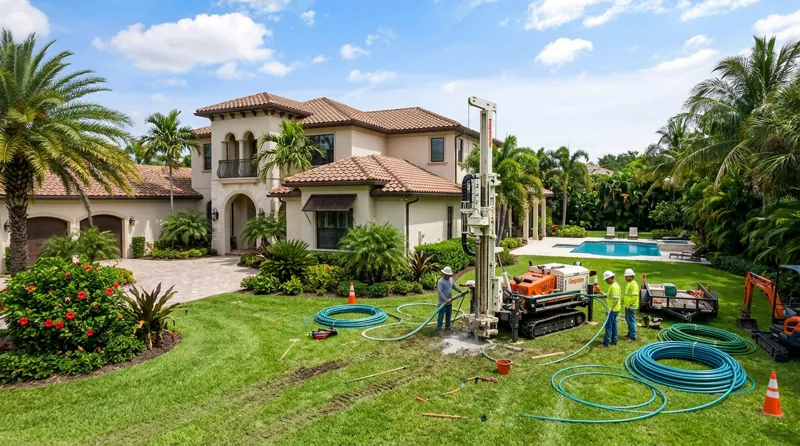
Why Florida Is a Different Geothermal Conversation
Forget everything you've read about geothermal payback in New England or the Midwest. Florida rewrites the equation.
In most states, geothermal is a heating story — replacing expensive oil or propane furnaces with ultra-efficient ground-source heat. In Florida, you barely need heating. The AC runs 8–10 months per year. The real question is: can geothermal cool your home more efficiently than a conventional air conditioner?
The answer is yes — but with an asterisk. Florida's ground temperatures run 67–77°F depending on region, which means you're rejecting heat into 72°F earth instead of 95°F outdoor air. That's a meaningful COP advantage (4.5–5.5 vs. 2.5–3.5 for standard AC), translating to roughly 30–40% lower cooling costs. But Florida's moderate electricity rates (12.53¢/kWh) and the lack of any state incentive mean that payback periods run longer than the Midwest or Northeast.
Three things make Florida's geothermal story genuinely interesting:
- The Floridan Aquifer. One of the most productive aquifer systems in the world runs beneath the entire state. Open-loop geothermal systems — which pump groundwater directly through the heat exchanger — are viable across large portions of Florida and can reduce installation costs by 20–30%.
- Free pool heating. Florida has ~1.7 million residential swimming pools — more than any other state. A geothermal desuperheater captures waste heat from cooling mode and heats your pool for essentially nothing. That's $1,200–$3,000/year in pool heating you no longer pay for.
- Hurricane resilience. Your ground loop is buried. It doesn't blow away in a Category 4 storm. Your neighbor's outdoor condenser unit? That's another story.
Let's be clear upfront: Florida is not the best state for geothermal ROI. The panhandle comes close to reasonable, South Florida is marginal at best, and the Keys are a non-starter. But for the right situation — replacing aging equipment, building new, or factoring in pool heating — the numbers can work.
Quick Verdict: Should You Go Geothermal in Florida?
| Your Situation | Verdict | Typical Payback | Notes |
|---|---|---|---|
| Panhandle home — replacing old HVAC (SEER 10–13) | ✅ Best FL scenario | 9–11 years | Real heating + cooling savings; cheapest drilling in state |
| New construction — anywhere except Keys | ✅ Worth it (incremental cost) | 8–12 years | Loop goes in during site work; no landscaping repair |
| Open-loop viable area — Floridan Aquifer access | ✅ Best payback option | 8–12 years | 20–30% cheaper install; superior efficiency |
| Pool owner — any region with pool heating value | ✅ Major value-add | 7–12 years (with pool credit) | Desuperheater eliminates $1,200–$3,000/yr pool heating |
| USDA REAP eligible — rural/agricultural property | ✅ Strong with grant | 4–7 years (with 25% REAP) | Citrus groves, nurseries, ranches qualify |
| Large home (4,000+ sqft) — high cooling load | ⚠️ Economies of scale help | 10–14 years | Per-ton cost drops; larger savings denominator |
| Central FL — replacing aging AC (SEER 14+) | ⚠️ Marginal — long payback | 14–18 years | Savings gap too narrow vs. modern AC |
| South FL / Miami — cooling only, warm ground | ❌ Hard to justify financially | 16–22 years | 75–77°F ground narrows COP advantage |
| Florida Keys — coral rock, saltwater, no land | ❌ Not practical | N/A | No freshwater aquifer; coral drilling prohibitive |
Find a Florida Geothermal Installer
Florida geothermal requires both an IGSHPA-certified designer and a FL-licensed water well contractor. Start your search here.
Find Installers → Free · No obligation · IGSHPA certified onlyDoes Geothermal Work in Florida?
Yes — but the value proposition is fundamentally different from northern states. In Michigan, geothermal replaces a $3,500/year gas bill with $900 in electricity. In Florida, you're shaving 30–40% off an AC-dominated electricity bill. The per-dollar savings are real but smaller.
| Region | HDD | CDD | Ground Temp (°F) | Annual Avg Temp (°F) | Primary HVAC Need |
|---|---|---|---|---|---|
| Pensacola (Panhandle) | 1,458 | 2,472 | 67–69 | 66 | Cooling-dominant, real heating need |
| Tallahassee (Panhandle) | 1,489 | 2,516 | 68–70 | 67 | Cooling-dominant, real heating need |
| Jacksonville (North FL) | 1,327 | 2,657 | 70–72 | 68 | Mostly cooling, light heating |
| Orlando (Central FL) | 658 | 3,088 | 72–74 | 72 | Almost all cooling |
| Tampa (Tampa Bay) | 503 | 3,314 | 73–75 | 73 | Almost all cooling |
| Miami (South FL) | 128 | 4,361 | 75–77 | 76 | Cooling only |
The panhandle is the sweet spot. Pensacola and Tallahassee have 1,400–1,500 heating degree days — enough to get real winter savings from geothermal's 3.8–4.5 heating COP, on top of summer cooling efficiency. Ground temps of 67–70°F are the coolest in the state, giving you the best heat rejection during cooling season.
As you move south, the case weakens. Miami has only 128 HDD (essentially zero heating) and ground temps of 75–77°F. You're rejecting heat into warm earth — still more efficient than outdoor air in August, but the delta narrows. South Florida paybacks stretch to 16–22 years for most homeowners.
Florida's Energy Market
Residential electricity rate (2024): 12.53¢/kWh (EIA, rank 18 nationally). Not cheap, but not expensive enough to drive the fast paybacks you see in New England (20–29¢/kWh). Florida's moderate rates are a headwind for geothermal ROI.
Grid carbon intensity: 765 lbs CO₂/MWh — primarily natural gas generation (over 70%). Geothermal reduces grid demand, but the environmental case is stronger in coal-heavy states.
Major Utilities
- Florida Power & Light (FPL): Largest utility, ~5.8M accounts across south and east FL. NextEra subsidiary.
- Duke Energy Florida: ~1.9M accounts in central and north-central FL.
- Tampa Electric (TECO): Tampa Bay area, ~800K accounts.
- JEA (Jacksonville Electric Authority): Municipal utility, Jacksonville metro.
- Gulf Power (now FPL): Northwest FL panhandle.
Utility rebates for geothermal: [NEEDS VERIFICATION] Most FL utilities offer HVAC efficiency rebates targeting air-source heat pumps and high-SEER AC units. No major utility has a dedicated ground-source heat pump rebate program identified as of this writing. FPL's BuildSmart program may apply to new construction projects. Check with your specific utility before assuming any rebate availability.
Regional Geology & Drilling Conditions
Florida's geology is dominated by carbonate rock — limestone and dolostone — covered by varying depths of unconsolidated sand, clay, and shell material. This creates drilling conditions unlike anywhere else in the country. Understanding your region's subsurface is critical to choosing the right loop type and getting accurate cost estimates.
| Region | Dominant Geology | Thermal Conductivity (BTU/hr·ft·°F) | Typical Drilling Cost (per ft) | Key Drilling Considerations |
|---|---|---|---|---|
| Panhandle (Pensacola–Panama City) | Sand overburden (30–100 ft) over Ocala Limestone | 0.8–1.2 (sand); 1.3–1.8 (limestone) | $12–$18/ft | Easiest/cheapest FL drilling; sand casing required through overburden; good grout seal needed at sand-limestone contact |
| North FL (Jacksonville–Gainesville) | Thin sand/clay over Floridan Aquifer limestone | 1.2–1.8 (limestone dominant) | $14–$20/ft | Excellent aquifer access; some artesian zones; karst voids possible in Ocala Limestone — experienced driller essential |
| Central FL / I-4 Corridor (Orlando–Daytona) | Karst limestone — Ocala/Avon Park formations with dissolution features | 1.2–1.6 (variable — voids reduce effective conductivity) | $16–$24/ft | SINKHOLE ZONE — active karst; loss-of-circulation common; tremie-pipe grouting mandatory; geotechnical assessment recommended in Pasco/Hernando/Hillsborough counties |
| Tampa Bay (Tampa–Sarasota) | Deeper limestone; Hawthorn Group clay confining unit over Floridan Aquifer | 1.0–1.5 (mixed clay/limestone) | $16–$22/ft | Hawthorn clay layer complicates aquifer access; sulfur/mineral content in some wells; deeper drilling may be needed (150–400 ft) |
| Southwest FL (Fort Myers–Naples) | Shell, sand, and marl over limestone; thick Hawthorn Group | 0.9–1.3 (unconsolidated dominant) | $14–$20/ft | Shallow water table (2–6 ft) complicates horizontal trenching; vertical preferred; shell beds can slow drilling; limited artesian access |
| Southeast FL (Miami–Palm Beach) | Miami Limestone / Key Largo Limestone over Biscayne Aquifer | 1.1–1.5 (porous limestone) | $16–$22/ft | Very porous — grout loss risk; saltwater intrusion near coast; Biscayne is shallow (20–80 ft) and unconfined; closed-loop preferred over open-loop near coast |
| Florida Keys | Key Largo Limestone / Miami Oolite; coral rock | 1.0–1.4 (porous coral limestone) | $25–$40+/ft | NOT RECOMMENDED — saltwater environment; no freshwater aquifer; extremely limited land area; coral drilling difficult and expensive; environmental permits restrictive |
Thermal conductivity data from Florida Geological Survey publications and IGSHPA design guidelines. Drilling costs are 2025–2026 estimates based on regional installer data and may vary ±20% based on site conditions, bore depth, and contractor. Conductivity ranges reflect the mix of soil/rock types within each region. (Florida Geological Survey)
Key takeaway: Florida's limestone-dominant geology is actually favorable for geothermal drilling — softer than the granite found in New England or the hard basalt in Hawaii, and significantly cheaper per foot. The challenges are karst dissolution in Central FL (sinkholes), the shallow water table in South FL (complicates horizontal loops), and saltwater intrusion along the coasts. An experienced FL driller who understands the local hydrogeology is essential — this isn't a job for a contractor from out of state.
Regional Costs and ROI
Florida installations tend to run somewhat cheaper than northern states: smaller heating loads mean smaller systems, limestone geology drills easier than granite, and no freeze protection is needed for loops. However, warmer ground temperatures may require longer loop runs for optimal heat rejection during Florida's extended cooling season.
| Region | Typical Size | Installed Cost | After 30% ITC | Notes |
|---|---|---|---|---|
| Panhandle (Pensacola / Tallahassee) | 3–4 ton | $18,000–$32,000 | $12,600–$22,400 | Most favorable — heating + cooling value |
| North FL / Jacksonville | 3–5 ton | $20,000–$36,000 | $14,000–$25,200 | Good open-loop potential via Floridan Aquifer |
| Central FL / Orlando | 4–5 ton | $22,000–$40,000 | $15,400–$28,000 | Sinkhole considerations in I-4 corridor |
| Tampa Bay | 4–5 ton | $22,000–$40,000 | $15,400–$28,000 | High cooling loads, moderate ground temps |
| South FL / Miami | 4–6 ton | $24,000–$45,000 | $16,800–$31,500 | Largest systems, warmest ground, longest payback |
South FL requires larger systems because of higher cooling loads (4,000+ CDD), larger average home sizes, and warmer ground temps that reduce per-ton efficiency. Cost estimates based on IGSHPA industry data and regional installer surveys. Individual quotes will vary based on loop type, soil conditions, and system brand.
Real-World Florida Case Studies
Case Study 1: Pensacola Panhandle Ranch — 10.3-Year Payback
- Location: Pensacola, Escambia County (limestone with sand overburden)
- Home: 2,400 sq ft ranch, built 1995, moderate insulation
- Prior system: 15-year-old AC (SEER 13) + electric furnace — end of life
- Prior annual energy cost: ~$3,800 (heating + cooling + electric water heater)
- System installed: 3-ton WaterFurnace closed-loop vertical (3 × 200ft bores)
- Gross cost: $26,000
- Federal ITC (30%): −$7,800
- Net cost: $18,200
- Annual geothermal operating cost: ~$2,040
- Annual savings: $1,760
- Simple payback: $18,200 ÷ $1,760 = 10.3 years
- With pool heating credit (desuperheater replacing $1,500/yr gas pool heater): $18,200 ÷ $3,260 = 5.6 years
The panhandle's 1,458 HDD give this system real winter value — the electric furnace was drawing 15–20 kW on cold nights. Geothermal's COP 3.8 heating vs. the furnace's COP 1.0 slashes winter bills by 60–70%. The desuperheater heats the pool April through November as a byproduct of cooling — eliminating the $125/month gas pool heater bill entirely. This is the best-case Florida scenario: aging equipment, panhandle location, pool heating value.
Case Study 2: Orlando Open-Loop Home — 15.4-Year Payback (Honest)
- Location: Orange County, Orlando metro (Floridan Aquifer access, limestone karst)
- Home: 2,800 sq ft two-story, built 2005, good insulation
- Prior system: 12-year-old AC (SEER 14) + gas furnace (minimal use, ~$200/yr gas)
- Prior annual energy cost: ~$3,200 (mostly cooling — $2,600 electric + $200 gas + $400 pool pump/heater)
- System installed: 4-ton ClimateMaster open-loop (supply well 120ft + injection well)
- Gross cost: $28,000
- Federal ITC (30%): −$8,400
- Net cost: $19,600
- Annual geothermal operating cost: ~$1,920 (electric for compressor + well pump)
- Annual savings: $1,280
- Simple payback: $19,600 ÷ $1,280 = 15.3 years
- Honest verdict: Marginal on pure payback math. Becomes more attractive if pool heating is factored in or if the existing HVAC needs replacement anyway.
This is the typical Central Florida scenario — and we're being transparent about the numbers. The existing SEER 14 AC was reasonably efficient. Geothermal saves ~$1,280/year — meaningful but not dramatic. The open-loop system via the Floridan Aquifer reduced installation cost by ~$5,000 vs. a closed-loop vertical, which is the only reason this case doesn't stretch to 18+ years. For Orlando homeowners with functioning HVAC, the financial case is weak unless you're replacing end-of-life equipment or capturing pool heating value.
Case Study 3: Jacksonville New Construction + Solar — 9.2-Year Payback (Incremental)
- Location: St. Johns County, Jacksonville suburbs (Floridan Aquifer limestone, thin sand overburden)
- Home: 3,200 sq ft new construction, 2026 energy code, spray foam insulation
- Conventional HVAC alternative: Dual-zone 5-ton SEER 16 split system — $14,500 installed
- Geothermal system: 4-ton WaterFurnace 7 Series variable-speed, open-loop via Floridan Aquifer (supply well 150ft + injection well), desuperheater for pool + DHW
- Gross geothermal cost: $34,000
- Federal ITC (30%): −$10,200
- Net geothermal cost: $23,800
- Incremental cost vs. conventional: $23,800 − $14,500 = $9,300
- Annual conventional HVAC cost: ~$2,680 (cooling-dominant, SEER 16)
- Annual geothermal operating cost: ~$1,670 (variable-speed + open-loop efficiency)
- Annual HVAC savings: $1,010
- 6 kW solar array (paired): $13,200 gross → $9,240 after ITC. Generates ~9,500 kWh/yr (JEA net metering)
- Solar offset of geo electricity: ~$840/yr (covers ~5,000 kWh of geo demand)
- Combined annual savings (HVAC + solar offset + pool heating): $1,010 + $840 + $1,800 pool = $3,650
- Incremental payback (geo only): $9,300 ÷ $1,010 = 9.2 years
- Combined payback (geo + solar incremental, with pool credit): ~5.1 years
New construction is where Florida geothermal makes the most financial sense. The open-loop goes in during site work — no landscape restoration costs, no working around existing foundation. The incremental cost over conventional HVAC is only $9,300 after ITC. Jacksonville's 1,327 HDD give meaningful winter value, and the variable-speed 7 Series handles Florida's humidity demands beautifully. Pairing with solar in Florida's 5.5+ peak-sun-hour environment pushes the combined payback under 6 years with pool heating credit. This is the template for making geothermal work in Florida.
Month-by-Month Energy Profile
Based on the Pensacola case study (2,400 sq ft, replacing SEER 13 AC + electric furnace):
| Month | Old HVAC Cost | Geothermal Cost | Monthly Savings | Notes |
|---|---|---|---|---|
| January | $480 | $210 | $270 | Peak heating — COP 3.8 vs. electric furnace COP 1.0 |
| February | $420 | $190 | $230 | Cold month — geothermal shines vs. electric resistance |
| March | $260 | $140 | $120 | Shoulder — light heating, light cooling |
| April | $210 | $130 | $80 | Cooling ramp-up begins |
| May | $320 | $190 | $130 | Full cooling season — COP 5.0 vs. SEER 13 |
| June | $410 | $230 | $180 | Peak humidity drives cooling load |
| July | $450 | $250 | $200 | Hottest month — ground still 68°F |
| August | $440 | $245 | $195 | Sustained cooling + desuperheater peak |
| September | $380 | $215 | $165 | Still heavy cooling |
| October | $240 | $145 | $95 | Cooling tails off |
| November | $210 | $130 | $80 | Shoulder — light heating returns |
| December | $380 | $175 | $205 | Heating ramp-up — electric furnace penalty |
| Annual Total | $4,200 | $2,250 | $1,950 |
At 12.53¢/kWh. Panhandle profile shows dual savings: winter heating (replacing electric furnace) and summer cooling (replacing SEER 13). Central and South FL profiles would show almost all savings concentrated in summer cooling months, with much smaller totals. Monthly figures include desuperheater DHW offset (~$15–$25/mo).
Open-Loop System Assessment: The Floridan Aquifer
The Floridan Aquifer System is one of the most productive aquifer systems in the world — extending beneath the entire state and into parts of Georgia, Alabama, and South Carolina. For geothermal, this is a major asset. Open-loop systems pump groundwater directly through the heat exchanger, delivering superior heat transfer efficiency and lower installation costs than closed-loop alternatives.
For a deeper look at how open-loop and closed-loop systems compare, see our open-loop vs. closed-loop guide.
How Open-Loop Works in Florida
- Supply well: Drills into the Floridan Aquifer (depth varies by region — 50–300ft)
- Water temperature: 70–76°F year-round, depending on location and depth
- Flow rate: Typically 3–5 GPM per ton of capacity needed
- Discharge: Water returns to a second injection well or, where permitted, surface water
- Permitting: Required from the relevant Water Management District (5 districts cover FL)
Open-Loop Viability by Region
| Region | Open-Loop Viability | Aquifer Depth | Key Considerations |
|---|---|---|---|
| Panhandle (Pensacola / Tallahassee) | ✅ Often viable | 50–150 ft | Good water quality, moderate yields. Sand overburden over limestone. |
| North FL / Jacksonville | ✅ Generally excellent | 100–300 ft | Strong Floridan Aquifer yields. Some of the best open-loop territory in the state. |
| Central FL / Orlando | ✅ Viable with caveats | 100–250 ft | Karst geology — sinkhole risk requires experienced driller. High yields where accessible. |
| Tampa Bay | ⚠️ Variable | 150–400 ft | Deeper aquifer access in some areas. Sulfur/mineral content may require treatment. SWFWMD permitting. |
| South FL / Miami | ⚠️ Saltwater intrusion risk | Shallow — 20–80 ft | Biscayne Aquifer is shallow and productive but saltwater interface is a concern near coast. |
| Florida Keys | ❌ Not viable | N/A | Saltwater environment. No freshwater aquifer access. Coral rock. |
Water Management District Permitting
Florida's five Water Management Districts regulate groundwater use, including open-loop geothermal. You'll need a Water Use Permit (or exemption for small systems) from your district:
- NWFWMD — Northwest FL Water Management District (Panhandle)
- SRWMD — Suwannee River Water Management District (North-central FL)
- SJRWMD — St. Johns River Water Management District (Northeast/Central FL)
- SWFWMD — Southwest FL Water Management District (Tampa Bay/Central-west)
- SFWMD — South FL Water Management District (South FL/Miami)
Permit timelines vary — budget 4–8 weeks. Your installer and well contractor should handle the application. Small systems using injection wells (returning water to the same aquifer) may qualify for general permits with shorter timelines.
Loop Type Cost Comparison
| Loop Type | Typical FL Cost (3–4 ton) | Land Needed | Best For | Florida Notes |
|---|---|---|---|---|
| Horizontal straight | $13,000–$22,000 | 1–2 acres | Rural panhandle/north FL with acreage | Limited by high water table in Central/South FL. Best in panhandle. |
| Horizontal slinky | $14,000–$24,000 | ½–1 acre | Suburban lots with adequate yard | Water table can complicate trenching. Sandy soil helps. |
| Vertical closed-loop | $18,000–$36,000 | Small — 15×15 ft/bore | Suburban lots, any region | Limestone drills easier than granite. Most versatile option. |
| Open-loop (Floridan Aquifer) | $15,000–$28,000 | Minimal — wellhead footprint | Anywhere with aquifer access | FL's biggest advantage. 20–30% cheaper than vertical closed. Permit required. |
| Pond/lake loop | $12,000–$22,000 | ½+ acre pond/lake, 8ft+ deep | Lakefront properties, retention ponds | Many FL communities have man-made lakes. Excellent where available. |
Open-loop is often the best value in Florida where the Floridan Aquifer is accessible. The abundant groundwater, moderate drilling costs in limestone, and elimination of extensive trenching or bore fields make it the most cost-effective option for many FL homeowners. For more on choosing between systems, see our open-loop vs. closed-loop comparison.
Incentives: Federal ITC and the Honest Picture
Let's be straightforward: Florida's incentive picture is thin. No state income tax means no state tax credit. No major utility rebate programs target geothermal specifically. The federal ITC is essentially your only financial incentive — and it's a good one, but you're working with fewer tools than homeowners in New York, Colorado, or even Georgia.
| Incentive | Amount | Status | How to Claim |
|---|---|---|---|
| Federal ITC (Section 25D) | 30% of total system cost | ✅ Confirmed through 2032 | IRS Form 5695 — see below |
| FL renewable energy property tax exemption | Exempts system from property tax increase | ✅ FL Statute 193.624 [NEEDS VERIFICATION — whether GSHPs qualify under this statute's definition] | Apply with county property appraiser |
| Utility rebates (FPL, Duke, TECO, JEA) | None identified for GSHP | [NEEDS VERIFICATION] | Check with your utility directly |
| PACE financing (Ygrene, FortiFi) | Financing — not a rebate | ⚠️ Available in many FL counties [NEEDS VERIFICATION — current program availability] | Apply through PACE provider |
| USDA REAP (rural/agricultural) | Up to 50% grant | ✅ Active | USDA Rural Development |
Incentive Stacking: What It Actually Looks Like
Unlike states with robust incentive programs, Florida's stack is straightforward — and limited. Here's the honest math for a typical $28,000 Central FL installation:
| Incentive Layer | Amount | Running Total (Net Cost) |
|---|---|---|
| Gross installation cost | $28,000 | $28,000 |
| Federal ITC (30%) | −$8,400 | $19,600 |
| FL state incentive | $0 | $19,600 |
| Utility rebate | $0 (none identified) | $19,600 |
| Property tax exemption (if applicable) | Avoids ~$200–$400/yr assessment increase | $19,600 (plus ongoing savings) |
| Net out-of-pocket | $19,600 |
USDA REAP for Florida Agricultural Properties
Florida's massive agricultural sector — citrus groves, nurseries, horse farms, cattle ranches, aquaculture — creates significant REAP opportunities. The math for a qualifying rural property:
| Incentive Layer | Amount | Running Total |
|---|---|---|
| Gross installation cost (commercial-scale) | $45,000 | $45,000 |
| USDA REAP grant (25%) | −$11,250 | $33,750 |
| Federal ITC (30% of remaining) | −$10,125 | $23,625 |
| REAP guaranteed loan (optional) | Finances remaining balance | $23,625 |
| Effective cost reduction | 47.5% covered |
For a nursery operation cooling a 5,000 sq ft office/retail space plus greenhouses, with $4,500/yr in current cooling costs, payback drops to approximately 5.2 years after REAP + ITC. Contact the USDA Florida State Office for current REAP application windows.
Compare this to a state like New York, where homeowners might stack federal ITC + state tax credit + NYSERDA rebate to reach 50–55% cost reduction. Florida homeowners get 30% and that's largely it. This is the primary reason Florida payback periods run longer than many other states. For a full breakdown of payback mechanics, see our payback period guide.
Solar + Geothermal Stacking
Florida is the Sunshine State — and pairing solar PV with geothermal can fundamentally change the operating cost equation. Both systems qualify for the 30% federal ITC independently.
The Combined Math
- Geothermal system: $28,000 gross → $19,600 after ITC. Annual electricity cost: ~$1,920
- 6 kW solar array: ~$12,000 gross → $8,400 after ITC. Generates ~9,000 kWh/year in FL
- Geothermal electricity demand: ~6,000–8,000 kWh/year
- Net result: Solar covers 100%+ of geothermal's electricity demand. Near-zero cooling cost.
- Combined net cost: ~$28,000 (both systems after ITC)
- Combined annual savings: $2,500–$3,200 (all conditioning costs + excess solar credit)
- Combined payback: 9–12 years — but you've eliminated conditioning costs for 25+ years
Florida's abundant solar resource (5.5–6.0 peak sun hours/day) makes this pairing particularly effective. Net metering policies vary by utility — FPL offers net metering but terms have tightened for new solar installations. Check current policies before sizing your system.
Pool Heating: Florida's Unique Geothermal Advantage
This is the section that can change the entire equation for Florida homeowners.
Florida has approximately 1.7 million residential swimming pools — far more than any other state. If you own a pool and run it year-round (as many Floridians do), you're already spending $1,200–$3,000 per year on pool heating via gas heater, electric heat pump, or solar thermal panels.
A geothermal system with a desuperheater captures waste heat produced during cooling mode and redirects it to your pool. In Florida, where your AC runs 8–10 months per year, the desuperheater operates almost continuously during the swimming season. The result: essentially free pool heating as a byproduct of cooling your home.
The Desuperheater Math
- How it works: During cooling, the geothermal unit rejects heat. A desuperheater diverts a portion of this rejected heat (typically 15–20% of total capacity) to a water-to-water heat exchanger connected to your pool loop.
- Output: 15,000–25,000 BTU/hr — sufficient to maintain pool temperature in FL's mild climate
- Operating cost: Essentially zero — it's waste heat that would otherwise be dumped into the ground loop
- Annual value: $1,200–$3,000/year (depending on current pool heating method and usage)
Impact on Payback
| Scenario | Annual Savings (No Pool) | Pool Heating Credit | Total Annual Savings | Payback (on $19,600 net) |
|---|---|---|---|---|
| Panhandle — replacing old HVAC | $1,760 | +$1,500 | $3,260 | 6.0 years |
| Central FL — replacing aging AC | $1,280 | +$1,500 | $2,780 | 7.1 years |
| South FL — cooling only | $900 | +$2,000 | $2,900 | 6.8 years |
Notice what happens: Pool heating value can cut payback nearly in half. For South FL homeowners — where geothermal's cooling-only savings struggle to justify the investment — pool heating can make or break the business case. A Miami homeowner with a heated pool may see better payback than an Orlando homeowner without one.
The desuperheater adds $800–$1,500 to system cost. On a $28,000 installation, that's 3–5% more upfront for $1,500–$3,000/year in pool heating value. It's the single best ROI add-on for Florida geothermal installations.
Sinkholes: Addressing the Elephant in the Room
We can't write about geothermal in Florida without addressing sinkholes. Central Florida — particularly the I-4 corridor from Tampa to Daytona Beach — sits on karst limestone terrain where sinkholes are a well-documented reality. Does drilling for geothermal make this worse?
The Honest Risk Assessment
- Can drilling trigger a sinkhole? In theory, yes. Improperly drilled or grouted vertical boreholes in karst terrain can create preferential flow paths that accelerate dissolution of limestone. This is a real risk, not fear-mongering.
- How is it managed? Proper grouting technique (tremie pipe method with bentonite or thermally-enhanced grout) seals the borehole annulus and prevents water migration between geological layers. This is standard practice — not special accommodation.
- Licensed contractors required: Florida DEP requires a licensed water well contractor for any geothermal well drilling. These contractors understand FL's karst geology and grouting requirements. This isn't optional.
- Some counties require geotechnical assessment: In high-sinkhole-risk areas (Pasco, Hernando, Hillsborough counties), a pre-drilling geotechnical review may be required or strongly recommended.
Practical Guidance
- Use a licensed, experienced FL well contractor. Not negotiable. Ask how many geothermal wells they've drilled in your county.
- Consider open-loop or horizontal loops in high-risk karst areas — these avoid the deep vertical drilling that intersects limestone layers.
- Closed-loop vertical is still viable in sinkhole-prone areas with proper grouting and experienced contractors. Thousands of wells have been drilled in Central FL without incident.
- Insurance note: Florida requires sinkhole coverage in homeowners insurance. Geothermal installation does not typically affect your sinkhole coverage, but verify with your insurer before drilling.
Bottom line: Sinkholes are a real consideration, not a dealbreaker. The risk is manageable with proper installation practices. If an installer dismisses your sinkhole concerns, find a different installer.
Hurricane Resilience
Florida averages a hurricane-force impact every 3–5 years. Here's where geothermal has an underappreciated advantage:
- Ground loops are buried. A vertical bore field 200ft underground or a horizontal loop 6ft below grade does not care about Category 4 winds. Your loop field will survive any storm Florida can produce.
- Indoor equipment. The geothermal heat pump unit sits inside your home — in a closet, garage, or utility room. No outdoor condenser unit to be ripped off its pad, hit by debris, or flooded.
- Conventional AC vulnerability: Outdoor condenser units are exposed to wind, flying debris, flooding, and storm surge. After Hurricane Ian (2022), thousands of outdoor AC units across Southwest FL were damaged or destroyed. Replacement wait times stretched months.
- Faster recovery. After a hurricane, when power is restored, a geothermal system restarts immediately — no need to inspect, repair, or replace outdoor equipment.
- Insurance angle: While no major FL insurer currently offers a specific geothermal discount, the elimination of an outdoor condenser unit removes one claim-generating component from your policy. Some insurers may factor this into underwriting for wind-exposed coastal properties.
This isn't a primary financial argument for geothermal — but for coastal FL homeowners who've lived through a major hurricane, the peace of mind has real value.
Vacation Rental Analysis
Florida's massive vacation rental market adds another angle to the geothermal calculus. Let's be region-specific:
Florida Keys — No
Coral rock, saltwater environment, minimal land area, no freshwater aquifer access. Geothermal is not practical here regardless of rental income potential.
Panhandle Beach Rentals (Destin, Panama City Beach, Pensacola Beach) — Worth Considering
- Best FL geothermal region + high-value rental market
- Year-round rentals benefit from both heating and cooling efficiency
- Pool heating via desuperheater adds guest amenity value — "heated pool included" extends rental season
- "Eco-friendly, geothermal-cooled" is a genuine Airbnb/VRBO differentiator in the eco-conscious market
- Hurricane resilience is a selling point for property management companies
Orlando Vacation Homes — Situational
- Massive vacation rental market (Disney/Universal corridor)
- High cooling loads — AC runs nearly year-round for occupied rentals
- Pool heating is a major amenity — guests expect heated pools. Desuperheater delivers this essentially free.
- Sinkhole consideration in I-4 corridor — proper installation essential
- MACRS depreciation: Rental properties may qualify for 5-year accelerated depreciation on the geothermal system, in addition to the 30% ITC (consult a tax professional — Section 48 business credit may apply instead of Section 25D)
South FL Coastal Rentals — Weak Case
- Long payback periods (16–22 years) weaken the investment thesis
- Pool heating is the strongest argument here — high-value South FL rentals often have heated pools
- Saltwater intrusion complicates open-loop in coastal areas
Permits & Licensing: What You Need in Florida
Florida's permitting landscape for geothermal involves multiple agencies at state, regional, and local levels. This section walks you through every permit and license you'll need — or that your contractor needs to hold.
Contractor Licensing Requirements
| License Type | Issuing Agency | Required For | How to Verify |
|---|---|---|---|
| Water Well Contractor | FL DEP (Chapter 373, F.S.) | ALL geothermal drilling — vertical bores, open-loop supply/injection wells | FL DEP Water Division |
| Mechanical Contractor (Class A or B) | FL DBPR (Chapter 489, F.S.) | Indoor heat pump installation, ductwork, refrigerant handling | DBPR License Verification |
| Electrical Contractor (if wiring needed) | FL DBPR | Dedicated circuit installation, electrical panel upgrades | Same DBPR verification portal |
| Plumbing Contractor (if open-loop) | FL DBPR | Piping connections to well system, desuperheater plumbing | Same DBPR verification portal |
Critical note: Florida requires a licensed water well contractor — not just an HVAC contractor — for all geothermal well drilling. This is under FL DEP regulation, separate from the DBPR mechanical contractor license. Many geothermal installers subcontract the drilling to a licensed well contractor. Verify both the installer's mechanical license AND the driller's well contractor license before signing any contract.
Permit Requirements by Type
| Permit | Agency | Typical Fee | Timeline | Notes |
|---|---|---|---|---|
| Water Well Construction Permit | FL DEP (via well contractor) | $0–$50 | 1–2 weeks | Well contractor files the well completion report. Required for ALL geothermal wells — closed-loop and open-loop. |
| Water Use Permit (open-loop) | Water Management District (WMD) | $0–$250 | 4–8 weeks | Required for open-loop systems. Small systems (<100,000 GPD) may qualify for general permit (faster). Five WMDs cover FL. |
| Consumptive Use Permit (large open-loop) | WMD | $250–$1,000+ | 6–12 weeks | For larger commercial systems exceeding general permit thresholds. Individual permit review. |
| Building Permit (mechanical) | County/city building department | $100–$500 | 1–3 weeks | Standard mechanical permit for indoor equipment. Some jurisdictions also require separate HVAC permit. |
| Electrical Permit | County/city building department | $50–$200 | 1–2 weeks | If new dedicated circuit or panel upgrade needed. Often combined with mechanical permit. |
| Geotechnical Assessment (sinkhole areas) | Private geotechnical firm | $500–$2,000 | 1–3 weeks | Recommended/required in high-karst counties: Pasco, Hernando, Hillsborough, portions of Marion, Citrus, Sumter. Not a government permit — a professional assessment. |
| HOA Architectural Review | Your HOA | $0–$100 | Varies | Usually not needed — no outdoor equipment visible. Drilling activity may require advance notice. Underground systems are a major advantage in deed-restricted FL communities. |
Typical Permitting Timeline (Closed-Loop)
- Week 1: Contractor pulls building permit from county — $100–$500
- Week 1–2: Well contractor files DEP well construction notice — $0–$50
- Week 2–4: Drilling and loop installation (1–3 days actual work)
- Week 4–5: Well completion report filed with DEP
- Week 5–6: Indoor equipment installation, duct connections, commissioning
- Week 6: Final inspection by county building inspector
- Total: 4–6 weeks from permit application to system operational
Typical Permitting Timeline (Open-Loop)
- Week 1: Contractor files WMD water use permit application — $0–$250
- Week 1–2: Building permit from county — $100–$500
- Week 4–8: WMD permit approval (this is the bottleneck)
- Week 8–9: Supply and injection well drilling (2–4 days)
- Week 9–10: Indoor equipment installation and commissioning
- Week 10: Final inspection
- Total: 8–10 weeks from initial application to system operational
The WMD water use permit is the main timeline difference between open-loop and closed-loop. If you're considering open-loop, start the permit process early — your contractor should file the WMD application first, then pull building permits while waiting for WMD approval.
How to Claim the Federal Tax Credit (IRS Form 5695)
- Confirm eligibility. System must be ENERGY STAR certified. Must be installed at your primary or secondary residence. Rental-only properties do not qualify for Section 25D (but may qualify for Section 48 business energy ITC — consult a tax professional).
- Gather documentation. Collect your itemized installer invoice (showing equipment and labor separately), ENERGY STAR/AHRI certificate for the heat pump unit, and proof of residence at the installation address.
- Complete IRS Form 5695, Part I. Enter the total installed cost (equipment + labor + drilling + loop materials) on Line 12a. Florida has no state grant to subtract — your full cost qualifies.
- Calculate the credit. Multiply Line 12a by 0.30. There is no dollar cap on the residential geothermal credit through 2032.
- Transfer to Form 1040. The credit flows from Form 5695 to Schedule 3, Line 5, and then to your Form 1040.
- Handle carryforward if needed. If your tax liability is less than the credit amount, the unused portion carries forward to subsequent tax years until fully used. Florida's lack of state income tax means no state form interaction.
- Retain all records for 7+ years. Keep the installer invoice, equipment certificates, building permits, well contractor license documentation, and proof of payment. The IRS can audit energy credits for up to 7 years.
Important for Florida: Because FL has no state income tax, there's no state tax credit to coordinate with. Your entire claim is federal. This simplifies the process but also means there's no additional state incentive to capture. The full cost of your installation — including well drilling, loop installation, equipment, and labor — qualifies for the 30% credit.
Finding & Vetting a Florida Installer
Florida's geothermal installer market is smaller than in northern states — because the residential market is smaller. But the contractors who specialize in FL geothermal tend to have deep experience with the state's unique challenges: karst geology, cooling-dominant design, open-loop permitting, and hurricane considerations.
Where to Search
- IGSHPA Contractor Directory: igshpa.org/find-a-contractor — search by state for IGSHPA-certified geothermal designers and installers
- WaterFurnace Dealer Locator: waterfurnace.com/dealer-locator — factory-trained WaterFurnace dealers
- ClimateMaster Dealer Locator: climatemaster.com/find-a-dealer — ClimateMaster authorized dealers
- Bosch Contractor Locator: bosch-thermotechnology.us — Bosch geothermal trained contractors
- FL DEP Well Contractor List: Contact FL DEP Water Division for licensed water well contractors in your county
- DBPR License Verification: myfloridalicense.com — verify any contractor's mechanical license status
8-Point Vetting Checklist
| # | Check | Why It Matters | Red Flag |
|---|---|---|---|
| 1 | IGSHPA certification (CGD or CIGD) | Industry standard for geothermal design competence | No geothermal-specific credentials — general HVAC only |
| 2 | FL DBPR mechanical license (active) | Legal requirement for HVAC installation in FL | Expired, suspended, or out-of-state license only |
| 3 | Well contractor license (DEP) | Legal requirement for all geothermal drilling in FL | Plans to drill without licensed well contractor |
| 4 | Florida-specific experience (5+ years) | FL's karst geology, cooling-dominant design, and WMD permitting require local expertise | "We do mostly heating up north" or no FL installs to reference |
| 5 | Manual J load calculation provided | Critical in FL — oversizing causes humidity problems; undersizing causes inadequate cooling | Rule-of-thumb sizing or "500 sq ft per ton" shortcuts |
| 6 | Insurance & bonding (current) | Protects you if something goes wrong during drilling | No general liability insurance or lapsed bonds |
| 7 | Written warranty (equipment + loop + labor) | Quality contractors stand behind their work; loop warranties should be 25–50 years | Verbal warranty only or refusal to specify warranty terms |
| 8 | References in your county | Karst conditions, aquifer access, and permitting vary county-to-county in FL | Cannot provide local references or deflects when asked |
Regional Installer Availability
| Region | Installer Availability | Notes |
|---|---|---|
| Panhandle (Pensacola–Tallahassee) | ⚠️ Limited — 3–6 contractors | Small market but dedicated operators; some travel from AL/GA border region |
| North FL (Jacksonville–Gainesville) | ⚠️ Moderate — 5–10 contractors | Best installer density outside of Central FL; Floridan Aquifer expertise common |
| Central FL (Orlando–Tampa) | ✅ Best in state — 10–15+ contractors | Largest metro market drives most FL geothermal activity; sinkhole expertise critical here |
| Southwest FL (Fort Myers–Naples) | ⚠️ Limited — 3–5 contractors | Growing market post-Hurricane Ian; some contractors expanding from Tampa Bay |
| Southeast FL (Miami–Palm Beach) | ⚠️ Limited — 3–5 contractors | Smallest residential geo market in FL; commercial projects more common |
Expect wait times: Florida's limited installer market means scheduling can take 4–8 weeks for a site assessment, and 2–4 months from contract to completed installation. Plan ahead — especially in spring (everyone wants AC before summer). For more on evaluating quotes and understanding the installation process, see our installation timeline guide and cost guide.
Maintenance & System Longevity
Florida's climate creates unique maintenance considerations that don't apply in northern states. Humidity, salt air (coastal), water chemistry (open-loop), and the year-round cooling load all affect system longevity and maintenance scheduling.
Maintenance Schedule
| Task | Frequency | Who | Florida-Specific Notes |
|---|---|---|---|
| Air filter replacement | Every 1–3 months | Homeowner | FL's year-round operation means more frequent changes than northern states. Monthly during peak cooling (May–Oct). Pollen season (Feb–May) also demands attention. |
| Condensate drain inspection | Monthly during cooling season | Homeowner | CRITICAL in FL — 8–10 months of continuous cooling produces enormous condensate volume. Algae growth in drain lines is common in FL's warm, humid climate. Flush with vinegar or bleach monthly. |
| Desuperheater/pool loop check | Twice annually | Homeowner/tech | Check pool heat exchanger for scale buildup. FL's hard water (especially from Floridan Aquifer supply) can cause mineral deposits. Clean or descale annually. |
| Refrigerant charge and coil inspection | Annually | HVAC technician | Standard heat pump maintenance. Indoor coil may accumulate mold in FL humidity — UV light or antimicrobial treatment recommended. |
| Loop pressure and flow check | Annually | Geothermal technician | Closed-loop: verify antifreeze concentration (not needed in most of FL — freeze protection only in panhandle if temps drop below 25°F). Open-loop: verify flow rate, check for sand intrusion. |
| Open-loop water quality test | Annually | Geothermal technician | FL-specific: Test for sulfur, iron, calcium, and TDS. High mineral content can foul heat exchangers. Tampa Bay area and some Central FL wells have sulfur issues. Descaling or water treatment may be needed. |
| Ductwork inspection | Every 2–3 years | HVAC technician | FL homes with ductwork in unconditioned attics (common) lose significant cooling efficiency through hot attic duct runs. Seal and insulate. Consider duct mastic if joints are aging. |
| Full system professional service | Annually | Geothermal technician | Comprehensive check: EWT/LWT temps, compressor amp draw, flow rates, thermostat calibration, electrical connections. Schedule in spring before peak cooling season. |
Component Lifespan
| Component | Expected Lifespan | Florida-Specific Factors |
|---|---|---|
| Ground loop (HDPE, closed-loop) | 50+ years | No freeze-thaw cycling in FL extends loop life. UV degradation not a factor (buried). Karst movement is not a documented risk to properly grouted loops. |
| Open-loop wells | 25–40 years | Depends heavily on water chemistry. Sulfur and iron in some FL aquifer zones can cause casing corrosion if not properly selected (stainless steel screens recommended in high-mineral areas). |
| Compressor | 15–20 years | FL's near-continuous cooling operation puts more hours on the compressor annually than heating-dominant states. Variable-speed compressors (WaterFurnace 7 Series, ClimateMaster Trilogy) may run more total hours but at lower stress levels. |
| Heat exchanger (water-to-refrigerant) | 20–25+ years | Copper coaxial or brazed-plate. Open-loop systems with high-mineral water should use cupronickel or stainless steel heat exchangers. |
| Circulating pump | 10–15 years | Standard maintenance item. Open-loop well pumps may need replacement every 8–12 years depending on water conditions and run hours. |
| Thermostat/controls | 10–15 years | Smart thermostats can optimize FL's cooling-dominant schedule — programmable setbacks during unoccupied hours save 10–15%. |
| Desuperheater | 15–20 years | Scale buildup from FL hard water is the primary life-limiting factor. Annual descaling extends life significantly. |
Total system life vs. conventional AC: A conventional FL air conditioner in the salt-air coastal environment typically lasts 8–12 years before corrosion and wear require replacement. Geothermal indoor units last 15–20 years (no outdoor exposure to salt, rain, UV, or hurricanes), and the ground loop lasts 50+ years. Over a 30-year period, you'll replace a conventional AC 2–3 times; a geothermal system needs one compressor module replacement at most. Factor this into your lifetime cost analysis. For more details, see our system lifespan guide and maintenance guide.
Florida vs. Neighboring States
| Factor | FL | GA | AL | SC |
|---|---|---|---|---|
| Electricity rate | 12.53¢ | 12.52¢ | 12.41¢ | 13.92¢ |
| Grid CO₂ (lbs/MWh) | 765 | 761 | 742 | 447 |
| Ground temp (°F) | 67–77 | 62–68 | 62–66 | 60–66 |
| HDD (range) | 128–1,489 | 1,500–3,000 | 1,600–3,200 | 1,800–3,200 |
| State incentive | None (no state income tax) | None | None | State tax credit (25%, up to $3,500) [NV] |
| Open-loop potential | Excellent (Floridan Aquifer) | Good (Coastal Plain) | Good (varied) | Good (Coastal Plain) |
| Sinkhole risk | Significant (Central FL) | Low–moderate | Low–moderate (north AL limestone) | Low |
| Permitting complexity | Moderate — WMD + DEP + county | Low — standard building permit | Low — standard building permit | Low — standard building permit |
| Installer availability | Limited (10–15 statewide) | Limited (8–12) | Limited (5–8) | Limited (5–8) |
| Best-case payback | 9–11 yr (panhandle) | 8–11 yr (north GA) | 8–10 yr (north AL) | 7–10 yr |
| Pool heating value | Highest — 1.7M pools | Moderate | Moderate | Moderate |
| Hurricane resilience value | High | Moderate | Moderate | Moderate–High (coast) |
Key takeaway: Georgia, Alabama, and South Carolina all have more heating demand (higher HDD) and cooler ground temperatures — giving geothermal a larger efficiency advantage. Florida's best region (the panhandle) is roughly comparable to northern Georgia or Alabama. South and Central FL are the weakest geothermal markets among these four states. Florida's unique advantages are open-loop access via the Floridan Aquifer, massive pool heating opportunity, and hurricane resilience. Florida's permitting is more complex than neighbors due to the WMD water use permits required for open-loop and DEP well contractor oversight.
Ready to Explore Geothermal for Your Florida Home?
Start with IGSHPA-certified contractors experienced in Florida's cooling-dominant climate. Get at least three quotes and verify well contractor licensing with FL DEP.
Get Free Quotes → Free · No obligation · IGSHPA certified onlyFrequently Asked Questions
It depends heavily on your situation. Best cases: panhandle homes replacing old HVAC (9–11 year payback), new construction anywhere (8–12 years incremental), and any home with a heated pool (desuperheater can cut payback by 3–5 years). Weakest case: South FL homes with newer AC and no pool — paybacks stretch to 16–22 years. Florida is not the strongest geothermal state, but specific scenarios can make strong financial sense.
Installed costs range from $18,000–$45,000 depending on region, system size, and loop type. After the 30% federal tax credit: $12,600–$31,500. Panhandle installations tend toward the lower end; South FL's larger cooling loads push toward the higher end. Open-loop systems via the Floridan Aquifer are typically 20–30% cheaper than closed-loop vertical.
Improper drilling in karst limestone can theoretically exacerbate sinkhole potential — this is a real consideration in Central FL's I-4 corridor. However, properly grouted boreholes drilled by licensed FL water well contractors do not create sinkhole risk. Thousands of wells have been drilled in karst FL without incident. The key is using experienced, licensed professionals and proper tremie-pipe grouting technique. If your area has high sinkhole risk, consider open-loop or horizontal systems that avoid deep vertical drilling.
Essentially, yes. A desuperheater captures waste heat from cooling mode and redirects it to your pool. In Florida's 8–10 month cooling season, this provides nearly year-round pool heating at no additional energy cost. The desuperheater adds $800–$1,500 to system cost but saves $1,200–$3,000/year in pool heating. It's the single best ROI add-on for Florida geothermal systems.
No. Florida has no state income tax, so there's no state tax credit. No major utility rebate programs target ground-source heat pumps specifically. The 30% federal ITC is essentially your only financial incentive. FL Statute 193.624 may exempt the system from property tax increases, but this is a minor benefit. PACE financing is available in many FL counties for the upfront cost, and USDA REAP grants apply to rural/agricultural properties.
Open-loop systems pump groundwater from a well, run it through the heat exchanger, and return it to the aquifer via an injection well. Florida's Floridan Aquifer — one of the world's most productive — makes open-loop viable across much of the state. It's typically 20–30% cheaper than closed-loop vertical and delivers excellent efficiency. You'll need a Water Use Permit from your Water Management District. Best areas: North FL/Jacksonville. Caution areas: coastal South FL (saltwater intrusion). Not viable: Florida Keys. See our open-loop vs. closed-loop guide for details.
The panhandle — Pensacola and Tallahassee — is the strongest market. With 1,400–1,500 HDD, these areas get real winter heating value on top of summer cooling efficiency. Ground temps are the coolest in the state (67–70°F). Paybacks of 9–11 years are realistic. South Florida (Miami) is the weakest — essentially cooling-only with warm ground temps and paybacks stretching to 16–22 years.
Geothermal heat pumps dehumidify as part of the cooling cycle — same as conventional AC. In fact, properly sized geothermal systems often provide better dehumidification because they run at lower, more consistent speeds (especially variable-speed models). The key is accurate Manual J load calculation — oversized systems short-cycle and dehumidify poorly. In Florida's high-humidity climate, proper sizing is more critical than in drier states.
The ground loop — buried 6–200+ feet underground — is effectively hurricane-proof. The indoor heat pump unit is protected by your home's structure. Compare this to a conventional outdoor condenser unit, which is exposed to wind, debris, flooding, and storm surge. After Hurricane Ian (2022), thousands of outdoor AC units were damaged across Southwest FL. Geothermal systems with intact ground loops restart immediately when power returns.
Yes — and it's a strong pairing. A 6 kW solar array in FL generates ~9,000 kWh/year, which can cover 100%+ of a geothermal system's electricity demand. Both systems qualify independently for the 30% federal ITC. Combined net cost after ITC is typically $25,000–$30,000 for near-zero conditioning costs for 25+ years. Check your utility's current net metering terms before sizing.
Two key licenses are required: (1) a FL DEP Water Well Contractor license (Chapter 373, F.S.) for any geothermal well drilling — vertical closed-loop bores or open-loop supply/injection wells, and (2) a FL DBPR Mechanical Contractor license (Class A or B, Chapter 489, F.S.) for the indoor heat pump installation and ductwork. Many geothermal companies employ the mechanical installer but subcontract drilling to a licensed well contractor. Verify both licenses before signing — DBPR at myfloridalicense.com and well contractor status through FL DEP.
Annual professional service is recommended, plus homeowner tasks monthly. Florida's year-round cooling means filters need changing every 1–3 months (monthly during peak summer), and condensate drain lines need monthly flushing to prevent algae buildup — Florida's warm, humid climate causes more condensate and faster biological growth than northern states. Open-loop systems should have water quality tested annually. Schedule your professional service in spring before the summer cooling season begins. See our maintenance guide for the complete schedule.
Bottom Line
Best candidates for geothermal in Florida:
- Panhandle homeowners replacing aging HVAC — 9–11 year payback, best regional value in the state
- New construction anywhere except the Keys — incremental cost difference is much smaller than retrofit
- Pool owners in any region — desuperheater "free pool heating" can cut payback by 3–5 years
- Homeowners with open-loop access via Floridan Aquifer — 20–30% lower installation cost
- Properties with hurricane resilience concerns — underground systems survive what outdoor condensers don't
- USDA REAP-eligible agricultural properties — citrus groves, nurseries, ranches can see 4–7 year payback with grant stacking
Weakest candidates:
- South FL homeowners with newer HVAC and no pool — 16–22 year payback is hard to justify
- Anyone in the Florida Keys — not practical (saltwater, coral rock, no aquifer)
- Homeowners with recently installed high-SEER AC (16+) — the savings gap is too narrow for reasonable payback
The honest summary: Florida is a middle-of-the-pack geothermal state. The lack of state incentives, moderate electricity rates, and cooling-dominant climate create longer paybacks than you'd see in the Northeast or Midwest. But the Floridan Aquifer, the pool heating angle, and hurricane resilience give Florida homeowners unique advantages that no other state offers in quite the same combination. If you're in the panhandle with an aging system and a pool, the case is strong. If you're in Miami with a newer AC and no pool, save your money.
For more on how the payback math works, see our payback period guide. For help understanding system types, see our open-loop vs. closed-loop comparison. For a nationwide perspective on installation costs, check our comprehensive cost guide.
Sources
- U.S. Energy Information Administration — Florida Electricity Profile (2024)
- EPA eGRID — Florida Grid Carbon Intensity Data
- International Ground Source Heat Pump Association (IGSHPA) — Design Standards & Contractor Directory
- DSIRE — Database of State Incentives for Renewables & Efficiency (Florida)
- IRS Form 5695 — Residential Energy Credits
- USDA Rural Energy for America Program (REAP)
- Florida Geological Survey — Geology, Hydrogeology & Karst Data
- FL DEP Water Division — Well Contractor Licensing & Water Well Regulations (Chapter 373, F.S.)
- FL DBPR — Contractor License Verification (Chapter 489, F.S.)
- South Florida Water Management District
- St. Johns River Water Management District
- Southwest Florida Water Management District
- Northwest Florida Water Management District
- WaterFurnace International — Residential Geothermal Systems & Dealer Locator
- ClimateMaster — Geothermal Heat Pump Systems & Dealer Locator
- Bosch Thermotechnology — Geothermal Heat Pumps
- Geothermal Exchange Organization (GEO) — Industry Data & Consumer Resources
- Florida Statute 193.624 — Renewable Energy Property Tax Exemption
- NOAA — Climate Normals, Ground Temperature Data