
In This Guide
- Why Delaware Is a Better Geothermal Market Than You'd Think
- Quick Verdict: Should You Go Geothermal?
- Does Geothermal Work in Delaware?
- 7-Region Geology & Drilling Conditions
- Delaware's Two Heating Markets
- Regional Costs & ROI by Fuel Type
- Real-World Case Studies
- Month-by-Month Energy Profile
- Open-Loop System Assessment
- Loop Type Cost Comparison
- Incentives: Federal + DE Green Energy Grant
- USDA REAP: Farm & Rural Business Grants
- Solar + Geothermal Stacking
- Beach Communities: The Overlooked Market
- Vacation Rental Analysis
- How to Claim the Federal Tax Credit
- Permits, Licensing & Regulatory Requirements
- Finding & Vetting a Delaware Installer
- Maintenance & System Longevity
- Delaware vs. Neighboring States
- Frequently Asked Questions
- Bottom Line
- Sources
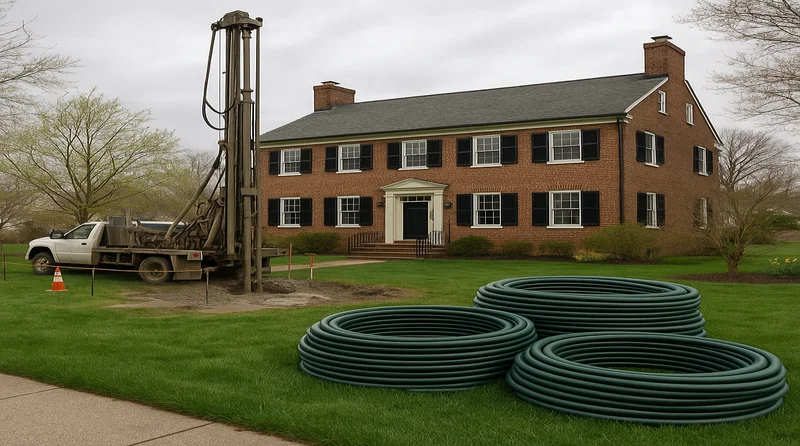
Why Delaware Is a Better Geothermal Market Than You'd Think
Delaware is easy to overlook. Smallest state, squeezed between Maryland, Pennsylvania, and New Jersey. But it should be on every geothermal conversation's radar.
Delaware has one of the few state-level geothermal grants still active in the mid-Atlantic — the DE Green Energy Program through DNREC. Stack that with the federal 30% credit, and an oil-heated home in the Wilmington suburbs can hit a 5–7 year payback. That's competitive with any state on the East Coast.
Delaware sits entirely on the Atlantic Coastal Plain — sandy soil, no hard rock, cheaper drilling than Pennsylvania or Connecticut. Ground temperatures of 54–56°F year-round deliver efficient COP of 3.8–4.5. And its electricity rate of 13.56¢/kWh (EIA 2024) is moderate — keeping operating costs reasonable without being so cheap that the savings gap disappears.
Quick Verdict: Should You Go Geothermal in Delaware?
| Your Situation | Verdict | Typical Payback |
|---|---|---|
| Oil heat — Wilmington suburbs, New Castle County | ✅ Strong yes | 5–7 years |
| Propane heat — rural Sussex/Kent counties | ✅ Yes | 7–9 years |
| New construction — anywhere in DE | ✅ Strong yes | 3–5 years (incremental) |
| Beach property — Rehoboth, Bethany, Lewes | ✅ Yes — high cooling + propane | 6–8 years |
| Vacation rental — DE beaches | ✅ Yes — enhanced ROI | 5–7 years |
| Electric resistance heat | ✅ Yes | 6–9 years |
| Aging heat pump replacement | ⚠️ Compare at replacement time | 9–13 years |
| Natural gas — New Castle County newer homes | ❌ Not on payback alone | 25–35 years |
Get Your Delaware Geothermal Quote
Connect with IGSHPA-certified installers serving Delaware. Look into MD and PA contractors too — they regularly work in DE.
Find Installers → Free · No obligation · IGSHPA certified onlyDoes Geothermal Work in Delaware?
Yes — and the geology is a genuine selling point. Atlantic Coastal Plain sediments (unconsolidated sand, silt, clay) mean drillers move fast here. A vertical bore field that takes three days in Pennsylvania takes two in Delaware.
| Area | HDD | CDD | Ground Temp (°F) | Primary Heating Fuel |
|---|---|---|---|---|
| Wilmington / New Castle County | 4,600 | 800 | 54–56 | Oil / Natural gas |
| Dover / Kent County | 4,200 | 850 | 55–57 | Gas / Propane mix |
| Rehoboth Beach / Sussex Coast | 3,800 | 900 | 55–57 | Propane / Electric |
| Georgetown / Rural Sussex | 4,000 | 850 | 55–57 | Propane / Electric co-op |
Ground temperatures of 54–57°F deliver COP 3.8–4.5 — excellent efficiency. Delaware's cooling season is real: 800–900 CDD means geothermal's cooling efficiency (COP 5.0+) adds $200–$350/year in summer savings on top of heating savings. Beach communities get the most cooling value.
7-Region Geology & Drilling Conditions
Delaware is only 96 miles long and 35 miles wide at its widest point — but its geology is not uniform. The state straddles two physiographic provinces: the Piedmont in the far north (crystalline rock near Wilmington) and the Atlantic Coastal Plain covering everything south of the Fall Line. Understanding which zone your property sits in directly affects drilling cost, loop design, and thermal performance.
The Fall Line — the geological boundary between hard Piedmont bedrock and soft Coastal Plain sediments — crosses Delaware roughly along I-95 through north Wilmington. Properties north of that line drill through rock. Properties south of it drill through sand, gravel, silt, and clay. Most of Delaware (over 90% of its land area) is Coastal Plain, which is why drilling costs here are among the lowest in the mid-Atlantic.
| Region | Geology | Thermal Conductivity (Btu/ft·hr·°F) | Typical Bore Depth | Drilling Difficulty | Notes |
|---|---|---|---|---|---|
| Northern New Castle County (Brandywine, Greenville, north of I-95) | Piedmont crystalline rock — gneiss, schist, some serpentinite | 1.2–1.8 | 200–300 ft | 🟠 Moderate–Hard | Only area in DE with hard rock drilling. Higher cost per foot, but excellent thermal conductivity compensates with shorter bores. Limited area — just a few square miles. |
| Wilmington suburbs (Pike Creek, Hockessin, Newark — transition zone) | Transition zone — weathered Piedmont bedrock overlain by Coastal Plain sediments, saprolite | 0.9–1.4 | 225–275 ft | 🟡 Moderate | Drillers may hit rock at 50–100 ft depth after passing through saprolite and decomposed rock. Mixed conditions require experienced driller. Most Pike Creek/Hockessin installs are straightforward. |
| Central New Castle County (Bear, Glasgow, Middletown) | Coastal Plain — unconsolidated sand and gravel (Potomac Formation) | 0.7–1.0 | 200–275 ft | 🟢 Easy | Classic Coastal Plain drilling — fast, predictable. Middletown's rapid growth means new construction geothermal opportunity. Good aquifer yields for open-loop consideration. |
| Dover / Kent County (Dover, Camden, Smyrna) | Unconsolidated sand, silt, clay (Calvert and Choptank Formations) | 0.6–0.9 | 200–250 ft | 🟢 Easy | Soft sediment — fastest drilling in the state. Lower thermal conductivity means slightly longer bores to compensate, but drilling speed and cost more than offset. Excellent open-loop aquifer. |
| Southern Kent County (Harrington, Milford, Felton) | Sand/clay mix — alternating layers (Choptank and St. Marys Formations) | 0.6–0.9 | 200–250 ft | 🟢 Easy | Similar to Dover. Clay layers can slow groundwater movement slightly — good for closed-loop thermal retention. Poultry farms in this area are strong USDA REAP candidates. |
| Sussex County interior (Georgetown, Seaford, Bridgeville, Laurel) | Sandy Coastal Plain — Bethany and Beaverdam Formations | 0.6–0.8 | 175–250 ft | 🟢 Easy | Loose sandy soil ideal for both vertical and horizontal loops. Flat terrain with large lots — horizontal slinky is often the cheapest option. Many poultry operations here benefit from REAP grants. |
| Sussex coastal / Rehoboth (Rehoboth, Bethany, Fenwick, Lewes, Dewey) | Beach sand, high water table — Holocene/Pleistocene deposits | 0.8–1.1 (water-saturated sand) | 175–225 ft | 🟢 Easy (but wet) | Water table at 3–10 ft boosts thermal conductivity — saturated sand conducts heat better. Drilling is easy but requires proper casing and grouting to prevent aquifer cross-contamination. Closed-loop strongly preferred over open-loop (saltwater intrusion risk). |
What This Means for Your Project
- If you're north of I-95 (Brandywine, Greenville): You're in the Piedmont. Expect drilling costs 20–30% higher than Coastal Plain areas. Budget accordingly, but don't let it deter you — thermal conductivity is higher, so you need fewer bore feet.
- If you're in the Pike Creek / Hockessin transition zone: Get a driller experienced with Delaware's Fall Line geology. They may hit rock at depth. Not a problem for experienced crews, but avoid bidders who only know soft-sediment drilling.
- If you're anywhere south of the C&D Canal: You're in easy-drilling territory. Coastal Plain sand and gravel is what makes Delaware one of the cheapest states to drill in the mid-Atlantic. Vertical bores install in hours, not days.
- If you're on the Sussex coast: High water table is actually an advantage — saturated sand has better thermal conductivity than dry sand. Just make sure your installer uses proper well casing and thermally enhanced grout to protect the aquifer.
Delaware's geological simplicity is an underrated advantage. Over 90% of the state sits on soft Coastal Plain sediments where a standard residential bore field (3–4 vertical bores) can be drilled and grouted in a single day. Compare that to 2–3 days in Pennsylvania's Piedmont rock or Connecticut's glacial till with boulders. Faster drilling = lower mobilization costs = lower total project cost.
Delaware's Two Heating Markets
Northern Delaware (New Castle County)
Wilmington, Newark, Pike Creek, Hockessin — older housing stock with pre-1960s colonials and ranches, many still on heating oil (20–25% of DE homes). These are the strongest geothermal candidates in the state. Their fuel costs are high, gas conversion isn't always feasible in older neighborhoods, and the payback math works. Also home to most of Delaware's gas customers — newer subdivisions and post-1980 construction where geothermal is a tougher financial sell.
Southern Delaware (Kent and Sussex Counties)
Dover, Georgetown, Milford, and the Sussex County beach communities. Gas pipelines are sparse — much of rural Sussex runs on propane (10–12% statewide but concentrated here). Beach communities add another layer: high cooling loads, investment-minded owners, and larger lots that sometimes allow horizontal loops.
Regional Costs and ROI by Fuel Type
| Region | 3-Ton Vertical (Gross) | After 30% ITC | Horizontal (if land) | Contractor Availability |
|---|---|---|---|---|
| New Castle County / Wilmington | $17,000–$25,000 | $11,900–$17,500 | $12,000–$19,000 | Good — PA/MD contractors serve DE |
| Kent County / Dover | $16,000–$24,000 | $11,200–$16,800 | $11,000–$18,000 | Moderate — MD Eastern Shore firms |
| Sussex County Coast | $16,000–$24,000 | $11,200–$16,800 | $11,000–$18,000 | Moderate — Salisbury/MD firms |
| Rural Sussex / Georgetown | $15,000–$23,000 | $10,500–$16,100 | $10,000–$17,000 | Moderate |
Delaware's Coastal Plain geology keeps drilling costs at the lower end of mid-Atlantic ranges — no hard rock, fast drilling, fewer complications.
Scenario 1: Heating Oil (Wilmington Suburbs) — Best Case
- Annual oil cost: ~650 gal × $3.80/gal = ~$2,470/year
- Geothermal cost: ~$480–$540/year (at 13.56¢/kWh, COP 4.0)
- Annual savings: ~$2,130–$2,290/year (heating + cooling)
- Payback (net ~$13,700 with DE grant): ~5–7 years
Scenario 2: Propane (Rural Sussex/Kent) — Strong Case
- Annual propane cost: ~650 gal × $3.20/gal = ~$2,080/year
- Geothermal cost: ~$480–$540/year
- Annual savings: ~$1,740–$1,900/year
- Payback (net ~$13,700): ~7–9 years
Scenario 3: Natural Gas (New Castle County) — Honest
- Annual gas cost: ~550 therms × $1.25 = ~$688/year
- Geothermal cost: ~$480–$540/year
- Annual savings: ~$348–$508/year (heating + cooling)
- Payback (net ~$14,700): ~25–35 years. Not compelling for existing gas homes.
25-Year Total Cost of Ownership
| System | Net Install | 25-yr Operating | 25-yr Total |
|---|---|---|---|
| Geothermal (after ITC + DE grant) | $10,500–$14,500 | $12,000–$13,500 | $22,500–$28,000 |
| Oil boiler + AC | $5,000–$8,000 | $61,750–$72,000 | $66,750–$80,000 |
| Propane furnace + AC | $4,500–$7,000 | $52,000–$60,000 | $56,500–$67,000 |
| Gas furnace + AC | $5,000–$8,000 | $21,000–$25,000 | $26,000–$33,000 |
Real-World Delaware Case Studies
Case Study 1: Pike Creek Oil-Heated Colonial — 5.8-Year Payback
- Location: Pike Creek, New Castle County (Coastal Plain, sandy soil)
- Home: 2,400 sq ft colonial, 1962 construction, oil-fired boiler + window AC units
- Prior fuel: Heating oil — 700 gal/year at $3.85/gal = $2,695/year + $350 window AC
- System installed: 3.5-ton vertical closed-loop (3 × 250ft bores in sandy sediment — fast drilling)
- Gross cost: $24,000 (includes ductwork retrofit from hot-water radiator system)
- Federal ITC (30%): −$7,200
- DE Green Energy grant: −$3,000 [verified at time of install]
- Net cost: $13,800
- Annual geo operating cost: ~$690/year (heating + cooling + desuperheater DHW)
- Annual savings: ($2,695 + $350) − $690 = $2,355/year
- Simple payback: $13,800 ÷ $2,355 = 5.8 years
Coastal Plain drilling completed in 1.5 days — vs. 2.5–3 days typical for Pennsylvania hard rock. The ductwork retrofit added ~$6,000 (converting from radiators to forced air). Homes with existing duct systems avoid this entirely and see faster payback. The DE Green Energy grant shaved a full year off the payback timeline.
Case Study 2: Rehoboth Beach Vacation Home — 6.2-Year Payback
- Location: West of Rehoboth Beach, Sussex County (sandy Coastal Plain, large lot)
- Home: 2,000 sq ft ranch, year-round VRBO rental, propane furnace + central AC
- Prior fuel: Propane — 750 gal/year at $3.30/gal = $2,475/year + $420 AC electricity
- System installed: 3-ton horizontal slinky loop (2 trenches × 250ft, 6ft depth — sandy soil, 0.8-acre lot)
- Gross cost: $18,500 (horizontal = cheaper than vertical)
- Federal ITC (30%): −$5,550
- DE Green Energy grant: −$3,000
- Net cost: $9,950
- Annual geo operating cost: ~$560/year (heating + cooling — heavy summer use)
- Annual savings: ($2,475 + $420) − $560 = $2,335/year
- Simple payback: $9,950 ÷ $2,335 = 4.3 years (standalone) / 6.2 years (incremental vs. propane furnace replacement at $7,500)
- Rental premium: "Eco-friendly geothermal — low utility costs" — estimated $10–$20/night premium during peak beach season
Horizontal loop in sandy soil was straightforward — no rocks, no ledge. Trenching took one day. The beach rental market rewards energy efficiency marketing, and guests appreciate consistent year-round comfort. Propane tank removal freed up yard space.
Case Study 3: Middletown New Construction — 3.4-Year Incremental Payback
- Location: Middletown, New Castle County (Coastal Plain sand/gravel — classic easy-drilling territory)
- Home: 2,400 sq ft new construction colonial, 2025 build, builder-spec'd with standard 16 SEER air-source heat pump (ASHP)
- Upgrade decision: Swap builder's ASHP for 4-ton geothermal with horizontal slinky loop (0.6-acre lot, sandy Coastal Plain soil) + 6 kW rooftop solar array
Cost Comparison: Geothermal + Solar vs. Standard ASHP
| Item | Standard ASHP (Builder Spec) | Geothermal + Solar Upgrade |
|---|---|---|
| HVAC system (installed) | $9,500 (16 SEER ASHP) | $21,000 (4-ton geo horizontal slinky) |
| 6 kW solar array | — | $16,800 gross |
| Gross total | $9,500 | $37,800 |
| Federal ITC — geo (30%) | — | −$6,300 |
| Federal ITC — solar (30%) | — | −$5,040 |
| DE Green Energy grant (geo) | — | −$3,000 |
| DE SREC value (est. 10-yr) | — | −$2,400 |
| Net total | $9,500 | $21,060 |
| Incremental cost of upgrade | $11,560 | |
Annual Operating Cost Comparison
| Cost Category | Standard ASHP | Geothermal + Solar |
|---|---|---|
| Heating electricity | $820/yr (COP 2.8 avg) | $390/yr (COP 4.2 avg) |
| Cooling electricity | $440/yr (SEER 16) | $210/yr (COP 5.0+) |
| Water heating (desuperheater) | $320/yr (electric tank) | $140/yr (desuperheater offsets ~60%) |
| Solar offset | — | −$740/yr (net metering, 7,800 kWh) |
| Net annual cost | $1,580/yr | $0–$50/yr |
| Annual savings vs. ASHP | — | ~$1,530–$1,580/yr |
- Incremental cost: $11,560
- Annual savings: ~$1,550/year
- Incremental payback: $11,560 ÷ $1,550 = ~3.4 years (combined geo + solar vs. ASHP)
- 25-year savings: ~$38,750 in avoided electricity costs vs. the ASHP baseline
- Net-zero potential: The 6 kW array offsets virtually all geothermal electricity consumption — annual energy cost approaches $0
New construction is where geothermal's economics are strongest. You're comparing the incremental cost of upgrading from builder-spec ASHP to geothermal — not the full system cost. In Middletown's sandy Coastal Plain soil, horizontal loop trenching completed in a single day, and the builder coordinated it with foundation/grading work to minimize site disruption. Adding solar at construction time avoids the separate mobilization cost of a retrofit install. The combined system eliminates essentially all conditioning costs for 25+ years — a powerful selling point in Delaware's competitive new-construction market.
For Middletown buyers comparing developments: geothermal + solar adds roughly $45–$55/month to a mortgage payment but eliminates $130+/month in utility costs. Net monthly savings from day one.
Month-by-Month Energy Profile
Based on the Pike Creek oil-heated colonial (Case Study 1 baseline, 2,400 sq ft):
| Month | Old Oil + AC Cost | Geothermal Cost | Monthly Savings | Notes |
|---|---|---|---|---|
| January | $410 | $100 | $310 | Peak heating — COP 3.8 at 54°F EWT |
| February | $375 | $92 | $283 | Cold month, heavy load |
| March | $250 | $68 | $182 | Shoulder — heating tails off |
| April | $95 | $35 | $60 | Minimal conditioning |
| May | $50 | $30 | $20 | Light cooling + DHW desuperheater |
| June | $85 | $50 | $35 | Cooling ramp-up — humid Delaware summers |
| July | $120 | $65 | $55 | Peak cooling — 800+ CDD drives real savings |
| August | $110 | $60 | $50 | Heavy cooling + desuperheater peak |
| September | $60 | $35 | $25 | Cooling tails off |
| October | $130 | $42 | $88 | Heating ramp-up |
| November | $310 | $78 | $232 | Heavy heating |
| December | $385 | $95 | $290 | Near-peak heating |
| Annual Total | $2,380 | $750 | $1,630 |
At 13.56¢/kWh, oil at $3.85/gal, COP 3.8 heating / 5.0 cooling. Delaware's summer humidity drives meaningful cooling savings June–August that add ~$140 annually beyond heating alone.
Open-Loop System Assessment
| Area | Open-Loop Viability | Key Considerations |
|---|---|---|
| New Castle County / Wilmington | ⚠️ Caution | Legacy industrial contamination near Wilmington. Water testing essential. Suburban well yields adequate where clean. |
| Kent County / Dover | ✅ Often viable | Coastal Plain aquifers yield well. Good water quality in most areas. DNREC permit required. |
| Rural Sussex County | ✅ Generally viable | Excellent sandy aquifer yields (10–30+ gpm). Clean water. Best open-loop territory in DE. |
| Sussex Coast / Beach communities | ⚠️ Saltwater intrusion risk | Proximity to Atlantic/bays means saltwater mixing at depth. Closed-loop preferred near coast. Test before committing. |
Delaware's sandy Coastal Plain aquifers are generally favorable for open-loop — especially in rural Kent and Sussex counties. Closed-loop remains the simpler default for coastal properties and Wilmington-area sites with contamination risk.
Loop Type Cost Comparison
| Loop Type | Typical DE Cost (3-ton) | Land Needed | Best For | Delaware Notes |
|---|---|---|---|---|
| Vertical closed-loop | $16,000–$25,000 | Small — 15×15 ft/bore | Suburban Wilmington, smaller lots | Coastal Plain = fast drilling, lower cost than rocky states |
| Horizontal slinky | $11,000–$18,000 | ½–1 acre | Sussex beach lots, rural Kent/Sussex | Sandy soil = easy trenching. 30–40% cheaper than vertical |
| Horizontal straight | $10,000–$16,000 | 1–2 acres | Sussex County farms, large rural lots | Cheapest option; flat terrain and sandy soil ideal |
| Pond loop | $12,000–$18,000 | ½+ acre pond, 8ft+ | Farm ponds in Kent/Sussex | Excellent where available; many DE farms have suitable ponds |
| Open-loop | $13,000–$20,000 | Existing well + discharge | Rural Sussex, central Kent | Best in sandy aquifer zones; DNREC permit required |
Incentives: Federal Credit + DE Green Energy Grant
| Incentive | Amount | Status | How to Claim |
|---|---|---|---|
| Federal ITC (Section 25D) | 30% of total cost | ✅ Confirmed through 2032 | IRS Form 5695 |
| DE Green Energy Program (DNREC) | Up to $3,000 grant | [NEEDS VERIFICATION — verify current availability] | DNREC Green Energy Program |
| Delmarva Power EmPOWER rebate | $200–$500 | [NEEDS VERIFICATION] | delmarvapower.com |
| DE Electric Cooperative rebate | Varies | [NEEDS VERIFICATION] | Contact co-op directly |
| USDA REAP (farms/rural biz) | 25–50% grant | ✅ Active | USDA Rural Dev. DE |
The Full Stack: What It Looks Like
For an oil-heated home installing a $22,000 system:
- Gross cost: $22,000
- Federal 30% ITC: −$6,600
- DE Green Energy grant: −$3,000 [if available]
- Net cost: ~$12,400
- Annual savings vs. oil: ~$2,200
- Payback: ~5.6 years
Delaware's incentive stack is among the best in the mid-Atlantic. The DE Green Energy Program grant is significant — few neighboring states offer a comparable state-level grant. Verify availability at DNREC before budgeting it into your calculations, as the program can run out of annual funding.
USDA REAP: Farm & Rural Business Grants
Delaware is one of the top poultry-producing states in the nation — Sussex County alone produces over 200 million broiler chickens annually, with major integrators like Perdue Farms and Mountaire Farms headquartered or operating major complexes in the state. These poultry operations — along with grain farms, processing facilities, and other rural businesses — are prime candidates for the USDA Rural Energy for America Program (REAP).
What REAP Covers
- Grant: Up to 50% of total eligible project cost (competitive — typical awards 25–40%)
- Loan guarantee: Up to 75% of project cost
- Combined cap: Grant + loan guarantee cannot exceed 75% of project cost
- Minimum grant: $2,500 (renewable energy systems)
- Maximum grant: $1,000,000 (renewable energy systems)
- Eligibility: Agricultural producers and rural small businesses in eligible areas — most of Kent and Sussex County qualifies; parts of rural New Castle County may also qualify
Sussex County Poultry Farm Example: REAP + ITC Stacking
A 15,000 sq ft poultry processing facility near Georgetown installing a commercial geothermal system to replace propane-fired heating and conventional cooling:
| Item | Amount |
|---|---|
| Commercial geothermal system (20-ton, vertical closed-loop) | $125,000 |
| USDA REAP grant (25% award — typical competitive rate) | −$31,250 |
| Adjusted basis for ITC ($125,000 − $31,250) | $93,750 |
| Federal Business Energy ITC — 30% (Section 48) | −$28,125 |
| MACRS 5-year depreciation (present value at 21% rate) | −$16,875 (est.) |
| Effective net cost | $48,750 |
| Effective incentive coverage | 61% of gross cost |
Annual Operating Savings
| Category | Old System (Propane + Electric) | Geothermal | Savings |
|---|---|---|---|
| Heating (propane) | $18,500/yr | — | — |
| Cooling (electric) | $6,200/yr | — | — |
| Geothermal electricity (heat + cool) | — | $8,400/yr | — |
| Annual total | $24,700/yr | $8,400/yr | $16,300/yr |
- Simple payback (after all incentives): $48,750 ÷ $16,300 = ~3.0 years
- 25-year net savings: Over $350,000 in avoided propane and electricity costs
Key REAP stacking rules:
- REAP grant reduces the ITC cost basis — you can't double-dip on the same dollar
- REAP loan guarantee does NOT reduce ITC basis — only the grant portion does
- MACRS accelerated depreciation applies to the ITC-adjusted basis (after 50% ITC basis reduction per Section 50(c))
- Application deadlines typically March 31 and October 31 each year — check USDA REAP page for current cycle
- Consult a tax professional experienced with agricultural energy credits — the ITC + REAP + MACRS interaction is complex and the savings are substantial enough to justify professional advice
For Delaware's poultry industry specifically: geothermal can provide both heating for broiler houses (maintaining 85–90°F for chick rearing) and cooling for processing facilities. The year-round load profile of a poultry operation makes geothermal's economics particularly strong — there's no off-season. Sussex County's sandy Coastal Plain geology allows cost-effective commercial bore fields, and the REAP + ITC stack can cover over 60% of the upfront cost.
Solar + Geothermal Stacking
Delaware's net metering laws support residential solar, and the state has a Renewable Portfolio Standard requiring 40% renewables by 2035. The combined solar + geo math for oil/propane homes:
- Geothermal alone: Reduces oil/propane spend by ~80%
- 5–6 kW solar array: ~$9,000–$11,000 net after 30% ITC — offsets most geo electricity
- Combined effect: Near-zero heating/cooling cost — energy independence from fossil fuel deliveries
- Combined payback: 8–11 years — but you're eliminating ALL conditioning costs for 25+ years
Delaware's SREC market (Solar Renewable Energy Certificates) provides additional income — DE SRECs have historically traded at $20–$40 each. This revenue stream can further reduce the effective combined payback.
Beach Communities: The Overlooked Market
The Lewes-to-Fenwick Island stretch represents a genuine geothermal opportunity:
- High cooling loads: 800–900 CDD, heavy Memorial Day–Labor Day occupancy. Geothermal's COP 5.0+ cooling dramatically reduces summer electricity bills.
- Propane heat: Most older Sussex beach properties run propane — the strongest ROI fuel scenario.
- Larger lots: Many beach properties have enough yard for horizontal loops — cheaper than vertical and easy to install in sandy soil.
- Investment horizon: Beach property owners think long-term. A 6–8 year payback on a 25-year system with a 50-year loop is attractive.
Wetlands caveat: Properties near Rehoboth Bay, Indian River Bay, or Assawoman Bay may need DNREC wetlands review for drilling. Not a dealbreaker — but know about it going in. Delaware does NOT have a Maryland-style Critical Area buffer zone, which is a meaningful advantage for coastal DE properties.
Vacation Rental Analysis
Delaware beach rentals — Rehoboth, Bethany, Dewey, Lewes — benefit from geothermal in multiple ways:
- Propane elimination: Removes delivery logistics and tank maintenance for seasonal/rental properties
- Summer cooling savings: Peak rental season = peak cooling demand. Geothermal delivers both at COP 5.0+
- Year-round capability: Enables off-season rentals (fall foliage, holiday weekends) with efficient heating
- Eco-premium: "Geothermal heated and cooled" is a legitimate listing differentiator on VRBO/Airbnb in the eco-conscious DE beach market
- MACRS depreciation: Rental properties may qualify for 5-year accelerated depreciation in addition to 30% ITC — consult a tax professional
How to Claim the Federal Tax Credit (IRS Form 5695)
- Confirm eligibility. ENERGY STAR certified GSHP at primary or secondary residence. Rental-only properties don't qualify for Section 25D (but may qualify for business energy ITC under Section 48).
- Gather documentation. Itemized installer invoice, ENERGY STAR/AHRI certificate, proof of residence. If claiming DE Green Energy grant too, keep DNREC approval documentation.
- Complete Form 5695, Part I. Enter total installed cost on Line 12a. Important: If you received the DE Green Energy grant, reduce your cost basis by the grant amount — only net out-of-pocket qualifies.
- Calculate credit. Multiply adjusted Line 12a by 0.30. No cap through 2032.
- Transfer to Form 1040. Credit flows to Schedule 3, Line 5.
- Handle carryforward. Unused credit rolls to subsequent tax years.
- Retain records 7+ years. Invoice, certificates, DNREC grant documentation, permits.
Permits, Licensing & Regulatory Requirements
Delaware's permitting process for geothermal systems involves multiple agencies and varies by county. This section covers everything you need to know — from well permits to HVAC licensing to coastal zone considerations.
DNREC Well Permits (7 Del. C. Chapter 60)
Any geothermal borehole drilled in Delaware requires a well permit from the Delaware Department of Natural Resources and Environmental Control (DNREC), Division of Water. This is governed by Title 7, Chapter 60 of the Delaware Code — the state's well construction and permitting statute.
- What requires a permit: All vertical boreholes for closed-loop geothermal systems, all supply/return wells for open-loop systems, and any exploratory or test holes drilled to assess subsurface conditions
- What does NOT require a DNREC well permit: Horizontal loop trenches (these are shallow excavations, not wells) — though local excavation/grading permits may still apply
- Application: Submit through DNREC's Division of Water. Your licensed well driller typically handles this as part of the project
- Fee: $50–$100 per well permit (subject to change — verify with DNREC)
- Requirements: Licensed well driller must perform the work. Borehole specifications (depth, diameter, casing, grouting) must meet Delaware well construction standards. Thermally enhanced bentonite grout is standard for closed-loop bores to prevent aquifer cross-contamination
- Open-loop additional requirements: Water appropriation permit if pumping exceeds 50,000 gallons/day. Discharge permit for return water — typically back to the aquifer via a return well, or to a surface water body with DNREC approval
HVAC Contractor Licensing (Division of Professional Regulation)
The Delaware Division of Professional Regulation (DPR) licenses HVAC contractors under the HVACR Board. Any contractor installing a geothermal heat pump in Delaware must hold a valid Delaware HVAC license — or be properly supervised by a licensed Delaware contractor.
- License types: Master HVACR (unrestricted), Journeyperson HVACR (works under master), and Apprentice
- Out-of-state contractors: PA, MD, and NJ contractors working in Delaware must either hold a Delaware HVAC license OR partner with a licensed DE contractor. Many regional geothermal firms maintain Delaware licenses specifically because they serve the DE market from neighboring states
- Verification: Search active licenses at DELPROS online verification. Ask your contractor for their Delaware license number before signing any contract
- Well drillers: Separately licensed through DNREC. Geothermal projects require both an HVAC contractor (for the heat pump and indoor equipment) and a licensed well driller (for the bore field). Some firms hold both licenses; many subcontract the drilling
County-by-County Requirements
| Requirement | New Castle County | Kent County | Sussex County |
|---|---|---|---|
| Building/mechanical permit | ✅ Required — NCC Dept. of Land Use | ✅ Required — Kent County Planning | ✅ Required — Sussex County Bldg. Code |
| Electrical permit | ✅ Required for heat pump wiring | ✅ Required | ✅ Required |
| Zoning review | Typically routine — check setback requirements for bore field | Routine — rural parcels rarely have issues | Routine — check flood zone and wetland overlays |
| HOA restrictions | ⚠️ Common in Hockessin, Pike Creek, Middletown subdivisions — review CC&Rs before committing | ⚠️ Less common — some Dover subdivisions | ⚠️ Beach community HOAs may restrict equipment location and drilling noise hours |
| Typical permit cost | $100–$300 | $75–$200 | $75–$200 |
| Inspection required | Yes — mechanical and electrical | Yes | Yes |
Wetlands & Coastal Zone Considerations
Delaware has extensive tidal and non-tidal wetlands, particularly in Sussex County's bay communities. These affect geothermal permitting:
- Tidal wetlands: Properties bordering Delaware Bay, Rehoboth Bay, Indian River Bay, or Assawoman Bay may require a DNREC Wetlands and Subaqueous Lands Section review before any drilling or trenching. Your installer should order a wetlands delineation or check DNREC's mapped wetland boundaries before finalizing loop design
- Non-tidal wetlands: Freshwater wetlands in rural Kent and Sussex counties are regulated under the Delaware Wetlands Act. If your property includes mapped wetlands, the loop field must avoid them — which may affect horizontal loop feasibility on smaller parcels
- Flood zones: FEMA-mapped flood zones (common in coastal Sussex, along Delaware River tributaries in New Castle County) don't prohibit geothermal, but equipment must be elevated per local flood ordinance. The heat pump unit itself should be above base flood elevation
- Delaware's advantage over Maryland: Delaware has NO equivalent to Maryland's Critical Area Act 1,000-foot buffer around the Chesapeake Bay. This means waterfront and near-waterfront properties in Sussex County face far fewer restrictions on geothermal drilling than comparable properties across the state line in Maryland
Permitting Timeline
| Permit/Approval | Agency | Typical Timeline | Notes |
|---|---|---|---|
| DNREC well permit | DNREC Division of Water | 2–4 weeks | Installer handles application. Standard process for residential bores. |
| County mechanical permit | County building dept. | 1–2 weeks | Standard HVAC permit process. |
| County electrical permit | County building dept. | 1–2 weeks | Often bundled with mechanical. |
| Wetlands review (if applicable) | DNREC Wetlands Section | 4–8 weeks | Only for properties with mapped wetlands. Can add significant time — start early. |
| HOA approval (if applicable) | HOA board | 2–6 weeks | Varies wildly by HOA. Submit early. Include noise plan and restoration timeline. |
| Open-loop water appropriation | DNREC | 4–6 weeks | Only for open-loop systems exceeding 50,000 gpd. |
| Total typical timeline (closed-loop, no wetlands) | 3–6 weeks | Many permits can be applied for simultaneously. | |
| Total with wetlands review | 8–14 weeks | Wetlands review is the bottleneck — start it first. |
Bottom line: Delaware's permitting is straightforward for most residential geothermal projects. A standard closed-loop installation on a suburban lot with no wetlands concerns can go from signed contract to drilling in 3–6 weeks. The only real complication is wetlands — and that affects only a subset of coastal Sussex County properties. Your installer should handle all permit applications as part of the project scope.
Finding & Vetting a Delaware Installer
Delaware's local geothermal contractor market is thin — the state is small enough that it doesn't support a large number of dedicated geothermal-only firms. But that's not a barrier. The PA, MD, and NJ contractor networks regularly serve Delaware, and the state's easy Coastal Plain geology means experienced drillers from neighboring states can mobilize quickly.
Where to Find Contractors
| Resource | URL | What You'll Find |
|---|---|---|
| IGSHPA Contractor Directory | igshpa.org/find-a-contractor | Certified geothermal installers. Search by ZIP — cast net to include SE PA, MD Eastern Shore, South NJ. |
| WaterFurnace Dealer Locator | waterfurnace.com/dealer-locator | Authorized WaterFurnace dealers serving Delaware. WF is the largest US residential geo brand. |
| ClimateMaster Dealer Locator | climatemaster.com/find-a-dealer | Authorized ClimateMaster dealers. Strong presence in mid-Atlantic region. |
| Bosch Contractor Locator | bosch-thermotechnology.us/find-contractor | Bosch/FHP geothermal heat pump authorized installers. |
| DE Division of Professional Regulation | delpros.delaware.gov | Verify any contractor's Delaware HVAC license status before signing. |
Regional Installer Availability
| Delaware Region | Local Availability | Where Contractors Come From | Typical Wait Time for Install |
|---|---|---|---|
| Northern New Castle County (Wilmington, Pike Creek) | 🟢 Good | SE Pennsylvania (Chester/Delaware/Lancaster counties), northern MD | 4–8 weeks |
| Southern New Castle (Middletown, Bear) | 🟢 Good | SE PA, Cecil County MD, some local DE firms | 4–8 weeks |
| Kent County (Dover, Smyrna) | 🟡 Moderate | MD Eastern Shore (Easton, Salisbury), some SE PA firms | 6–10 weeks |
| Sussex County inland (Georgetown, Seaford) | 🟡 Moderate | Salisbury/MD Eastern Shore, some Delmarva-based firms | 6–12 weeks |
| Sussex County coast (Rehoboth, Bethany) | 🟡 Moderate | Same as Sussex inland — Salisbury corridor contractors | 6–12 weeks (longer in summer due to beach construction season) |
8-Point Installer Vetting Checklist
Use this checklist before signing with any geothermal contractor in Delaware:
- Delaware HVAC license verification. Search DELPROS for active Master HVACR license. If out-of-state contractor, confirm they have a DE license or are partnered with a licensed DE firm. No license = no contract.
- IGSHPA certification. Ask for their IGSHPA Accredited Installer certificate. This is the industry standard for geothermal-specific training — separate from general HVAC licensing. Not legally required in DE, but strongly recommended.
- Manual J load calculation. Demand a room-by-room Manual J heat loss/gain calculation specific to YOUR home — not a rule-of-thumb estimate. Oversized systems waste money; undersized systems underperform. The load calc determines system tonnage.
- Detailed written proposal. The bid should specify: system tonnage, heat pump make/model, loop type, number of bores/trench length, bore depth, grouting material, ductwork modifications (if any), desuperheater (yes/no), thermostat, and all permit fees. Vague "geothermal system installed" bids are a red flag.
- Loop design documentation. Ask for the loop design calculation or software output (e.g., LoopLink, GLD). This shows the contractor properly sized the ground loop for Delaware's soil conditions and your home's heating/cooling loads — not just guessing.
- Insurance and bonding. Verify general liability insurance ($1M minimum) and workers' comp. Ask for certificate of insurance naming you as additionally insured during the project.
- References and track record. Ask for 3–5 completed geothermal installations in Delaware or the mid-Atlantic. Speak with at least two references. Ask specifically: Was the system sized correctly? Any issues during drilling? How's it performing after 1–2 heating/cooling seasons?
- Warranty clarity. Get written warranty terms for: heat pump equipment (typically 5–10 year manufacturer), loop field (typically 25–50 year), labor/workmanship (varies — 1–5 years is common). Know who you call for service — the installer, a local HVAC firm, or the manufacturer.
Get Your Delaware Geothermal Quote
Search IGSHPA's directory for certified installers serving your ZIP code — include neighboring state contractors within 60 miles.
Find Installers → Free · No obligation · IGSHPA certified onlyMaintenance & System Longevity
Geothermal heat pumps are among the lowest-maintenance HVAC systems available — there's no outdoor condenser exposed to weather, no combustion components, and the ground loop is buried and sealed for decades. Delaware's specific conditions — Coastal Plain sandy soil, high water tables near the coast, and occasional salt air in beach communities — create a favorable maintenance environment overall.
Delaware-Specific Maintenance Considerations
- Sandy soil advantage: Delaware's unconsolidated Coastal Plain sediments don't shift or heave like clay-heavy soils in other states. This means less stress on buried loop piping and fewer concerns about bore collapse or loop damage over time.
- High water table (coastal areas): Saturated soil around the loop maintains consistent thermal contact and prevents the dry-out problems that can reduce efficiency in arid states. Delaware's wet conditions are actually beneficial for ground loop performance.
- Salt air (Sussex coast): Beach community installations should use marine-grade fasteners and protective coatings on any exposed metal components (electrical disconnects, refrigerant line connections). The heat pump itself is indoor-mounted, so salt air exposure is minimal compared to conventional outdoor AC condensers — a genuine advantage of geothermal in coastal environments.
- Humidity: Delaware's humid summers mean the desuperheater produces more free hot water during cooling season (the waste heat from cooling is captured for domestic hot water). This is a performance benefit, not a maintenance concern.
Maintenance Schedule
| Task | Frequency | Who Does It | Est. Cost | Delaware-Specific Notes |
|---|---|---|---|---|
| Air filter replacement | Every 1–3 months | Homeowner | $5–$20/filter | Beach homes: check monthly during summer rental season when occupancy is high and doors open frequently. |
| Thermostat check / seasonal mode switch | Spring and fall | Homeowner | Free | Programmable/smart thermostats recommended — especially for vacation rentals to avoid conditioning empty homes. |
| Condensate drain inspection | Annually (spring) | Homeowner or HVAC tech | Free / $75–$125 | Delaware's humid summers produce heavy condensation in cooling mode. Flush the drain line annually to prevent clogs and water damage. |
| Desuperheater check (if installed) | Annually | HVAC technician | Part of annual service | Check pump operation and heat exchanger. Delaware's high cooling loads mean heavy summer desuperheater use — verify pump is operating. |
| Professional system inspection | Annually | HVAC technician | $100–$200 | Refrigerant charge, electrical connections, loop pressure, thermostat calibration, airflow. Schedule in early fall before heating season. |
| Loop pressure / antifreeze check | Every 3–5 years | Geothermal specialist | $150–$300 | Closed-loop systems with glycol antifreeze should be tested for concentration and pH. Delaware's mild winters mean less antifreeze degradation than northern states. |
| Ductwork inspection | Every 5 years | HVAC technician | $100–$200 | Especially important for retrofit installations (like Case Study 1's radiator-to-duct conversion). Check for leaks, disconnections, insulation degradation. |
| Flow center / circulator pump service | Every 5–7 years | Geothermal specialist | $200–$400 (if pump replacement needed) | Circulator pumps are the most likely component to need replacement before the heat pump itself. Sandy aquifer water (open-loop) can accelerate wear — flush valves annually if open-loop. |
Component Lifespan
| Component | Expected Lifespan | Replacement Cost (Approx.) | Delaware Context |
|---|---|---|---|
| Ground loop (HDPE pipe) | 50+ years | N/A — rarely replaced | Delaware's stable, non-corrosive sandy soil is ideal for HDPE longevity. No freeze/thaw rock movement. Some manufacturers warranty loops for 50 years. |
| Heat pump compressor | 15–25 years | $2,000–$4,000 | Indoor location protects from weather. Delaware's moderate climate (not extreme cold or heat) reduces compressor stress vs. northern states. |
| Heat pump unit (complete) | 20–25 years | $5,000–$8,000 (swap) | When the heat pump reaches end-of-life, you replace just the indoor unit — the ground loop stays. Second-generation swap cost is a fraction of initial install. |
| Circulator pump(s) | 10–15 years | $300–$600 | The most common "repair" in a geothermal system's life. Simple swap — any HVAC tech can do it. |
| Desuperheater pump | 8–12 years | $150–$300 | Runs more in Delaware's cooling season (heavy summer use). Budget for replacement around year 10. |
| Thermostat | 10–15 years | $100–$300 | Smart thermostats (Ecobee, Honeywell) with geothermal-compatible staging recommended. |
| Antifreeze (closed-loop) | Refresh every 10–15 years | $200–$400 | Propylene glycol degrades over time. Delaware's mild freeze conditions mean less antifreeze stress, but still test periodically. |
The 50-year math: A geothermal system installed today in Delaware will likely need one heat pump replacement (~year 22), two sets of circulator pumps, and one antifreeze refresh over a 50-year period. Total maintenance and replacement cost: roughly $8,000–$14,000 over 50 years. Compare that to replacing a conventional furnace + AC twice (every 15–18 years) at $8,000–$12,000 each time, plus annual fuel costs. Geothermal's total cost of ownership is dramatically lower — the ground loop is the gift that keeps giving.
Delaware vs. Neighboring States
| Factor | DE | MD | NJ | PA |
|---|---|---|---|---|
| Electricity rate | 13.56¢ | 15.04¢ | 16.29¢ | 12.51¢ |
| State incentive | DE Green Energy grant ($3K) | EmPOWER [NV] | NJCEP [NV] | Utility [NV] |
| Oil home payback | 5–7 yr | 5–7 yr | 6–8 yr | 6–7 yr |
| Drilling cost | Low — Coastal Plain sand | Low coastal / Med inland | Varies — Pine Barrens sand vs. NW rock | High — Piedmont/Plateau hard rock |
| Coastal permitting | No statewide buffer ✅ | Critical Area buffer ⚠️ | CAFRA zones ⚠️ | No coastal overlay ✅ |
| Permitting complexity | 🟢 Low — DNREC well permit + county mechanical, straightforward process | 🟡 Moderate — MDE well permit + county, Critical Area adds complexity for bay properties | 🟠 Moderate–High — NJDEP well permit, CAFRA in coastal, stricter municipal requirements | 🟡 Moderate — Varies by county, some require geothermal-specific permits, no statewide standard |
| Installer availability | 🟡 Moderate — small local market, relies on PA/MD/NJ contractors | 🟢 Good — larger state with more local firms, especially Baltimore and Eastern Shore | 🟢 Good — strong market in NW NJ, decent statewide | 🟢 Good — largest market in region, especially SE PA and Lehigh Valley |
| Best scenario | Wilmington oil belt + beach propane | Eastern Shore oil | NW NJ oil | Philly suburb oil |
Delaware's edge: Among the best state-level incentive stacks in the mid-Atlantic (DE Green Energy + federal 30%), the easiest drilling geology (Coastal Plain sand), and no coastal buffer zone restricting beach property installations. For oil-heated New Castle County homes and propane-heated Sussex beach properties, Delaware is one of the strongest geothermal markets on the East Coast.
Delaware's limitation: The state's small size means fewer local geothermal contractors. You'll likely be working with firms based in Pennsylvania, Maryland, or New Jersey. This isn't a problem — these contractors know Delaware's geology and serve the market regularly — but it can mean slightly longer scheduling timelines and potentially higher mobilization costs for Sussex County projects if the contractor is based in the Philadelphia or Baltimore corridor.
Frequently Asked Questions
Program availability changes — it's funded through a utility surcharge and can exhaust annual allocation. Check DNREC's Green Energy Program page for current status before counting on it. Even without the grant, the federal 30% ITC alone delivers 6–7 year payback for oil homes.
On pure payback, no — 25–35 years. Makes financial sense only at system replacement time (compare incremental cost vs. new gas furnace + AC) or new construction. If you're building new, the incremental cost of choosing geo over gas HVAC is modest and you lock in lower operating costs for 30 years.
Yes — significantly. Sandy sediment drills faster and easier than Pennsylvania's hard rock or Connecticut's granite. A typical DE bore field installs in 1.5–2 days vs. 2.5–3 days in harder geology. This translates to $2,000–$4,000 lower drilling costs for a standard residential system.
If you're on propane — strong yes. 6–8 year payback, eliminates propane delivery, and geothermal's summer cooling efficiency is a genuine asset during peak beach season (900 CDD). Horizontal loops are often feasible on beach lots with sandy soil. For rentals, "eco-friendly geothermal" is a legitimate listing differentiator. Check DNREC for wetlands issues if your property borders a bay.
If you have ½ acre or more of accessible ground, likely yes. Sussex County's sandy Coastal Plain soil is ideal for trenching — no rocks, no ledge. Horizontal slinky loops cost 30–40% less than vertical and install quickly in sandy soil. Even beach properties set back from the water often have enough yard. Ask your installer to quote both vertical and horizontal options.
Delaware's local contractor market is thin — but that's not a barrier. Baltimore-area, southeastern PA, and South Jersey contractors regularly work in DE. The Coastal Plain geology is familiar to them. Search IGSHPA's directory and cast your net into neighboring states. Get at least three quotes.
No — and this is a meaningful advantage. Maryland's 1,000-foot Critical Area buffer around the Chesapeake Bay complicates geothermal permitting for many waterfront properties. Delaware has no equivalent statewide restriction. The exception: tidal wetlands near Delaware's bays do require DNREC review, but this is site-specific, not a blanket zone.
Yes — but the federal credit applies to your cost AFTER subtracting the grant. On a $22,000 system: subtract the $3,000 DE grant first, then apply 30% ITC to the remaining $19,000 = $5,700. Your total incentives: $3,000 + $5,700 = $8,700, leaving net cost ~$13,300. Even with the grant reducing the ITC base, the combined stack is among the best in the mid-Atlantic.
Delaware's sandy Coastal Plain aquifers can support open-loop in the right locations — rural Kent and Sussex counties are best. Avoid near the coast (saltwater intrusion risk) and near Wilmington (legacy contamination). DNREC permit required. Most DE installers default to closed-loop for simplicity.
Oil-heated homes in the Wilmington suburbs (New Castle County) — 5–7 year payback, especially with the DE Green Energy grant. Close second: propane-heated beach and rural Sussex County properties — 6–9 years, with high summer cooling savings adding value. Weakest: gas homes in newer New Castle County subdivisions (25–35 years).
Geothermal installations in Delaware require two types of licensed professionals. The HVAC contractor must hold a valid Delaware Master HVACR license issued by the Division of Professional Regulation (DPR) — verify at DELPROS online. The well driller must be licensed through DNREC's Division of Water under 7 Del. C. Chapter 60. Out-of-state contractors from PA, MD, or NJ must either hold a Delaware HVAC license or partner with a licensed Delaware firm. IGSHPA certification is strongly recommended but not legally required in Delaware. Always verify both the HVAC license and drilling license before signing a contract.
Geothermal systems require minimal maintenance compared to conventional HVAC. Homeowner tasks: Replace air filters every 1–3 months (monthly during summer for beach rentals), and switch thermostat modes seasonally. Professional service: Schedule an annual inspection ($100–$200) in early fall — the technician checks refrigerant charge, electrical connections, loop pressure, and airflow. Every 3–5 years: Have a geothermal specialist test the antifreeze concentration and pH in closed-loop systems ($150–$300). The ground loop itself requires zero maintenance — it's sealed HDPE pipe buried underground with a 50+ year lifespan. Delaware's sandy soil and stable conditions are actually easier on geothermal systems than clay-heavy or rocky states.
Bottom Line
Strong candidates:
- Oil-heated Wilmington suburb homes — 5–7 year payback with DE Green Energy grant, one of the best cases on the East Coast
- Propane-heated Sussex/Kent County homes and beach properties — 6–9 years
- New construction anywhere in DE — Coastal Plain geology + incentive stack makes DE ideal
- Beach vacation rentals — propane elimination + eco-marketing premium + MACRS depreciation potential
- Poultry farms and rural businesses — USDA REAP + ITC can cover 60%+ of costs
Not compelling:
- Gas homes in New Castle County — 25–35 year payback; only at system replacement or new construction
Ready to Explore Geothermal for Your Delaware Home?
Verify the DE Green Energy grant status at DNREC, then get three competitive quotes from IGSHPA-certified installers.
Get Free Quotes → Free · No obligation · IGSHPA certified onlyFor neighboring state comparisons, see our Maryland guide, New Jersey guide, and Pennsylvania guide. For the full payback picture, see our payback period hub.
🎬 Video: Geothermal in Delaware
Coming soon — Chuck the Contractor will cover Delaware's Coastal Plain advantage, the DE Green Energy grant, and a real Wilmington-area oil-to-geothermal conversion.
Sources
- EIA — Delaware Electricity Profile (13.56¢/kWh, 2024)
- DNREC — Delaware Green Energy Program
- IRS — Residential Clean Energy Credit (Section 25D)
- ENERGY STAR — Geothermal Heat Pump Tax Credits
- IGSHPA — Find a Certified Contractor
- NOAA — U.S. Climate Normals (Delaware HDD/CDD)
- DSIRE — Delaware Incentives and Policies
- USDA — Rural Energy for America Program (REAP)
- U.S. Census — Delaware QuickFacts
- Delmarva Power — Utility Programs
- DNREC — Division of Water, Well Permits
- Delaware Code — Title 7, Chapter 60 (Well Construction)
- DE Division of Professional Regulation — HVACR Board
- DELPROS — Delaware Professional License Verification
- DNREC — Wetlands and Subaqueous Lands
- WaterFurnace — Dealer Locator
- ClimateMaster — Find a Dealer
- GeoExchange — Geothermal Heat Pump Consortium
- USDA NASS — Delaware Agricultural Statistics