
In This Guide
- Why Arizona's Extreme Heat Makes the Geothermal Case
- Quick Verdict: Should You Go Geothermal?
- Ground Temperatures by Region
- Regional Costs & ROI
- Real-World Case Studies
- Month-by-Month Energy Profile
- Open-Loop System Assessment
- Loop Type Cost Comparison
- Incentive Stacking: What Arizona Actually Offers
- Solar + Geothermal: Arizona's Ultimate Combo
- Pool Heating & Desuperheaters
- Dust Storm & Monsoon Resilience
- Vacation Rental & Airbnb Analysis
- USDA REAP for Ranch Properties
- How to Claim the Federal Tax Credit
- Arizona vs. Neighboring States
- Frequently Asked Questions
- Bottom Line
- Arizona Geology & Drilling Conditions by Region
- Permits & Contractor Licensing
- Finding & Vetting Arizona Installers
- Maintenance & System Longevity
- Sources
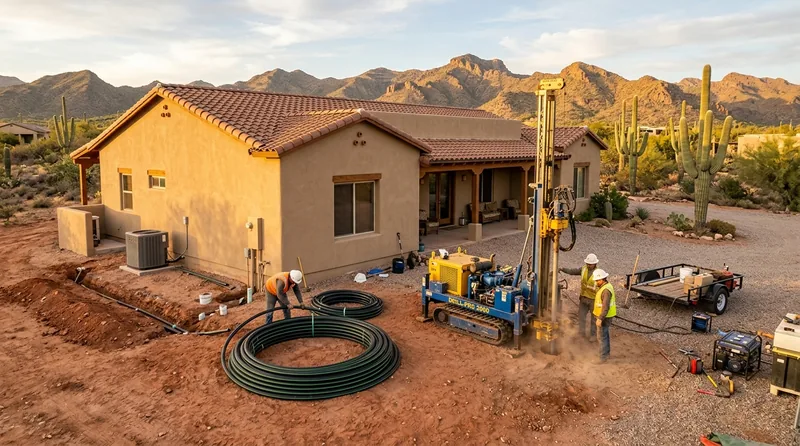
Why Arizona's Extreme Heat Makes the Geothermal Case
It's 3:00 PM on a July afternoon in Phoenix. The air temperature reads 115°F. Your conventional air conditioner is trying to reject heat from your house into that 115°F air — and its efficiency is collapsing. Meanwhile, just 50 feet below your backyard, the earth sits at a steady 72–76°F. That's a 40-degree advantage. That's the geothermal argument for Arizona in a single image.
Here's what most people miss about ground-source heat pumps: the hotter the climate, the bigger the advantage over conventional air-source systems. An air conditioner's efficiency (measured in COP) drops as outdoor temperature climbs. At 95°F, a good air-source unit runs around COP 3.5. At 115°F, that same unit limps along at COP 2.0–2.5. A ground-source heat pump rejecting into 72°F earth? COP 4.5–5.5 — regardless of what's happening on the surface.
Arizona is really two states when it comes to geothermal:
- The desert lowlands (Phoenix, Tucson, Yuma) — cooling-dominant, extreme heat, where the ground-source COP advantage over air-source is the largest in the country. But mild winters mean heating savings are minimal, and that matters for payback.
- The high country (Flagstaff, Prescott, Payson, Pinetop) — heating-dominant, propane-dependent, where geothermal works like it does in Colorado or Idaho. These communities have some of the best payback numbers in the Southwest.
Three things shape the Arizona geothermal conversation:
- TOU rate arbitrage. APS and SRP run aggressive time-of-use rates — summer on-peak electricity can hit 25–35¢/kWh during the exact hours your AC runs hardest (3–8 PM). A geothermal system using 30–40% less electricity per BTU during those peak hours saves significantly more than the average 12.74¢/kWh rate suggests.
- Water scarcity kills open-loop. Arizona is in a water crisis. Colorado River allocations are being cut. Open-loop systems that pump and discharge groundwater are essentially impossible in most of the state. Closed-loop is your only real option — plan accordingly.
- No state incentives. Let's be upfront: Arizona offers zero state tax credits or rebates for geothermal heat pumps. The federal 30% ITC is your incentive. That's it. Every payback number in this guide reflects that reality.
One more thing to be honest about: if you heat with natural gas in Phoenix and your winters are mild (they are), the heating-side savings from geothermal are small. Phoenix averages only 1,000 heating degree days. The payback case in the Valley rests almost entirely on cooling savings and TOU rate optimization. For gas-heated Phoenix homes with moderate cooling loads, payback can stretch to 15–25 years. That's not a sales pitch — it's math. But for propane homes in the high country, new construction anywhere, or Phoenix homes on punishing TOU rate plans, the numbers tell a very different story.
Quick Verdict: Should You Go Geothermal in Arizona?
| Your Situation | Verdict | Typical Payback |
|---|---|---|
| Flagstaff / high country — propane heating | ✅ Best AZ scenario | 6–9 years |
| Rural electric resistance heating (Rim Country, tribal lands) | ✅ Strong — slash heating bills 60–70% | 5–8 years |
| New construction — anywhere in AZ | ✅ Incremental cost is low | 5–9 years |
| Phoenix home on high TOU rate plan (APS/SRP) | ✅ Peak savings are significant | 8–12 years |
| USDA REAP eligible — ranch / agricultural property | ✅ 55% cost coverage possible | 4–7 years |
| Tucson cooling-heavy home | ⚠️ Moderate — depends on usage | 9–14 years |
| Phoenix replacing aging AC + gas furnace | ⚠️ Moderate — cooling savings drive it | 10–16 years |
| Phoenix gas heating only (mild winter) | ❌ Honest: heating savings too small | 15–25 years |
Get 3 Free Quotes from Arizona Geothermal Installers
Desert geology, caliche drilling, and TOU rate optimization require local expertise. Compare bids from installers who know Arizona's unique conditions — ground temps, soil types, and utility rate structures vary dramatically from Phoenix to Flagstaff.
Get Your Free Quotes →Ground Temperatures by Region
Arizona's geology creates six distinct geothermal zones. The ground temperature at 50 feet depth determines your system's baseline efficiency — and in Arizona, these numbers range from excellent (Flagstaff) to warm-but-still-better-than-air (Yuma).
| Region | Ground Temp (50ft) | HDD | CDD | Dominant Load | GSHP Advantage |
|---|---|---|---|---|---|
| Phoenix Metro | 72–76°F | 1,000 | 4,200 | Extreme cooling | Ground is 35–40°F cooler than peak air |
| Tucson | 68–72°F | 1,400 | 3,200 | Strongly cooling-dominant | Good ground delta; lower cooling load than PHX |
| Flagstaff / High Country | 48–52°F | 7,400 | 200 | Heating-dominant | Classic cold-climate GSHP economics |
| Prescott / Verde Valley | 58–62°F | 4,200 | 900 | Mixed (heating-lean) | Ideal ground temp for both modes |
| Yuma / SW Desert | 74–78°F | 600 | 4,800 | Almost exclusively cooling | Warmest ground — still beats 120°F air |
| Payson / Rim Country | 54–58°F | 5,500 | 500 | Heating-dominant | Excellent ground temp + propane displacement |
A note on Phoenix's 72–76°F ground temperature: yes, that's warmer than the ideal 50–55°F you'd find in the Midwest. It means your cooling-mode COP won't be quite as stellar as a system in Indiana. But here's the context — you're comparing that 72°F ground to 115°F outdoor air. The delta between ground and air is what drives the efficiency advantage, and Arizona's delta during peak cooling season is among the largest in the country. A geothermal system in Phoenix during July is working with a 40°F advantage. A system in Indianapolis in July might have a 35°F advantage (55°F ground vs. 90°F air). Phoenix actually wins on the cooling delta.
Flagstaff and the Rim Country are a completely different story. At 48–52°F ground temp and 7,400 heating degree days, Flagstaff's geothermal profile looks more like Colorado than it does Phoenix. These communities are heavily propane-dependent, and propane-to-geothermal conversions offer the fastest payback in the state.
Arizona Geology & Drilling Conditions by Region
Understanding your local geology isn't academic — it directly determines your drilling cost, bore depth, and system efficiency. Arizona's geology spans some of the most varied terrain in the United States, from Phoenix basin alluvial fill to Flagstaff volcanic rock to Tucson granitic schist.
| Region | Formation Type | Thermal Conductivity (BTU/hr·ft·°F) | Typical Bore Depth | Drill Cost/ft | Key Challenge |
|---|---|---|---|---|---|
| Phoenix Basin (alluvial) | Alluvial fill — sand, gravel, silt below caliche | 0.8–1.1 | 200–300 ft | $12–$18 | Caliche hardpan at 3–20 ft; requires percussion rig |
| Phoenix Caliche Belt (Scottsdale, Mesa, Chandler) | Calcium carbonate hardpan over alluvium | 0.7–1.0 | 220–320 ft | $15–$22 | Thickest caliche in AZ; adds $3,000–$6,000 to drilling |
| Tucson Basin | Granitic alluvium, decomposed granite, some volcanic | 1.0–1.3 | 200–280 ft | $13–$19 | Decomposed granite holds up well; manageable drilling |
| Flagstaff / High Country | Volcanic basalt overlying Coconino Sandstone | 1.2–1.5 | 250–350 ft | $16–$24 | Hard basalt requires percussion; excellent thermal conductivity |
| Prescott / Verde Valley | Granite, schist, mixed Tertiary volcanics | 1.1–1.4 | 250–350 ft | $15–$22 | Variable conditions; granite zones add drill time |
| Yuma / Lower Sonoran | Deep alluvial fill, river terrace deposits | 0.9–1.2 | 180–280 ft | $12–$17 | High water table in some areas; extreme heat means larger systems |
| Payson / Rim Country | Mixed granite, schist, limestone; Mogollon Rim edge | 1.1–1.4 | 250–320 ft | $15–$21 | Limestone zones require closed-loop only; propane terrain ideal for geo |
The Caliche Problem: What Phoenix Homeowners Need to Know
Caliche (calcium carbonate hardpan) is the #1 cost variable for Phoenix-area installations. Unlike the soft alluvial soils of Iowa or Indiana where horizontal loops can be trenched for $3–$5/linear foot, Phoenix caliche can stop a standard excavator cold.
Here's what to expect:
- Depth: Caliche layers typically begin at 3–20 feet below grade and run 1–10 feet thick. Some areas (North Scottsdale, parts of Chandler) have multiple caliche layers stacked vertically.
- Horizontal trenching: Essentially not viable through caliche. If your lot requires horizontal loops, a contractor must either jackhammer through caliche (very expensive) or go shallow and loop above it (less thermally effective).
- Vertical drilling: Most Phoenix installations are vertical bore for exactly this reason. Rotary percussion rigs drill through caliche with less trouble, though bit wear adds cost. Expect $15–$22/foot in caliche-heavy zones vs. $12–$15 in softer basin soils.
- The silver lining: Once through the caliche, Phoenix alluvial fill below ~25 feet is soft and drillable. Your bores hit thermally adequate ground once past the hardpan.
Practical advice: Before getting quotes, ask potential drillers: "Have you done installations within a mile of my address?" Local drillers often have informal knowledge of caliche depth in your specific neighborhood. A soil boring or geotechnical assessment ($300–$500) before finalizing contracts can prevent expensive mid-job surprises.
The Arizona Geological Survey (azgs.arizona.edu) maintains a publicly searchable well log database — you can look up historic well records near your address to see what formations previous drillers encountered. Your geothermal contractor should already be doing this. If they're not, ask them why.
Regional Costs & ROI
Installed System Cost by Region
Arizona installation costs are roughly average nationally in most regions, but Phoenix metro carries a 10–20% premium due to caliche drilling challenges. The limited number of certified GSHP installers in the state (compared to the Midwest) also affects pricing — less competition means less downward pressure on quotes.
| Region | System Size | Installed Cost | After 30% ITC | Notes |
|---|---|---|---|---|
| Phoenix Metro | 4–6 ton | $32,000–$60,000 | $22,400–$42,000 | Larger systems for extreme cooling; caliche drilling premium |
| Tucson | 3–5 ton | $26,000–$48,000 | $18,200–$33,600 | Slightly lower cooling load than Phoenix; less caliche |
| Flagstaff / High Country | 3–4 ton | $22,000–$40,000 | $15,400–$28,000 | Heating-dominant design; volcanic basalt drilling |
| Prescott / Verde Valley | 3–4 ton | $24,000–$42,000 | $16,800–$29,400 | Mixed climate; variable drilling conditions |
| Yuma / SW Desert | 4–5 ton | $28,000–$52,000 | $19,600–$36,400 | Extreme cooling; very limited installer pool |
Why the wide ranges? Several factors:
- Caliche. This calcium carbonate hardpan is everywhere in the Phoenix basin, typically at 3–20 feet depth. It's like drilling through concrete. Horizontal trenching through caliche costs 30–50% more than standard soil, and many Phoenix installations go vertical just to punch through it and reach the softer alluvial fill below.
- System sizing. A Phoenix home that sees sustained 115°F afternoons might need 5–6 tons of cooling capacity. The same square footage in Flagstaff might need only 3 tons. Bigger system = higher cost.
- Installer availability. Arizona isn't Iowa. There are fewer certified geothermal installers, especially in Yuma and rural areas. Getting three competitive quotes (which you absolutely should — see the CTA below) can require looking across metro areas.
- Lot constraints. Small suburban lots in Scottsdale or Chandler limit horizontal loop options, pushing toward vertical bores at $15–$25 per foot of depth.
The TOU Rate Math
This is where Arizona gets interesting. The average residential electricity rate is 12.74¢/kWh, which makes the raw economics look modest. But that average masks the TOU reality:
- APS summer on-peak (3–8 PM): 24–32¢/kWh
- SRP summer on-peak (2–8 PM): 25–35¢/kWh
- Off-peak: 5–8¢/kWh
Your AC runs hardest during on-peak hours — exactly when rates are highest. A geothermal system using 30–40% less electricity per BTU of cooling means 30–40% less consumption at peak rates. The effective savings per kWh avoided can be 2–3x what you'd calculate from the average rate.
For a Phoenix home spending $3,500/year on summer electricity (mostly cooling), a geothermal system might save $1,200–$1,800 annually — with a disproportionate chunk of those savings coming from peak-hour consumption reduction. Against a post-ITC cost of $25,000–$35,000, that puts payback in the 14–20 year range for gas homes — or 8–12 years if you're also displacing propane heating or electric resistance.
Real-World Case Studies
Case Study 1: Flagstaff Propane Home
The property: 2,400 sqft ranch-style home at 7,000 feet elevation in Flagstaff. Built in 1998 with a 90% AFUE propane furnace and central AC (rarely used — maybe 15 days per year). 0.7-acre lot with ponderosa pines.
The problem: Propane costs had climbed to $3.80/gallon. The family burned 900 gallons per year for heating and hot water — roughly $3,420 annually. The 26-year-old furnace was nearing end of life. Replacing it with another propane furnace would cost $6,000–$8,000 and lock in another decade of rising propane prices.
The system: 3-ton ClimateMaster Tranquility 30 with three 250-foot vertical bores drilled into volcanic basalt. Total installed cost: $34,000. After 30% ITC: $23,800 net cost.
The geology challenge: Flagstaff sits on volcanic basalt overlaying Coconino Sandstone. Basalt is hard to drill but has excellent thermal conductivity (1.2–1.5 BTU/hr·ft·°F) — meaning the bores transfer heat efficiently once installed. The drill crew brought rotary percussion equipment specifically for basalt work.
Year 1 results:
- Annual electricity for GSHP: $1,080 (10,200 kWh at blended 10.6¢/kWh — Flagstaff has lower rates than Phoenix)
- Former propane cost: $3,420
- Annual savings: $2,340
- Desuperheater providing ~60% of domestic hot water (displaced another 80 gallons of propane worth $304)
- Total annual savings: $2,644
- Simple payback: 9.0 years (net cost ÷ annual savings)
- Lifetime savings (20-year, 3% fuel escalation): $71,200
The verdict: This is the cleanest geothermal case in Arizona. High heating load, expensive propane, moderate system cost, good geology. The family's monthly winter bills dropped from $450–$500 to $140–$180. The system also provides modest cooling for the 15–20 days each summer when Flagstaff hits the 90s — a bonus the propane furnace never offered.
Case Study 2: Phoenix TOU Rate Home
The property: 3,200 sqft two-story in Gilbert (East Valley). Built in 2008 with a 14 SEER AC and 80% AFUE natural gas furnace. Family of four. SRP electricity with TOU rate plan. Pool in the backyard (a classic Arizona setup).
The problem: Summer electricity bills hitting $450–$550/month despite a relatively efficient home. The AC ran nearly continuously from 2–8 PM on peak summer days — right during SRP's highest rate tier at 28¢/kWh. Annual cooling electricity: approximately $2,600. Annual gas heating: approximately $380. Total HVAC energy: roughly $2,980.
The system: 5-ton WaterFurnace 7 Series with four 300-foot vertical bores and a desuperheater plumbed to the pool. Total installed cost: $52,000. After 30% ITC: $36,400 net cost. (The caliche layer at 8 feet required a percussion-equipped drill rig, adding roughly $4,000 to drilling costs.)
Year 1 results:
- Annual GSHP electricity: $1,440 (cooling-dominant operation, ~13,800 kWh)
- Former HVAC energy: $2,980
- Annual HVAC savings: $1,540
- Desuperheater pool heating: eliminated $600/year in gas pool heater costs (April–October waste heat keeps pool at 84°F)
- Total annual savings: $2,140
- Simple payback: 17.0 years without pool credit, 14.3 years including pool savings
- Lifetime savings (20-year, 3% escalation): $57,800
Why 14+ years? Gas heating in Phoenix is cheap because you barely need it. This system's payback rests almost entirely on the cooling efficiency advantage and pool heating bonus. The COP improvement from SEER 14 (COP ~4.1) to ground-source (COP ~5.2 in cooling) is meaningful but not as dramatic as replacing propane. The TOU savings help — the family's peak-hour consumption dropped 38% — but it's still a longer payback than northern Arizona.
The honest take: This is a moderate investment with a long payback that makes sense if you plan to stay 15+ years and value the pool heating, reliability (no outdoor condenser to maintain in dust storms), and comfort. If you're looking for a 7-year ROI, this isn't your scenario — but Flagstaff is.
Case Study 3: Scottsdale New Construction + Solar
The property: 2,800 sqft single-story new construction in North Scottsdale (McDowell Mountain Ranch area). Built 2025. High-performance envelope: spray foam insulation, Low-E triple-pane windows, 8-foot ceilings with spray-foamed attic. Builder originally spec'd a 16 SEER2 air-source heat pump paired with gas tankless water heater. The homeowner chose to upgrade to geothermal and add solar during construction.
Why new construction changes the math: This is the most financially compelling geothermal scenario in Arizona. The incremental cost — geothermal vs. air-source — is far lower than a full retrofit:
- Air-source heat pump (builder spec): $12,000 installed
- Geothermal system (4-ton WaterFurnace 5 Series, 3 × 280-ft vertical bores): $38,000 installed
- Incremental cost: $26,000
- Solar array (8 kW, flush-mount roof): $22,000 installed
- Combined incremental cost before ITC: $48,000
- 30% ITC on geothermal ($38,000 × 0.30 = $11,400): applied
- 30% ITC on solar ($22,000 × 0.30 = $6,600): applied
- Net combined cost after tax credits: $30,000
- Monthly payment (20-year, 5.5% green home loan): $206/month
Year 1 performance:
- Annual GSHP electricity: 8,400 kWh (cooling-dominant but high-efficiency envelope reduces load)
- Air-source alternative would have consumed: ~13,200 kWh (SEER 16 vs. COP 5.2 in cooling mode)
- Electricity reduction: 4,800 kWh/year
- Annual GSHP savings vs. air-source: $1,190 (at blended APS rate including TOU)
- Solar production: 12,800 kWh/year (AZ averages 5.5–6.0 peak sun hours/day)
- Geothermal consumption: 8,400 kWh
- Solar surplus: 4,400 kWh → exported to grid at ~3¢/kWh APS export rate
- Solar self-consumption value: ~$1,300 (avoided purchases at 12.74¢/kWh average)
- Total annual value of combined system: ~$2,490
- Simple payback on $30,000 net cost: 12.0 years
- Payback on $26,000 incremental geo-only: 7.5 years (vs. builder-spec air source)
The day-one cash flow story: On a 20-year loan, the $206/month payment is more than offset by $207/month in combined energy savings ($2,490 ÷ 12 = $207.50). This system is essentially cash-flow positive from month one — the loan payment is covered by the savings, and the homeowner's utility bill drops to near-zero for 8 months of the year.
APS TOU optimization: The homeowner enrolled in APS's Saver Choice Max plan. The solar array covers peak-hour consumption during spring and fall (March–May, October–November). During summer peak months, the geothermal system's dramatically lower kWh consumption vs. air-source — combined with solar covering ~60% of daytime load — keeps the on-peak rate exposure minimal.
Desuperheater: Provides ~65% of domestic hot water year-round, eliminating the planned gas tankless (another $2,500 avoided + $180/year in gas). Not included in the payback calculation above — it's pure bonus.
The lesson: Arizona's best geothermal economics are in new construction where the incremental cost is the only relevant cost. If you're building or buying a new home in Arizona, the geothermal upgrade conversation starts with "what's the incremental cost over standard HVAC?" not "what does a full system cost?" In most cases, the incremental cost after ITC is $12,000–$18,000 — and with solar, the daily energy math can work from day one.
Month-by-Month Energy Profile
Here's what a geothermal system looks like across a full year in a typical Phoenix home — the 3,200 sqft Gilbert property from Case Study 2. This illustrates how Arizona's extreme seasonal swing concentrates savings into the summer months.
| Month | Avg High (°F) | Conventional HVAC (kWh) | Geothermal (kWh) | Monthly Savings | Notes |
|---|---|---|---|---|---|
| January | 67 | 320 | 260 | $8 | Minimal heating; gas furnace was cheap too |
| February | 71 | 260 | 210 | $6 | Shoulder month — system barely runs |
| March | 77 | 380 | 290 | $12 | Light cooling begins |
| April | 85 | 620 | 440 | $24 | Cooling ramps up; pool desuperheater active |
| May | 95 | 1,100 | 740 | $72 | Serious cooling; TOU savings start compounding |
| June | 104 | 1,680 | 1,080 | $168 | Peak cooling month #1; COP advantage is massive |
| July | 106 | 1,820 | 1,160 | $184 | Highest consumption + monsoon humidity |
| August | 104 | 1,740 | 1,120 | $174 | Monsoon humidity adds latent load |
| September | 100 | 1,340 | 900 | $123 | Still brutal; savings still strong |
| October | 89 | 760 | 530 | $46 | Cooling tapers; pool still warm from desuperheater |
| November | 76 | 340 | 270 | $9 | Shoulder month |
| December | 66 | 360 | 300 | $8 | Light heating; some days use neither mode |
| Annual Total | — | 10,720 | 7,300 | $834 | Electricity savings only (add gas/pool offsets for full picture) |
Notice the seasonal concentration: June through September account for 78% of annual savings. This is Arizona's geothermal signature — the system earns its keep during the brutal summer months when the COP advantage over air-source is greatest and TOU rates are highest. Winter savings are negligible because Phoenix winters are mild and gas heating is cheap.
The $834 in electricity savings shown here is the conservative, electricity-only number. Add the displaced gas heating ($380), displaced pool heating ($600), and the avoided maintenance on an outdoor condenser, and the full annual value reaches $2,100+.
Open-Loop System Assessment
Let's address this directly: open-loop geothermal is essentially not an option in most of Arizona.
Open-loop systems pump groundwater through the heat pump and discharge it — typically back to the aquifer or to a surface drain. They're often cheaper to install and can be highly efficient. But they require two things Arizona largely doesn't have: abundant groundwater and permissive water regulations.
| Factor | Arizona Reality | Impact on Open-Loop |
|---|---|---|
| Groundwater availability | Active Management Areas (AMAs) cover Phoenix, Tucson, Prescott, and most populated areas | ❌ Well permits heavily restricted |
| Water rights | Prior appropriation doctrine; new groundwater rights nearly impossible in AMAs | ❌ Can't get new pumping allocation |
| Discharge regulations | ADEQ Aquifer Protection Permits required for any groundwater discharge | ❌ Permitting is complex and expensive |
| Colorado River crisis | Lake Mead at historically low levels; Tier 2a shortage declared | ❌ Political environment hostile to new water use |
| Well water quality | High mineral content (calcium, sulfates) in many basins | ⚠️ Scaling and corrosion risks if somehow permitted |
| Rural areas outside AMAs | Some exempt wells exist in unregulated areas | ⚠️ Possible but limited; standing column wells may work |
The bottom line: Plan for a closed-loop system. If you're in a rural area outside an Active Management Area and have an existing high-yield well, talk to a hydrologist and ADEQ about standing column well options. But for 90%+ of Arizona homeowners, closed-loop vertical or horizontal is the path.
This isn't a disadvantage unique to geothermal — it's an Arizona reality. And closed-loop systems have their own strengths: zero water consumption, zero maintenance on the ground loop, and 50+ year expected lifespan for the HDPE pipe.
Loop Type Cost Comparison
With open-loop off the table for most Arizonans, here's how the three closed-loop configurations compare — with Arizona-specific cost adjustments for desert geology.
| Loop Type | Cost per Ton | AZ-Specific Premium | Best For | Arizona Considerations |
|---|---|---|---|---|
| Horizontal | $3,500–$5,500 | +20–40% in caliche areas | Large lots (0.5+ acre) with soft soil | Caliche makes trenching expensive in Phoenix basin; great in Flagstaff/Rim Country with softer soil; requires 6–8ft depth for stable desert temps |
| Vertical | $5,000–$8,000 | +10–25% for caliche/basalt | Small lots, any soil type | Most common in Phoenix metro; punch through caliche layer to reach alluvial fill; basalt in Flagstaff is hard but has excellent conductivity |
| Slinky | $4,000–$6,000 | +15–30% in caliche areas | Medium lots; compromise option | Coiled pipe in shorter trenches; same caliche challenges as horizontal but needs less total trench length |
The Caliche Factor
If you're in the Phoenix metro area, caliche is probably the single biggest variable in your installation cost. This calcium carbonate hardpan — sometimes called "desert concrete" — forms layers typically 3–20 feet below the surface throughout the Phoenix basin, parts of Tucson, and the lower Sonoran Desert.
What caliche means for your install:
- Horizontal trenching through caliche requires rock trenching equipment — think specialized chain or wheel trenchers rated for rock. Budget 30–50% more than standard horizontal costs.
- Vertical drilling through caliche is more routine (rotary drill rigs handle it), but it adds time and bit wear. The good news: once you're through the caliche layer (usually 5–15 feet thick), you hit alluvial fill with moderate thermal conductivity of 0.8–1.0 BTU/hr·ft·°F.
- Flagstaff's volcanic basalt is hard but good for geothermal. Basalt has thermal conductivity of 1.2–1.5 BTU/hr·ft·°F — significantly better than desert alluvial soils. Your loops transfer heat more efficiently in basalt, so you may need slightly less total bore footage.
Always get a soil survey or consult with a local drilling company before finalizing quotes. A few hundred dollars for a geologic assessment can save thousands in unexpected drilling costs.
Incentive Stacking: What Arizona Actually Offers
Let's be honest: Arizona's incentive landscape for geothermal heat pumps is thin. There's one big incentive, and then... that's about it.
Federal Investment Tax Credit (ITC) — 30%
The Residential Clean Energy Credit under IRC Section 25D covers 30% of the total installed cost of a geothermal heat pump system — including equipment, labor, drilling, ductwork modifications, and the ground loop. This credit applies through 2032, stepping down to 26% in 2033 and 22% in 2034.
For a typical Arizona system:
- $30,000 system → $9,000 credit
- $45,000 system → $13,500 credit
- $60,000 system → $18,000 credit
This is a dollar-for-dollar tax credit, not a deduction. It reduces your federal tax liability directly. If you can't use the full credit in year one, the unused portion rolls forward to future tax years. See our federal geothermal tax credit guide for the complete breakdown.
What Arizona Doesn't Offer
- No state tax credit for geothermal heat pumps
- No statewide rebate program (unlike California's TECH Clean California)
- APS and SRP — as of early 2026, neither utility offers a specific rebate for ground-source heat pumps, though both have general energy efficiency programs that occasionally include heat pump incentives. Check current offerings directly with your utility — these programs change frequently.
- TEP (Tucson Electric Power) — similar situation; no dedicated GSHP rebate
This is a gap. Arizona legislators have enthusiastically embraced solar incentives for decades but haven't extended the same treatment to geothermal. Given the state's extreme cooling loads and the efficiency advantage of ground-source systems, there's a strong policy case for state-level incentives. But as of 2026, they don't exist.
What to Stack With the Federal ITC
- USDA REAP grant (see below) — up to 25% grant + 25% loan guarantee for rural agricultural properties
- Energy-efficient mortgage (EEM) — FHA and VA loans allow you to finance energy improvements into your mortgage at favorable rates
- PACE financing — available in some Arizona jurisdictions; repaid through property tax assessments
- Manufacturer rebates — WaterFurnace, ClimateMaster, and others occasionally offer $500–$1,500 equipment rebates
Solar + Geothermal: Arizona's Ultimate Combo
Arizona has the highest solar resource in the continental United States — over 300 sunny days per year in Phoenix, with peak solar irradiance exceeding 6.5 kWh/m²/day. When you pair that solar abundance with a geothermal heat pump, the economics compound in a way that's hard to beat anywhere else.
Here's why the combination works so well:
Solar generates most when geothermal consumes most. A rooftop solar array's peak production is 10 AM–4 PM. Your geothermal system's peak cooling load runs from noon–8 PM. There's a 4–6 hour overlap where your solar panels are directly powering your heat pump. Every kWh your panels generate that feeds your GSHP is worth 25–35¢ (the TOU rate you would have paid) — not the 3–5¢ you'd get for exporting it to the grid.
Geothermal is the ultimate "solar sponge." Under APS's and SRP's current net metering/net billing structures, export credits are far less valuable than self-consumption. A geothermal system shifts a huge electrical load (cooling) from grid power to on-site solar consumption. For a 5-ton GSHP in Phoenix, that's 7,000–9,000 kWh/year of additional on-site consumption that would otherwise be exported at low credit rates.
The combined system math (Phoenix example):
- 8 kW solar array: $18,000 installed (before ITC)
- 5-ton geothermal system: $48,000 installed (before ITC)
- Combined cost: $66,000
- Combined 30% ITC: $19,800
- Net cost: $46,200
- Combined annual savings: $3,800–$4,600 (electricity savings + gas displacement + TOU optimization)
- Combined payback: 10–12 years
Separately, neither system hits a 10-year payback in Phoenix. Together, the synergy gets them there. The solar ITC and geothermal ITC stack — you claim 30% on each system independently.
Pool Heating & Desuperheaters
Arizona has one of the highest per-capita pool ownership rates in the country — approximately 35% of Phoenix metro homes have a swimming pool. If you're one of them, a geothermal desuperheater is essentially free pool heating.
Here's how it works: in cooling mode, your geothermal heat pump extracts heat from your house and rejects it into the ground loop. A desuperheater is a small heat exchanger that captures a portion of that waste heat before it goes underground and routes it to your pool instead. You're heating your pool with heat you already removed from your home — energy that would otherwise be dumped into the earth.
What this means in Arizona:
- April through October (7 months), your GSHP runs in cooling mode extensively. The desuperheater keeps your pool at 82–86°F without any additional energy input.
- November through March, cooling demand is minimal, so the desuperheater contributes little. But Arizona pool season is mostly April–October anyway.
- Dollar value: A typical gas pool heater in Phoenix costs $400–$800/year to operate. A solar pool heater costs $200–$400/year (pump electricity). A desuperheater costs effectively $0 in additional energy because it's using waste heat. Annual savings: $400–$800.
- Equipment cost: Adding a desuperheater to a geothermal installation costs $500–$1,500 (included in many units). It's covered by the 30% ITC as part of the geothermal system.
For pool owners, the desuperheater can shave 1–3 years off the overall system payback. It's one of the most underrated value-adds in Arizona geothermal installations.
One caveat: desuperheaters work best when the GSHP is running frequently. In the mild shoulder months (March, November), the system runs less, and pool heating output drops. You may still want a backup pool heater for those brief windows if you insist on 84°F water year-round.
Dust Storm & Monsoon Resilience
If you've lived through a Phoenix haboob — that wall of dust rolling across the Valley at 60 mph — you know what it does to outdoor equipment. Conventional AC condensers get blasted with fine desert grit that clogs fins, coats coils, and degrades efficiency. After a bad dust storm season, HVAC techs across Phoenix are booked solid cleaning condensers.
Monsoon season (July–September) brings its own hazards: microbursts that hurl debris into outdoor units, flash flooding that can submerge ground-level equipment, and hail that dents condenser fins.
A geothermal heat pump's ground loop is immune to all of it. The HDPE pipes sit 6–300 feet underground — no dust, no wind, no flooding, no hail. The indoor heat pump unit is protected inside your home, just like a furnace. There are no outdoor components exposed to Arizona's harsh surface conditions.
What this means practically:
- No condenser cleaning after dust storms ($150–$300/visit for professional cleaning)
- No fin straightening after hail events
- No flood damage risk to outdoor equipment
- No efficiency degradation from dirty coils over time
- Reduced maintenance budget: geothermal systems need a filter change and annual checkup. Conventional split systems in Arizona need condenser cleanings, refrigerant checks, and more frequent coil replacement due to environmental wear.
It's not the primary reason to go geothermal — cost savings should drive that decision. But in Arizona specifically, the resilience advantage is more meaningful than in milder climates. Ask anyone who's replaced a condenser fan motor after monsoon debris tore it up.
Vacation Rental & Airbnb Analysis
Arizona's vacation rental markets are booming in three distinct regions, each with a different geothermal case:
Sedona
Average nightly rate: $280–$450. Occupancy: 65–75% annually. Red rock country draws visitors year-round, with peaks in spring and fall when the weather is perfect. Sedona sits at 4,500 feet elevation — hot summers (mid-90s) and cold winters (lows in the 30s) — making it a genuine dual-mode HVAC market.
Geothermal angle: A Sedona vacation rental runs heating and cooling nearly year-round, and guest comfort is non-negotiable for 5-star reviews. A geothermal system provides consistent comfort regardless of outdoor conditions, reduces operating costs, and eliminates outdoor condenser noise (important for those "peaceful red rock retreat" listings). Payback estimate: 8–12 years on a $35,000–$45,000 system, accelerated by high occupancy and the dual-mode savings.
Marketing value: "Eco-luxury" is a legitimate differentiator in Sedona's market. Sustainability-conscious travelers (a significant slice of Sedona's demographic) will choose a geothermal-heated listing over a comparable conventional one.
Scottsdale
Average nightly rate: $200–$500+ (wide range from condos to luxury estates). Peak season: January–April (snowbird season) and major events (Waste Management Open, Barrett-Jackson). Scottsdale vacation rentals are cooling-dominant — summer rates drop because fewer people want to visit at 115°F.
Geothermal angle: The economics are tougher in Scottsdale because peak occupancy coincides with mild weather (winter) when HVAC savings are minimal. Summer is when geothermal saves the most, but occupancy drops. Still, a pool-equipped Scottsdale rental with a desuperheater gets year-round pool heating value, and the reduced maintenance from eliminating the outdoor condenser lowers operating costs. Payback: 12–18 years — longer than Sedona or Flagstaff.
Flagstaff (Ski Season)
Average nightly rate: $180–$350. Peak seasons: winter (Arizona Snowbowl skiing) and summer (Phoenix residents fleeing the heat). Flagstaff vacation rentals need serious heating — December through March sees regular sub-zero nights and significant snowfall.
Geothermal angle: This is the strongest vacation rental case in the state. Heating costs are the biggest operating expense for Flagstaff rentals, and most run on expensive propane. Replacing propane with geothermal drops operating costs dramatically, and the system handles summer cooling demand too (increasingly relevant as Flagstaff summers warm). Payback: 6–9 years, often faster than owner-occupied homes because high-season rental rates generate revenue that offsets operating costs.
USDA REAP for Ranch Properties
Arizona has significant agricultural land — cattle ranches across the high desert, produce operations in the Yuma growing region, and smaller farms scattered throughout. If you're a rural small business or agricultural producer, the USDA Rural Energy for America Program (REAP) can transform geothermal economics.
REAP offers two components:
- Grants of up to 25% of total project cost (competitive — not guaranteed)
- Loan guarantees of up to 75% of total project cost
Combined with the federal ITC:
- System cost: $40,000
- REAP grant (25%): −$10,000
- Remaining cost: $30,000
- Federal ITC (30% of original): −$12,000
- Net cost: $18,000 (55% reduction)
Eligibility requirements:
- Located in a USDA-designated rural area (most of Arizona outside Phoenix and Tucson metro qualifies)
- Agricultural producer or rural small business
- Project must be for a commercial operation (not a personal residence — unless the residence is part of a working farm/ranch)
- Must demonstrate energy savings
Arizona-specific opportunities:
- Cattle ranches in Cochise, Graham, or Navajo counties — often running inefficient propane or electric resistance heating on ranch houses and bunkhouses
- Yuma-area agricultural operations — climate-controlled packing houses and worker housing
- Agritourism operations (guest ranches, farm stays) — commercial buildings qualify for REAP
At a 55% effective cost reduction, REAP-eligible properties can see payback periods of 4–7 years — the best economics in the state. The application process is competitive and requires an energy audit, but the payoff is substantial. Applications are typically due in the spring.
Get 3 Free Quotes from Arizona Geothermal Installers
Whether you're in the Phoenix heat, Flagstaff cold, or a ranch property qualifying for REAP, local installer expertise matters. Get quotes from contractors who understand your specific geology, utility rates, and available incentives.
Get Your Free Quotes →How to Claim the Federal Geothermal Tax Credit (IRS Form 5695)
Step 1: Confirm Your System Qualifies
Your geothermal heat pump must meet ENERGY STAR requirements at the time of installation. It must be installed at your primary or secondary residence in the United States. Rental-only properties don't qualify for the residential credit (Section 25D) — but may qualify for the commercial credit (Section 48) or REAP. Ask your tax professional.
Step 2: Gather Your Documentation
Collect the final invoice from your installer showing total system cost (equipment, labor, drilling, ground loop, ductwork modifications). Get the ENERGY STAR certification or AHRI certificate for your specific heat pump model. Save the manufacturer's certification statement. Keep a copy of any permits pulled for the installation.
Step 3: Calculate Your Credit Amount
The credit is 30% of the total qualified expenditure. Include: heat pump unit, ground loop materials and installation, drilling costs, ductwork modifications required for the GSHP, desuperheater (if installed as part of the system), and thermostat/controls. Do not include: landscaping restoration, decorative covers, or unrelated home improvements done at the same time.
Step 4: Complete IRS Form 5695 (Part I)
Download Form 5695 (Residential Energy Credits) from irs.gov. Enter your total qualified geothermal heat pump costs on Line 3. Multiply by 0.30 to calculate the credit. Enter the result on Line 13 (or current applicable line — form line numbers may shift between tax years).
Step 5: Transfer to Your Form 1040
The credit from Form 5695 flows to Schedule 3 (Form 1040), Line 5. This reduces your tax liability dollar-for-dollar. If the credit exceeds your tax liability for the year, the unused portion carries forward to subsequent tax years — it doesn't expire.
Step 6: File and Keep Records
File Form 5695 with your federal tax return (Form 1040). Keep all documentation — invoices, AHRI certificates, permits, manufacturer statements — for at least 7 years in case of audit. Digital copies are fine.
Step 7: Carry Forward Any Unused Credit
If your tax liability was less than the credit amount, track the unused balance. Apply it on next year's Form 5695 in the carryforward section. Continue until the full credit is claimed. There's no expiration on the carryforward — but don't lose track of the remaining balance. Your tax software should handle this automatically if you use the same platform each year.
Arizona vs. Neighboring States
How does Arizona's geothermal landscape compare to its neighbors? Each state has different incentives, climates, and challenges.
| Factor | Arizona | Nevada | Utah | New Mexico | California | Colorado |
|---|---|---|---|---|---|---|
| Avg. Electricity Rate | 12.74¢ | 12.22¢ | 10.86¢ | 13.01¢ | 27.04¢ | 14.30¢ |
| State Incentive | None | None | None | None | TECH Clean CA | Tax credit (varies) |
| Federal ITC | 30% | 30% | 30% | 30% | 30% | 30% |
| Primary Challenge | Caliche; water scarcity | Water scarcity; desert soil | Cold winters; variable geology | Sparse installer network | High costs; permitting | Altitude; granite drilling |
| Cooling Load | Extreme (PHX/TUC) | High (Las Vegas) | Moderate | Moderate–High | Varies widely | Low–Moderate |
| Heating Load | Low (PHX) to High (Flag) | Low (LV) to Mod (Reno) | High | Moderate–High | Varies widely | High |
| Open-Loop Feasibility | Very limited | Very limited | Moderate | Limited | Moderate (varies) | Good in many areas |
| Solar Stacking | Excellent (#1 solar) | Excellent (#2 solar) | Good | Very good | Excellent (NEM 3.0 synergy) | Good |
| Typical Payback Range | 5–16 years | 7–15 years | 7–14 years | 6–14 years | 5–25 years | 6–14 years |
| Best Scenario | Flagstaff propane | Reno propane | Rural propane | Rural propane/ER | Mountain propane + solar | Mountain propane |
Key takeaway: Arizona and Nevada share similar challenges — desert geology, water scarcity restricting open-loop, and extreme cooling loads. Arizona's advantage is the sheer volume of its cooling load (Phoenix is hotter than Las Vegas) and its solar resource for stacking. California has better state incentives but dramatically higher electricity rates and installation costs. Colorado has more favorable geology and water availability but lacks Arizona's extreme cooling advantage.
Arizona Permits & Contractor Licensing
Arizona's permitting for geothermal installations is straightforward compared to coastal states — no groundwater discharge permits for closed-loop systems (which represent 90%+ of Arizona installations), no CEQA-equivalent reviews, and county processes that are generally efficient. Here's what to expect.
Contractor Licensing (ROC)
All geothermal heat pump installations in Arizona must be performed by a licensed contractor registered with the Arizona Registrar of Contractors (ROC). The relevant license classes:
- ROC Class A General Engineering Contractor: Covers large commercial geothermal projects where the drilling and loop field are the primary scope.
- ROC Class B-1 General Commercial Contractor or B-2 General Residential Contractor: Covers the HVAC and ductwork portion of residential installations.
- ROC A-17 Air Conditioning and Refrigeration: Most residential geothermal installers hold this specialty license. It covers equipment installation, refrigerant handling (EPA 608 certification required), and related electrical work.
- Water well drilling: A separate license issued by the Arizona Water Well Registration program under the Arizona Department of Environmental Quality (ADEQ). Your drilling subcontractor must hold a valid well driller's license even for closed-loop bores — the license classification is "closed-loop geothermal driller" under Arizona state code.
Verify any contractor's ROC license at roc.az.gov before signing a contract. Look up by name and confirm the license class covers your project type. Also verify the license is current and bonded. ROC complaints and disciplinary actions are searchable in the same database — check for any patterns before committing.
Building Permits (County & City)
| Jurisdiction | Permit Required | Where to Apply | Typical Timeframe | Notes |
|---|---|---|---|---|
| Maricopa County (unincorporated) | Mechanical + Electrical permits | Maricopa County Planning Dept. | 1–3 weeks (online) / 4–8 weeks (plan review) | City of Phoenix, Scottsdale, Mesa, Chandler have their own permit offices |
| City of Phoenix | Mechanical + Electrical | phoenix.gov/pdd (online portal) | 2–4 weeks | Express permit available for residential systems under $10K scope |
| City of Scottsdale | Mechanical + Electrical | scottsdaleaz.gov/permits | 2–3 weeks | Often faster than Phoenix; detailed plan review for new construction |
| Pima County (Tucson area) | Mechanical + Electrical | webcms.pima.gov/building | 2–4 weeks | Closed-loop well bore requires ADEQ notification |
| Coconino County (Flagstaff area) | Mechanical + Electrical + Well notification | coconino.az.gov/building | 3–5 weeks | Basalt drilling may trigger additional geological review in sensitive areas |
| Yavapai County (Prescott area) | Mechanical + Electrical | yavapai.us/development | 2–4 weeks | AMA boundary runs through the area; check ADWR map for AMA status |
Budget for permits: Residential geothermal permits in Arizona typically run $300–$900 depending on jurisdiction and system size. New construction permit costs are usually rolled into the builder's permit package.
Arizona Department of Water Resources (ADWR) — Closed-Loop
Closed-loop geothermal systems do not consume or discharge groundwater — the loop is a sealed, pressurized circuit. However, closed-loop bore holes still require notification to ADWR because the wells technically penetrate aquifer zones.
The process for most residential closed-loop installations:
- Your licensed well driller submits a Well Registration with ADWR before drilling begins (ARS §45-593)
- After completion, the driller submits a Well Completion Report documenting bore depth, casing, grout sealing, and fluid type (glycol mix percentage)
- Grouting requirements are strict: bores must be fully grouted from bottom to surface to prevent cross-contamination between aquifer zones — this is non-negotiable and enforced
No water use permit is required for sealed closed-loop systems. If a contractor quotes you an "ADWR water use permit" for a standard closed-loop residential install, clarify — that's for open-loop systems (which are nearly impossible to permit in Arizona's AMAs). Don't let confusion about permit types become a cost-inflation opportunity.
HOA Considerations
Arizona law ARS §33-1816 (for HOA-governed subdivisions) and ARS §33-441 (for CC&R-restricted properties) include solar and renewable energy provisions, but geothermal systems are treated differently from rooftop solar. Geothermal installations don't change the visible exterior of your home — there's typically no above-grade equipment visible post-installation except a clean-out port at grade level.
Most Arizona HOAs have no explicit geothermal policy because the technology is new enough that their CC&Rs predate it. In practice:
- Phoenix metro HOAs: Rarely cause issues. Drilling occurs in the backyard; no visible equipment change. The main consideration is a 24–48 hour utility locating service call before drilling (Arizona 811 — call before you dig).
- Historic district concerns: Scottsdale's Old Town area and some Tucson historic zones have stricter review. Consult with the HOA or historic board before drilling — though ground penetration in a rear yard is far less visible than a rooftop solar installation.
- If you're in doubt: Get the HOA's written acknowledgment before drilling begins. It's a 15-minute process compared to a potential expensive dispute later.
Typical Arizona Permitting Timeline
| Phase | Duration | Who Does It | Notes |
|---|---|---|---|
| ADWR well registration filed | Day 0–3 | Drilling contractor | Filed before drilling begins |
| Arizona 811 utility locate | 2–5 business days | Drilling contractor | Required before any ground penetration |
| County/city mechanical permit application | Week 1 | HVAC contractor | Online submission in most jurisdictions |
| Permit review and approval | 1–4 weeks | County/city building dept. | Faster for residential vs. commercial |
| Drilling and loop installation | 2–5 days | Drilling subcontractor | Caliche zones add 1–2 days |
| HVAC equipment installation | 1–2 days | HVAC/mechanical contractor | May require separate electrical permit |
| Final inspection | 1–3 days after completion | County/city inspector | Inspector verifies permits match work scope |
| ADWR well completion report filed | Within 30 days of completion | Drilling contractor | Confirms bore grouting and sealing |
| Total project duration | **3–7 weeks** | — | New construction can be faster (parallel scheduling) |
Finding & Vetting Arizona Geothermal Installers
The installer is the most important variable in any geothermal project. Arizona has fewer certified geothermal contractors than the Midwest, which means you need to be more diligent — and sometimes more patient — to find a qualified crew. Here's how to do it right.
Where to Find Certified Installers
Start with these sources:
- IGSHPA Contractor Locator (igshpa.org/find-a-contractor): International Ground Source Heat Pump Association directory of trained and certified contractors. Filter by Arizona. Look for IGSHPA Accredited Installer designation — it means the technician completed formal training on loop design, system sizing, and installation standards.
- WaterFurnace Dealer Locator (waterfurnace.com/find-a-dealer): WaterFurnace is the market leader for residential GSHP in the US. Their authorized dealers are factory-trained.
- ClimateMaster Dealer Locator (climatemaster.com/residential): Second major brand; similarly trained dealer network.
- Bosch Thermotechnology (bosch-thermotechnology.com): Growing geothermal line with regional dealer network in AZ.
- Arizona ROC License Lookup (roc.az.gov): Search by contractor name or license number. Verify license class (A-17 or B-1/B-2 with geothermal scope), bond status, and complaint history.
- GeoExchange Industry Consortium (geoexchange.org): Trade organization with a contractor directory weighted toward larger commercial and residential contractors.
Regional installer availability in Arizona:
| Area | Estimated IGSHPA-Certified Installers | Typical Quote Lead Time | Notes |
|---|---|---|---|
| Phoenix Metro (Maricopa County) | 6–10 | 1–3 weeks | Most options in state; caliche expertise varies |
| Tucson / Pima County | 3–5 | 2–4 weeks | Smaller market; fewer contractors but genuine desert experience |
| Flagstaff / Coconino County | 2–4 | 3–6 weeks | Some Phoenix contractors travel here; local basalt expertise rare |
| Prescott / Yavapai County | 2–4 | 2–5 weeks | Some overlap with Phoenix/Flagstaff contractors |
| Yuma / Western AZ | 1–3 | 4–8 weeks | Thinnest market; may require contractor relocation for project |
8-Point Vetting Checklist
Before signing any contract, ask every contractor these questions:
| # | Question | What a Good Answer Looks Like | Red Flag |
|---|---|---|---|
| 1 | What is your ROC license number and class? | Provides number immediately; it verifies on roc.az.gov | Can't provide it; license is expired or in a different class |
| 2 | Do you hold an IGSHPA certification? | Shows cert card or references IGSHPA training on their website | "What's IGSHPA?" |
| 3 | Who does your well drilling — in-house or sub? | Clear answer; sub-driller should also be licensed | Vague about who drills; no driller license on hand |
| 4 | Have you worked in my neighborhood / zip code? | Yes, describes local caliche conditions specifically | "Soil is soil" — no local knowledge |
| 5 | Can you provide 3 local references with contact info? | Immediately provides references; references answer when called | Delays on references; references are outside Arizona |
| 6 | What equipment brand do you install and why? | Specific answer with reasoning (efficiency, parts availability, warranty) | "Whatever the customer wants" — indicates installer-agnostic reseller relationship |
| 7 | How do you handle the ITC documentation? | Provides final invoice showing itemized costs; offers AHRI cert | "Ask your accountant" — means they don't know what documentation you need |
| 8 | What is your APS/SRP rate plan recommendation? | Mentions TOU rate optimization; recommends reviewing rate options post-install | No awareness of APS/SRP TOU structure |
Get 3 Competing Arizona Geothermal Quotes
Arizona's limited contractor pool makes competitive bidding especially important. Getting three quotes is not just about price — it surfaces differences in equipment specification, loop design, drilling approach, and warranty terms that can significantly affect your long-term experience.
Request Your Free Quotes →Maintenance & System Longevity
One of geothermal's most significant advantages in Arizona is its maintenance profile. No outdoor condenser means no condenser coil to clean after dust storms, no refrigerant lines exposed to 115°F summer heat, and no compressor sitting in monsoon rain. The system lives indoors — cleaner, cooler, and longer-lived.
Annual Maintenance Schedule
| Task | Frequency | Who Does It | Estimated Cost | Arizona-Specific Notes |
|---|---|---|---|---|
| Air filter replacement | Monthly (summer); quarterly (winter) | Homeowner | $10–$25/filter | Phoenix dust and pollen season (Feb–April) demands monthly changes; monsoon adds particulates |
| Condensate drain check | Quarterly | Homeowner or HVAC | DIY free | Critical in summer — heavy condensate load from desert dehumidification; check for algae growth in drain pan |
| Ground loop pressure check | Annually | Certified GSHP tech | Included in service call | Low pressure indicates micro-leak; HDPE pipe should hold pressure for 50+ years if properly installed |
| Antifreeze concentration test | Every 3–5 years | Certified GSHP tech | $50–$100 | Less critical in AZ than cold climates (loops don't freeze) but inhibitor depletion still occurs over time |
| Desuperheater check + flush | Annually | HVAC tech | Included in service call | Scale buildup in AZ's hard water (particularly Phoenix) can reduce heat transfer efficiency; flush annually |
| Blower motor lubrication | Every 2–3 years | HVAC tech | Included in service call | AZ dust infiltration through return air increases motor wear vs. national average |
| Refrigerant circuit check | Every 3–5 years | EPA 608-certified tech | $80–$150 | Geothermal refrigerant circuits are factory-sealed; normal check confirms no leaks, not a routine recharge |
| Full system tune-up | Annually (before summer) | Certified GSHP tech | $150–$300 | March–April tune-up before peak cooling season; verify EWT, LWT, COP, flow rate |
Annual maintenance budget: Budget $200–$400/year for professional service plus $100–$200 in filters. Compared to a conventional split system in Phoenix ($300–$600/year including condenser cleanings, coil treatments, and more frequent refrigerant checks), geothermal comes out similar or slightly cheaper — while delivering dramatically better efficiency.
System Component Lifespan in Arizona Conditions
| Component | Expected Lifespan | Arizona Factors | Replacement Cost |
|---|---|---|---|
| Heat pump unit (compressor, heat exchanger, controls) | 20–25 years | Indoor location = no outdoor degradation; AZ heat in utility rooms may slightly shorten if room isn't cooled | $8,000–$18,000 installed |
| Ground loop (HDPE pipe) | 50+ years | No freeze-thaw stress; stable soil chemistry in AZ; grouting longevity enhanced by dry soil | Not typically replaced |
| Circulating pump | 10–15 years | Hard water scale can affect pump bearings over time; annual flush recommended | $400–$800 |
| Expansion tank | 10–15 years | Minor AZ-specific concerns; standard life | $150–$300 |
| Air handler / blower | 20–25 years | Dust ingestion from Phoenix particulate environment slightly accelerates wear vs. national average | $1,200–$2,500 |
| Desuperheater | 10–15 years | Hard water scale is the main enemy; annual flushing extends life significantly | $500–$1,200 installed |
| Thermostat/controls | 10–15 years | Standard life; smart thermostat upgrades improve TOU optimization | $200–$600 |
Arizona-Specific Maintenance Tips
Hard water scale management: Phoenix and Tucson have some of the hardest water in the US (Water Hardness Index 13–20 grains/gallon in many AZ municipal supplies). This affects your desuperheater heat exchanger more than any other geothermal component. An annual citric acid flush ($50 in materials, 1 hour) keeps the desuperheater at full efficiency. Ask your installer to show you the flush procedure at commissioning — it's DIY-friendly.
Dust season filter protocol: Phoenix's dust storm season (haboobs, June–September) and spring pollen season (February–April) demand more frequent filter changes than the national average. A MERV-11 filter changed monthly during dust season will prevent blower motor wear and maintain airflow. Consider a whole-home air filtration upgrade if your household has allergy concerns.
Attic ductwork: If your air handler is in an attic (common in Arizona), verify that duct insulation is rated for your attic conditions. Phoenix attic temps reach 145–160°F in summer. Standard duct insulation (R-8) is marginal; R-12 or R-16 is better. Properly insulated ducts from the geothermal air handler to conditioned space deliver the COP advantage where it belongs — inside your home.
TOU pre-cooling: If you're on an APS or SRP time-of-use rate plan, program your thermostat to pre-cool the house to 72°F between 11 AM–2 PM (off-peak), then let the setpoint drift to 76°F during the 3–8 PM peak window. Your geothermal system's thermal mass advantage makes this strategy more effective than it would be with a conventional air-source system — the ground loop's stable temperature allows efficient operation even during brief off-peak bursts.
Frequently Asked Questions
Does geothermal work in Phoenix's extreme heat?
Yes — and Phoenix is actually where the efficiency advantage over conventional AC is largest. A conventional air conditioner trying to reject heat into 115°F air operates at drastically reduced efficiency (COP 2.0–2.5). A geothermal system rejects heat into 72–76°F earth at COP 4.5–5.5. The hotter the surface air, the bigger the efficiency gap. That said, Phoenix's warm ground temperature (72–76°F) means the geothermal COP isn't as high as it would be in cooler ground — but the advantage over air-source is still substantial. Learn more about how geothermal heat pumps work.
Can I use an open-loop system in Arizona?
In most of the state, no. Arizona's Active Management Areas (covering Phoenix, Tucson, Prescott, and surrounding areas) heavily restrict groundwater pumping. New well permits for residential HVAC are extremely difficult to obtain. Some rural areas outside AMAs may allow standing column wells with existing water rights, but this requires consultation with both a hydrologist and the Arizona Department of Water Resources. Plan for a closed-loop system — it's the practical choice for 90%+ of Arizona homeowners.
What is caliche and how does it affect installation costs?
Caliche is a calcium carbonate hardpan — essentially natural concrete — that forms in layers beneath the surface throughout the Phoenix basin and other desert areas. It's typically found 3–20 feet deep. For horizontal ground loops, caliche requires rock trenching equipment that costs 30–50% more than standard soil excavation. For vertical bores, rotary drill rigs handle caliche but it adds time and expense. The premium typically ranges from $3,000–$8,000 depending on caliche thickness and loop type. Get a geologic assessment before finalizing installation quotes.
How much does a geothermal system cost in Arizona after the tax credit?
After the 30% federal ITC, typical net costs range from $15,400–$28,000 in Flagstaff/mountain areas (3–4 ton systems) to $22,400–$42,000 in Phoenix metro (4–6 ton systems). Phoenix systems tend to be larger (more cooling capacity needed) and face the caliche drilling premium. Get three quotes from certified installers to understand pricing for your specific property and geology. See our geothermal payback period guide for detailed ROI analysis.
Is geothermal worth it if I heat with natural gas in Phoenix?
Honestly, probably not if heating savings are your primary motivation. Phoenix has only ~1,000 heating degree days — your gas heating costs are likely $300–$500/year. Geothermal won't generate enough heating savings to justify the upfront cost. However, if you're looking at geothermal for cooling efficiency plus pool heating (desuperheater), plus TOU rate optimization, plus gas furnace elimination (one less gas appliance), the combined value proposition can work — especially if you plan to stay 15+ years. Compare with propane replacement scenarios where the math is much stronger.
How does solar + geothermal work together in Arizona?
Exceptionally well. Solar panels produce peak power during daytime hours when your geothermal system draws peak cooling electricity. Every kWh your solar array produces that powers your GSHP is worth the full retail/TOU rate (25–35¢ during summer peaks) rather than the low export credit (3–5¢). A combined solar + geothermal system in Phoenix typically achieves a 10–12 year combined payback — faster than either system alone because of the self-consumption synergy.
Do I need a bigger system for a Phoenix home vs. a Flagstaff home?
Generally yes. Phoenix's extreme cooling load means a typical 2,500 sqft home might need 4–5 tons of cooling capacity, while the same square footage in Flagstaff might need 3 tons focused on heating. System sizing depends on home insulation, window exposure, ceiling height, and local climate — not just square footage. A Manual J load calculation from a certified installer is essential in Arizona because of the extreme cooling conditions.
What happens to a geothermal system during a haboob or monsoon?
Nothing. That's the point. Ground loops are buried 6–300 feet underground — completely immune to dust storms, monsoon winds, hail, flooding, and debris. The indoor heat pump unit is protected inside your home. Compare this to a conventional AC condenser sitting outdoors, getting sandblasted by haboobs and pelted by monsoon hail. Geothermal's resilience is a meaningful operational advantage in Arizona's harsh surface environment.
Are there any Arizona state incentives for geothermal?
No. As of 2026, Arizona offers no state tax credit, rebate, or utility incentive specifically for geothermal heat pumps. The federal 30% ITC is your primary incentive. Rural agricultural properties may qualify for USDA REAP grants (up to 25% of project cost). Check with APS, SRP, or TEP directly for any current general heat pump rebate programs — these change periodically. See our federal tax credit guide for details on the ITC.
How long does a geothermal ground loop last in Arizona's desert soil?
The HDPE (high-density polyethylene) pipe used in closed-loop systems is rated for 50+ years and is unaffected by Arizona's dry desert soils. In fact, the lack of moisture extremes (freeze-thaw cycles) in most of Arizona means less mechanical stress on the pipe over time. The indoor heat pump unit lasts 20–25 years — comparable to or better than a conventional AC/furnace combination. The ground loop will outlast two or three heat pump replacements.
Bottom Line
Arizona's geothermal story is really two stories.
In the high country — Flagstaff, Prescott, Payson, Pinetop — the case is clear. These are cold-winter communities running on expensive propane where geothermal delivers 6–9 year payback periods, slashes heating costs by 60–70%, and provides cooling capacity as a bonus. If you're burning propane at 7,000 feet in Arizona, geothermal should be at the top of your list when your furnace needs replacing.
In the desert lowlands — Phoenix, Tucson, Yuma — the case is more nuanced. The efficiency advantage over conventional AC is real and substantial (COP 4.5–5.5 vs. COP 2.0–2.5 at peak temperatures). TOU rate arbitrage amplifies the savings. Pool heating via desuperheater adds tangible value. But mild winters mean heating savings are negligible, and the upfront cost is significant with no state incentives to soften it. For Phoenix gas homes, payback stretches to 15–25 years on heating alone. The cooling + pool + TOU equation brings it to 10–16 years.
The strongest Phoenix-area case is the combined approach: solar + geothermal + desuperheater + TOU rate optimization. When you stack those four elements, the combined system approaches a 10–12 year payback — reasonable for a system that will last 25+ years with minimal maintenance and zero exposure to Arizona's dust, monsoons, and extreme surface temperatures.
The weakest case? A Phoenix gas home with a recently replaced efficient AC, no pool, no solar, and no TOU rate plan. That homeowner should wait for either the AC or furnace to fail, propane/gas prices to rise, or state incentives to appear — then reevaluate.
Wherever you are in Arizona, start with quotes. The cost range is wide ($20,000–$60,000), geology varies block by block, and your specific utility rate plan changes the math significantly. Three competitive quotes from certified installers — armed with a Manual J load calculation and soil assessment — will tell you more than any guide can.
Sources
- U.S. Energy Information Administration. "State Electricity Profile: Arizona." EIA, 2024. eia.gov/electricity/state/arizona/
- Arizona Public Service (APS). "Residential Rate Schedules — Time-of-Use Plans." 2025–2026. aps.com
- Salt River Project (SRP). "Residential Electric Rate Plans." 2025–2026. srpnet.com
- Arizona Department of Water Resources. "Active Management Areas." azwater.gov
- NOAA National Climatic Data Center. "Climate Normals: Phoenix, Tucson, Flagstaff." 1991–2020. ncei.noaa.gov
- Internal Revenue Service. "Form 5695: Residential Energy Credits." IRC Section 25D. irs.gov
- USDA Rural Development. "Rural Energy for America Program (REAP)." rd.usda.gov
- Arizona Geological Survey. "Geologic Map of Arizona." azgs.arizona.edu
- U.S. Nuclear Regulatory Commission. "Palo Verde Nuclear Generating Station." nrc.gov
- International Ground Source Heat Pump Association (IGSHPA). "Ground Source Heat Pump Design and Installation Standards." 2024.
- ASHRAE. "Handbook — HVAC Applications: Geothermal Energy." 2023.
- Arizona Corporation Commission. "Utility Rate Cases and Energy Programs." azcc.gov
- Arizona Registrar of Contractors (ROC). "License Verification Portal." roc.az.gov
- Arizona Geological Survey. "Arizona Well Registry and Groundwater Data." azgs.arizona.edu
- WaterFurnace International. "7 Series Geothermal Heat Pump Technical Specifications." waterfurnace.com
- ClimateMaster. "Tranquility 30 Series Product Data." climatemaster.com
- Arizona Department of Environmental Quality (ADEQ). "Water Well Permitting and Grouting Requirements." azdeq.gov
- GeoExchange Industry Consortium. "Geothermal Heat Pump Contractor Standards." geoexchange.org