
In This Guide
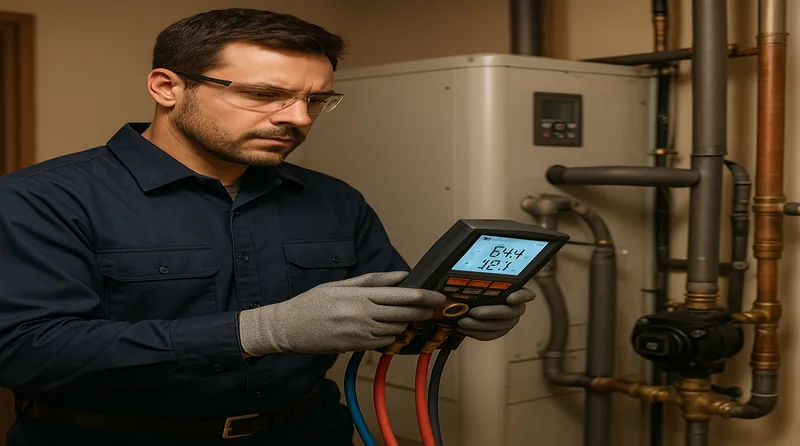
Most geothermal troubleshooting guides are written for homeowners. "Call your installer." "Check your filter." Useless. This one is for the tech standing in front of the unit with a fault code blinking, a customer on their second heating season without hot water, and no idea why the FP1 keeps tripping at 2 AM.
Geothermal is different from standard split-system work in one fundamental way: the ground loop introduces a variable that doesn't exist in conventional HVAC — one that most manufacturers won't troubleshoot for you and most training programs cover for maybe two hours. EWT and LWT are the diagnostic backbone of every geothermal service call. If you understand the water-side of the system, 80% of faults become obvious. If you skip it and go straight to the refrigerant circuit, you'll miss the actual problem half the time.
This guide covers the full diagnostic stack: EWT/LWT interpretation, fault codes for the three major residential manufacturers, loop pressure testing step-by-step, antifreeze concentration, and the six most common component failures with specific check procedures. Print the tables. Add this to your tablet. Use it on the job.
EWT/LWT — The Core Diagnostic Framework
EWT (Entering Water Temperature) is the loop fluid temperature as it arrives at the unit from the ground. LWT (Leaving Water Temperature) is the loop fluid leaving the unit back into the ground. The delta-T between them is your first and most important diagnostic data point.
Before you touch a manifold gauge or pull a refrigerant pressure, read EWT and LWT. If a monitoring system like WaterFurnace Symphony or ClimateMaster SmartTouch is installed, pull the historical trend first — a loop that was fine all winter but dropped to 28°F during a cold snap tells you something very different than a loop that's been running at 29°F for three weeks.
Delta-T Reference Table
| Operating Mode | Normal ΔT (EWT − LWT) | Flag Condition |
|---|---|---|
| Heating | 8–12°F | <6°F = low flow or oversized loop; >15°F = undersized loop or restricted flow |
| Cooling | 5–10°F | <4°F = low flow or oversized loop; >12°F = undersized loop or thermal buildup |
EWT Operating Limits
| Condition | Temperature | Consequence |
|---|---|---|
| Heating minimum EWT | 25°F (−4°C) | Below this: hard freeze-protection lockout (FP2) |
| Heating warning EWT | 30°F | FP1 range — check antifreeze and loop flow |
| Optimal heating EWT | 40–55°F | Normal operating range for most US climates |
| Cooling maximum EWT | 90°F (32°C) | Above this: high-pressure protection lockout |
| Optimal cooling EWT | 55–75°F | Normal operating range |
Reading EWT tells you where the problem is. EWT within normal limits but unit faulting → fault is in the refrigerant circuit or airside. EWT out of range → start with the loop: pump operation, antifreeze, loop length (sizing error), or soil thermal recovery (loop too aggressive for geology). Don't let a loop problem send you chasing a refrigerant ghost.
Fault Codes: WaterFurnace, ClimateMaster, Bosch
One note before the tables: any code that clears on reset and doesn't return within 30–60 minutes is probably an intermittent condition — often a brief EWT dip during a cold night or a transient refrigerant pressure spike during startup. Log it, check the EWT trend, schedule a follow-up. Codes that return within an hour are active problems — don't reset and leave.
WaterFurnace Series 5 / Series 7
| Code | Meaning | First Check |
|---|---|---|
| FP1 | Freeze Protection 1 — EWT < 30°F | EWT reading, loop pump running, antifreeze concentration |
| FP2 | Freeze Protection 2 — EWT < 25°F, hard lockout | Emergency — check for loop freeze event, pump failure, severe antifreeze dilution |
| HP | High Pressure — refrigerant discharge > 610 PSI (R-410A) | Cooling: EWT too high, dirty coil/filter, blocked return air |
| LP | Low Pressure — suction < 40 PSI | Refrigerant undercharge or very low EWT in heating |
| LOC | Lockout — 3 faults in 2 hours | Diagnose root fault first; reset clears after repair |
| CO | Hard lockout — requires manual thermostat reset | Same as LOC but persistent; root cause mandatory before reset |
| LO | Low superheat / loss of charge | Check refrigerant charge, TXV/EXV operation |
| VS | Variable Speed fault (Series 7 only) | ECM blower motor, inverter board; pull fault history via Aurora interface |
| AHS | Auxiliary heat >20% of runtime | Loop undersized or sizing error; audit loop vs. design |
| AO | Airflow obstruction | Filter, blower wheel, duct restriction |
ClimateMaster Trilogy 45 / 65
| Code | Meaning | First Check |
|---|---|---|
| EWT LO | Entering Water Temp below minimum | Same as FP1 — check loop, pump, antifreeze |
| EWT HI | Entering Water Temp above maximum | Cooling mode: loop thermal buildup; check soil conductivity vs. design |
| HP TRIP | High pressure cutout | Same as WaterFurnace HP above |
| LP TRIP | Low pressure cutout | Refrigerant undercharge or EWT too low |
| LWT LO | Leaving water temp too low | Loop flow too low — check pump, valves, flow restriction |
| LOCK OUT | Unit locked — fault active | Pull fault history via SmartTouch before resetting |
| FAN FAULT | Blower motor error | Check motor, run capacitor, blower wheel clearance |
| COMP FAULT | Compressor overcurrent | Measure amp draw vs. nameplate RLA; check for liquid slugging |
Bosch (formerly Florida Heat Pump)
| Code | Meaning | First Check |
|---|---|---|
| E1 | Low pressure / refrigerant undercharge | Suction pressure, refrigerant leak check |
| E2 | High pressure — cooling EWT too high or blocked coax | EWT reading, coaxial heat exchanger scale buildup (open loop) |
| E3 | Low EWT freeze protection | Loop pump, antifreeze, loop heat buildup |
| E5 | Compressor overcurrent | Amp draw, compressor winding resistance, liquid slugging |
| E8 | Flow switch fault (if equipped) | Verify loop flow; check flow switch adjustment and wiring |
Loop Pressure Diagnostics
Loop pressure is the vital sign most new geo techs ignore. It's also where slow leaks hide for years before triggering a fault code.
Normal Pressure Ranges
- Static (pump off): 30–50 PSI. Should hold stable overnight. A drop of more than 3 PSI indicates an active leak.
- Dynamic (pump running): Up to 60–65 PSI at pump outlet. Varies with pump model and flow rate.
- Minimum working pressure: 15 PSI. Below this, air can enter the loop at the expansion tank connection.
- Expansion tank pre-charge: 15–20 PSI. Check with pump off and loop depressurized. A waterlogged tank reads the same as loop pressure even with the pump off — that tank is dead, replace it.
Step-by-Step Pressure Test Procedure
- Record static pressure with pump off. Compare to the installation commissioning documentation if available.
- Start the pump. Watch the pressure rise. An excessive surge followed by a pressure drop suggests air pockets in the loop header.
- Listen for gurgling during startup or purge — air in the loop, typically at the pump inlet or header connections.
- Check the differential across the pump. Compare to the pump curve to estimate flow rate. Most residential geo systems need 3 GPM per ton.
- If pressure is low or dropping: isolate the unit with the loop isolation valves. Pressurize the isolated loop to 60 PSI with the fill pump. Let stand 30 minutes with pump off. More than 5 PSI drop = active leak in the loop field or header. Less than 2 PSI = loop is tight; investigate expansion tank or fitting on the unit side.
Common Loop Pressure Problems
Slow leak at a fitting or fusion joint: Most common in the first two years after installation. Polyethylene heat fusions are generally reliable, but mechanical fittings at the flow center, manifold headers, and connection to the unit are the usual suspects. Check those first before digging.
Waterlogged expansion tank: The tank has lost its air pre-charge and filled with loop fluid. System can't absorb thermal expansion, so pressure swings wildly with temperature changes. Replace the tank — there's no repair for a blown bladder.
Purge port left cracked open: Sounds obvious, but it happens on service calls. Check every purge port and fill valve after any loop work.
Air Purging Procedure
After loop repair, refill, or any air introduction: connect a purge pump or use the flow center's built-in purge configuration. Circulate at 3–4 GPM minimum until no bubbles appear in the clear sight glass or return port. Refill and pressurize to 35–40 PSI static. Re-check expansion tank pre-charge before final pressurization.
Antifreeze Concentration Testing
Test antifreeze concentration on every service call in climates with design EWT below 40°F. After any loop repair or purge operation. Every three to five years as routine maintenance. Whenever you see FP1 or FP2 codes. After a freeze event (obviously).
Antifreeze Types
| Type | Preferred Use | Notes |
|---|---|---|
| Propylene glycol | Residential, food-adjacent properties | Food-safe, slightly lower heat transfer coefficient than ethylene |
| Ethylene glycol | Commercial, non-food environments | Better heat transfer, toxic — requires secondary containment in some jurisdictions |
| Methanol | Legacy installs only (pre-2000) | Flammable, carcinogenic, no longer used in new installs — replace if found |
Target Concentration
Freeze point should be at least 10°F below the design minimum EWT for your region. A Minnesota installation with design EWT of 25°F needs freeze protection to 15°F or below. Don't rely on the unit's freeze protection as a substitute for proper antifreeze — the freeze protection controls protect the equipment by shutting it down, not by preventing loop fluid from freezing.
Testing With a Refractometer
- Draw a small sample from a purge port or Schrader valve in the loop system.
- Place 2–3 drops on the refractometer prism and close the cover.
- Read the scale specific to your fluid type. Propylene glycol and ethylene glycol have different scales — make sure your refractometer has both, or use one calibrated for the fluid type in the system.
- Cross-reference the concentration reading to the freeze point chart for that fluid.
- Do not use a hydrometer — it's inaccurate for glycol solutions and gives meaningless readings for propylene glycol.
Adjusting Concentration
Add premixed concentrate (sold as a 50% solution by most manufacturers). Never add straight 100% glycol — dilute it first, or use only the premix. Introduce via fill/flush port, circulate for 5–10 minutes, retest. Document the final concentration on your service ticket and put a label at the flow center with the date and reading. Future techs on this system will thank you.
Glycol Degradation
Concentration can be fine on the refractometer while the fluid is still degraded. Glycol inhibitor packages deplete over time — without inhibitors, glycol becomes acidic and accelerates corrosion in ferrous pump housings and heat exchangers. Degraded fluid looks brownish and smells sour (like vinegar). If you see that, don't just top off — flush the entire loop and refill with fresh premixed solution. A pH test (target 8–10 for inhibited glycol) can confirm inhibitor depletion before visual signs appear.
Common Component Failures
Circulator Pump Failure
What you see: No loop flow, FP1/FP2 codes, zero delta-T on the water side despite unit running. The compressor may be running but producing no meaningful heating or cooling.
Check procedure: Verify 24V control signal is reaching the pump. Measure pump amperage — nameplate current with zero amps means no power; very low amps means impeller slip or failure. On pumps with an access plug, verify shaft rotation by hand. A seized bearing feels like grinding resistance or is completely locked; an overheated motor housing is another indicator.
Most common cause: Bearing failure from a dry-run event — air lock at startup, never purged properly, or a one-time event years ago that slowly degraded the bearing. Second most common: ECM control board failure on variable-speed pumps.
Fix: Most residential flow center pumps use Taco or Grundfos cartridge pumps — they're plug-and-play replacements. Replace the cartridge assembly, not just the motor, unless you have access to the specific repair parts.
TXV / EXV Failure
What you see: High superheat (above 15°F at compressor suction), low suction pressure, reduced heating or cooling capacity, compressor running hot.
Identify TXV vs. EXV: Fixed TXVs are passive mechanical valves — no wiring. EXVs (electronic expansion valves) are motor-driven and found on inverter-drive units like WaterFurnace Series 7 and ClimateMaster Trilogy 65. EXV faults show up as control codes; check coil resistance (40–60 Ω is normal; open = coil failure).
TXV diagnosis: A failing TXV has a distinctive sound — a gurgling or hunting hiss as the valve cycles. High superheat with that sound is a near-certain TXV diagnosis. A completely stuck-open TXV will show extremely low superheat and possible liquid flood-back.
Fix: Replace the TXV. Always add a liquid line filter-drier after any refrigerant circuit repair. Reclaim first, replace the drier, install new TXV, pull 500-micron vacuum, recharge by weight. EXV replacements may require recalibration via the manufacturer's service software — check the service bulletin before leaving.
Reversing Valve Failure
What you see: Unit is stuck in heating mode when cooling is called, or vice versa. Worst case: the valve is stuck mid-position, which allows discharge gas to bypass the compressor — you'll see almost no temperature differential, the compressor running constantly, and rapidly rising discharge temperature. That's a unit-down emergency.
Check: Verify 24V solenoid is energized in the correct mode. Measure solenoid coil resistance — should be 5–15 Ω. An open circuit means the coil burned out. If the coil is fine but the valve won't shift, the valve body itself is stuck mechanically.
The rubber mallet trick: Sometimes a stuck valve will shift if you tap the body lightly with a rubber mallet while the solenoid is energized. This is a diagnostic technique, not a permanent fix — if the valve needs tapping to shift, it needs replacement.
Fix: Coil-only failure is inexpensive and quick — replace the coil. Mechanical body failure requires full refrigerant reclaim and valve replacement, which is a significant labor job.
Coaxial Heat Exchanger Scaling (Open-Loop Systems)
What you see: Gradually increasing EWT/LWT differential over successive service visits. Reduced cooling capacity that's gotten worse over time. Hard water deposits visible at flush ports.
Who this affects: Open-loop systems pulling from a well with high mineral content — calcium hardness above 200 mg/L is the typical threshold for significant scaling over time. Check the water test report from installation; it should be in the commissioning file.
Check: A TDS meter on the supply water confirms mineral load. Compare refrigerant discharge temperature to prior season logs — rising discharge temp in cooling with consistent refrigerant charge and airflow points to coax scaling.
Fix: Descale with dilute citric acid or a proprietary coax descaling solution — follow the product instructions and flush thoroughly afterward. Severe scaling requires coax replacement. Prevention options: scale inhibitor injection system, sacrificial anode on the entering water line, or converting to closed loop if the well geology allows.
Desuperheater Failure (Hot Water Assist)
What you see: Customer reports no improvement in water heating since installation, or performance has degraded. The geo system's contribution to hot water is zero or near-zero.
Check: Verify 24V signal is reaching the desuperheater pump — it should only energize when the compressor is running. Listen for the pump running during compressor operation. Check pump rotation — the impeller can be installed backwards, producing zero flow but normal amperage. Verify the tank thermostat isn't set above 120°F on configurations where a high tank setpoint blocks desuperheater input.
Fix: Most desuperheater pumps are Taco 006 or equivalent cartridge pumps. Replace the cartridge. For scale blockage in the desuperheater coil inside the tank (open-loop hard water), descale or replace the coil — this is rare but happens on very hard water sites after 10+ years.
Compressor Failure
What you see: Unit draws power but produces no meaningful refrigerant pressure differential. Loud rattling, grinding, or the unit tripping its breaker. In winding failure, you may get a high amp draw followed by thermal overload cutout.
Before condemning a compressor: Megger test the windings — insulation resistance should read above 2 MΩ to ground. Below 1 MΩ indicates compromised winding insulation, which typically means the compressor is at end of life. Verify amp draw against nameplate RLA (Running Load Amps). Check superheat before calling it — very low superheat (liquid flood-back) can damage a compressor that was otherwise serviceable.
Root causes to find and fix: Low refrigerant charge leading to thermal cycling and winding burnout (most common). Liquid flood-back from an oversized unit at low loads. Acid burnout from moisture contamination in the refrigerant circuit. Find and fix the cause, or the replacement compressor will fail too.
After replacement: Reclaim all refrigerant, replace the filter-drier (mandatory after burnout), pull 500-micron vacuum, recharge to nameplate weight, verify leak-free, document everything. On acid burnout jobs, a triple-evacuation is good practice and some manufacturers require it for warranty.
Quick Diagnostic Flowchart
Use this as a field reference before diving into manufacturer-specific procedures:
| Symptom | First Checks | Second Checks |
|---|---|---|
| No heating or cooling at all | Thermostat signal, breaker, fault code | Clear lockout → observe if code returns within 1 hr |
| Low heating capacity | EWT (>30°F?), airflow (filter/blower) | Refrigerant charge, TXV superheat |
| Low cooling capacity | EWT (<90°F?), loop ΔT, airflow | Refrigerant charge, coaxial heat exchanger (open-loop) |
| FP1 / FP2 codes | EWT reading, loop pump running | Antifreeze concentration, loop pressure, loop leak check |
| High energy use, unit runs constantly | Loop ΔT (low flow?), EWT seasonal trend | Duct leakage, load audit, oversizing check |
| Short cycling | Thermostat time delay, runtime per cycle | Refrigerant charge, equipment sizing vs. load |
| Compressor noise | Identify: rattle = liquid slug/loose mount; squeal = bearing; grinding = mechanical | Megger test windings, check amp draw vs. RLA |
| No hot water contribution | Desuperheater pump 24V signal, pump running | Pump rotation direction, tank thermostat setting, coax scale |
Tools to Keep in the Truck
A standard HVAC van handles about 70% of a geothermal service call. The other 30% requires tools most conventional HVAC techs don't carry. If you're doing regular geo service work, these need to be permanent fixtures in your kit:
- Digital manifold gauge set — compatible with R-410A and R-454B (the replacement refrigerant starting to appear in newer installs)
- Dual-probe digital thermometer — for simultaneous EWT/LWT readings; single-probe takes too long and the reading drifts
- Refractometer — calibrated for propylene glycol and ethylene glycol (dual-scale models exist). Non-negotiable for cold-climate work.
- Clamp meter — for compressor RLA, circulator pump amp draw, ECM motor current
- Pressure gauge, 0–100 PSI — for loop pressure testing and expansion tank pre-charge check
- Megger (insulation resistance tester) — for compressor winding diagnosis; regular DMM resistance check is insufficient
- 2-stage vacuum pump — capable of pulling below 500 microns; required for any refrigerant circuit work
- Flow meter or manufacturer flow port gauge — Taco and Grundfos flow centers often have integral flow indicators; otherwise a clamp-on ultrasonic flow meter is useful for larger commercial geo jobs
- pH test strips or digital pH meter — for glycol fluid quality; catch inhibitor depletion before it becomes a corrosion event
- Laptop with manufacturer service software — WaterFurnace Aurora Interface, ClimateMaster SmartTouch — essential for fault history, variable-speed diagnostics, and EXV calibration
Preventive Maintenance Schedule
Print this and hand it to your customers. A maintained geothermal system runs 25+ years. A neglected one calls you every winter.
| Interval | Task |
|---|---|
| Annual | Replace/clean air filter; check loop static pressure; inspect flow center fittings; verify antifreeze concentration (cold climates); clean condensate drain; log EWT/LWT and loop pressure in service record |
| Annual (spring) | Verify cooling mode operation; confirm EWT vs. design at first cooling cycle; check reversing valve shift |
| Annual (fall) | Verify heating mode operation; test antifreeze concentration before first freeze risk; check expansion tank pre-charge |
| Every 3–5 years | Full loop fluid flush and inhibitor refresh; coaxial heat exchanger inspection (open-loop systems); pump bearing check; blower wheel cleaning |
| Every service call | Record EWT, LWT, loop pressure, suction/discharge pressure, superheat in service log. This historical data is worth more than any single diagnostic reading. |
The service log point is worth emphasizing. EWT trending upward over three seasons in a cooling-dominant climate tells you the loop is building thermal load over time — probably too short for the geology. One EWT reading tells you nothing; three years of seasonal data tells you everything. Logging 30 seconds of data per visit builds that record for free.
Frequently Asked Questions
What does an FP1 or FP2 code mean on a WaterFurnace unit?
FP1 (Freeze Protection 1) activates when loop-side EWT drops below 30°F. FP2 is a hard lockout below 25°F. On FP1: check EWT, verify the loop pump is running, and test antifreeze concentration. On FP2: treat it as an emergency — check for a loop freeze event, pump failure, or severe antifreeze dilution. Clear the lockout only after diagnosing the root cause.
What is the correct EWT/LWT delta-T for a geothermal system?
Heating mode: expect 8–12°F delta-T. Below 6°F suggests low flow or an oversized loop; above 15°F indicates an undersized loop or flow restriction. Cooling mode: expect 5–10°F. Outside these ranges with good loop pressure and pump operation points to the refrigerant circuit or airside, not the loop.
How do I test antifreeze concentration in a geothermal loop?
Use a refractometer calibrated for your fluid type. Draw a sample from the purge port or Schrader valve, place 2–3 drops on the prism, read the scale, cross-reference to a freeze point chart. Do not use a hydrometer. Target freeze protection 10°F below your design minimum EWT. Always test after a loop repair or purge, not just annually.
What causes a geothermal unit to short cycle?
Usually oversized equipment for the load — the unit satisfies setpoint before completing a full run cycle. Check runtime per cycle (should be 30–45 minutes minimum in design conditions). Other causes: thermostat time delay too short, or refrigerant undercharge tripping the low-pressure switch. Confirm sizing with a Manual J load calculation before recommending equipment changes.
How do I know if loop pressure is normal?
Static pressure (pump off) should be 30–50 PSI and hold stable. A drop of more than 3 PSI overnight indicates an active leak. Dynamic pressure with the pump running reaches 60–65 PSI at the outlet. Minimum working pressure is 15 PSI. Check expansion tank pre-charge (pump off): should be 15–20 PSI. A waterlogged tank reads close to loop pressure even with the pump off.
How do I diagnose TXV vs. EXV failure?
A failing TXV shows high superheat (>15°F), low suction pressure, and often a distinctive gurgling or hunting sound. For EXV failures on variable-speed units (WaterFurnace Series 7, ClimateMaster Trilogy 65), look for a control board fault code and test coil resistance (40–60 Ω normal; open = coil failed). After TXV replacement, always add a liquid line filter-drier and recharge by weight. EXV replacements may require recalibration via service software.
Sources
- IGSHPA Closed-Loop/Ground-Source Heat Pump Systems Installation Guide — International Ground Source Heat Pump Association
- WaterFurnace Aurora Interface / Symphony System Documentation — WaterFurnace International
- ClimateMaster SmartTouch Controls Reference Guide — ClimateMaster
- Bosch Geothermal Heat Pump Technical Documentation
- ASHRAE Handbook: HVAC Systems and Equipment, Chapter 26 — Ground-Source Heat Pumps
- EPA Section 608 Refrigerant Handling Requirements — U.S. Environmental Protection Agency
- Geothermal Ground Loop Design Guide — Geothermal Insider
- Geothermal Heat Pump Maintenance Guide — Geothermal Insider